Aug 9, 2026·Improving IQ / PreparationDoes Chess Make You Smarter?
Does chess make you smarter? Meta-analyses show chess players score higher on IQ tests, but chess lessons show little real transfer. See the evidence.
Dr. Russell T. WarneChief Scientist
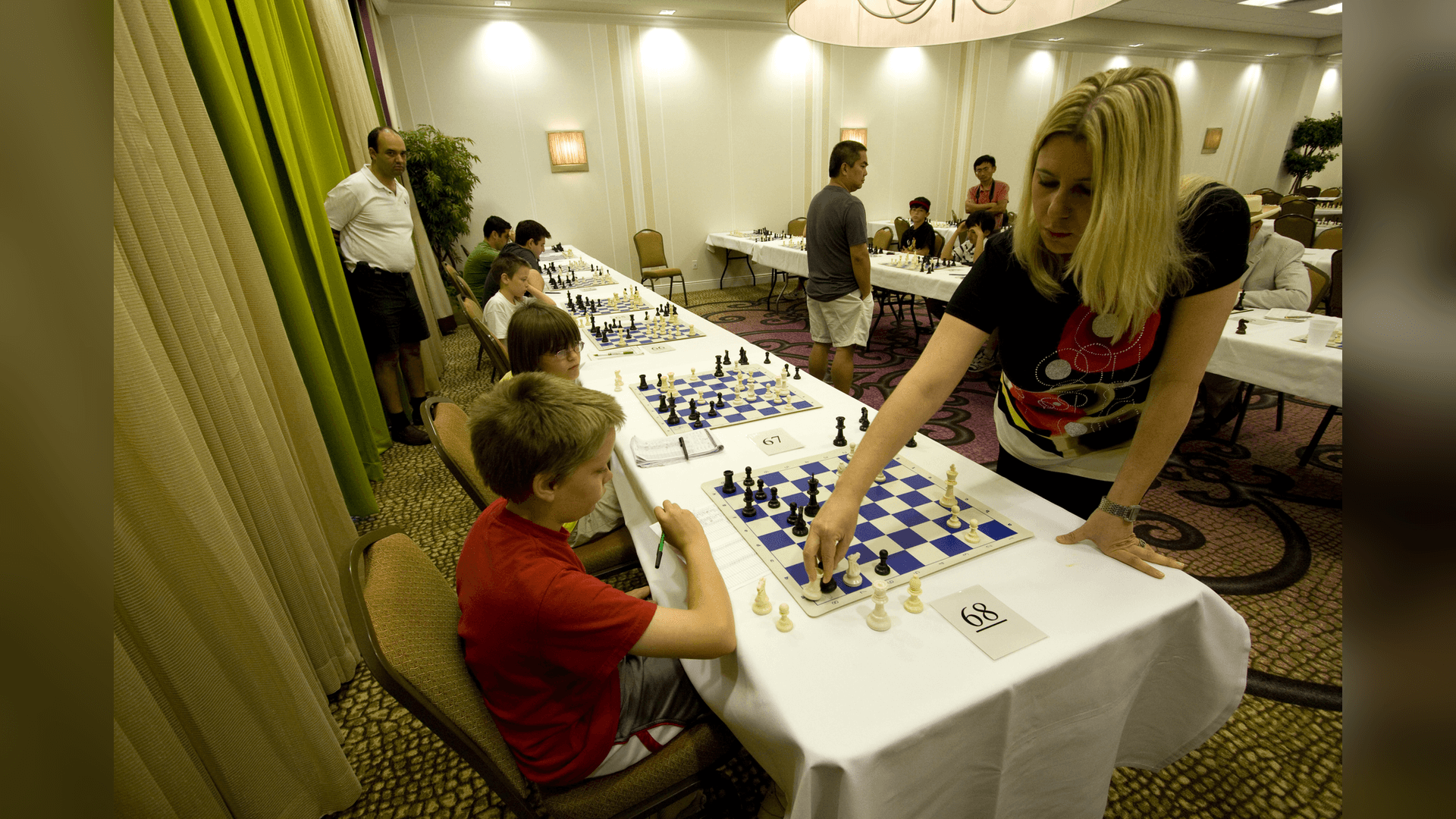
Chess does not appear to make you smarter, at least in the way most people hope. Chess players do score higher on intelligence tests than non-players, by about half a "standard deviation" on average, but the best available evidence points to selection: smarter people take up chess and stick with it. When researchers test chess instruction with rigorous experimental designs, the cognitive benefits mostly evaporate. This article walks through what the meta-analyses actually found, why the correlation gets misread, and what that means if you love the game.
The correlation is real: chess players score higher
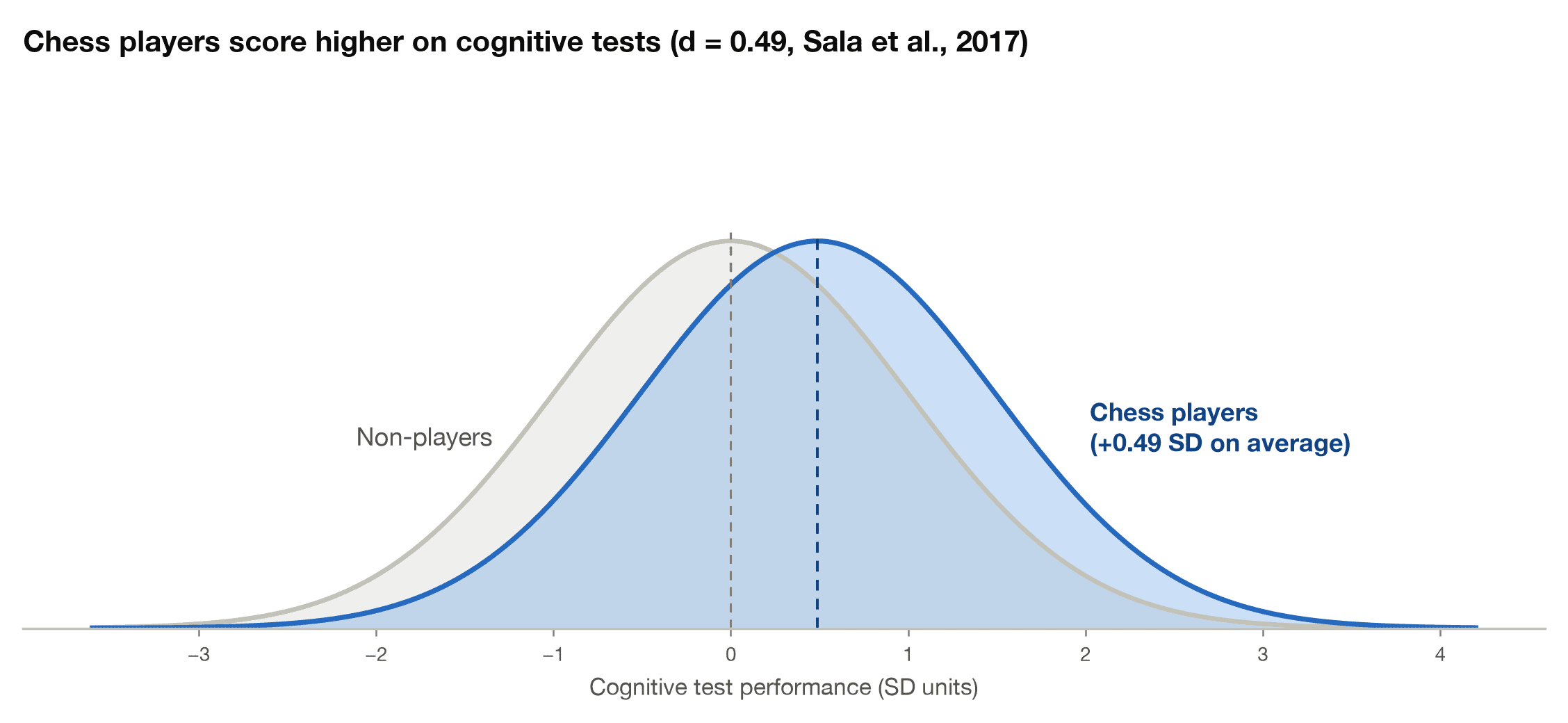
Start with the part the popular claim gets right. A 2017 meta-analysis in the journal Intelligence pooled studies comparing chess players with non-players and found that chess players outperformed non-players on intelligence-related skills, with an average "effect size" of d = 0.49, roughly half a standard deviation (Sala et al., 2017).
The pattern holds inside the game as well. A comprehensive meta-analysis of cognitive ability and chess skill found that skill correlates with fluid reasoning (r = .24), short-term memory (r = .25), processing speed (r = .24), and comprehension-knowledge (r = .22), with the strongest link to numerical ability (r = .35) (Burgoyne et al., 2016). A psychometric study of 90 adult tournament players rated between 1311 and 2387 Elo likewise found a clear-cut moderate relationship between general intelligence, and in particular numerical intelligence, and playing strength (Grabner et al., 2007). Speculation about individual grandmasters is a different exercise; see our article on
Magnus Carlsen's IQ for how thin those famous numbers are.
Correlation versus causation: the selection story
A correlation between chess and IQ has two possible readings. Chess could train the mind, or bright minds could gravitate to chess. Two details in the data favor the second reading. In the Grabner study, the strongest single predictor of playing strength was accumulated chess experience; experience, current tournament activity, intelligence, and personality together accounted for about 55 percent of the variance in expertise.
The moderators in the Burgoyne meta-analysis point the same way. The correlation between fluid reasoning and chess skill was r = .32 in youth samples and r = .11 in adult samples, and r = .32 among unranked players against r = .14 among ranked ones. Ability matters most for who enters the game and climbs early; among established players, practice dominates. The meta-analysts themselves observe that chess masters appear to be, on average, more intelligent than the general population, which is exactly what selection predicts.
What happens when schools teach chess?
The training claim has been tested directly. A meta-analysis of 24 school chess-instruction studies, covering 2,788 young people in chess conditions and 2,433 controls, found a moderate overall effect of g = 0.338, with a somewhat stronger effect on mathematics (g = 0.382) than on reading (g = 0.248) (Sala & Gobet, 2016). On its face, that looks like real transfer.
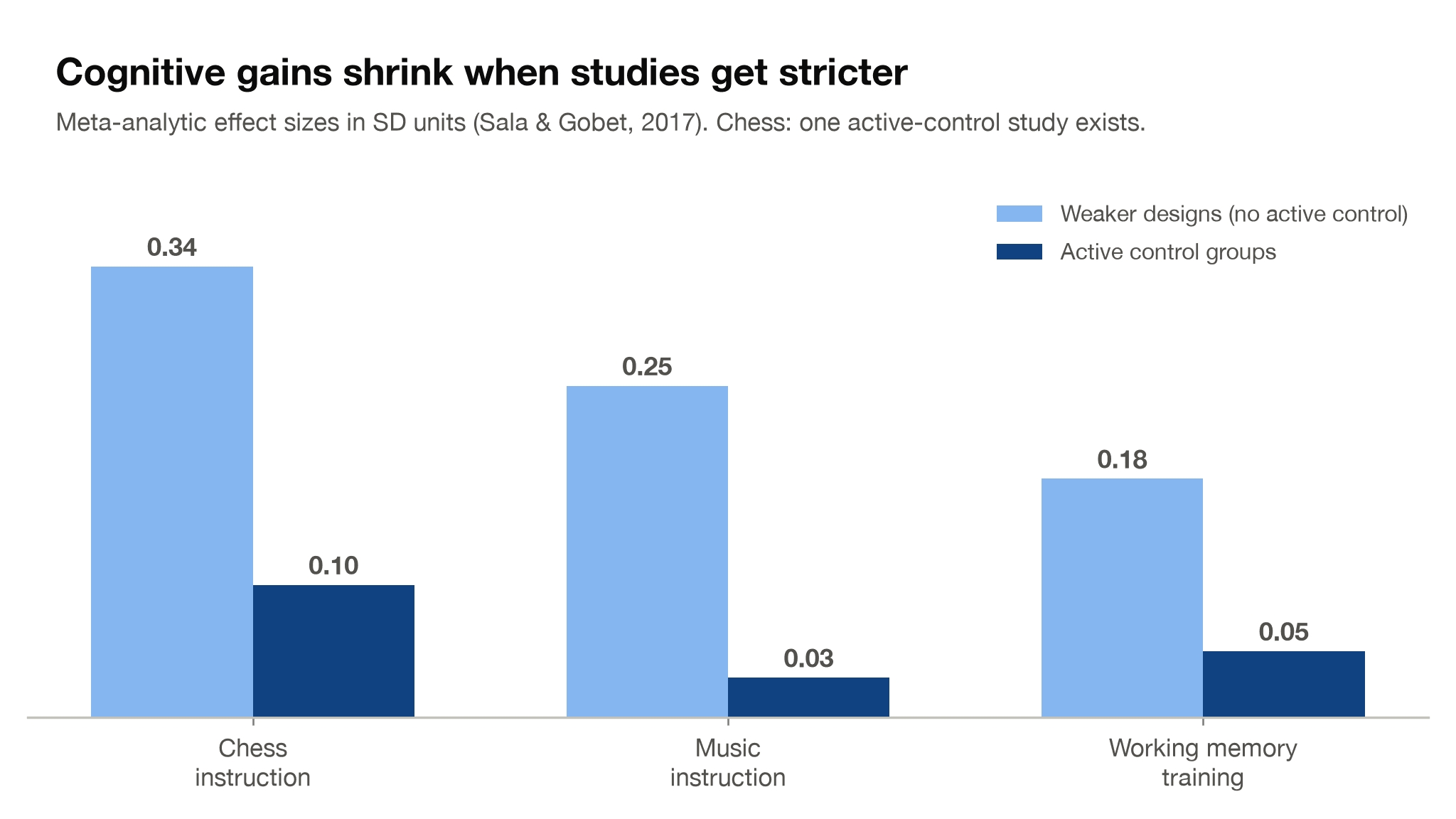
The picture changes once study quality enters the analysis. Reviewing chess, music, and working memory training together, the same authors reported that the size of the effects was inversely related to the quality of the experimental design (Sala & Gobet, 2017). Chess research has almost no studies with "active control groups," comparison classes given an engaging alternative activity to rule out novelty and placebo effects. The single chess study that used one found an effect of just 0.10 standard deviations. Music instruction fell from 0.25 against passive controls to 0.03 against active ones, and working memory training fell from 0.18 to 0.05. The authors concluded that far transfer of learning rarely occurs, and, borrowing a century-old phrase, that "far transfer remains a chimera."
Chess and the limits of getting smarter
This is the same pattern that sank commercial brain training: solid gains on the trained task, little or nothing beyond it. Cognitive skills are largely domain-specific. Thousands of hours of chess build a formidable mental library of chess patterns, and that library does not lend itself out to algebra homework or office work. We cover the broader evidence in our articles on
whether you can increase your IQ and
whether brain training apps actually work.
Frequently asked questions
Does playing chess increase your IQ?
There is no solid evidence that it does. Raw effects from school studies shrink as design quality improves, the only chess study with an active control group found a 0.10 SD effect, and the leading meta-analysts concluded that far transfer of learning rarely occurs.
Are chess players smarter than average?
On average, yes, by about half a standard deviation (d = 0.49) on intelligence-related tests. The best explanation is that smarter people are more likely to take up chess and persist at it.
Does chess help kids do better in school?
Uncontrolled studies suggest small gains, especially in math, but they mostly lack active control groups, so novelty and placebo effects cannot be ruled out. Under proper controls, far-transfer effects are minimal or null.
Does IQ predict how good you get at chess?
Partly. Cognitive ability correlates with chess rating, most strongly in children and novices, but accumulated chess experience is the strongest single predictor of playing strength.
Why do so many people believe chess makes you smarter?
Because the correlation is real and visible: chess players do score higher, and strong players are often plainly brilliant. The mistake is reading a selection effect as a training effect.
The takeaway
Play chess. It is a deep, inexpensive, social game with a lifetime of genuine skill growth inside it. Just play it as a game rather than as an IQ workout, because chess reveals and rewards intelligence far more than it creates it. And if what you actually want is a reading on your cognitive ability, measure it directly: the Reasoning and Intelligence Online Test from
RIOT IQ reports properly normed scores, and the
free RIOT IQ test takes far less time than learning the Sicilian.
References
1. Sala, G., & Gobet, F. (2016).
Do the benefits of chess instruction transfer to academic and cognitive skills? A meta-analysis. Educational Research Review, 18, 46-57.
doi.org2. Sala, G., & Gobet, F. (2017).
Does far transfer exist? Negative evidence from chess, music, and working memory training. Current Directions in Psychological Science, 26(6), 515-520.
doi.org3. Sala, G., Burgoyne, A. P., Macnamara, B. N., Hambrick, D. Z., Campitelli, G., & Gobet, F. (2017).
Checking the "Academic Selection" argument. Chess players outperform non-chess players in cognitive skills related to intelligence: A meta-analysis. Intelligence, 61, 109-118.
doi.org4. Burgoyne, A. P., Sala, G., Gobet, F., Macnamara, B. N., Campitelli, G., & Hambrick, D. Z. (2016).
The relationship between cognitive ability and chess skill: A comprehensive meta-analysis. Intelligence, 59, 72-83.
doi.org5. Grabner, R. H., Stern, E., & Neubauer, A. C. (2007).
Individual differences in chess expertise: A psychometric investigation. Acta Psychologica, 124(3), 398-420.
doi.org6. Sala, G., & Gobet, F. (2017).
Does far transfer exist? Open-access full text. PubMed Central.
pmc.ncbi.nlm.nih.govTake our professional IQ test
Want to know your IQ? Try the first ever professional online IQ test.
AuthorDr. Russell T. WarneChief Scientist
