Aug 9, 2026·Improving IQ / PreparationThe Memory Palace Technique: How the Method of Loci Works
The memory palace, or method of loci, stores information along an imagined route. Learn how it works, what brain imaging shows, and how to build your own.
Dr. Russell T. WarneChief Scientist
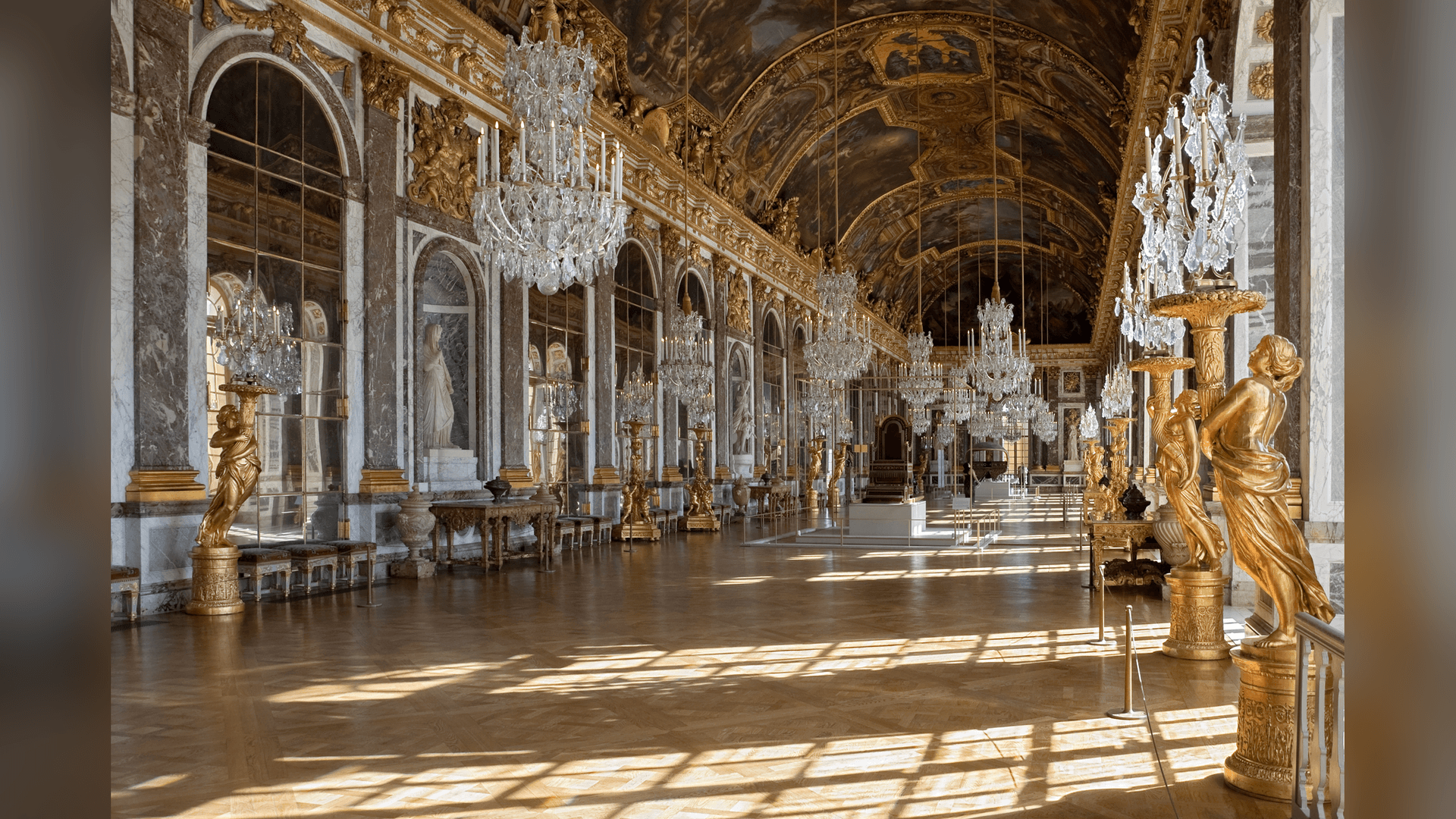
A memory palace is a mental walk through a place you know well, used as a filing system for whatever you need to remember. You turn each item into a vivid image, place the images at fixed spots along an imagined route, and retrieve them later by mentally retracing your steps. Known formally as the "method of loci" (loci is Latin for places), it is one of the oldest memorization techniques on record and one of the best supported by modern evidence. It is also regularly oversold: it improves recall of the material you encode with it, and there is no evidence it raises intelligence.
How the method of loci works
The technique has three moves. First, encode: convert each thing you want to remember into a concrete, exaggerated image. Second, place: put one image at each location, or locus, along a familiar route, such as your front door, hallway, and kitchen. Third, retrace: to recall the material, walk the route in your mind and read off the images in order.
The method works because it converts arbitrary information into the kind human memory handles best. Spatial layouts of familiar places are stored deeply and effortlessly, and attaching new material to them provides both strong retrieval cues and a built-in ordering. It also relieves pressure on
working memory, the limited mental workspace that ordinarily caps how much we can juggle at once.
A technique older than the printing press
Tradition credits the invention to the Greek poet Simonides of Ceos, in a story told by Cicero in De Oratore. After a banquet-hall roof collapsed, Simonides is said to have identified the crushed bodies by recalling where each guest had been seated, and he drew the lesson that images placed in ordered locations aid recall. The tale is legend rather than established history, but the method itself is certainly ancient: Roman orators used it to memorize long speeches, and the historian Frances Yates chronicled its two-thousand-year career in her 1966 book The Art of Memory.
What brain imaging shows
Memory champions have ordinary brains
In 2003, Eleanor Maguire and colleagues studied people renowned for outstanding memory feats in forums such as the World Memory Championships, using cognitive testing along with structural and functional brain imaging. Their superior memory was not driven by exceptional intellectual ability or by structural brain differences. What set them apart was a spatial learning strategy, which engaged the hippocampus and other regions critical for spatial memory. The world's best memorizers, in other words, are practiced users of the method of loci and its relatives, working with standard-issue brains.
Six weeks of training reshapes brain networks
A 2017 study in Neuron scanned 23 of the world's most successful memory athletes and then gave memory-palace style training to novices for six weeks. The novices' patterns of brain connectivity shifted toward the pattern that distinguished the athletes, and the more athlete-like a trainee's connectivity became, the larger their memory improvements, with effects still measurable four months after training ended. The change was a distributed reorganization of networks rather than growth in any single region.
Does it actually work? The evidence
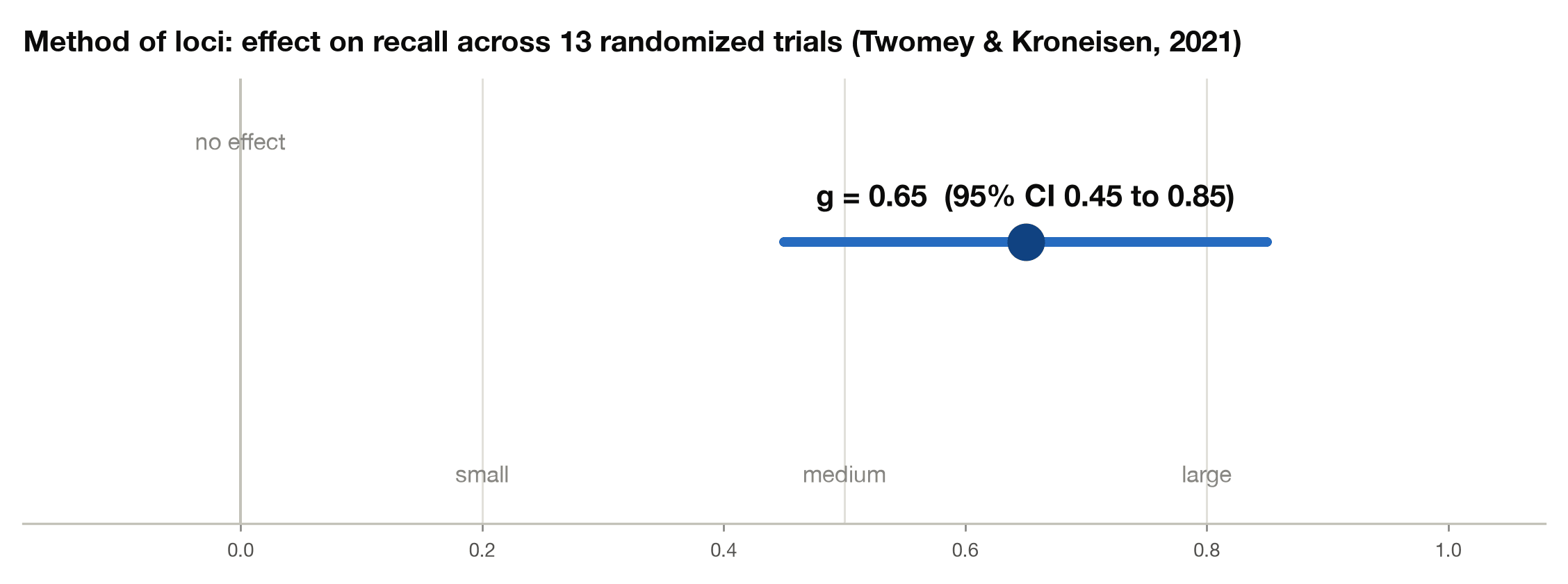
Yes, for memorization. A 2021 meta-analysis in the Quarterly Journal of Experimental Psychology pooled 13 randomized controlled trials of the method of loci, mostly run in university settings, and found a medium effect size: g = 0.65, with a 95 percent confidence interval from 0.45 to 0.85. In plain terms, the average trained participant recalled more than most untrained ones, by a solid and statistically reliable margin.
One caveat belongs next to that number: the meta-analysis flagged a high risk of experimental bias in many of the included studies, so the precise size of the effect is less certain than the direction. The direction, though, is consistent, and it agrees with everything memory athletes demonstrate in competition.
How to build your first memory palace
• Choose a place you know well: Your home, a commute, or a childhood school. Detail matters more than size.
• Fix one walking route: Pick 10 to 20 distinct stops in an order you will never vary: front door, hallway, sofa, kitchen sink, stairs.
• Turn each item into a vivid image: Exaggerate freely. A giant lemon snoring on the sofa is more memorable than the word "lemon."
• Place one image per stop: Interact the image with the location, then move to the next stop.
• Walk the route to recall: Retrace the path in your mind and the images surface in order. Once old material fades, the same palace can be reused.
The method suits anything with an order: speeches, shopping lists, vocabulary, anatomy, or exam facts. For unordered material, or for choosing among techniques, see our guide to
mnemonic devices that work.
What a memory palace will not do
The method of loci is a skill, and skills are specific. It speeds up memorization of the material you encode with it, and nothing in the research suggests it raises IQ or general cognitive ability. Maguire's champions, for all their tournament feats, showed no exceptional intellectual ability. The same pattern, strong gains on the practiced task with no transfer to intelligence, appears throughout cognitive training research, including the
dual n-back literature. Treat the memory palace as an excellent tool for memorizing, and treat any promise that it will make you smarter with suspicion.
Frequently asked questions
What is a memory palace?
A memory palace is a mental model of a familiar place used to store information. You place vivid images of the things you want to remember at fixed spots along an imagined route, then recall them by mentally retracing the route.
Does the memory palace technique actually work?
Yes, for memorization. A 2021 meta-analysis of 13 randomized controlled trials found a medium effect size (g = 0.65), and imaging studies show novices' brain networks begin to resemble memory athletes' after about six weeks of practice.
Do memory champions have special brains?
Apparently not. A 2003 imaging study of world-class memorizers found no structural brain differences and no exceptional intellectual ability. Their advantage came from a trained spatial strategy engaging the hippocampus.
Does using a memory palace increase IQ?
No. The method improves recall of the specific material you encode with it. There is no evidence that this kind of training transfers to fluid intelligence or IQ scores.
Who invented the memory palace?
Tradition credits the Greek poet Simonides of Ceos, whose story Cicero tells in De Oratore. Roman orators used the method to memorize speeches, and Frances Yates traced its history in The Art of Memory.
The takeaway
The memory palace is that rare study technique with both two millennia of testimonials and modern randomized trials behind it. It will genuinely enlarge what you can memorize. It will not change the reasoning ability that intelligence tests measure, and no honest memory coach claims otherwise. If you would like to know where that ability stands, the Reasoning and Intelligence Online Test from RIOT IQ provides a properly normed measure, beginning with a
free IQ test.
References
1. Maguire, E. A., Valentine, E. R., Wilding, J. M., & Kapur, N. (2003).
Routes to remembering: The brains behind superior memory. Nature Neuroscience, 6(1), 90-95.
doi.org2. Twomey, C., & Kroneisen, M. (2021).
The effectiveness of the loci method as a mnemonic device: Meta-analysis. Quarterly Journal of Experimental Psychology, 74(8), 1317-1326.
doi.org3. Dresler, M., Shirer, W. R., Konrad, B. N., Muller, N. C. J., Wagner, I. C., Fernandez, G., Czisch, M., & Greicius, M. D. (2017).
Mnemonic training reshapes brain networks to support superior memory. Neuron, 93(5), 1227-1235.
doi.org4. Cicero, M. T.
De Oratore, Book 2, 351-354. Perseus Digital Library.
perseus.tufts.edu5. Yates, F. A. (1966).
The art of memory. University of Chicago Press.
archive.orgTake our professional IQ test
Want to know your IQ? Try the first ever professional online IQ test.
AuthorDr. Russell T. WarneChief Scientist