Nov 25, 2025·Improving IQ / PreparationHow to Improve IQ
How to get a higher IQ: Boost your score with practice & rest, but real intelligence improves slowly through education. Learn how to ace an IQ test the right way.
Dr. Russell T. WarneChief Scientist

Many people want to become smarter and raise their IQ. This desire makes sense: higher intelligence correlates with better educational outcomes, career success, and health benefits. But is increasing your IQ actually possible? The answer is more nuanced than you might expect.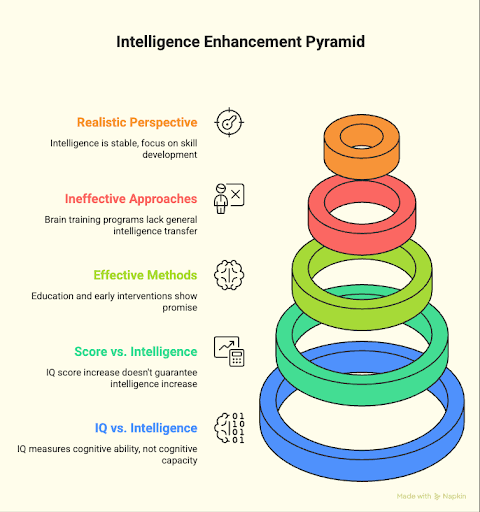
IQ vs. Intelligence
Let’s start by distinguishing between IQ and intelligence. Intelligence is the underlying cognitive ability that helps us reason, solve problems, and adapt. IQ is simply the score obtained on a test designed to measure this ability.
This distinction matters because raising your IQ score doesn't necessarily mean increased cognitive capacity. Just as a higher reading on a thermometer does not cause a room to get warmer, a higher IQ score doesn't automatically indicate greater intelligence.
Raising Your Score vs. Increasing Intelligence
Several methods can boost an IQ score without changing actual intelligence:
Learning about test structure and question types can improve performance. Research shows that brief coaching on matrix reasoning problems, which are common on IQ tests, can raise scores by about 6-7 points. Simply retaking a test typically results in a 5-point increase on the second attempt due to increased familiarity. Taking a test when well-rested, properly nourished, comfortable, and motivated produces better results than when tired, hungry, uncomfortable, or disinterested.
Increasing underlying intelligence is much more challenging. Education shows the most consistent positive effect, with each additional year associated with an IQ increase of about 1-5 points. Some of this represents genuine cognitive development, though the precise amount remains unclear. Some early childhood interventions can produce IQ gains, but these gains typically are lost within a few years. More intensive programs have shown promising results, but these tend to be small studies that are incredibly expensive to implement on a large scale. It has been very challenging to find programs that are both feasible and produce permanent IQ gains.
Ineffective Approaches To Increasing Your IQ Score
Despite numerous claims, many intelligence-boosting products lack solid evidence:
Most "brain training" programs show minimal transfer to general intelligence. While they might improve performance on tasks similar to the training exercises, benefits do not extend to overall cognitive ability or even to other cognitive abilities that are unlike the skills being trained. Any product promising dramatic IQ increases in a short time almost certainly overstates its benefits. Genuine improvements of the specifically trained skills are believable, though.
A Realistic Perspective
When considering IQ improvement, maintain realistic expectations. While increases in specifically trained skills are possible through sustained effort and cognitive engagement, dramatic changes are unlikely. Evidence suggests intelligence, while not completely fixed, remains relatively stable across the lifespan.
Rather than fixating on IQ scores, consider developing specific skills, knowledge, and thinking patterns relevant to your goals. Critical thinking, problem-solving strategies, and domain-specific expertise can improve substantially with dedicated practice, even if underlying general intelligence remains stable.
Take our professional IQ test
Want to know your IQ? Try the first ever professional online IQ test.
AuthorDr. Russell T. WarneChief Scientist
