Don't cram. Research shows distributed practice is the best strategy. Learn which ASVAB subtests to prioritize to boost your AFQT score.
Dr. Russell T. WarneChief Scientist
Share
The Armed Services Vocational Aptitude Battery (ASVAB) is the U.S. military's primary selection and placement instrument. Taken annually by over one million Americans, the ASVAB determines eligibility to enlist in any branch of the armed forces and which military occupational specialties (MOSs) a recruit qualifies for. Given the stakes, it makes sense that many test takers want to know how to prepare effectively.
What Does the ASVAB Measure?
The computerized ASVAB consists of ten subtests that assess aptitudes across four domains: verbal, math, science and technical, and spatial. These subtests include General Science, Arithmetic Reasoning, Word Knowledge, Paragraph Comprehension, Mathematics Knowledge, Electronics Information, Auto and Shop Information, Mechanical Comprehension, and Assembling Objects.
Four subtests (Arithmetic Reasoning, Mathematics Knowledge, Paragraph Comprehension, and Word Knowledge) combine to produce the Armed Forces Qualification Test (AFQT) score, which determines basic enlistment eligibility. The minimum AFQT score varies by branch. At the time of this writing, the Army (31), Marine Corps (32), and Navy (35) have lower minimum AFQT scores than the Air Force, which often requires a 36, while the Coast Guard typically needs a 40, though some sources group the Army/Marines/Air Force at 31, with the Navy at 35. The different branches of the military periodically adjust the minimums.
Research confirms thatASVAB scores predict military job performance with correlations averaging around 0.60 after corrections for measurement error and range restriction. This predictive validity explains why the military relies so heavily on the test for both selection and job placement decisions.
What Are the Most Effective ASVAB Study Strategies?
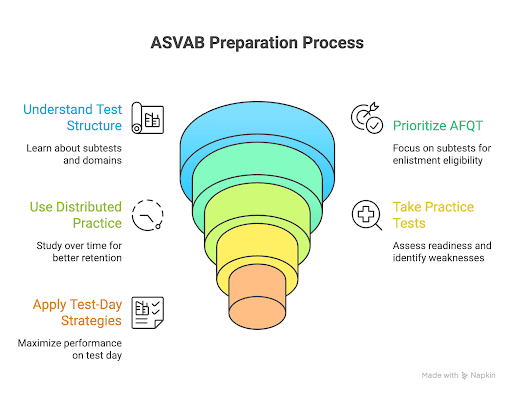
The most important principle for ASVAB preparation is to avoid cramming. Research on learning consistently demonstrates thatspreading study sessions across multiple days or weeks produces superior retention compared to one long study session. This better strategy is called “distributed practice.” The benefits are even more pronounced when the retention interval is longer and includes reviewing previously learned material, which is directly relevant to test preparation.
Studying for 30 minutes daily over several weeks will produce better results than attempting to learn everything in a single weekend marathon session. When repetitions are spaced, the brain encodes information in different contexts, creating multiple retrieval pathways and strengthening long-term retention.
Which Content Areas Should You Focus On?
Because the AFQT score determines basic eligibility, most test takers should prioritize the four subtests that contribute to it.
• Arithmetic Reasoning: Covers basic operations with whole numbers, fractions, and decimals, along with word problems involving percentages, ratios, and proportions. Calculators are not permitted, so strong mental math and pencil-and-paper calculation skills are essential.
• Mathematics Knowledge: Focuses on algebra, including equations and inequalities, as well as geometry concepts such as area, perimeter, and volume.
• Word Knowledge: Assesses vocabulary through synonym identification.
• Paragraph Comprehension: Measures reading comprehension skills, including identifying main ideas, drawing conclusions, and understanding an author’s purpose.
For those seeking specific military occupational specialties, the technical subtests become important. General Science covers life science, earth and space science, and physical science at a high school level. Electronics Information tests understanding of electrical circuits and systems. Mechanical Comprehension assesses knowledge of mechanical and physical principles. Auto and Shop Information covers automotive maintenance and repair along with basic shop practices.
How Do ASVAB Practice Tests Help?
Taking ASVAB practice tests serves two purposes. First, they reveal which content areas need the most attention, allowing test takers to focus their study time efficiently. Second, they help examinees become familiar with question formats and time constraints before the test day.
The official ASVAB website provides sample questions for each subtest. The U.S. Army also offers a free ASVAB Challenge app and pre-ASVAB tests through recruiters. Commercial ASVAB study guides are widely available, though quality varies.
One caution relates to practice effects. Simply retaking cognitive tests leads to score improvement, not because underlying abilities have increased, but because examinees become familiar with test formats and develop test-taking strategies. Studies on IQ tests have found practice effects of roughly 5-10 points on repeated administrations, with the largest gains occurring between the first and second test. While familiarity can help on test day, practice test scores may overestimate actual ASVAB performance if they closely mimic the real thing.
What Strategies Work Best on Test Day?
The ASVAB is offered in two formats: a computerized adaptive test (CAT-ASVAB) at Military Entrance Processing Stations and a paper-and-pencil version at Military Entrance Test sites. About 70% of test takers complete the computerized version, which typically takes less time because it adapts to the examinee's ability level.
Several strategies can help maximize performance. Read each question carefully before examining the answer choices. Manage your time appropriately; do not spend too long on any single question if it means running out of time for later ones. Eliminate obviously incorrect answers before guessing; with four options, eliminating even one wrong answer increases the probability of a correct guess from 25% to 33%. On the paper version, answer easier questions first and return to difficult ones if time permits. However, if you are taking the computerized version, do not skip questions because the system does not allow examinees to return to previous questions.
Physical preparation matters too. Get adequate sleep the night before. Know the test location and arrive on time. Bring valid identification. Leave personal items, calculators, and electronic devices behind; they are not permitted in the testing room.
Can You Retake the ASVAB?
Test takers dissatisfied with their initial ASVAB scores can retake the test. A one-month waiting period is required between the first and second attempts, another month between the second and third, and six months after the third attempt. The most recent score, not the highest, is used for enlistment purposes.
The Army and Navy also offer a Future Soldier/Sailor Preparatory Course for recruits who score between 21 and 49 on the AFQT. This 30- to 90-day program provides instruction on all ASVAB content areas along with opportunities to retest. Completion has helped many recruits achieve qualifying scores.
Why Does ASVAB Preparation Work, But Only to a Point?
Because the ASVAB measures a combination of learned knowledge and cognitive abilities, preparation can genuinely improve scores, but within limits. Content-heavy subtests like Word Knowledge, General Science, and Electronics Information are most amenable to studying. These draw on crystallized knowledge that accumulates through education and experience.
Other subtests, particularly Arithmetic Reasoning and Assembling Objects, tap more heavily into fluid reasoning abilities. While strategies and familiarity can help, the underlying cognitive abilities they measure are relatively stable traits. This is why ASVAB scores predict job performance: they capture genuine differences in mental abilities that matter for training and work.
Where Can You Get an Accurate Measure of Cognitive Abilities?
Anyone interested in understanding their cognitive abilities more broadly may benefit from taking a professionally developed IQ test. TheReasoning and Intelligence Online Test (RIOT) offers this opportunity. Created by Dr. Russell T. Warne, who has over 15 years of experience in intelligence research, the RIOT is the first online IQ test designed to meet professional standards established by the American Psychological Association, American Educational Research Association, and National Council on Measurement in Education. Unlike amateur online tests, the RIOT received expert review, includes a proper U.S.-based norm sample, and provides accurate, trustworthy scores. Understanding cognitive strengths and weaknesses can inform not only military career decisions but educational and occupational planning more broadly.
Watch “IQ Explained in 8 Minutes: The Truth About IQ (And Why It Matters)” on the Riot IQ YouTube channel to understand how general cognitive ability relates to ASVAB preparation and performance.
Take our professional IQ test
Want to know your IQ? Try the first ever professional online IQ test.