Jun 30, 2026·Improving IQ / PreparationCan Brain Training Apps Actually Increase IQ?
Explore the limits of brain games, practice effects, and the truth about cognitive growth. Read our science-backed guide and try the RIOT IQ test!
Dr. Russell T. WarneChief Scientist
The brain training industry has exploded in the past two decades. Apps like Lumosity, Elevate, Peak, and BrainHQ promise to sharpen memory, boost processing speed, and improve cognitive performance through short daily game sessions. Some have gone further, implying that their programs can raise IQ, delay cognitive decline, or even protect against dementia. It is a compelling pitch: spend 15 minutes a day playing games on a phone and become smarter.
As someone who has spent over 15 years researching intelligence and developing the Reasoning and Intelligence Online Test (RIOT), I understand the appeal. Intelligence matters in almost every domain of life, and if there were a simple, affordable way to raise it, that would be one of the most important scientific breakthroughs in decades. Unfortunately, the evidence tells a much more sobering story.
The Promise vs. the Evidence
Brain training companies market their products with language that suggests broad cognitive improvement. The implicit message, and sometimes the explicit one, is that training on specific cognitive tasks will generalize to improved performance in school, at work, and in everyday life. Some companies have gone further still. Lumosity, one of the most prominent brain training apps, was the subject of a Federal Trade Commission enforcement action in 2016 for deceptive advertising. The company paid $2 million in settlement after the FTC found that Lumosity had made unfounded claims that its games could improve performance at work and school, delay age-related cognitive decline, and even reduce impairment associated with conditions like Alzheimer's disease and PTSD. As the FTC's Director of Consumer Protection stated at the time, "Lumosity simply did not have the science to back up its ads." That case was not an isolated incident. It reflected a broader pattern in the brain training industry: marketing claims that outpace the scientific evidence.
Near Transfer vs. Far Transfer
To understand why brain training apps fail to deliver on their biggest promises, it is essential to understand a fundamental concept in cognitive psychology: the distinction between near transfer and far transfer.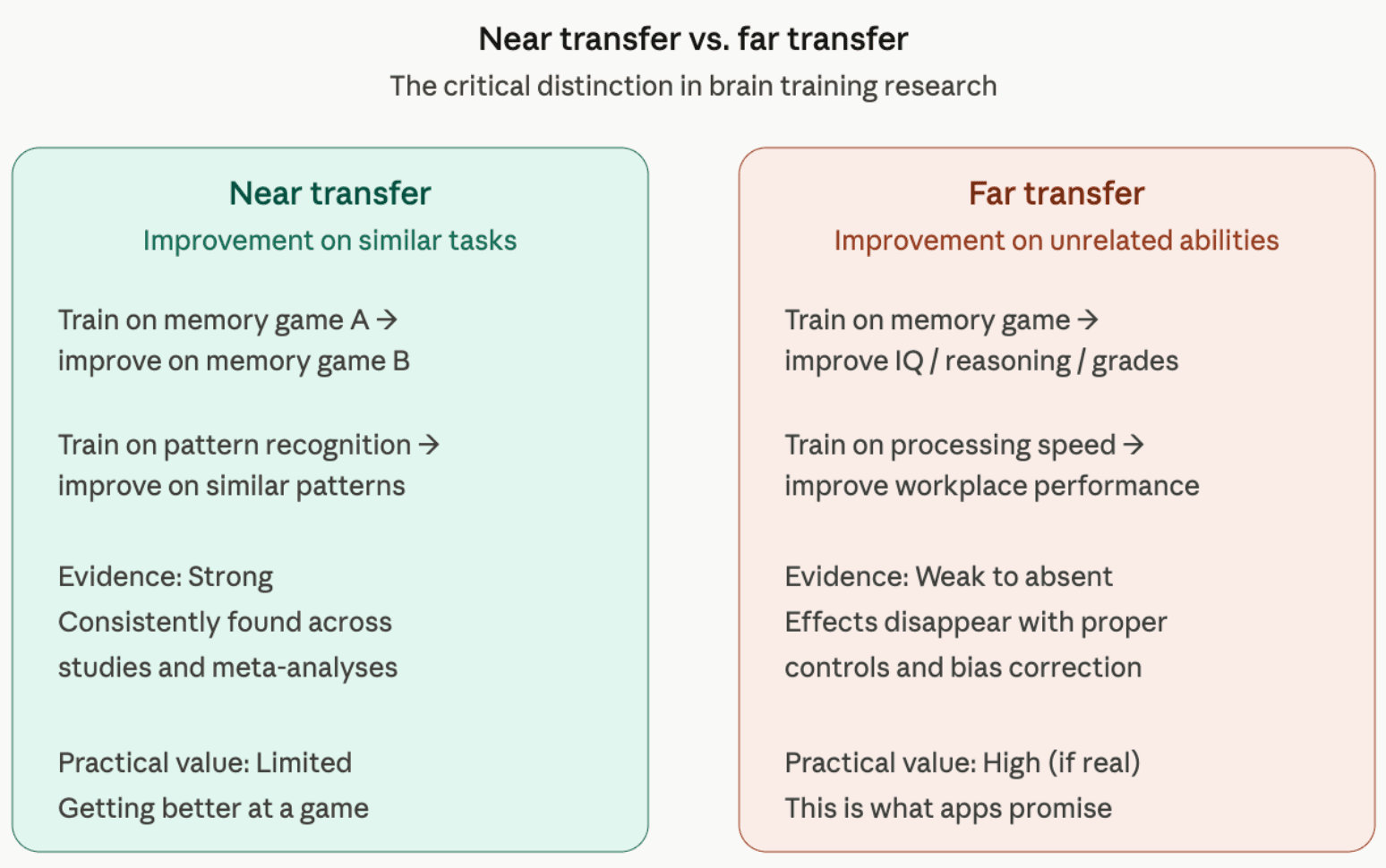 Near transfer occurs when practicing a task leads to improvement on closely related tasks that share similar cognitive demands. If a person practices a specific type of memory game, they will get better at that game and at structurally similar memory tasks. This is not surprising and is well established in the literature.
 Far transfer is the claim that matters for the IQ question. Far transfer would mean that training on a specific cognitive task leads to improvement on fundamentally different cognitive abilities, such as reasoning, reading comprehension, arithmetic, or general intelligence. If brain training apps produced far transfer, then playing memory games on a phone would make a person better at solving novel problems, understanding complex texts, and performing well on IQ tests. That is the claim the industry depends on.
What the Meta-Analyses Show
The most authoritative evidence on brain training comes from meta-analyses, which statistically combine the results of many individual studies to identify the overall pattern.
Melby-Lervåg, Redick, and Hulme (2016) published a comprehensive meta-analysis in Perspectives on Psychological Science examining 87 publications with 145 experimental comparisons. They found reliable improvements immediately following training on working memory tasks. However, for measures of far transfer, including nonverbal ability, verbal ability, reading comprehension, and arithmetic, there was no convincing evidence of improvement when the training group was compared to an active control group. Even the short-term gains in working memory did not appear to be maintained a few weeks after training ended. A second-order meta-analysis by Sala and Gobet (2019) published in Collabra: Psychology went even further. This study aggregated the results of multiple prior meta-analyses covering working memory training, video game training, music training, chess training, and exergames. When placebo effects and publication bias were controlled for, the overall far-transfer effect size was indistinguishable from zero. This held regardless of the type of training program and regardless of whether the trainees were children, adults, or older adults. The authors concluded that the lack of far transfer "is an invariant of human cognition."
Why Training on Narrow Tasks Cannot Reconfigure the Brain
The failure of far transfer is consistent with what psychologists have known about skill acquisition for over a century: practice makes a person better at the specific thing being practiced, and the benefits diminish rapidly as the task becomes less similar.
Consider an analogy. Lifting weights makes a person stronger, but it does not make a person a better chess player, even though chess requires sustained mental effort. The muscles involved are different, and the skills do not transfer. Cognitive training works similarly. Practicing a specific working memory game strengthens the neural circuits involved in that particular task. But IQ reflects the efficiency of a broad neural network spanning frontal, parietal, temporal, and occipital regions, as described by the Parieto-Frontal Integration Theory. Strengthening one narrow circuit does not reconfigure the brain's entire cognitive architecture.
A person who practices an n-back task (a common working memory exercise used in brain training research) develops strategies, becomes familiar with the timing and format, and learns to manage the specific demands of that particular exercise. But those strategies and that familiarity do not translate to solving matrix reasoning problems, comprehending complex texts, or navigating novel real-world situations, because those tasks rely on different combinations of cognitive processes.
Practice Effects vs. Real Cognitive Gains
The distinction between task-specific improvement and genuine cognitive growth connects directly to a concept that is well understood in intelligence testing: the practice effect. When a person takes the same IQ test twice, their score typically increases by about 5 IQ points on the second administration and about 3 more points on the third (Scharfen et al., 2018). This increase is not because the person has become smarter between testings. It occurs because familiarity with the test format, the types of questions, and the pacing all reduce the novelty of the task and improve performance. Brain training apps produce something very similar. The user becomes better at the trained tasks, sees higher scores on the app's own progress metrics, and the feedback loop feels rewarding. But those gains are hollow in the same way that practice effects on an IQ test are hollow: the score goes up, but the underlying cognitive ability has not changed. Intelligence researchers call these "hollow gains" because no one actually gets smarter from them.
What Does Raise IQ (and What Does Not)
If brain training apps do not raise IQ, what does? The evidence on this question is clear on a few points and frustratingly vague on others.
The most robust evidence for raising IQ comes from education. According to the best available meta-analytic estimate, an additional year of schooling raises IQ by approximately 1 to 5 points (Ritchie & Tucker-Drob, 2018). It is not clear how much of this is genuine intelligence gain versus improved familiarity with the types of tasks that appear on IQ tests, but the effect is real and has been replicated across many studies. Adoption into higher-quality home environments has also been shown to raise IQ by approximately 3 points compared to what would be expected if the child had remained with their birth family. On the prevention side, avoiding known IQ-lowering exposures, such as lead poisoning, prenatal alcohol exposure, and traumatic brain injury, protects cognitive development.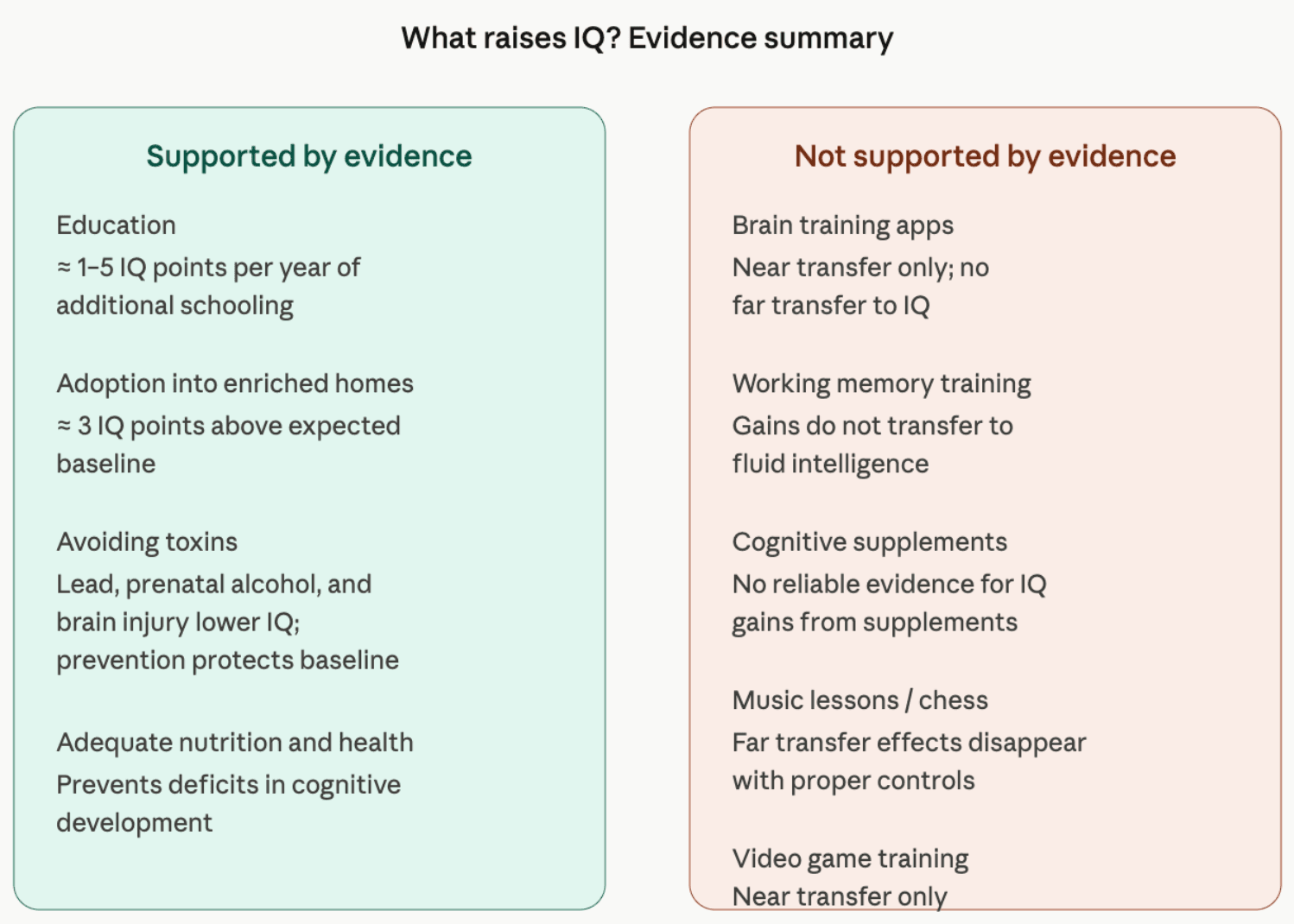
Why the Apps Feel Like They Work
If brain training apps do not actually raise IQ, why do so many users report feeling sharper after using them? Several factors contribute to this perception.
First, there is a placebo effect. Studies that use "active control" groups, where the control participants engage in an equally engaging but non-cognitive activity, consistently show smaller training effects than studies that use passive controls where the control group does nothing. This suggests that some of the apparent benefit comes from the expectation of improvement rather than from the training itself.
Second, there is a selection bias in how people evaluate their own cognitive performance. A person who has just spent 20 minutes concentrating intensely on a cognitive game may feel more mentally alert afterward. That feeling of sharpness is real, but it is a transient state of arousal, not evidence of a lasting change in cognitive ability.
Third, the apps themselves are designed to be rewarding. Rising scores, streak counters, achievement badges, and personalized progress dashboards all create a strong sense of forward momentum. That sense of improvement is genuine for the trained tasks, but the app's metrics do not measure whether the gains have generalized to anything beyond the games themselves.
Putting It All Together
Can brain training apps increase IQ? The weight of the evidence says no. The distinction between near and far transfer is the key: these apps make users better at the specific games they play, but the cognitive architecture that underlies general intelligence, the broad frontoparietal network that IQ tests are designed to assess, is not meaningfully altered by practicing narrow tasks on a screen.
This does not mean the apps are worthless. Some people enjoy them, and staying mentally active is generally beneficial for maintaining cognitive function in later life. But the specific claim that these apps will make a person smarter has not been substantiated. For anyone who wants to understand their cognitive abilities as they actually are, the right tool is a professionally developed IQ test, not an app that trains performance on a narrow set of games.
Take the First-Ever Professional Online IQ Test
The Reasoning and Intelligence Online Test (RIOT) is the first online IQ test that meets professional standards for psychological assessment. It was created by Dr. Russell Warne, who has over 15 years of experience in intelligence research and is the author of In the Know: Debunking 35 Myths about Human Intelligence (Cambridge University Press). What makes the RIOT different from the countless online IQ tests found with a quick internet search? Most of those tests are created by amateurs without proper training in psychometrics. The RIOT clearly stands out as the first-ever professional online IQ test. The RIOT underwent the same rigorous development process as traditional in-person IQ tests used by psychologists, including expert review, the first-ever proper U.S.-based online norm sample, and compliance with educational and psychological testing standards from APA, AERA, and NCME. References
Melby-Lervåg, M., Redick, T. S., & Hulme, C. (2016). Working memory training does not improve performance on measures of intelligence or other measures of "far transfer": Evidence from a meta-analytic review. Perspectives on Psychological Science, 11(4), 512–534. https://doi.org/10.1177/1745691616635612 Ritchie, S. J., & Tucker-Drob, E. M. (2018). How much does education improve intelligence? A meta-analysis. Psychological Science, 29(8), 1358–1369. https://doi.org/10.1177/0956797618774253 Sala, G., & Gobet, F. (2019). Near and far transfer in cognitive training: A second-order meta-analysis. Collabra: Psychology, 5(1), 18. https://doi.org/10.1525/collabra.167 Scharfen, J., Peters, J. M., & Holling, H. (2018). Retest effects in cognitive ability tests: A meta-analysis. Intelligence, 67, 44–66. https://doi.org/10.1016/j.intell.2018.01.003 Warne, R. T. (2020). In the know: Debunking 35 myths about human intelligence. Cambridge University Press. https://doi.org/10.1017/9781108593298
Take our professional IQ test
Want to know your IQ? Try the first ever professional online IQ test.
AuthorDr. Russell T. WarneChief Scientist
