Aug 9, 2026·Improving IQ / PreparationDoes Dual N-Back Training Increase IQ?
Dual n back training famously promised IQ gains in 2008, but replications and meta-analyses tell a different story. See what the transfer evidence shows.
Dr. Russell T. WarneChief Scientist
No. Dual n-back training reliably makes you better at dual n-back and closely related working memory tasks, but the best-controlled studies and the largest meta-analyses find no reliable improvement in IQ or fluid intelligence. The famous 2008 experiment that launched a wave of brain-training products reported real score gains, and those gains did not survive replication under stricter conditions. Here is what the task is, why the original study caused such excitement, and where the effect went.
What dual n-back is
Dual n-back is a working memory exercise in which you monitor two streams at once, usually a spoken letter and a square lighting up on a grid, and respond whenever the current item matches the one from n steps back. As you improve, n increases, so the task stays near the edge of your capacity. The theory behind it was reasonable:
working memory correlates strongly with "fluid intelligence" (Gf), the ability to solve novel problems, so stretching the one might plausibly raise the other. What
fluid intelligence actually is, and why it resists training, turned out to be the heart of the story.
The 2008 study that started it all
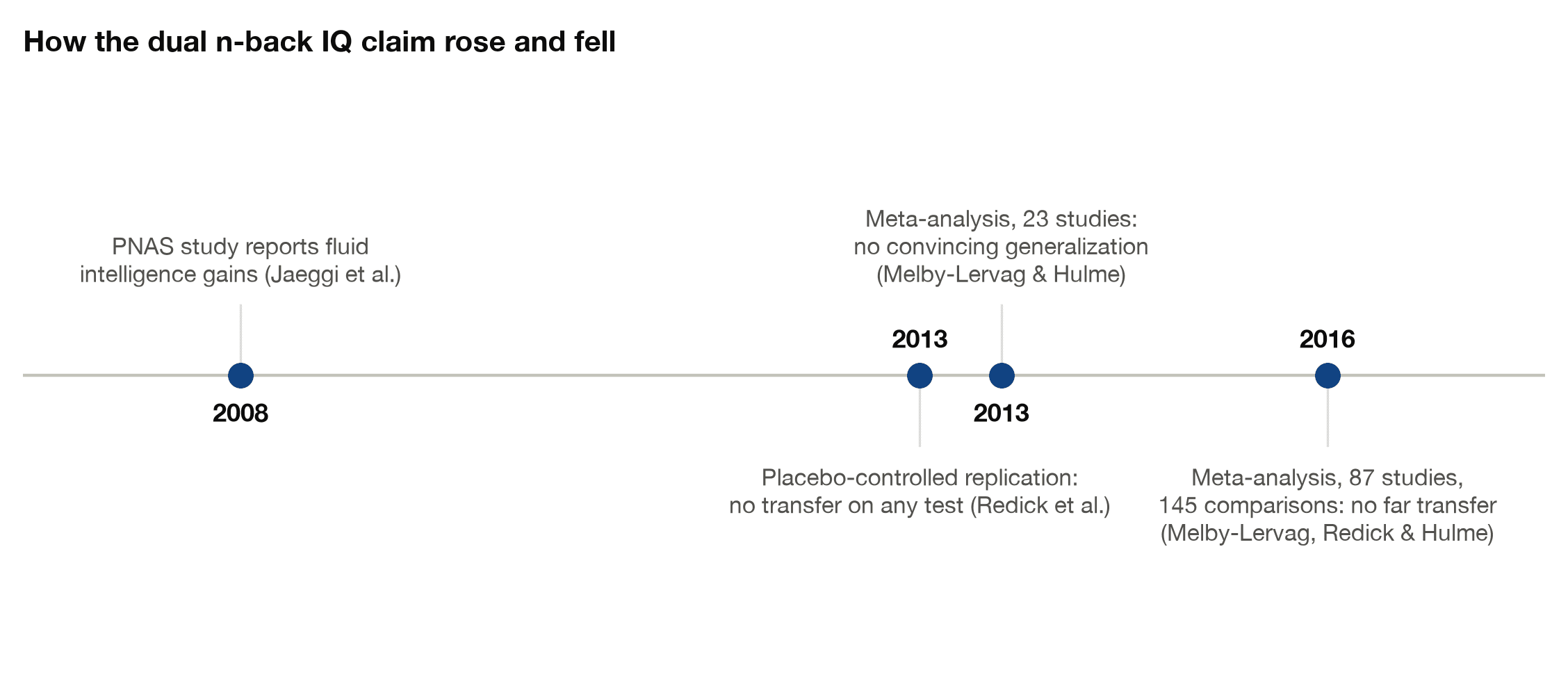
In 2008, Susanne Jaeggi, Martin Buschkuehl, John Jonides, and Walter Perrig reported in PNAS that adults who practiced adaptive dual n-back improved on measures of fluid intelligence, and that the gain was dosage-dependent: more training sessions, more improvement. The authors themselves noted the finding cut against a long history of research showing that performance on trained tasks can rise dramatically while transfer to other tasks remains poor. That is exactly why the paper made headlines. If correct, it meant a few weeks at a computer could raise the ability psychologists had long considered most resistant to intervention.
Where the effect went
The replication that failed to find it
The most rigorous replication attempt came from Thomas Redick and colleagues in 2013. Young adults completed 20 sessions of adaptive dual n-back, while an active placebo group trained on an adaptive visual-search task and a third group had no contact. Everyone took batteries of tests before, during, and after training, covering fluid intelligence, multitasking, working memory capacity, crystallized intelligence, and perceptual speed. Trained participants got much better at dual n-back itself. Despite high statistical power, there was no positive transfer to any cognitive ability test.
Why control groups matter
The contrast with 2008 is mostly a lesson in design. Early studies tended to use passive, no-contact control groups, which leave expectation effects uncontrolled: people who believe they received a brain workout may simply try harder at posttest. They also often measured fluid intelligence with a single, shortened matrix test, so task-specific improvement could masquerade as an ability gain. Redick's study closed both loopholes, and the effect disappeared.
What the meta-analyses say
Two large evidence reviews settled the question for most of the field. In 2013, Monica Melby-Lervag and Charles Hulme meta-analyzed 23 studies of working memory training and found reliable short-term improvements on working memory tasks themselves, with verbal working memory gains fading at follow-up and "no convincing evidence of the generalization of working memory training to other skills," including nonverbal and verbal ability.
In 2016, Melby-Lervag, Redick, and Hulme scaled the analysis up to 87 publications and 145 experimental comparisons. Against treated control groups, far-transfer measures such as nonverbal ability, verbal ability, reading, and arithmetic showed no convincing evidence of any reliable improvement. A telling detail: across studies, how much a group improved on working memory tasks did not predict how much far transfer it showed, which is the opposite of what a genuine capacity-building mechanism would produce.
Near transfer versus far transfer
The n-back episode is the clearest modern illustration of a distinction worth internalizing. "Near transfer," improvement on tasks similar to the one you practiced, is real, common, and short-lived. "Far transfer," improvement in the underlying ability that many tasks share, is what almost never shows up under rigorous controls. Practicing a task that resembles an IQ subtest can raise your score on that subtest without making you any smarter, for the same reason that rehearsing one song does not make you a better musician in general. Intelligence researcher Russell T. Warne's book In the Know reaches the same skeptical conclusion about cognitive training and far transfer, across 35 popular myths about intelligence.
Should you bother with dual n-back?
As a puzzle you enjoy, certainly; it is a demanding task and getting better at it is satisfying. As an IQ intervention, the evidence says no. The commercial products built on the 2008 finding are a related story with the same moral, which we cover in our review of whether
brain training apps can actually increase IQ. If your goal is better cognitive performance in daily life, the unglamorous fundamentals still hold the evidence: adequate sleep, physical exercise, education, and managing health conditions.
Frequently asked questions
What is dual n-back training?
Dual n-back is a working memory exercise in which you track two streams at once, usually a spoken letter and a square's position on a grid, and respond whenever the current item matches the one from n steps back. The task adapts, increasing n as you improve.
Did the original study really show IQ gains?
Jaeggi and colleagues reported in PNAS in 2008 that dual n-back training improved fluid intelligence scores, with more training producing bigger gains. The design had weaknesses, including passive control groups and single short intelligence measures, and the result did not replicate under stricter conditions.
Why do scientists no longer believe dual n-back raises IQ?
A rigorous 2013 replication with an active placebo group and multiple intelligence measures found no transfer at all, and meta-analyses covering up to 145 experimental comparisons found no convincing far-transfer effects against treated controls.
Does dual n-back improve working memory at least?
Modestly and narrowly. Meta-analyses show short-term improvements on working memory tasks similar to the trained one, but these gains fade at follow-up for verbal working memory and do not generalize to reasoning, reading, or arithmetic.
Is any brain training proven to increase IQ?
No brain-training program has convincingly demonstrated far transfer to intelligence in well-controlled research. Score improvements on practiced tasks reflect task learning rather than a smarter brain.
Where you actually stand
Dual n-back will make you better at dual n-back, and the evidence stops there. Fifteen years of replications and meta-analyses are about as decisive as cognitive science gets. If the question behind your interest is really "how sharp am I?", measurement answers it better than training claims ever will: the Reasoning and Intelligence Online Test from RIOT IQ reports properly normed scores, and its
free IQ test takes far less time than 20 sessions of n-back.
References
1. Jaeggi, S. M., Buschkuehl, M., Jonides, J., & Perrig, W. J. (2008).
Improving fluid intelligence with training on working memory. Proceedings of the National Academy of Sciences, 105(19), 6829-6833.
doi.org2. Redick, T. S., Shipstead, Z., Harrison, T. L., Hicks, K. L., Fried, D. E., Hambrick, D. Z., Kane, M. J., & Engle, R. W. (2013).
No evidence of intelligence improvement after working memory training: A randomized, placebo-controlled study. Journal of Experimental Psychology: General, 142(2), 359-379.
doi.org3. Melby-Lervag, M., & Hulme, C. (2013).
Is working memory training effective? A meta-analytic review. Developmental Psychology, 49(2), 270-291.
doi.org4. Melby-Lervag, M., Redick, T. S., & Hulme, C. (2016).
Working memory training does not improve performance on measures of intelligence or other measures of "far transfer": Evidence from a meta-analytic review. Perspectives on Psychological Science, 11(4), 512-534.
doi.org5. Warne, R. T. (2020).
In the know: Debunking 35 myths about human intelligence. Cambridge University Press.
doi.orgTake our professional IQ test
Want to know your IQ? Try the first ever professional online IQ test.
AuthorDr. Russell T. WarneChief Scientist