May 4, 2026·Improving IQ / Preparation10 Tips for Achieving a High Score on an IQ Test
Want an accurate score? Discover 10 science-backed IQ test tips to manage anxiety, optimize sleep, and avoid hollow gains. Read the full guide today!
Dr. Russell T. WarneChief Scientist
Most people who prepare for an IQ test approach it the same way they would a school exam — they search for practice questions, memorize formats, and hope for the best. That strategy does not translate to intelligence testing. IQ tests are not measuring what a person has memorized. They measure how well a person's mind works under controlled conditions.
I have spent over 15 years researching intelligence and have seen what the data actually say about test performance. Some preparation strategies produce meaningful improvements. Others produce what researchers call "hollow gains" — the score rises, but the underlying cognitive ability does not change. And a few common approaches actively suppress performance. The ten tips below are grounded in what psychometrics research supports, so that anyone preparing for an IQ test understands not just what to do, but why it works.
One clarification before proceeding: IQ and intelligence are not the same thing. Intelligence is the general mental capability underlying reasoning, planning, and problem solving. IQ is the numerical score a test produces to measure that capability. Several tips below help an examinee obtain a score that accurately reflects genuine intelligence — which is different from strategies that inflate the score without changing the underlying ability.
Why does test preparation matter?
Before the specific tips, it is worth establishing the baseline. How much does preparation actually move the needle?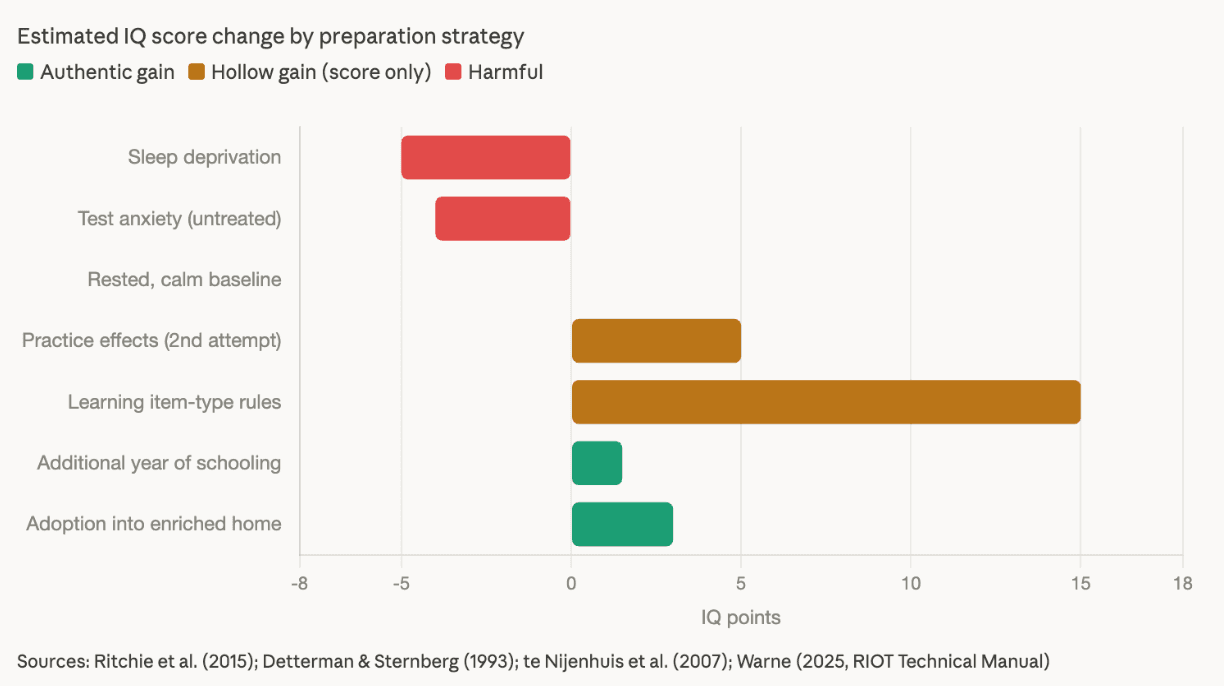 The picture is clear. Some strategies produce real gains that reflect genuine cognitive engagement. Others inflate the number without changing the ability underneath it. A few common behaviors actively suppress performance. The tips below map onto all three categories.
Tip 1: Get adequate sleep before testing
Sleep is the tip most frequently ignored and most consistently supported by research. It is not simply rest — it is the period during which the brain consolidates information, clears metabolic waste, and restores the resources that underlie fluid reasoning and working memory. Sleep deprivation has a well-documented negative effect on the specific abilities IQ tests measure most heavily: processing speed, working memory, and fluid reasoning. A single night of poor sleep can reduce performance on reasoning tasks by the equivalent of several IQ points.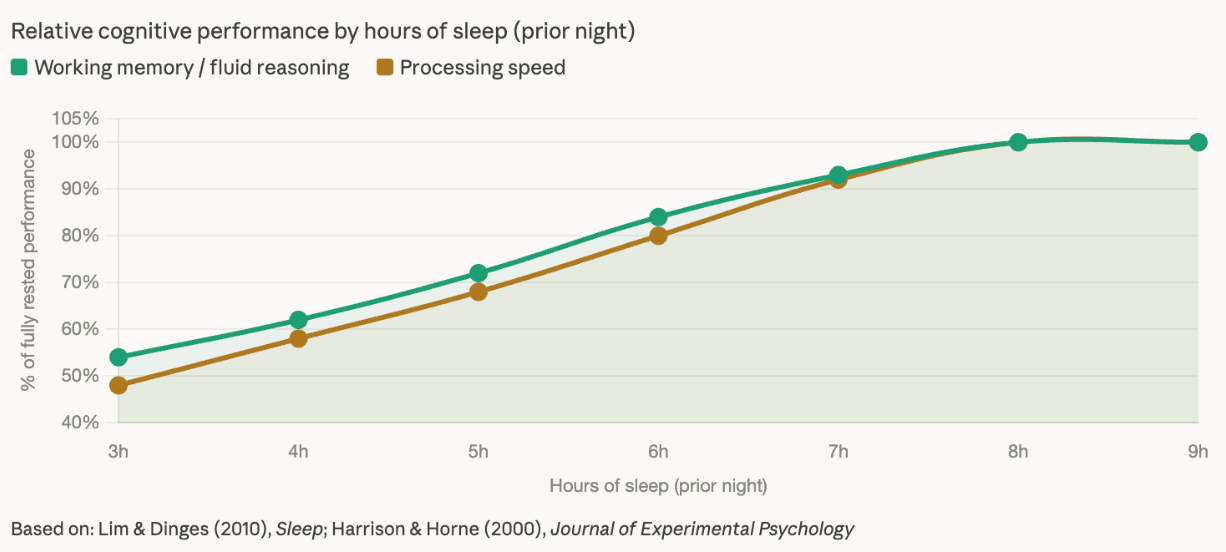 Aim for seven to nine hours on each of the two nights before testing. Two consecutive nights of adequate sleep outperform a single good night. For tests like the Reasoning and Intelligence Online Test (RIOT), which allows examinees to spread subtests across different days, this tip carries particular practical weight — there is no reason to rush through a full battery when cognitive freshness is recoverable overnight.
Tip 2: Manage test anxiety
Test anxiety is not a personality flaw. It is a well-documented phenomenon with measurable effects on IQ test performance. The performance decrements it produces are real, and they tend to hit precisely the cognitive processes IQ tests emphasize most: working memory and fluid reasoning. The mechanism is well understood. Anxiety consumes working memory resources. When an examinee is preoccupied with worry, those resources are unavailable for the cognitive task at hand.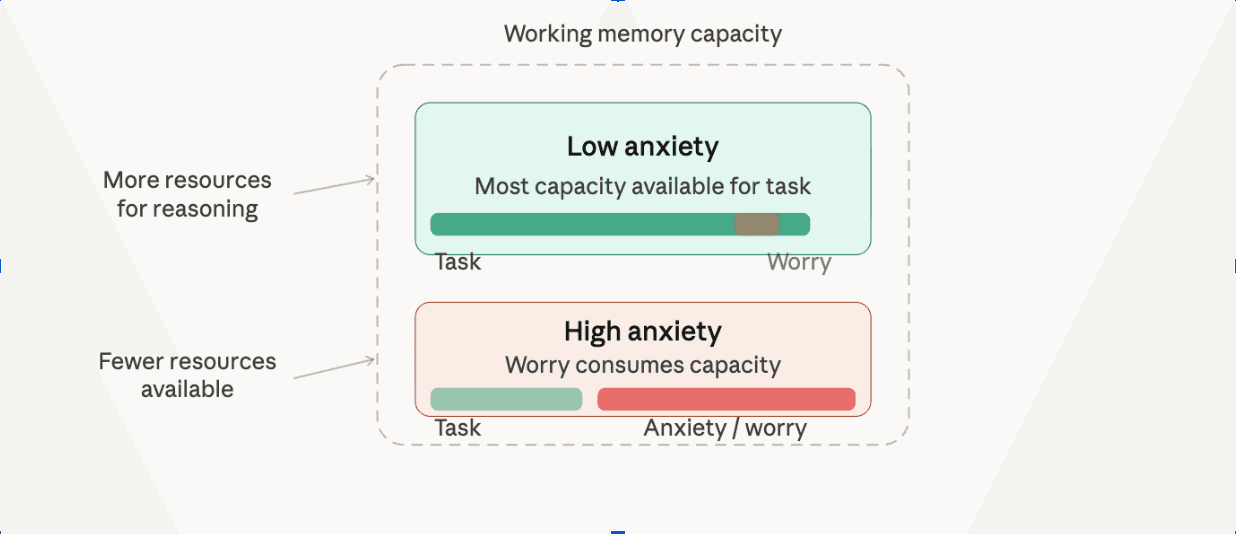 Deep breathing exercises immediately before testing reduce physiological arousal. Reframing the test as an informational exercise rather than a high-stakes judgment also helps. For chronic test anxiety, brief cognitive-behavioral interventions have the strongest evidence. Familiarity with each subtest format before test day removes one of the main sources of anxiety — uncertainty about what is coming. The RIOT makes its instruction videos publicly available on YouTube so examinees can preview every subtest in advance.
Tip 3: Understand how practice effects work — and their limits
Retaking an IQ test produces a score increase of approximately 5 IQ points on the second administration and about 3 additional points on the third. This is the practice effect, and it occurs because familiarity with item formats gives examinees an advantage unrelated to cognitive ability.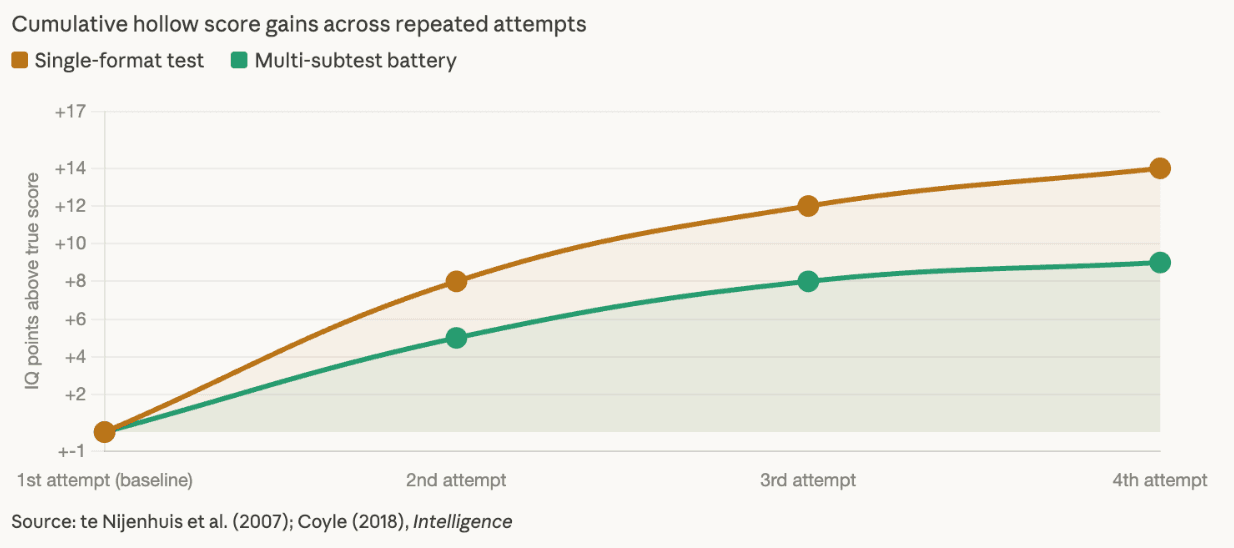 These inflated scores no longer accurately represent cognitive ability, which defeats the purpose of testing. For an examinee who wants an accurate cognitive profile — not just a high number — repeated retesting with the same test is counterproductive. What is appropriate, however, is previewing the types of tasks that will appear on a test so that confusion about format does not suppress performance. That is a meaningfully different goal.
Tip 4: Familiarize yourself with each subtest format in advance
A 15-minute instructional video explaining the rules of a matrix reasoning task raised scores by approximately 15 IQ points. That is a large number, and it illustrates exactly why examinees unfamiliar with a task format can score substantially below their true ability. Those 15 points were not reflecting a change in intelligence — they were reflecting the fact that viewers had been taught the underlying rules of one task and could therefore improve in their performance of that specific task. There is an important asymmetry here: learning the rules of one item type does not transfer to other subtests. Every subtest measures a different cognitive ability through a different task. Knowing how to approach matrix reasoning does not help with a working memory or processing speed task. Previewing each subtest individually is therefore worth doing across the full battery, not just for one or two item types.
Tip 5: Give genuine effort — but understand its limits
Deliberate effort does not substantially raise IQ scores above what an examinee's ability would produce. Trying harder does not generate intelligence that is not already there. But insufficient effort can meaningfully lower a score. Careless responding, random guessing, or giving up on difficult items will suppress performance. The practical recommendation is to engage with each problem as carefully as the time limit allows, without straining toward a kind of effortful performance that tips into anxiety — which, as Tip 2 explains, is its own score suppressant.
Tip 6: Manage time at the item and subtest level
IQ tests almost universally impose time limits. On many individually administered tests and on the RIOT, each individual item has its own time limit. Spending excessive time on one difficult item cannot be recovered on a later item. On group-administered tests, time limits apply to an entire subtest, which demands a different kind of pacing. Excessive time pressure introduces inaccuracy into scores, meaning the results are not as good at measuring a person’s true ability.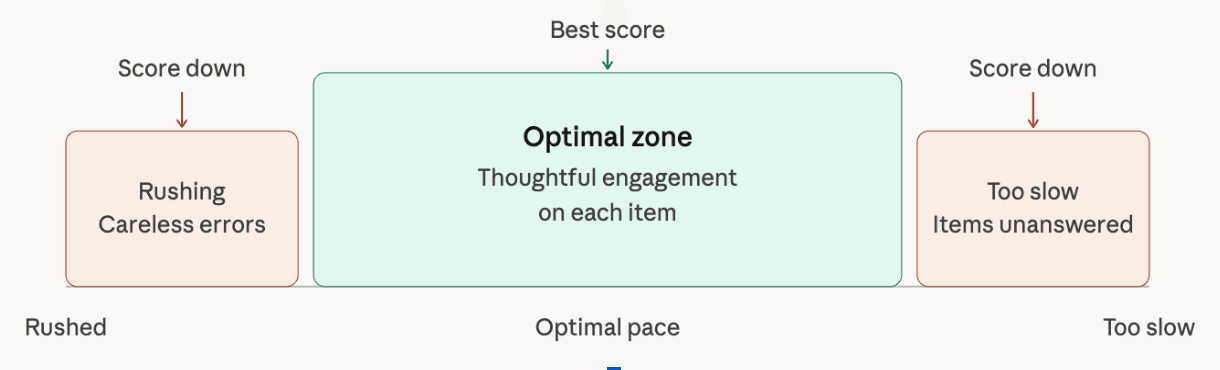 The practical recommendation is a steady, deliberate pace. On item-timed tests, move on from a clearly intractable item rather than burning time on a problem unlikely to be solved. On subtest-timed tests, monitor remaining time and calibrate accordingly. Neither excessive speed nor prolonged hesitation serves performance.
Tip 7: Take breaks strategically
Cognitive fatigue is real. Extended periods of demanding mental work make it more difficult to pay attention, and performance on complex tasks can decline significantly after extended effort. Taking breaks between subtests (not mid-subtest, if possible) allows recovery without disrupting any individual task. The RIOT is designed with this in mind. Examinees can pause between subtests indefinitely and can even complete remaining subtests on a different day. This is not a workaround — it is a deliberate design choice reflecting the psychometric reality that an accurate score requires an examinee who is cognitively fresh. Spreading testing across sessions is a legitimate and effective strategy.
Tip 8: Arrive in good physical condition
Cognitive performance is embedded in a biological system, and several physical factors on test day have well-documented effects. Even mild dehydration — a body water loss of just 1–2% — measurably impairs attention, working memory, and psychomotor speed. Arriving well-hydrated costs nothing and has meaningful protective effects.
Nutrition also matters. A moderate, familiar meal several hours before testing is preferable to either skipping eating or eating heavily immediately beforehand. Light-to-moderate aerobic exercise the day before testing produces short-term benefits for executive function and processing speed, though heavy exercise immediately before testing is not recommended.
Tip 9: Choose a professionally developed test
The quality of any score is only as good as the quality of the test that produced it. A score from a poorly designed test does not accurately represent cognitive ability regardless of how well-prepared the examinee was.
Most online IQ tests are not created by professionals. They lack representative norm samples, do not undergo systematic item analysis, and are not grounded in any recognized theory of intelligence. A score from one of these tests may be higher or lower than the examinee's true IQ by a substantial and unknowable margin.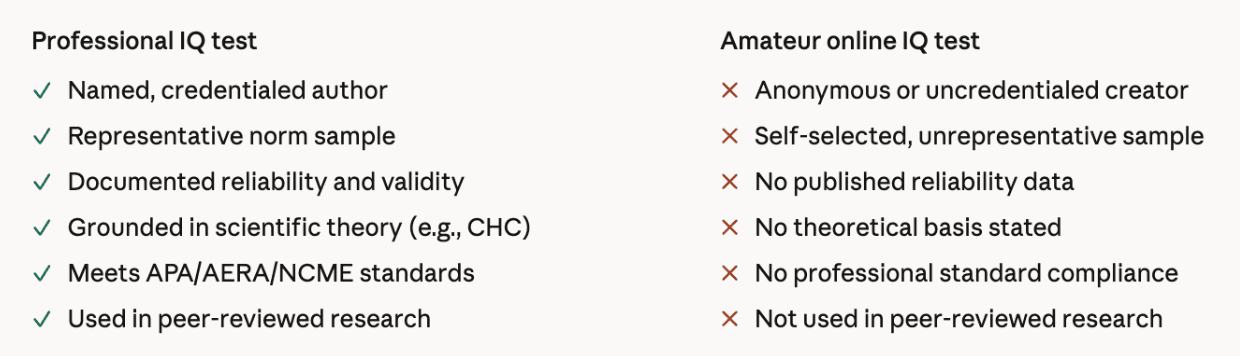 A professional test is one with a named, credentialed author, published technical documentation, a representative norm sample, and evidence of both reliability and validity. Scores from such a test carry the same scientific meaning as a traditional individually administered battery. Scores from amateur tests are completely uninterpretable.
Tip 10: Interpret the score as a profile, not just a number
A single global IQ score, while informative, does not tell the full story. Most professional IQ test batteries — including those built on the Cattell-Horn-Carroll (CHC) theory, the mainstream framework in intelligence research — report multiple index scores alongside the global score.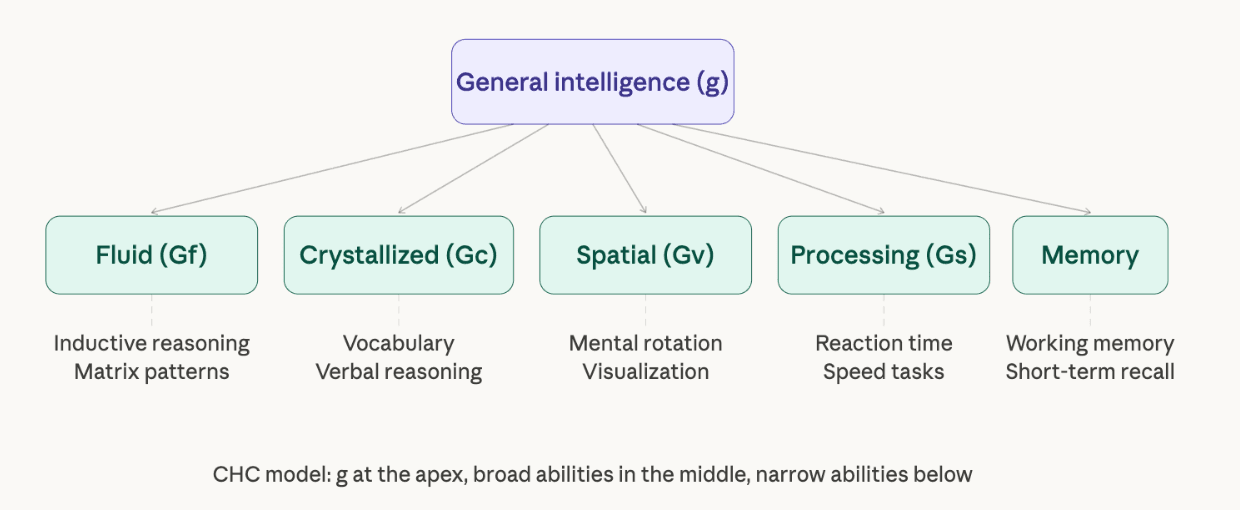 Index scores reveal cognitive strengths and weaknesses that a global score conceals. An examinee might have strong verbal reasoning alongside comparatively weaker processing speed. Both matter for different real-world activities, and subtest scores from validated batteries predict specific cognitive outcomes better than global IQ alone in many applied contexts. A professional battery is not just measuring IQ — it is producing a cognitive map.
Putting it all together
The key insight across all ten tips is this: a high score is only meaningful if it accurately reflects cognitive ability. Strategies that produce hollow gains do not accomplish this. Strategies that remove obstacles to accurate measurement — sleep, anxiety management, format familiarity, physical readiness, and a professionally designed test — do.
What about long-term intelligence development?
These ten tips concern test-day and preparation strategies. A reasonable follow-on question is whether any longer-term approaches genuinely develop the underlying cognitive ability IQ tests measure.
The interventions with the strongest evidence are formal schooling — one additional year of education raises IQ by approximately one to two points — and growing up in a cognitively enriching home. Adoption into a cognitively stimulating home is associated with IQ increases of approximately three points compared to remaining with the birth family in a lower-resource environment. Both effects represent genuine improvements in cognitive ability, not hollow gains. Popular interventions such as brain training apps have much weaker and more contested evidence. Near-transfer effects — where training on one task improves that specific task — are reliable. Far-transfer effects, where training on one cognitive task produces genuine improvements in general intelligence, have proven much harder to demonstrate. The strategies with genuine long-term support — sustained formal education, cognitively stimulating environments — are also among the most beneficial investments a person can make across many dimensions of life beyond IQ alone.
A note on what scores actually mean
An IQ score is not a trophy. It is a data point about one component of cognitive functioning, measured at a particular moment in time. IQ is a probabilistic predictor of many life outcomes — school performance, occupational attainment, and others — but not a deterministic one. It is also not exact; every test score includes a margin of error that any professional test will report alongside the score.
Taking the first professional online IQ test
For examinees who want an accurate, professionally meaningful score from an online test, the Reasoning and Intelligence Online Test (RIOT) is the first online IQ test developed to meet the same professional standards applied to traditional in-person assessments. I developed the RIOT over more than 15 years of active intelligence research. It is grounded in the Cattell-Horn-Carroll (CHC) model, underwent expert content review by cognitive, educational, and developmental psychologists, and uses the first representative U.S.-based norm sample ever collected for an online IQ test. It meets the technical and ethical standards jointly published by the American Educational Research Association, the American Psychological Association, and the National Council on Measurement in Education. Like many professional test batteries, the RIOT reports a global IQ alongside index scores across multiple cognitive domains — giving examinees a full cognitive profile rather than a single number.
Citations
[Detterman, D. K., & Sternberg, R. J. (Eds.). (1993). Transfer on trial: Intelligence, cognition, and instruction. Ablex Publishing.]
Take our professional IQ test
Want to know your IQ? Try the first ever professional online IQ test.
AuthorDr. Russell T. WarneChief Scientist
