Jun 30, 2026·Improving IQ / PreparationHow Does Sleep Affect IQ and Cognitive Performance?
Does sleep deprivation lower your intelligence? Discover how sleep impacts memory and cognitive performance. Read the guide and take the RIOT IQ test!
Dr. Russell T. WarneChief Scientist
Sleep is one of the most powerful influences on cognitive function, and it is one of the most commonly neglected. Most adults know that poor sleep makes them feel sluggish, but the actual impact on the cognitive abilities that IQ tests measure is far more severe than most people realize. As someone who has spent over 15 years studying intelligence and developing the Reasoning and Intelligence Online Test (RIOT), I consider sleep one of the most underappreciated variables in cognitive performance. Understanding how sleep affects cognition is essential for anyone interested in intelligence, whether they are preparing for an IQ test, managing cognitive demands at work, or simply trying to think clearly.
What Sleep Does for the Brain
Sleep is not a passive state. It is an active period of neural processing during which the brain performs several functions essential for cognition.
The most well-studied cognitive function of sleep is memory consolidation. During slow-wave sleep (also called deep sleep), the brain replays and reorganizes information that was acquired during waking hours (Klinzing et al., 2019). The hippocampus reactivates recently encoded neural patterns, and these reactivations are coordinated with thalamic sleep spindles and neocortical slow oscillations, creating a synchronized system that gradually transfers information from the hippocampus to long-term cortical storage. This is not merely a theoretical model; experimentally boosting the coupling between these sleep rhythms has been shown to enhance memory consolidation in humans (Geva-Sagiv et al., 2023). REM sleep (the stage associated with vivid dreaming) plays a complementary role, particularly for procedural memory and for integrating new information with existing knowledge structures. The combination of slow-wave and REM sleep across a full night creates the conditions the brain needs to consolidate learning, clear metabolic waste products, and restore the neural resources that support cognitive performance the following day.
This consolidation process has direct relevance to the kinds of knowledge that IQ tests assess. Vocabulary, general knowledge, and learned reasoning strategies, all of which contribute to crystallized intelligence, depend on the accumulation of well-consolidated memories over years of learning. A person who chronically sleeps poorly is not just impaired on the day of testing; they may have accumulated less crystallized knowledge over time because their brain had fewer opportunities to consolidate what they learned each day.
How Sleep Deprivation Impairs Cognition
The effects of sleep deprivation on cognitive performance have been studied extensively, and the findings are consistent: sleep loss impairs nearly every cognitive domain that IQ tests measure.
A meta-analysis by Lim and Dinges (2010) published in Psychological Bulletin examined 70 studies containing 147 cognitive tests and found that short-term sleep deprivation (less than 48 hours) produced significant impairments across six cognitive categories. The effect sizes varied by domain: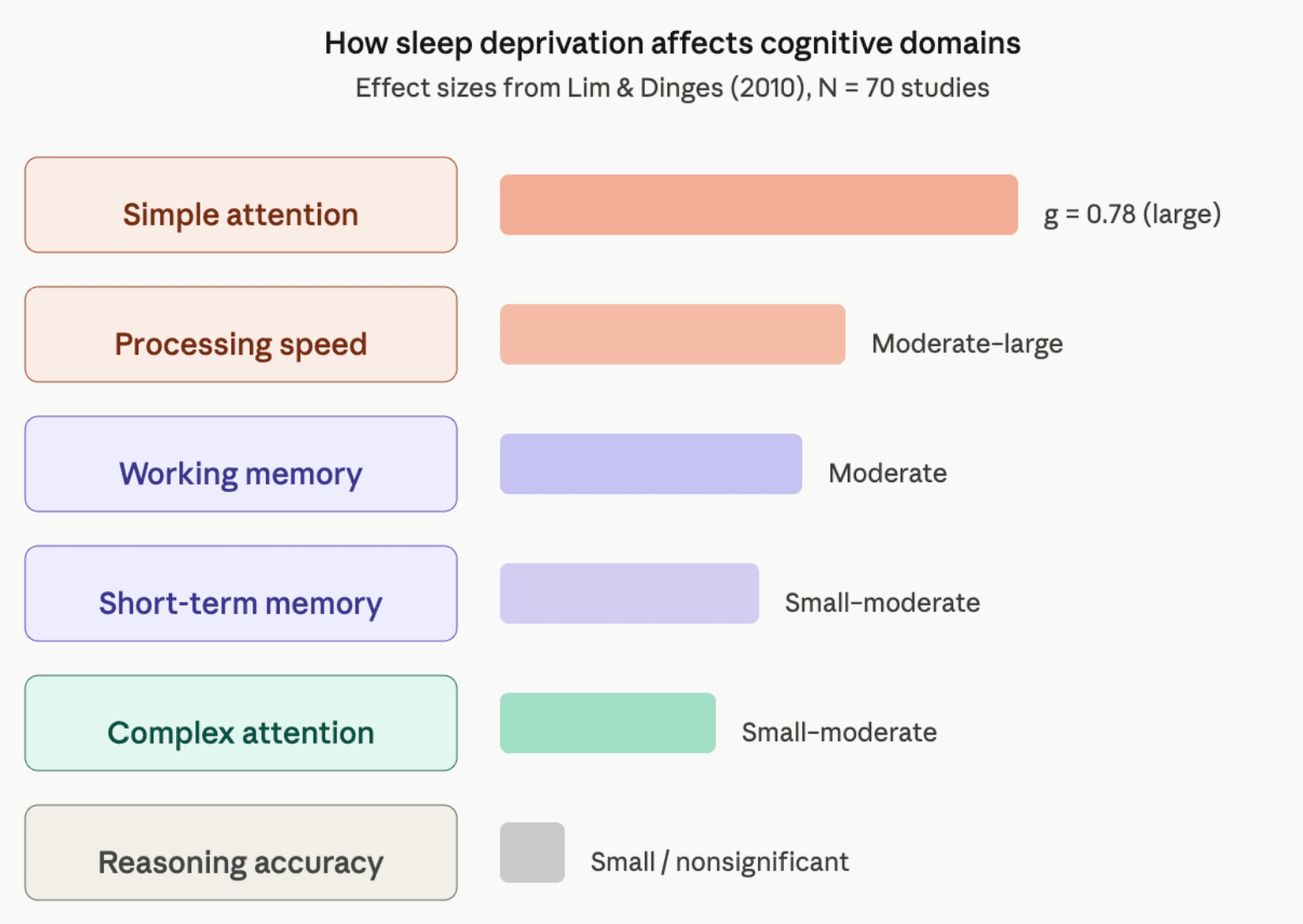 An earlier meta-analysis by Pilcher and Huffcutt (1996) published in Psychological Bulletin examined 19 studies and found that sleep-deprived individuals performed worse on cognitive tasks than 97% of non-sleep-deprived controls. They also found that partial sleep deprivation (getting some sleep, but not enough) had a more profound cumulative effect on functioning than a single night of total sleep deprivation, likely because people underestimate the accumulating deficit when they are getting "some" sleep each night.
Why Some Abilities Are More Vulnerable Than Others
The pattern of impairment shown in the graphic above is not random. It reflects the underlying neuroscience of how sleep loss affects the brain.
Attention and vigilance are the most vulnerable because they depend on sustained tonic activation of the prefrontal cortex and the arousal systems of the brainstem. Sleep deprivation directly reduces the brain's baseline arousal level, making it progressively harder to maintain focus over time. On an IQ test, this translates to more careless errors, slower response times, and difficulty staying engaged with the task, particularly on longer subtests.
Working memory is highly sensitive because it depends on the dorsolateral prefrontal cortex (dlPFC), a region that is among the most metabolically demanding in the brain and among the first to show reduced activation under sleep loss. Working memory is one of the strongest predictors of IQ scores and is essential for tasks like mental arithmetic, following complex instructions, and solving multi-step problems. Neuroimaging studies have confirmed that sleep deprivation disrupts connectivity within the frontoparietal network, the same brain regions identified by the Parieto-Frontal Integration Theory (P-FIT) as central to intelligent behavior.
Higher-order reasoning shows a more complex pattern. On some measures, abstract reasoning is surprisingly resilient to short-term sleep loss, particularly when the task is brief and novel enough to temporarily engage the test taker's remaining attentional resources. But this resilience breaks down with longer or more sustained cognitive demands, and it is less apparent under chronic partial sleep restriction than under acute total deprivation.
Chronic Sleep Restriction: The Silent Cognitive Drain
Total sleep deprivation, such as staying awake for 24 or 36 hours, produces dramatic cognitive impairment that most people can recognize. But chronic partial sleep restriction, getting slightly less sleep than needed over days, weeks, or months, is far more common and in some ways more insidious.
Research has shown that restricting sleep to six hours per night for two weeks produces cognitive deficits equivalent to one or two nights of total sleep deprivation. The critical difference is that people who are chronically sleep-restricted rate their own alertness and performance as much better than it actually is. They adapt subjectively to the feeling of being tired, but their objective cognitive performance continues to deteriorate. This dissociation between perceived and actual performance is one of the most concerning findings in sleep research, because it means that millions of people are operating with impaired cognition without knowing it.
Sleep and Children's Cognitive Development
The relationship between sleep and cognition is particularly important during childhood and adolescence, when the brain is still developing. Research has consistently found associations between sleep duration and cognitive performance in children. A study by Gruber and colleagues (2010) found that shorter sleep duration was associated with lower IQ scores in healthy school-age children, even after controlling for other relevant variables. Longitudinal studies have added to this picture. Persistent sleep problems during childhood, particularly difficulties initiating and maintaining sleep, have been linked to poorer performance on measures of executive functioning in later years. The prefrontal cortex, which is critical for working memory and executive control, undergoes significant maturation during childhood and adolescence, and this developmental process appears to be sensitive to sleep quality.
For parents and educators, the practical implication is clear: adequate sleep is not a luxury for children. It is a biological necessity for the cognitive development that supports learning, academic performance, and the kind of reasoning that IQ tests measure.
Does Sleep Change IQ?
An important distinction must be made here. Sleep deprivation impairs cognitive performance, which can lower scores on an IQ test. But it does not change a person's underlying intelligence. Intelligence, as a stable trait, reflects the efficiency of the brain's cognitive architecture, shaped by genetics, development, and long-term environmental influences. Sleep is not one of those long-term shaping forces in the same way that education or genetics are.
What sleep determines is how much of a person's cognitive potential is available on any given day. This is analogous to how a world-class sprinter will run slower with a sprained ankle. The ankle does not make them less athletic; it prevents them from expressing their full ability. If an examinee takes an IQ test after poor sleep, the resulting score will underestimate their true ability. Professional test administrators are trained to recognize signs of fatigue and may recommend rescheduling in such cases.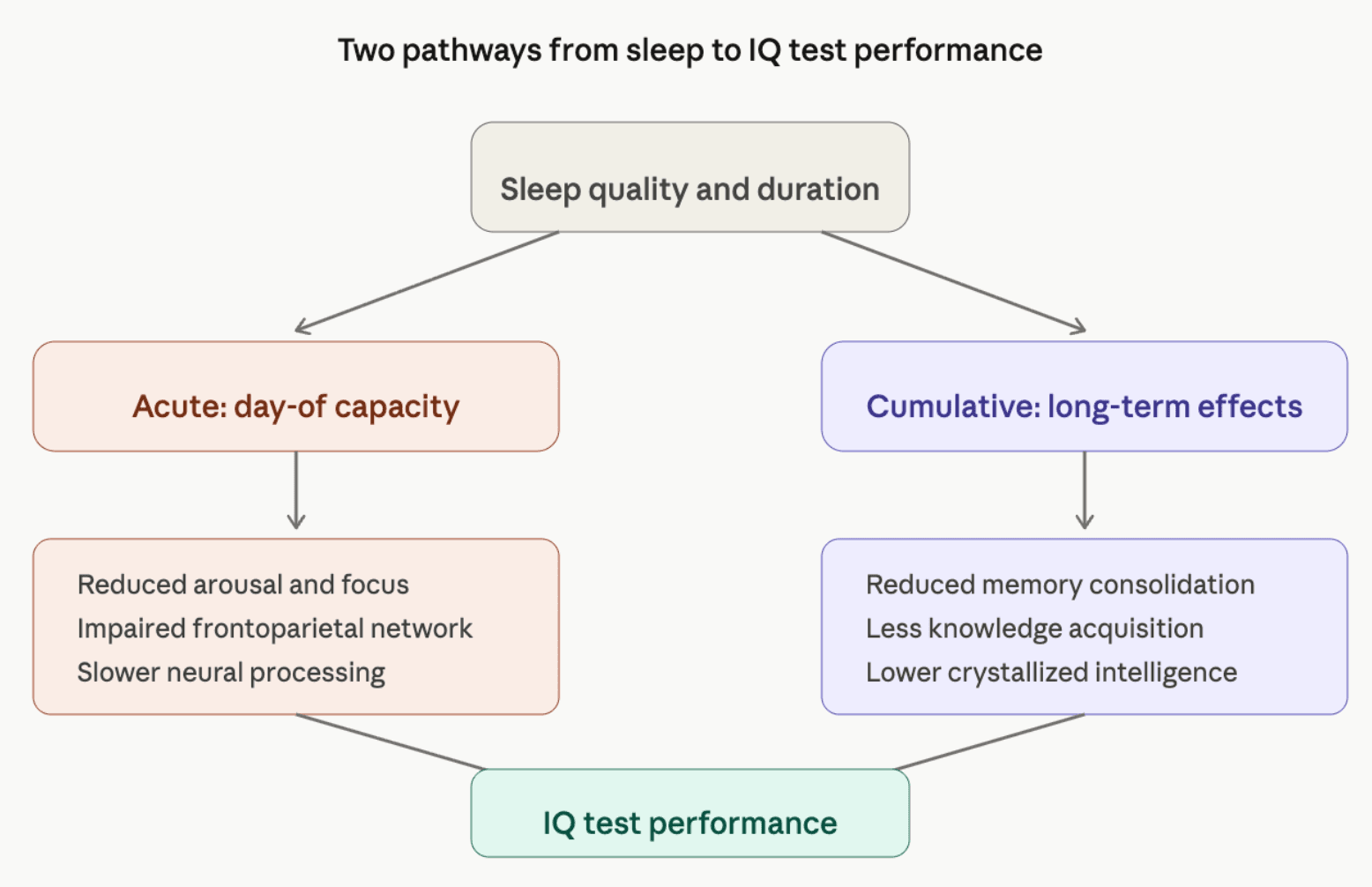
Practical Implications for Cognitive Performance
The research on sleep and cognition leads to several practical conclusions.
Getting adequate sleep, typically seven to nine hours for adults and more for children and adolescents, is one of the most effective things a person can do to maintain cognitive performance. Unlike brain training apps, which have not been shown to produce lasting improvements in general intelligence, sleep is a genuine biological requirement for optimal cognitive function. The comparison is instructive: billions of dollars have been spent developing and marketing brain training tools that produce no far transfer to IQ, while the most powerful cognitive performance tool available is free and requires only that a person prioritize it.
For anyone preparing for an IQ test or any cognitively demanding task, sleep should be treated as part of the preparation. Chronic sleep restriction in the days or weeks before a test will impair the very abilities the test is designed to measure, even if the test taker feels adequately rested. The RIOT allows examinees to take subtests on different days and to take breaks between them, precisely because cognitive testing should reflect a person's best effort under optimal conditions, not their performance while impaired by fatigue.
Take the First-Ever Professional Online IQ Test
The Reasoning and Intelligence Online Test (RIOT) is the first online IQ test that meets professional standards for psychological assessment. It was created by Dr. Russell Warne, who has over 15 years of experience in intelligence research and is the author of In the Know: Debunking 35 Myths about Human Intelligence (Cambridge University Press). What makes the RIOT different from the countless online IQ tests found with a quick internet search? Most of those tests are created by amateurs without proper training in psychometrics. The RIOT clearly stands out as the first-ever professional online IQ test. The RIOT underwent the same rigorous development process as traditional in-person IQ tests used by psychologists, including expert review, the first-ever proper U.S.-based online norm sample, and compliance with educational and psychological testing standards from APA, AERA, and NCME.
References
Geva-Sagiv, M., Mankin, E. A., Engel, S., Gober, L., Chung, P., Fried, I., & Nir, Y. (2023). Augmenting hippocampal–prefrontal neuronal synchrony during sleep enhances memory consolidation in humans. Nature Neuroscience, 26(6), 1100–1110. https://doi.org/10.1038/s41593-023-01324-5 Gruber, R., Laviolette, R., Deluca, P., Monson, E., Cornish, K., & Bhattacharyya, J. (2010). Short sleep duration is associated with poor performance on IQ measures in healthy school-age children. Sleep Medicine, 11(3), 289–294. https://doi.org/10.1016/j.sleep.2009.09.007 Klinzing, J. G., Niethard, N., & Born, J. (2019). Mechanisms of systems memory consolidation during sleep. Nature Neuroscience, 22(10), 1598–1610. https://doi.org/10.1038/s41593-019-0467-3 Lim, J., & Dinges, D. F. (2010). A meta-analysis of the impact of short-term sleep deprivation on cognitive variables. Psychological Bulletin, 136(3), 375–389. https://doi.org/10.1037/a0018883 Pilcher, J. J., & Huffcutt, A. I. (1996). Effects of sleep deprivation on performance: A meta-analysis. Sleep, 19(4), 318–326. https://doi.org/10.1037/0033-2909.119.2.272 Warne, R. T. (2020). In the know: Debunking 35 myths about human intelligence. Cambridge University Press. https://doi.org/10.1017/9781108593298
Take our professional IQ test
Want to know your IQ? Try the first ever professional online IQ test.
AuthorDr. Russell T. WarneChief Scientist
