Aug 9, 2026·Improving IQ / PreparationMnemonic Devices: Types That Actually Work
Mnemonic devices from acronyms to the keyword method can boost recall fast. See which types actually work according to research, and where they fall short.
Dr. Russell T. WarneChief Scientist

Mnemonic devices are memory aids that attach hard-to-remember information to something your brain handles easily: an image, a place, a sound pattern, or a familiar word. Some, such as the "method of loci" and the keyword method, carry strong experimental support. Others, such as acronyms, are convenient but only lightly studied. The right mnemonic can make memorization dramatically faster. None of them raises intelligence, and for durable learning the research favors practice testing and spaced review over any memory trick. This article ranks the main types by evidence and explains where each one fits.
What counts as a mnemonic device
A mnemonic is any deliberate encoding strategy that gives new material extra retrieval routes. Rote repetition leaves you a single, fragile path back to a fact. A mnemonic converts the fact into a vivid image, a location, a rhyme, or a meaningful chunk, each of which is the kind of content human memory retains well, and each of which serves as a cue at recall time. The techniques below differ mainly in which conversion they perform.
The main types, ranked by evidence
Method of loci, the memory palace
The best-evidenced imagery mnemonic. You place images of the items to be remembered along a route through a familiar place and recall them by mentally retracing it. A 2021 meta-analysis of 13 randomized controlled trials found a medium effect on recall (g = 0.65), and imaging research shows that world-class memory athletes rely on exactly this kind of spatial strategy rather than on unusual brains. Our full guide to
the memory palace technique covers the history and the how-to.
The keyword method
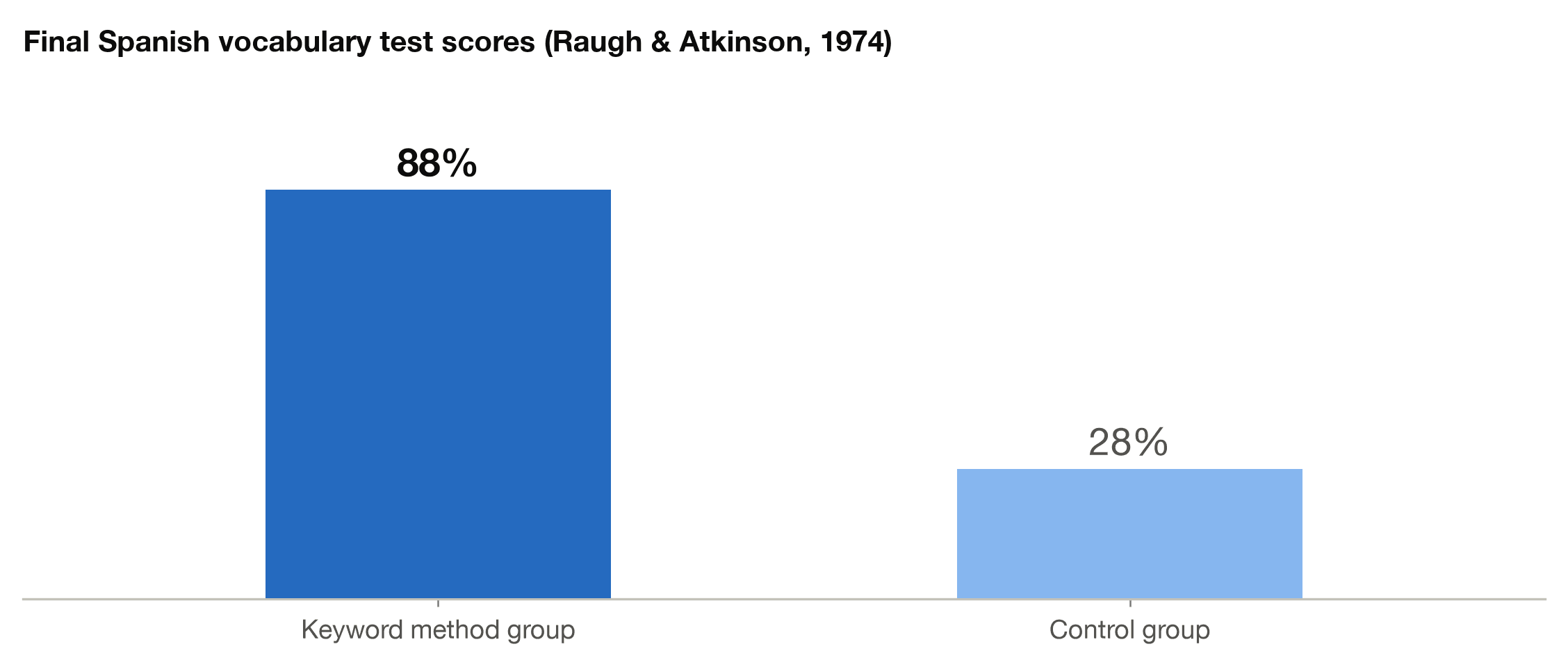
Developed and tested by Richard Atkinson and Michael Raugh at Stanford in the 1970s for foreign vocabulary. You link the foreign word to a similar-sounding English "keyword," then form a mental image of the keyword interacting with the word's meaning. In their Spanish experiments the results were striking: a final test score of 88 percent correct for the keyword group against 28 percent for the control group. A companion Russian-vocabulary study was published in a peer-reviewed APA journal in 1975.
Chunking
Recoding long strings into larger meaningful units, the way phone numbers are broken into groups. It rests on George Miller's classic 1956 estimate that immediate memory holds about seven plus or minus two chunks; modern research on
working memory puts the true capacity nearer four. Either way, the capacity limit applies to chunks rather than raw items, so bigger chunks mean more retained.
The pegword system
A cousin of the memory palace for numbered lists: you memorize rhyming pegs (one is a bun, two is a shoe), then image each list item interacting with its peg. It belongs to the same well-supported imagery family, though it has been tested in fewer trials than the method of loci.
Rhymes and songs
"Thirty days hath September" and the alphabet song exploit acoustic encoding: rhythm and rhyme constrain what the missing word can be. Evidence here is thinner and mostly indirect, but the mechanism is sound and the cost is low.
Acronyms and acrostics
First-letter mnemonics such as ROY G BIV for the rainbow or a sentence like "Please Excuse My Dear Aunt Sally" for order of operations. They are handy for short ordered lists, and they carry the thinnest research base of the group. Use them when the material is brief and the letters are distinctive.
The honest caveat: memorizing is not learning
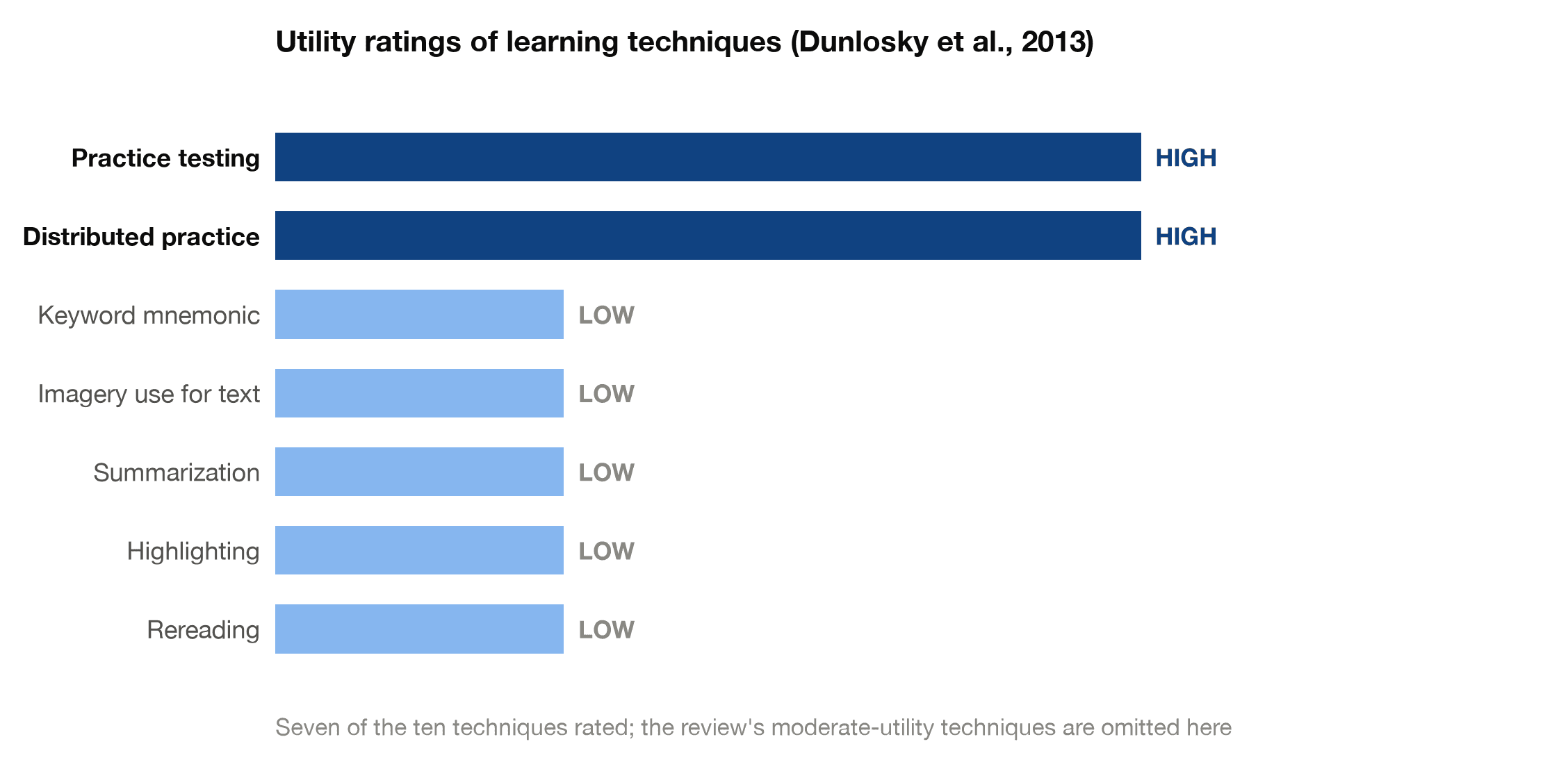
The most careful evidence review in this area, published by John Dunlosky and colleagues in 2013, rated ten learning techniques for classroom usefulness. Practice testing and distributed practice (spacing study sessions over time) earned high utility ratings. The keyword mnemonic was rated low utility, alongside summarization, highlighting, imagery use for text, and rereading, because its benefits often fail to generalize across materials and to persist over time in real educational settings.
Those two findings are compatible. The keyword method genuinely produces large short-term gains in the lab, and it still rates poorly as an all-purpose study strategy. The practical resolution is to use mnemonics for the initial encoding of stubborn material, then secure it with spaced retrieval practice, which is what the high-utility techniques provide.
Mnemonics and IQ: know the difference
Mnemonics improve recall of the specific content you encode with them. They do not raise general reasoning ability, and the people who use them most spectacularly are not intellectual outliers: brain-imaging research on superior memorizers found their feats rested on learned spatial strategy, with no exceptional intellectual ability involved. The same skill-versus-ability distinction runs through the whole cognitive training literature, including
dual n-back training, where practiced tasks improve without any reliable gain in intelligence.
Picking the right tool
• Foreign vocabulary: The keyword method, backed up with spaced retrieval practice.
• Speeches, lists, and exam facts in order: The method of loci.
• Long numbers: Chunking into meaningful groups.
• Short ordered sets: Acronyms, acrostics, or a rhyme.
Frequently asked questions
What are mnemonic devices?
Mnemonic devices are memory aids that attach hard-to-remember information to something easier to remember, such as a word, image, rhyme, or familiar place. Classic examples include ROY G BIV and the memory palace used by memory athletes.
Which mnemonic device works best?
For pure memorization, the method of loci has the strongest evidence, with a medium effect size (g = 0.65) across 13 randomized trials. For long-term learning overall, research rates practice testing and spaced review above any imagery mnemonic.
Does the keyword method work for learning languages?
It works impressively in the short term; in Stanford experiments one keyword group scored 88 percent on a final vocabulary test versus 28 percent for controls. A major review rated it low utility for durable classroom learning, so pair it with spaced retrieval practice.
Do mnemonic devices make you smarter?
No. Mnemonics improve recall of the material you encode with them, and there is no evidence they raise IQ or transfer to general reasoning ability. They are study tools rather than intelligence boosters.
Why do mnemonics work?
They convert abstract, arbitrary information into forms human memory handles well: vivid images, spatial locations, sounds, and meaningful chunks. That gives your brain more retrieval cues than rote repetition provides.
The takeaway
Mnemonics are the closest thing studying has to power tools: dramatic for the narrow job each was built for, and no substitute for the slow work of spaced, tested learning. They will not move your IQ, because memorized content and reasoning ability are different things. If you want the second one measured properly, the Reasoning and Intelligence Online Test from RIOT IQ is built for exactly that, and its
free IQ test is the place to start.
References
1. Raugh, M. R., & Atkinson, R. C. (1974).
A mnemonic method for the acquisition of a second-language vocabulary (Tech. Rep. No. 224). Stanford University.
files.eric.ed.gov2. Atkinson, R. C., & Raugh, M. R. (1975).
An application of the mnemonic keyword method to the acquisition of a Russian vocabulary. Journal of Experimental Psychology: Human Learning and Memory, 1(2), 126-133.
doi.org3. Dunlosky, J., Rawson, K. A., Marsh, E. J., Nathan, M. J., & Willingham, D. T. (2013).
Improving students' learning with effective learning techniques: Promising directions from cognitive and educational psychology. Psychological Science in the Public Interest, 14(1), 4-58.
doi.org4. Twomey, C., & Kroneisen, M. (2021).
The effectiveness of the loci method as a mnemonic device: Meta-analysis. Quarterly Journal of Experimental Psychology, 74(8), 1317-1326.
doi.org5. Miller, G. A. (1956).
The magical number seven, plus or minus two: Some limits on our capacity for processing information. Psychological Review, 63(2), 81-97.
psychclassics.yorku.ca6. Maguire, E. A., Valentine, E. R., Wilding, J. M., & Kapur, N. (2003).
Routes to remembering: The brains behind superior memory. Nature Neuroscience, 6(1), 90-95.
doi.orgTake our professional IQ test
Want to know your IQ? Try the first ever professional online IQ test.
AuthorDr. Russell T. WarneChief Scientist