Working memory is the mental workspace that holds and works with information for seconds at a time. How it works, its four-chunk limit, and why it matters.
Dr. Russell T. WarneChief Scientist
Share
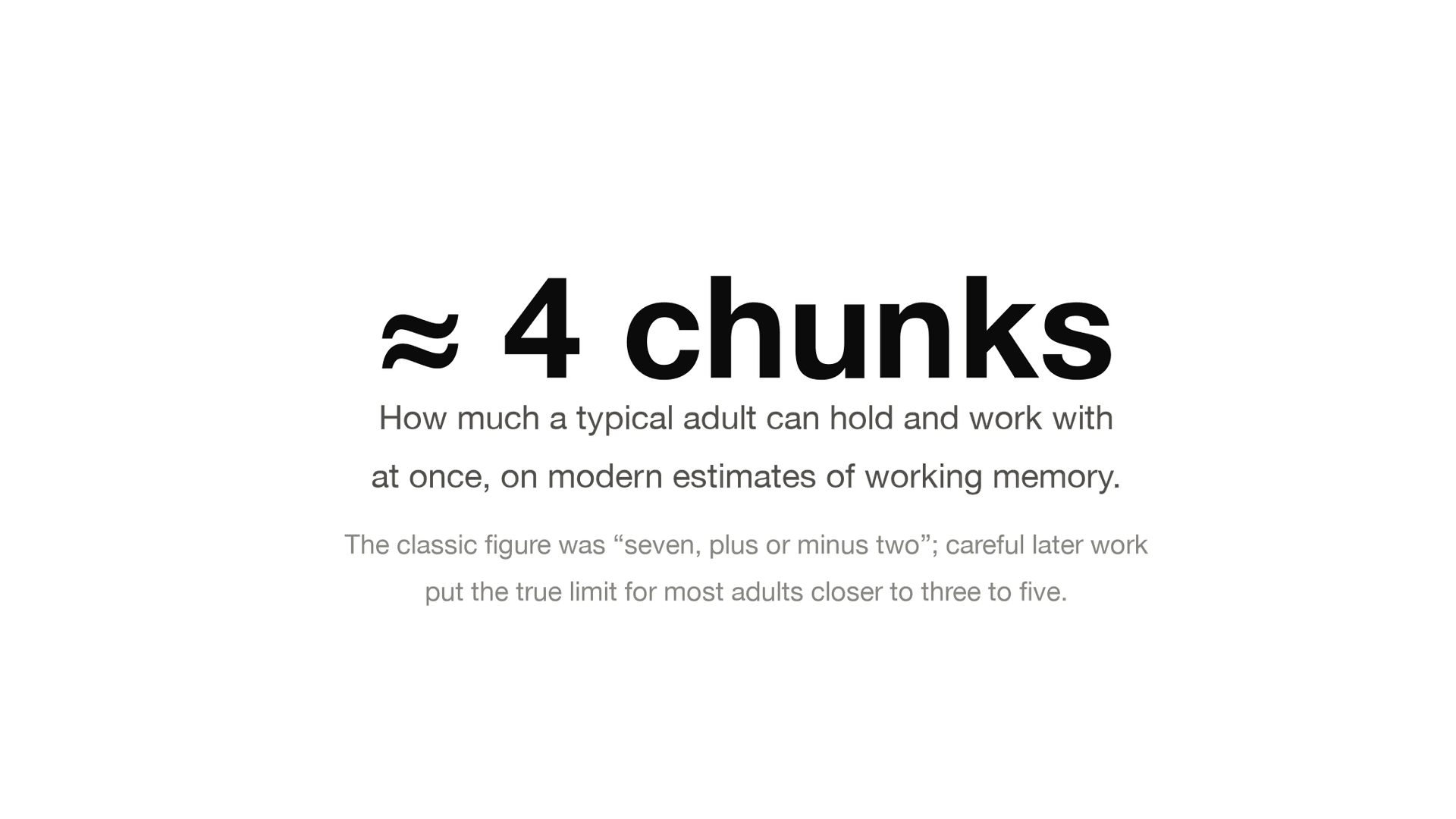
"Working memory" is the mental workspace that holds and manipulates information over a span of seconds: the system you use to keep a phone number in mind while opening the dial pad, or to carry the 1 in mental arithmetic. It is distinct from short-term storage because it works on information rather than merely parking it, and it is one of the strongest cognitive correlates of fluid intelligence. Its capacity is startlingly small, about four chunks for a typical adult, and that limit shapes how everyone learns, reads, and reasons.
The model behind the term
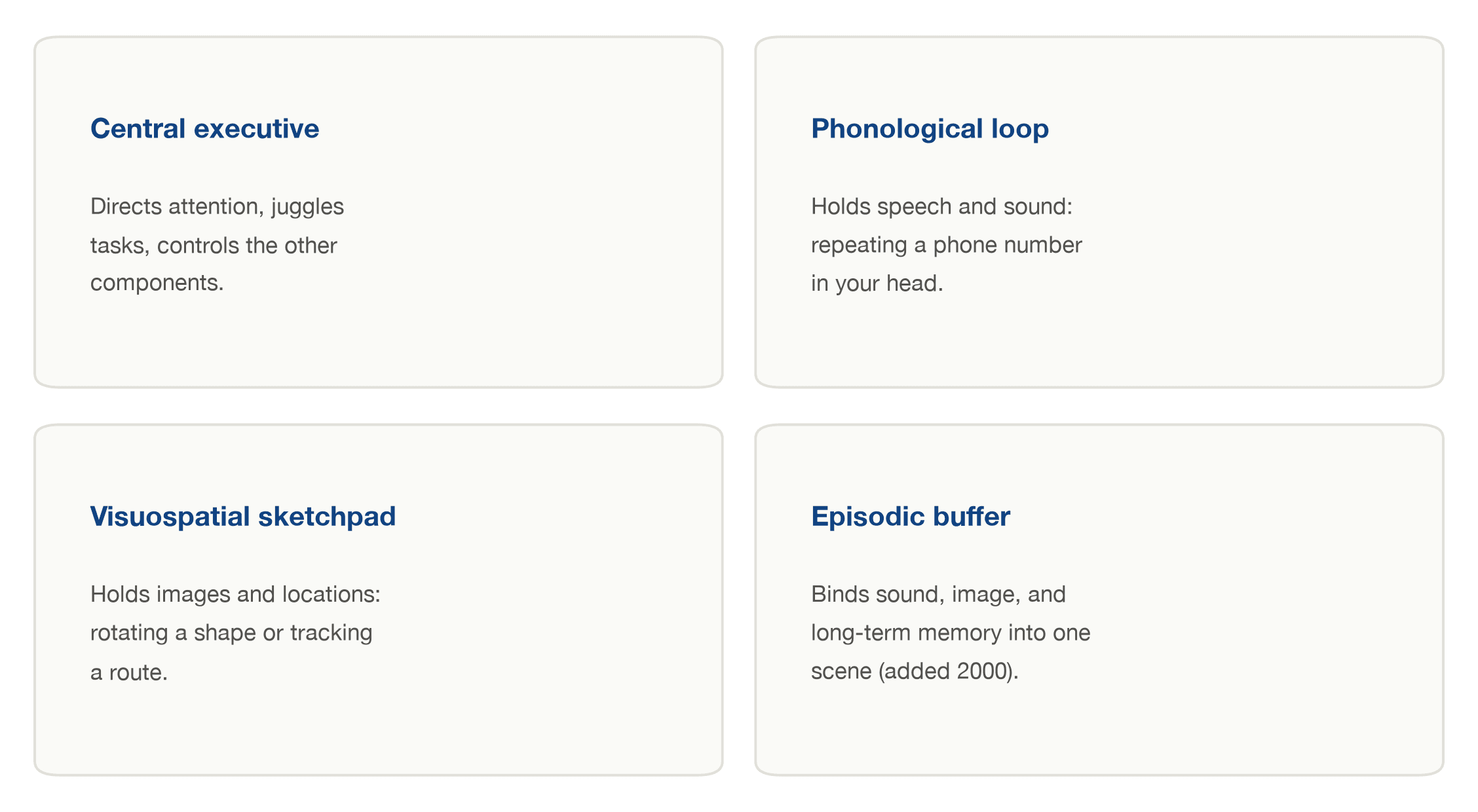
The modern concept comes from Alan Baddeley and Graham Hitch, who proposed in 1974 that the mind's workspace is not one store but a small system of cooperating parts: a "phonological loop" for speech and sound, a "visuospatial sketchpad" for images and locations, and a "central executive" that directs attention and coordinates the other two. In 2000 Baddeley added a fourth component, the "episodic buffer," which binds sounds, images, and long-term memories into unified scenes.
How much it holds
The classic answer was George Miller's famous 1956 estimate of "the magical number seven, plus or minus two." Miller himself was half joking about the number's neatness, and later, stricter experiments that prevent rehearsal and grouping put the real limit for most adults at about four chunks, in a range of roughly three to five. The trick that stretches the limit is "chunking": 1-7-7-6 is four digits, but for an American reader 1776 is one chunk. Expertise works largely by building bigger chunks, which is how a chess master holds a whole position in mind.
Working memory on IQ tests
Every major intelligence battery measures working memory directly. The WAIS-IV builds its Working Memory Index from "Digit Span," repeating digit sequences forward, backward, and in sorted order, and "Letter-Number Sequencing," which requires reordering mixed strings on the fly. The forward version leans on simple storage; the backward and sequencing versions add the manipulation that makes it working memory rather than mere echo. Research labs lean on the "n-back" task, where you signal whenever the current item matches the one from n steps earlier. Our overview of IQ test question types shows where these items sit in a full battery.
Working memory and intelligence
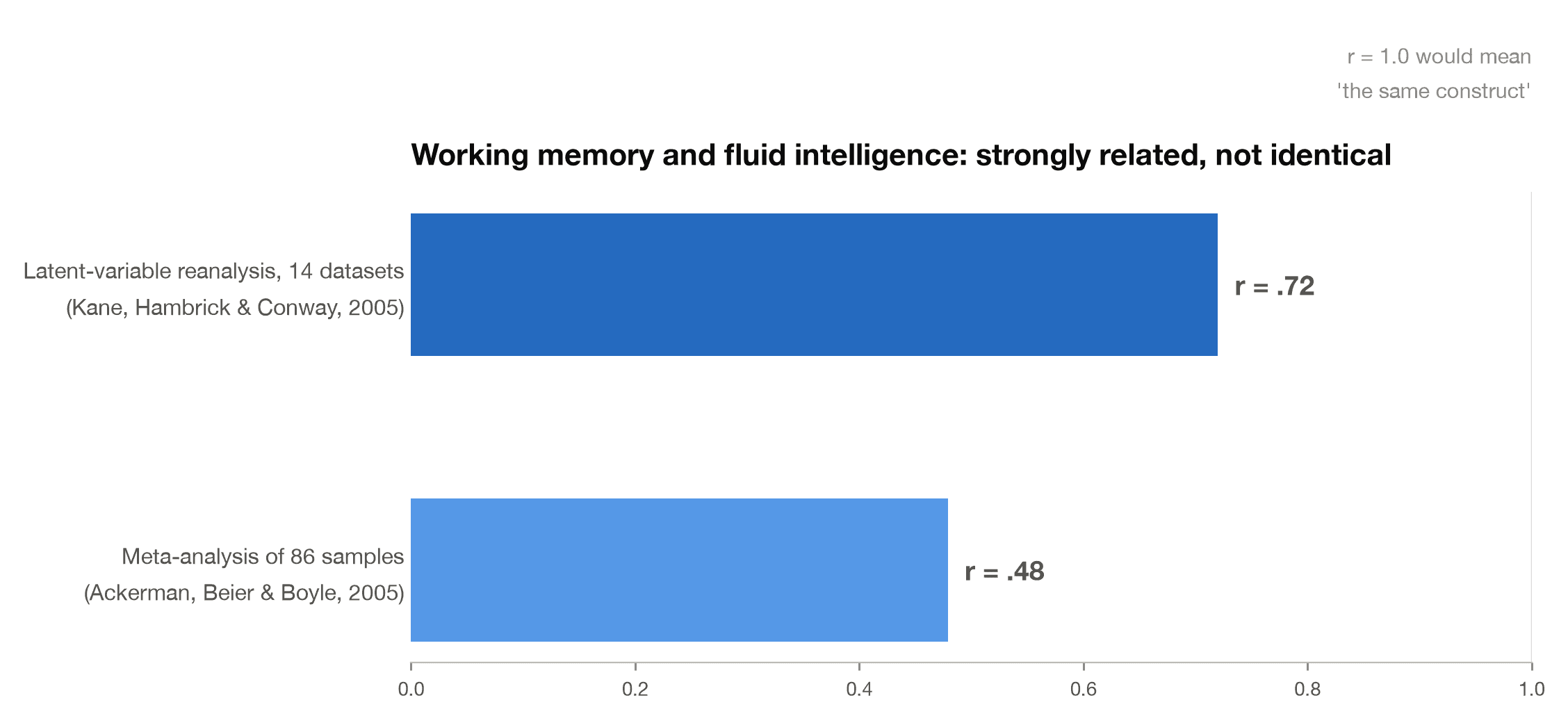
Working memory capacity is among the strongest correlates of "fluid intelligence," the ability to reason through novel problems. A meta-analysis of 86 samples estimated the true-score correlation near .48, and a latent-variable reanalysis of 14 datasets put the construct-level figure at about .72, roughly half their variance shared. Strongly related, then, and still not the same thing: reasoning draws on the workspace, but it is more than storage. See our companion articles on fluid intelligence and crystallized intelligence for the abilities on the other side of that equation.
Can training raise it?
Commercial brain-training built an industry on the hope that expanding working memory would raise intelligence. The evidence says otherwise. A 2013 meta-analytic review found that training produces reliable short-term gains on the trained tasks and close variants, with no convincing generalization to reasoning, attention, reading, or arithmetic, and verbal gains that faded at follow-up. Practice makes you better at the exercise, not smarter.
Capacity also follows a natural arc: it expands sharply through childhood and adolescence, peaks in early adulthood, and declines gradually from the twenties onward for processing-heavy tasks, even as vocabulary and knowledge keep rising across the lifespan. Deficits matter clinically as well: children with ADHD show reliable working memory impairments, largest on spatial tasks.
Frequently asked questions
What is an example of working memory?
Doing 47 times 6 in your head: you hold 42, carry the 4, compute 24 plus 4, and keep every intermediate result alive while you work. Following multi-step directions and parsing long sentences use the same workspace.
How is working memory different from short-term memory?
Short-term memory stores information briefly; working memory stores and manipulates it. Repeating digits back is short-term storage; repeating them in reverse order requires working memory.
What IQ subtests measure working memory?
On the WAIS-IV, Digit Span and Letter-Number Sequencing form the Working Memory Index. Research studies typically use n-back and complex span tasks.
Does working memory decline with age?
Gradually, yes. Processing-intensive capacity declines steadily from the twenties, while verbal knowledge keeps growing across most of the lifespan, a trade documented in large adult samples.
Is poor working memory linked to ADHD?
Yes. Meta-analysis finds children with ADHD show working memory deficits independent of general ability, with the largest effects on spatial storage and spatial executive tasks.
The takeaway
Working memory is the narrow desk on which all deliberate thinking gets done: four chunks wide, measurable, strongly tied to reasoning, and stubbornly resistant to training shortcuts. Modern assessments measure it because it matters. The Reasoning and Intelligence Online Test from RIOT IQ includes working memory tasks alongside reasoning, knowledge, and spatial items, which is what it takes to measure the whole architecture rather than one room of it.
References
1. Baddeley, A. (2000). The episodic buffer: A new component of working memory? Trends in Cognitive Sciences, 4(11), 417-423. doi.org
2. Miller, G. A. (1956). The magical number seven, plus or minus two: Some limits on our capacity for processing information. Psychological Review, 63(2), 81-97. doi.org
3. Cowan, N. (2001). The magical number 4 in short-term memory: A reconsideration of mental storage capacity. Behavioral and Brain Sciences, 24(1), 87-114. doi.org
4. Kane, M. J., Hambrick, D. Z., & Conway, A. R. A. (2005). Working memory capacity and fluid intelligence are strongly related constructs. Psychological Bulletin, 131(1), 66-71. doi.org
5. Ackerman, P. L., Beier, M. E., & Boyle, M. O. (2005). Working memory and intelligence: The same or different constructs? Psychological Bulletin, 131(1), 30-60. doi.org
6. Melby-Lervåg, M., & Hulme, C. (2013). Is working memory training effective? A meta-analytic review. Developmental Psychology, 49(2), 270-291. doi.org
7. Martinussen, R., Hayden, J., Hogg-Johnson, S., & Tannock, R. (2005). A meta-analysis of working memory impairments in children with attention-deficit/hyperactivity disorder. Journal of the American Academy of Child & Adolescent Psychiatry, 44(4), 377-384. doi.org
Take our professional IQ test
Want to know your IQ? Try the first ever professional online IQ test.