Verbal reasoning is the ability to understand and think with language. Learn how IQ tests measure it and how it relates to crystallized intelligence.
Dr. Russell T. WarneChief Scientist
Share
Verbal reasoning is the ability to understand language and think with it: to grasp what words mean, see how concepts relate to one another, and draw logical conclusions from spoken or written information. Professional IQ tests measure it with tasks such as vocabulary, similarities, analogies, and comprehension questions, and verbal tasks are among the best single indicators of overall intelligence. This article explains what verbal reasoning covers, how the major tests measure it, and how it connects to the store of knowledge psychologists call "crystallized intelligence."
Verbal reasoning, defined
Psychology's reference works define the two halves of the term separately. The APA Dictionary of Psychology defines "reasoning" as thinking in which logical processes of an inductive or deductive character are used to draw conclusions from facts or premises, and "verbal ability" as the demonstrated skill to comprehend and communicate effectively with words. Verbal reasoning is the two together: reasoning carried out through language. The dictionary also distinguishes receptive abilities (understanding what you read or hear) from productive abilities (expressing yourself fluently), and a good verbal test samples both.
Language has earned its central place in measurement. Verbal reasoning tasks have appeared on intelligence tests for over a century, because words are the medium of schooling and of most abstract thought. Verbal items are also practical: they are straightforward to write, administer, and score, which is one reason they translate so well to online testing.
How IQ tests measure verbal reasoning
Four question formats have carried verbal measurement since the field began, and the APA Dictionary describes each one.
• Vocabulary: You define words or recognize their meanings. A vocabulary test measures the number and level of words a person can use or understand, a direct sample of accumulated word knowledge ("What does the word reluctant mean?").
• Similarities: You state how two things are alike, or sort items into categories by their likeness ("In what way are a boat and a car alike?").
• Analogies: You grasp the relationship between two items and extend it to a new case. The dictionary's own example: paintbrush is to paint as pen is to what?
• Information and comprehension: Information items ask general knowledge questions, and comprehension items ask how you would deal with a practical situation, such as finding a lost wallet.
Current clinical instruments still organize themselves this way. The WAIS-5, the 2024 edition of the Wechsler Adult Intelligence Scale, treats verbal comprehension as one of the five cognitive domains it measures, builds its Verbal Comprehension Index from the Similarities and Vocabulary subtests, and folds Information and Comprehension in at the full-scale level. The RIOT IQ test follows the same logic with a Verbal Reasoning index measured by three subtests: Vocabulary, Information, and Analogies. For a wider tour of item formats, see our guide to the kinds of questions on an IQ test.
Verbal reasoning and crystallized intelligence
In the Cattell-Horn tradition, "crystallized intelligence" (Gc) is the sum of one's knowledge, measured by tests of vocabulary, general information, and so forth. Its counterpart, "fluid intelligence" (Gf), is the set of mental processes used when dealing with relatively novel tasks. Verbal reasoning tests are therefore the main way crystallized ability shows up on an IQ test: every vocabulary item and every information question samples what you have learned and retained. The framework that grew out of this work, the Cattell-Horn-Carroll (CHC) model, remains the standard taxonomy of cognitive abilities in modern test design, and the WAIS-5 even offers an ancillary score named the Verbal Expanded Crystalized Index.
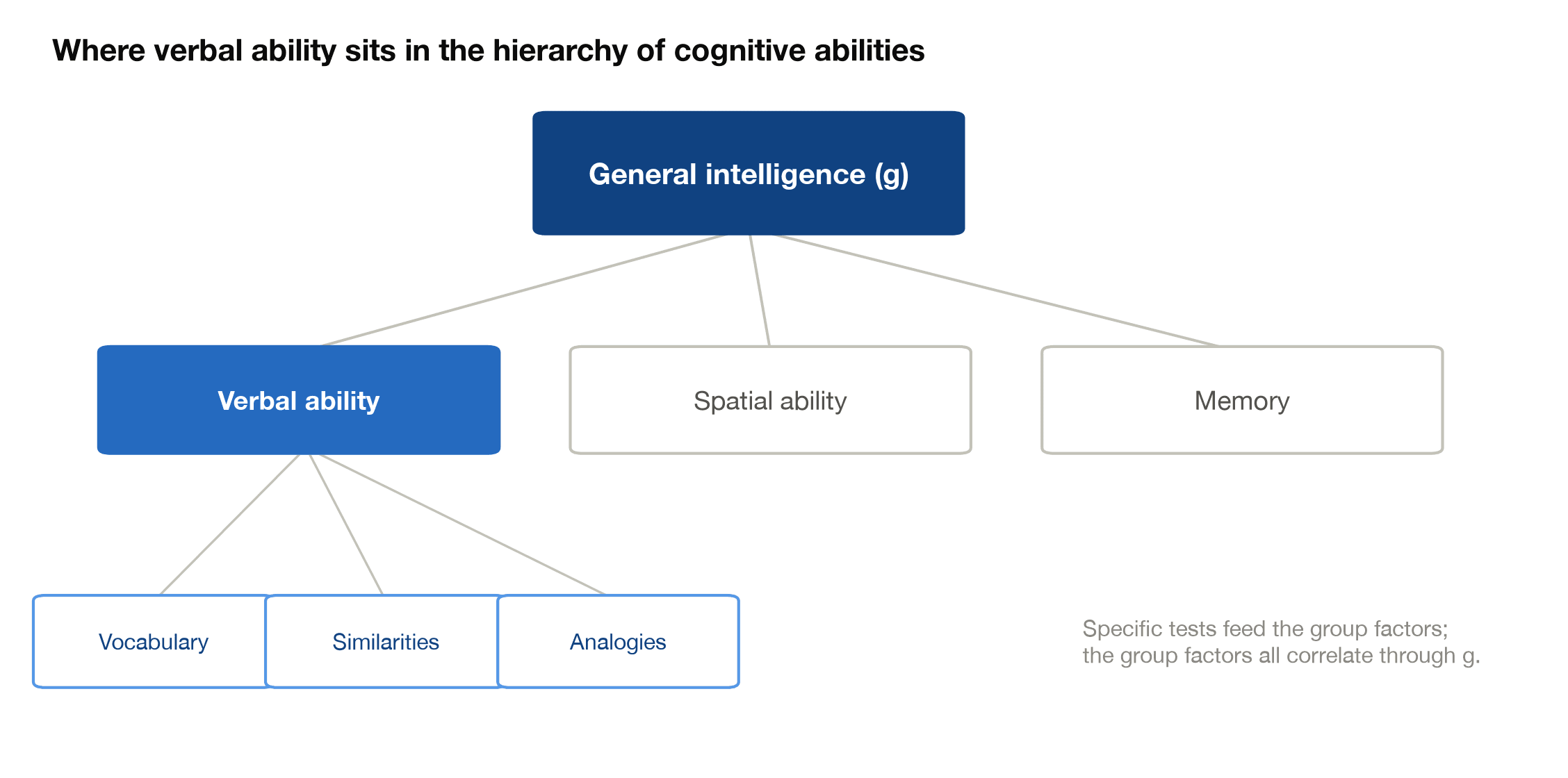
Verbal ability is what psychometricians call a "group factor." In the hierarchical model of cognitive abilities, general intelligence (g) sits at the top, a middle level holds group factors such as the verbal, spatial, and memory domains, and specific tests occupy the bottom level. Scores on almost all cognitive tests correlate positively with one another, a pattern called the "positive manifold," and g indexes that shared core, accounting for roughly 40 percent of the variance when a diverse battery is given to a broad sample (Plomin & Deary, 2015).
A higher verbal than nonverbal score means language-based tasks are a relative strength for you; modest gaps in either direction are common and usually carry no special meaning. Test publishers also build nonverbal composites, such as the WAIS-5 Nonverbal Index, so that people with expressive language or motor problems can be measured without those confounds. Because every index draws on g, the full-scale score remains the best summary of overall ability, and it is general ability, more than any single subtest, that makes intelligence one of the best predictors of key outcomes such as education and occupational status.
Frequently asked questions
What is verbal reasoning in simple terms?
Thinking with words. It combines reasoning, drawing conclusions from premises, with verbal ability, the skill to comprehend and communicate effectively with language.
How do IQ tests measure verbal reasoning?
With vocabulary, similarities, analogies, general information, and comprehension tasks. On the WAIS-5, the Verbal Comprehension Index is built from Similarities and Vocabulary, with Information and Comprehension contributing at the full-scale level.
Is verbal reasoning the same as crystallized intelligence?
They overlap heavily without being identical. Crystallized intelligence is the sum of acquired knowledge, and because it is measured largely through verbal tasks, verbal reasoning tests are the most common way it appears on an IQ test.
What if my verbal score is higher than my nonverbal score?
Language-based tasks are a relative strength for you. Modest gaps are common and usually not meaningful, and because all cognitive abilities correlate through g, your full-scale score still summarizes overall ability well.
Can you improve verbal reasoning?
The knowledge it draws on, such as vocabulary and general information, grows with reading, education, and experience. Practicing test items mainly improves familiarity with the format rather than the underlying general ability the test measures.
The takeaway
Verbal reasoning is thinking carried out in language, and language is where a lifetime of accumulated knowledge lives. That is why vocabulary and analogy items, humble as they look, are among the most informative questions a test can ask. If you would like to see your own verbal profile measured against a modern norm, the Reasoning and Intelligence Online Test from RIOT IQ includes a Verbal Reasoning index built from Vocabulary, Information, and Analogies subtests, and the free RIOT IQ test is the place to start.
References
1. American Psychological Association. (2018). Cattell-Horn theory of intelligence. In APA dictionary of psychology. dictionary.apa.org
2. American Psychological Association. (2023). Verbal comprehension. In APA dictionary of psychology. dictionary.apa.org
3. American Psychological Association. (2018). General factor. In APA dictionary of psychology. dictionary.apa.org
4. McGrew, K. S. (2009). CHC theory and the human cognitive abilities project: Standing on the shoulders of the giants of psychometric intelligence research. Intelligence, 37(1), 1-10. doi.org
5. Pearson. (2025). Measure more with WAIS-5 [Brochure]. Pearson Assessments. pearsonassessments.com
6. Plomin, R., & Deary, I. J. (2015). Genetics and intelligence differences: Five special findings. Molecular Psychiatry, 20(1), 98-108. pmc.ncbi.nlm.nih.gov
7. Warne, R. T. (2020). In the know: Debunking 35 myths about human intelligence. Cambridge University Press. doi.org
Take our professional IQ test
Want to know your IQ? Try the first ever professional online IQ test.