Aug 9, 2026·General IQ & IntelligenceWhat Is Eidetic Memory? (And Is Photographic Memory Real?)
Eidetic memory lets some children retain vivid visual images after they vanish. Learn what science shows and why photographic memory has never been proven.
Dr. Russell T. WarneChief Scientist
Eidetic memory is the ability to keep "seeing" a vivid image of a picture for a short time after the picture is taken away. It is real and well studied, it appears in roughly 2 to 10 percent of preadolescent children, and it is virtually absent in adults. It is also far more limited than what most people mean by photographic memory, a permanent mental snapshot that can be re-read at will. No claim of true photographic memory has ever survived controlled testing. This article covers what eidetic imagery actually is, who has it, and what happened when scientists went looking for a genuinely photographic mind.
What eidetic memory actually is
In the scientific literature, "eidetic imagery" is the term that comes closest to the popular idea of photographic memory. Researchers identify "eidetikers," people who form eidetic images, with the Picture Elicitation Method: the person studies an unfamiliar picture for about 30 seconds, the picture is removed, and the person reports what they still see. A true eidetiker continues to describe the picture in the present tense, with detail, as if it were still in front of them.
How an eidetic image behaves
An eidetic image does not behave like a photograph. It fades involuntarily and piece by piece, most images last between about half a minute and several minutes, and the image can be destroyed on purpose. In the classic testing protocols of Ralph Norman Haber, the researcher who studied eidetic children for roughly two decades, something as simple as blinking could wipe the image out permanently. A camera-like memory would not dissolve in parts or vanish at a blink, which is the first reason psychologists treat eidetic memory and photographic memory as different claims.
Who has it: almost entirely children
The great majority of documented eidetikers are children. Prevalence estimates among preadolescents run from about 2 percent to 10 percent, with no difference between boys and girls, and most research finds that virtually no adults possess the ability. Why eidetic imagery disappears with age is still not fully understood.
Even in children, the ability is less impressive than the label suggests. Haber's 1979 review in Behavioral and Brain Sciences, pointedly titled "Twenty years of haunting eidetic imagery: where's the ghost?", questioned what the phenomenon actually amounts to. Eidetic children do not show unusually accurate long-term memory, and eidetic imagery is not correlated with intelligence in the classic literature. It is a curious feature of childhood perception, and it fades before adulthood.
Is photographic memory real?
The case of Elizabeth
The single most famous claim of adult photographic memory appeared in Nature in 1970. Charles Stromeyer III and Joseph Psotka described "Elizabeth," a Harvard student who reportedly viewed a 10,000-dot random-dot stereogram with one eye, and a day later fused it with a pattern shown to the other eye, something that would require storing the dot texture with near-perfect fidelity. If accurate, it remains the strongest laboratory demonstration of photographic memory on record.
Why scientists are skeptical
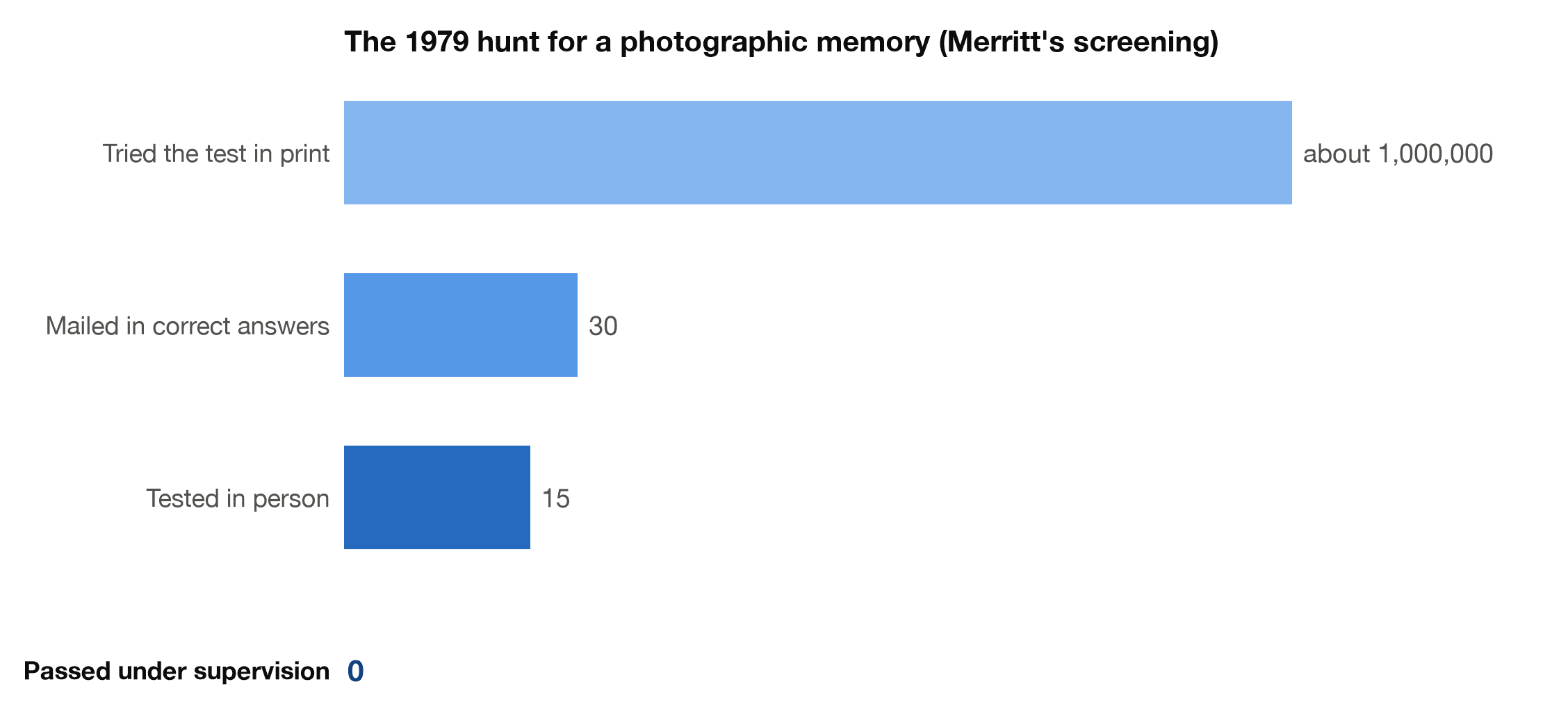
The result was never replicated, and Elizabeth herself was never retested. In a twist that did not help the case, Stromeyer married her. Some psychologists have concluded that something about the findings is fishy, a charge Stromeyer denies, but the scientific record simply stops there. In 1979, researcher John Merritt tried to find another Elizabeth by publishing a similar stereogram test in newspapers and magazines. He estimated that about 1 million people tried it. Thirty mailed in correct answers, he visited 15 of them at home, and with a scientist watching, not one could repeat the feat.
That is where the evidence stands after more than half a century: one unreplicated case, one million-person screening that found nobody, and no verified adult with photographic memory anywhere in the scientific literature.
How people with amazing memories really do it
Memory feats that look photographic are almost always produced by trained strategies. A 2003 brain-imaging study in Nature Neuroscience examined people renowned for outstanding performance at events such as the World Memory Championships and found that their superior memory was not driven by exceptional intellectual ability or by structural brain differences. They relied on a learned spatial strategy, engaging the hippocampus and other regions critical for spatial memory. The main tool of that trade is
the memory palace technique, which anyone can learn.
A separate phenomenon sometimes confused with photographic memory is
hyperthymesia, or highly superior autobiographical memory, in which a few dozen documented people can recall nearly every day of their own lives. That ability is involuntary and applies to personal experience, not to memorizing pictures or pages on demand.
Eidetic memory and IQ
Strong recall and high intelligence are separate things. Eidetic imagery in children shows no correlation with intelligence, and the imaging research on memory champions found no sign of exceptional intellectual ability. IQ tests measure reasoning: spotting patterns, solving novel problems, and holding information in mind while working on it. The capacity that matters most for that last part is
working memory, the mental workspace where information is held and manipulated for seconds, and it is a different system from the visual persistence seen in eidetic children.
Frequently asked questions
Is photographic memory real?
No verified case of adult photographic memory exists. The one famous laboratory case, tested in 1970, was never retested or replicated, and a 1979 screening of roughly one million people found no one who could pass a similar test under controlled conditions.
What is the difference between eidetic and photographic memory?
Eidetic imagery is a documented phenomenon in which mostly children briefly continue to see a removed picture; the image fades in parts within seconds to minutes. Photographic memory, meaning a permanent and detailed mental snapshot that can be read back at will, has never been documented.
Can adults have eidetic memory?
Almost never. Research consistently finds eidetic imagery in roughly 2 to 10 percent of preadolescent children and virtually no adults. Why the ability disappears with age remains an open question.
Is eidetic memory linked to high IQ?
No. Eidetic imagery in children is not correlated with intelligence, and brain-imaging studies of superior memorizers found no exceptional intellectual ability. Memory feats and IQ are separate traits.
Can you train a photographic memory?
You cannot train a literal photographic memory, since no such ability has ever been documented. You can dramatically improve recall with mnemonic techniques such as the method of loci, which is how memory champions produce their feats.
The takeaway
Eidetic memory is real, rare, and confined almost entirely to childhood, and photographic memory is a legend that controlled testing has never confirmed. Remarkable recall, where it exists, is either a trained skill or a narrow quirk, and neither one is intelligence. If you want to know how your reasoning ability actually measures up, the Reasoning and Intelligence Online Test from RIOT IQ offers a properly normed starting point with its
free IQ test.
References
1. Haber, R. N. (1979).
Twenty years of haunting eidetic imagery: Where's the ghost? Behavioral and Brain Sciences, 2(4), 583-594.
doi.org2. Stromeyer, C. F., III, & Psotka, J. (1970).
The detailed texture of eidetic images. Nature, 225(5230), 346-349.
nature.com3. Searleman, A. (2007).
Is there such a thing as a photographic memory? And if so, can it be learned? Scientific American.
scientificamerican.com4. Foer, J. (2006, April 27).
No one has a photographic memory. Slate.
slate.com5. Maguire, E. A., Valentine, E. R., Wilding, J. M., & Kapur, N. (2003).
Routes to remembering: The brains behind superior memory. Nature Neuroscience, 6(1), 90-95.
pubmed.ncbi.nlm.nih.govTake our professional IQ test
Want to know your IQ? Try the first ever professional online IQ test.
AuthorDr. Russell T. WarneChief Scientist