Aug 9, 2026·General IQ & IntelligenceWhat Is Hyperthymesia? Highly Superior Autobiographical Memory
Hyperthymesia, or highly superior autobiographical memory (HSAM), lets rare people recall almost every day of life. See what UC Irvine research found.
Dr. Russell T. WarneChief Scientist

Hyperthymesia, today usually called "highly superior autobiographical memory" or HSAM, is an extremely rare condition in which a person can recall nearly every day of their own life. Given a random date, someone with HSAM can typically name the day of the week it fell on and describe what they did and what was in the news. The first documented case, a woman studied as "AJ" and later identified as Jill Price, was described by University of California, Irvine researchers in 2006, and more than 50 people have been identified since. The ability is real, involuntary, and, outside the autobiographical domain, surprisingly ordinary.
The case that started it: AJ
In 2006, Elizabeth Parker, Larry Cahill, and James McGaugh published a case study in the journal Neurocase describing a woman whose remembering was, in their words, "nonstop, uncontrollable, and automatic." Given any date, AJ could say what day of the week it fell on and what she was doing. She had approached the researchers herself, because the constant replay of her own past felt less like a gift than a burden. The authors proposed the name "hyperthymestic syndrome" and identified AJ as the first reported case. She later went public as Jill Price.
The paper drew a distinction that matters for everything written about HSAM since: AJ differed from previously studied memory experts, who use practiced mnemonic techniques to memorize large amounts of personally irrelevant information. Her recall was specific to her own life, and she never trained for it.
From hyperthymesia to HSAM
The research group at UC Irvine's Center for the Neurobiology of Learning and Memory went on to identify further cases, and the condition was renamed highly superior autobiographical memory, replacing the original label hyperthymesia. The center reports that more than 50 people with HSAM have now been identified. Media accounts often say fewer than 100 people worldwide have the ability, but there is no official registry, so any precise count should be treated with caution.
What HSAM can and cannot do
Extraordinary in one domain
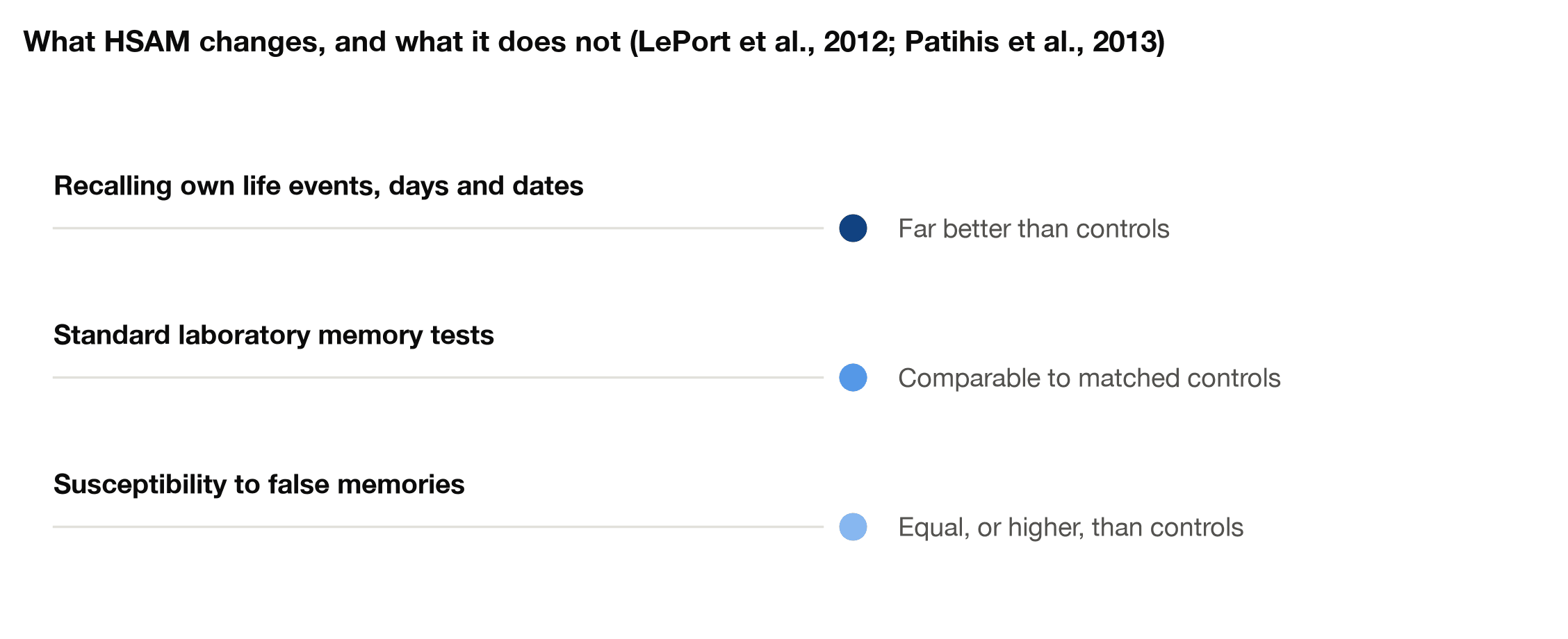
A 2012 study in Neurobiology of Learning and Memory characterized eleven HSAM participants in detail. They were far better than matched control participants at recalling personal and public autobiographical events, along with the days and dates on which those events occurred.
Ordinary everywhere else
The same study found that HSAM participants performed comparably to age- and sex-matched controls on most standard laboratory memory tests. Their advantage is domain-specific: their own lived experience, indexed by date. Hand them a word list or a standard recall task and they look like everyone else.
And still fallible
HSAM does not make memory reliable. A 2013 study in the Proceedings of the National Academy of Sciences tested HSAM participants with classic false-memory procedures. They were as likely as controls to falsely recognize lure words, they were equally likely to report having seen nonexistent footage of a plane crash, and in a misinformation task they showed higher overall false memory than controls. An extraordinary autobiographical memory is still a human memory, reconstructive and open to distortion.
What their brains look like
Structural brain imaging in the 2012 study identified nine brain structures that differed morphologically between HSAM participants and controls. What that means is genuinely unsettled. The differences could contribute to the ability, or they could be the consequence of decades spent involuntarily rehearsing one's own past. Correlation, in this literature as everywhere, is not destiny.
HSAM, photographic memory, and trained mnemonists
Three phenomena get mixed together in popular accounts, and they are worth separating. HSAM is involuntary and autobiographical. Photographic memory, a permanent mental snapshot readable at will, has never been scientifically documented in anyone, as our article on
eidetic memory explains. And the astonishing feats of memory athletes come from trained spatial strategies, since brain-imaging research found no unusual intellect or brain structure among world-class memorizers. The prodigious memory sometimes seen in
savant syndrome is different again, arising alongside developmental differences rather than from training or from HSAM-style date-indexed recall.
Does HSAM mean high intelligence?
There is no evidence that it does. The case literature does not report unusual IQs among HSAM participants, and their ordinary performance on standard laboratory memory tasks argues against any general cognitive advantage. Intelligence tests measure reasoning with novel material, supported by capacities such as
working memory, and remembering what happened on a Tuesday in 1994 calls on none of that. Memory for your own life and measured intelligence are simply different traits.
Frequently asked questions
What is hyperthymesia?
Hyperthymesia, now usually called highly superior autobiographical memory (HSAM), is an extremely rare condition in which people recall most days of their own lives in detail, typically including the day of the week for any given date.
Who was the first person diagnosed with hyperthymesia?
Jill Price, studied as "AJ" by James McGaugh and colleagues at UC Irvine and described in a 2006 Neurocase paper. She contacted the researchers because her constant remembering felt like a burden.
How many people have hyperthymesia?
UC Irvine's Center for the Neurobiology of Learning and Memory reports more than 50 identified cases. Media reports often say fewer than 100 people worldwide, but no official registry exists.
Do people with HSAM have perfect memories?
No. They are dramatically better at recalling their own past, yet they score about the same as everyone else on standard laboratory memory tests, and research found they form false memories at similar or even higher rates than controls.
Is hyperthymesia the same as photographic memory?
No. HSAM is about reliving one's own autobiographical events, not storing visual snapshots, and true photographic memory has never been scientifically documented in anyone.
The takeaway
HSAM is one of the most striking memory phenomena ever documented, and it is also narrow: a spectacular archive of one person's life, attached to ordinary scores on nearly everything else. It is a useful reminder that memory and intelligence are not the same trait. If it is your reasoning ability you are curious about, the Reasoning and Intelligence Online Test from RIOT IQ measures it against modern norms, starting with a
free IQ test.
References
1. Parker, E. S., Cahill, L., & McGaugh, J. L. (2006).
A case of unusual autobiographical remembering. Neurocase, 12(1), 35-49.
doi.org2. LePort, A. K. R., Mattfeld, A. T., Dickinson-Anson, H., Fallon, J. H., Stark, C. E. L., Kruggel, F., Cahill, L., & McGaugh, J. L. (2012).
Behavioral and neuroanatomical investigation of Highly Superior Autobiographical Memory (HSAM). Neurobiology of Learning and Memory, 98(1), 78-92.
doi.org3. Patihis, L., Frenda, S. J., LePort, A. K. R., Petersen, N., Nichols, R. M., Stark, C. E. L., McGaugh, J. L., & Loftus, E. F. (2013).
False memories in highly superior autobiographical memory individuals. Proceedings of the National Academy of Sciences, 110(52), 20947-20952.
doi.org4. University of California, Irvine, Center for the Neurobiology of Learning and Memory.
Highly Superior Autobiographical Memory. cnlm.uci.edu5. Maguire, E. A., Valentine, E. R., Wilding, J. M., & Kapur, N. (2003).
Routes to remembering: The brains behind superior memory. Nature Neuroscience, 6(1), 90-95.
pubmed.ncbi.nlm.nih.govTake our professional IQ test
Want to know your IQ? Try the first ever professional online IQ test.
AuthorDr. Russell T. WarneChief Scientist