What is an aptitude test? Unlike knowledge exams, it measures your potential to learn new skills. We explain the difference between measuring specific job performance and general intelligence.
Dr. Russell T. WarneChief Scientist
Share
In the modern hiring landscape, resumes only tell half the story. To fill in the gaps, employers often rely on aptitude tests, which are standardized assessments designed to evaluate a candidate's ability to succeed in a specific role. Unlike a test of knowledge, which measures what a person has already learned (like a history exam), an aptitude test measures potential. It predict a person’s ability to succeed at learning a new skill or performing a job, often before the candidate has had any formal training in that area.
How Does An Aptitude Test Differ from an IQ Test?
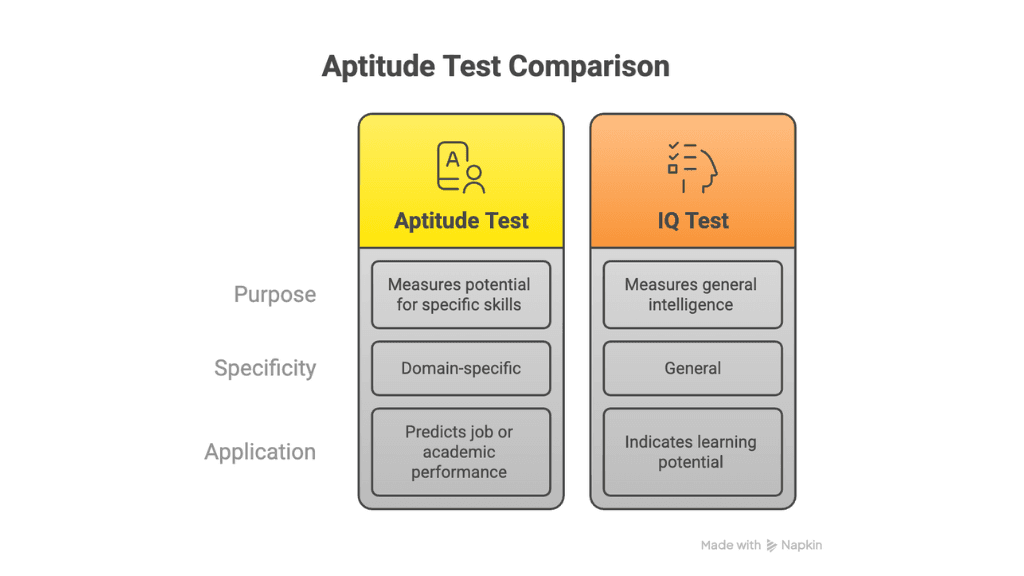
While the terms are often used interchangeably, there is a distinct difference between an aptitude test and an IQ test. An IQ test is designed to measure general intelligence, which refers to cognitive abilities and processing speed. An aptitude test, however, is more specific; its purpose is to make predictions about future performance in a particular domain. IQ tests are also often used to make predictions, but they tend to be very general (e.g., college GPA), whereas an aptitude test might measure success at a specific job, in a specific training program, or in a particular school class.
How Are Aptitude Tests Created?
The development of a professional aptitude test in employment settings is a rigorous scientific process that goes far beyond writing random questions. It begins with a job analysis, in which psychologists break down a specific job to identify the core cognitive, interpersonal, and motor skills required for success, such as spatial visualization for architects or error-checking for data entry clerks. Once these traits are isolated, test items are drafted to measure them specifically.
These items are then piloted by administering them to a sample of current job holders (called “incumbents”), and other data are collected on their job performance. This information establishes the predictive ability of the aptitude test: if a test cannot distinguish between high- and low-performers currently in the job, then it probably won’t predict good performers in the future. An even better tryout consists of administering the test to job applicants and hiring as many as is feasible and later seeing which ones were high performers. Again, if the test predicts their future performance well, then it is a suitable aptitude test to use for hiring. Regardless of the methodology, the extensive development process for professionally-developed tests ensures that the assessment is fair, objective, and legally defensible.
Examples of US-Based Nationwide Aptitude Tests
Several large-scale assessments in the United States serve as the blueprint for how aptitude is measured. The most prominent example is the Armed Services Vocational Aptitude Battery (ASVAB), used by the U.S. military. The ASVAB is a comprehensive battery that measures distinct aptitudes ranging from arithmetic reasoning to mechanical comprehension. The U.S. military uses this test to assign thousands of recruits (often young men and women with little skilled work history) every year to a wide variety of jobs. The ASVAB is widely considered the gold standard for matching raw human potential with specific occupational training tracks.
Another example is the O*NET Ability Profiler, developed for the U.S. Department of Labor. This assessment connects an individual's profile to the massive O*NET database of occupations, linking traits like "Spatial Perception" or "Clerical Perception" to hundreds of potential careers. In the educational and counseling sectors, the Differential Aptitude Tests (DAT) are frequently administered to map specific student abilities, such as language usage or abstract reasoning, to suitable career paths. These tests do not measure what a person has memorized in school, but rather performance on tasks that have been shown in research to predict future job performance in various careers.
Can You Prepare for an Aptitude Test?
A common myth in recruitment is that a candidate cannot study for an aptitude test because it measures "natural" ability. However, preparation can significantly impact performance. Much like an athlete training for a race, a candidate can sharpen their cognitive reflexes. The most effective strategy involves daily practice to become familiar with the test format; understanding whether a test uses multiple-choice or interactive elements prevents wasting valuable time figuring out the mechanics during the actual exam.
Time management is also an important skill to develop. Most aptitude tests are strictly timed to measure processing speed. Candidates who practice pacing themselves by answering known questions quickly and returning to harder ones later often outscore those who get stuck on a single difficult problem. Finally, careful reading of instructions is extremely important; many tests include subtle instructions that, if misunderstood, can lead to poor scores, regardless of the examinee's actual ability.
For organizations seeking to integrate these cognitive metrics into their selection process, platforms like RIOT IQ offer a streamlined solution for professional administration. The service allows hiring managers to create dedicated assessments tailored to specific roles and invite candidates directly via email or a secure link. Through a centralized dashboard, administrators can manage these invitations and access detailed score reports as soon as they are completed. This capability enables HR teams to validate candidate potential with scientific rigor, ensuring that hiring decisions are backed by objective, verified data.
Watch “The Ability That Predicts STEM Success Better Than IQ” with Dr. Thomas Coyle on the Riot IQ YouTube channel to understand how aptitude testing goes beyond traditional IQ measures.
Take our professional IQ test
Want to know your IQ? Try the first ever professional online IQ test.