Jan 26, 2026·General IQ & Intelligence
What Is a Cognitive Test?
What is a cognitive test? It measures abilities like memory and reasoning. Learn why IQ tests are a specific type of cognitive assessment used to measure intelligence.
A cognitive test is an assessment designed to measure mental abilities such as reasoning, memory, attention, and problem-solving. The term covers a broad category of instruments used across many settings, from clinical screenings for dementia to employment assessments for job candidates.
How Do Cognitive Tests Differ From IQ Tests?
The relationship between cognitive tests and IQ tests causes considerable confusion. In practice, the terms often overlap. An IQ test is a specific type of cognitive test designed to measure general mental ability, or g, and express the result as an intelligence quotient. Other cognitive tests may focus on narrower abilities, such as working memory, processing speed, or verbal reasoning, without producing an overall IQ score.
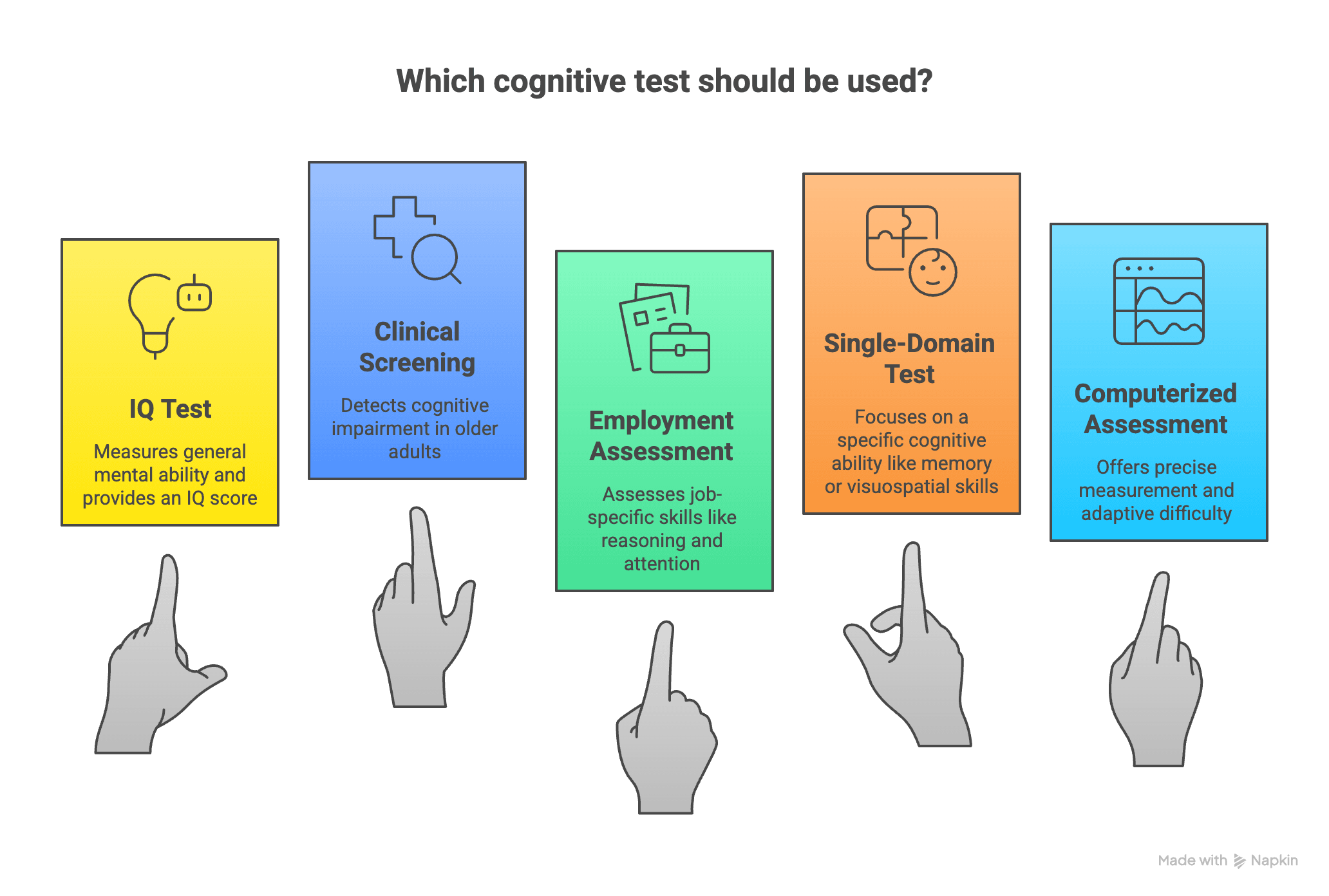
The difference matters because not all cognitive tests aim to measure the same traits. A brief clinical screening like the Mini-Mental State Exam checks for signs of cognitive impairment in older adults but does not provide an IQ score. An employment assessment might measure numerical reasoning and attention to detail without claiming to assess general intelligence. Meanwhile, comprehensive IQ tests like the Wechsler Adult Intelligence Scale measure multiple cognitive domains and combine them into an overall score.
What unites all these instruments is that they assess cognitive abilities, or the mental processes that allow people to think, learn, and solve problems. The differences lie in their scope, purpose, and the specific abilities they target.
What Do Cognitive Tests Measure?
Cognitive tests assess various mental abilities that fall under the broader umbrella of human cognition. The specific domains measured depend on the test's purpose.
Memory tests may assess short-term retention, working memory (manipulating information while holding it), or long-term retrieval. Tasks might involve recalling word lists, repeating number sequences backward, or remembering details from a story. Attention and processing speed tasks involve focusing on relevant information, filtering distractions, and completing simple mental tasks quickly, such as reaction time measures or symbol-coding exercises.
Reasoning and problem-solving tasks, often called fluid reasoning, involve identifying patterns, drawing inferences, and solving novel problems. (Matrix reasoning tasks, where examinees identify missing pieces in visual patterns, are a common item format for reasoning tests.) Verbal abilities like vocabulary knowledge, reading comprehension, and verbal analogies assess how well someone understands and uses language. Visuospatial skills involve mental rotation of objects, understanding spatial relationships, or copying complex figures, which are abilities important in fields like engineering and architecture.
Research confirms that performance across these domains tends to correlate positively. People who score well in one area typically score well in others. This pattern led to the concept of general intelligence, which Charles Spearman first identified in 1904. IQ tests are specifically designed to capture this general factor alongside more specific abilities.
Where Are Cognitive Tests Used?
In clinical and medical settings, healthcare providers use cognitive screening tools to detect impairment in patients, particularly older adults showing signs of memory problems. The Montreal Cognitive Assessment (MoCA) and Mini-Cog are commonly used to screen for mild cognitive impairment and dementia. A positive screen typically leads to more comprehensive neuropsychological testing to identify specific deficits, differentiate between conditions, and guide treatment planning.
Many employers use cognitive ability tests as part of their hiring process. Research consistently shows that these tests predict job performance and training success across a wide range of occupations, with particularly strong validity for complex jobs. The military's ASVAB is one prominent example, but many private employers use similar assessments to identify candidates who can learn quickly and solve problems effectively.
Schools use cognitive assessments for placement decisions, identifying students for gifted programs, and diagnosing learning disabilities. Scientists studying intelligence, aging, brain function, and cognitive development also rely heavily on standardized cognitive tests because they provide reliable, comparable data across studies and populations.
What Types of Cognitive Tests Are Available?
The variety of cognitive assessment tools can be overwhelming, ranging from brief screening instruments to comprehensive test batteries requiring several hours to complete.
Brief screening tools like the Mini-Mental State Exam (MMSE), Montreal Cognitive Assessment (MoCA), and Mini-Cog take 3-15 minutes and provide a quick check for cognitive impairment. They sample multiple domains but lack the depth to characterize specific deficits. Comprehensive IQ tests like the Wechsler Adult Intelligence Scale (WAIS), Stanford-Binet, and Woodcock-Johnson provide detailed assessment across multiple cognitive domains. These require trained administration and produce both an overall IQ and subscores for specific abilities.
Single-domain tests focus on one specific ability. The Raven's Progressive Matrices measures nonverbal reasoning, while the Wisconsin Card Sorting Test assesses executive function. Employment assessments designed for hiring typically measure verbal reasoning, numerical reasoning, and abstract reasoning in a shorter format optimized for group administration. Computerized assessments have expanded rapidly in recent years, offering precise reaction time measurement, adaptive difficulty adjustment, and instant scoring.
Are Cognitive Tests Accurate?
The accuracy of a cognitive test depends on several factors:
• Reliability (consistency of scores across administrations)
• Validity (whether the test actually measures what its creators or users claim)
• The quality of the norm sample against which scores are compared
Professionally developed cognitive tests undergo rigorous evaluation. Test creators pilot items, analyze statistical properties, screen for bias, and norm the test on representative samples. The result is an instrument that produces consistent, meaningful scores when used appropriately.
Not all cognitive tests meet these standards, however. Many free online assessments are created by amateurs without proper psychometric training. These tests may produce inflated or meaningless scores because they lack appropriate norm samples, contain poorly designed items, or fail to meet professional standards. Context also matters; a brief screening tool designed to detect dementia is not appropriate for measuring intelligence in healthy adults, and an employment test validated for one job family may not be useful for predicting performance in a different role.
What Should You Know Before Taking a Cognitive Test?
Several practical considerations apply when preparing for a cognitive assessment:
• Rest and alertness matter, because fatigue, illness, or medication effects can lower scores
• Familiarity with test formats reduces anxiety and prevents confusion and misunderstanding
• Effort influences results, as low motivation or careless responding will depress scores
• Professional tests differ substantially from amateur ones in reliability and validity
Getting adequate sleep before testing and taking breaks when permitted helps ensure accurate results. Knowing what question types to expect allows examinees to focus on demonstrating their abilities rather than figuring out instructions. Taking the test seriously and trying one's best ensures that results reflect actual ability.
Where Can I Get an Accurate Cognitive Assessment?
For anyone seeking a reliable measure of their cognitive abilities, selecting a professionally developed test is important. The Reasoning and Intelligence Online Test (RIOT) offers exactly that.
Created by Dr. Russell T. Warne, who has over 15 years of experience in intelligence research, the RIOT is the first online IQ test designed to meet professional standards established by the American Psychological Association, American Educational Research Association, and National Council on Measurement in Education. Unlike amateur online tests, the RIOT received expert review, had a proper U.S.-based norm sample, and provides accurate, trustworthy scores.
Watch “IQ Explained in 8 Minutes: The Truth About IQ (And Why It Matters)” on the Riot IQ YouTube channel to see how cognitive tests are used to measure general thinking ability.
Take our professional IQ test
Want to know your IQ? Try the first ever professional online IQ test.
Article Categories
All ArticlesUnderstanding IQ ScoresTaking an IQ TestRIOT-Specific InformationGeneral IQ & IntelligenceAdvanced Topics & ResearchIQ Scores & InterpretationMensa & High-IQ SocietiesOnline IQ Tests IQ Test Basics & FundamentalsAverage IQ & DemographicsFamous People & IQHistory & Origins Of IQ TestingAccuracy, Reliability & CriticismSpecial Population & Related ConditionsImproving IQ / PreparationSpecific IQ Tests & FormatsIQ Testing for HR & RecruitmentSkills Assessment
Related Articles
What Are Culture Fair Intelligence Tests?Is Humor a Sign of High IQ?Does Dyslexia Affect IQ Tests?What Raises Your IQ Score the Most?When Is Cognitive Testing Used?What Does a Cognitive Function Test Measure?What Is the Stanford-Binet Test?Is IQ Malleable?Is it Difficult to Measure Intelligence?Are There Multiple Intelligences in the Human Mind?Is Intelligence Too Complex to Summarize with One Number?Is Intelligence Whatever Collection of Tasks a Psychologist Puts on a Test?Breaking the Intelligence & IQ TabooA Comprehensive History of IQ TestsThe Pro-Human Aspects of Intelligence ResearchWhat is an IQ Test? A Beginner's Guide.Resources to Learn About IQ and IntelligenceStudying IQ MattersWhat Is a Cognitive Test?What Is an Aptitude Test?The Search For Albert Einstein’s IQEQ TestEmotional IntelligenceIs Intelligence Hereditary?Multiple IntelligencesThe g FactorTheories of IntelligenceHistory of IQ TestsWhat is IQ? What is Intelligence?Is IQ the Same as Intelligence?
Take our IQ testsCompare all tests
Basic IQ Test
5 subtests + 5 cognitive abilities
Features
- ~13 Minutes
- IQ score
- Cognitive abilities breakdown
- ±5.6 IQ margin of error
5/15 Subtests
Learn moreVocabulary
Matrix Reasoning
SToVeS
Visual Reversal
Symbol Search
Full IQ Test
15 subtests + all cognitive abilities
Features
- ~52 Minutes
- IQ score
- Cognitive abilities breakdown
- ±3.7 IQ margin of error
15/15 Subtests
Learn moreVocabulary, Information, Analogies
Matrix Reasoning, Visual Puzzles, Figure Weights
Object Rotation, SToVeS, Spatial Orientation
Computation Span, Exposure Memory, Visual Reversal
Symbol Search, Abstract Matching
Simple Reaction Time, Choice Reaction Time

Community
Intelligence Journals & Organizations
Our Articles