🇺🇸The official website of Riot IQ
My Dashboard
  • Home
  • Test Manual
  • Administer IQ Tests
  • Articles
  • Podcast

Table of Contents

  • The
  • Does
  • Limits of IQ
Sep 9, 2025·General IQ & Intelligence

The g Factor

Learn about Spearman’s g factor, its link to general intelligence, evidence supporting its reality, and how IQ tests like the RIOT measure g and other abilities.

Dr. Russell T. WarneChief Scientist
Share
The g Factor

Measure your
intelligence online.

Google

Assessments

  • All IQ Tests
  • Basic IQ Test
  • Full IQ Test
  • Custom IQ Test
  • Free IQ Test

Our Socials

  • X
  • YouTube
  • Facebook
  • LinkedIn

Other IQ Tests

  • WAIS-V
  • SB-5
  • Raven's 2
  • RIAS-2
  • CogAT 9
  • WISC-V

Community

  • Join Subreddit
  • Join Discord

Other Pages

  • Test Manual
  • Administer IQ Tests
  • About Us
  • Articles
  • Data
  • FAQ

Research

  • What do polygenic scores really predict?
  • Working speed and ability on the RIOT

Intelligence Journals & Organizations

  • Human Intelligence Research & Education (HIRE) Foundation
  • International Society for Intelligence Research (ISIR)
  • Intelligence & Cognitive Abilities Journal (ICA)
  • Intelligence Journal
  • Mensa Foundation

Contact

  • Email
  • Support

News & Press

  • International Society for Intelligence Research
  • American Thinker
  • Mensa Foundation (1/2)
  • Mensa Northern New Jersey
  • The University of Western Australia
  • Prolific
  • Quillette
  • Brainz

Our Articles

  • Gmatclub (1/2)
  • ApolloTechnical
  • LessWrong
  • Psychreg
  • Study in Switzerland
  • SuccessConsciousness
  • Creative Organizational Design (1/2)
  • ABNewsWire
  • Vanderbilt University

Our Articles

  • The Globe and Mail
  • Barchart
  • Journal
  • Mensa Foundation (2/2)
  • Psychologs
  • Creative Organizational Design (2/2)
  • AZBigMedia
  • Thoughts on Life and Love
  • Anxiety and Depression Association of America

Our Articles

  • Before It's News
  • Siglo XXI
  • TechBullion
  • Medium
  • Gmatclub (2/2)
  • MSN
  • National Review
  • Minding the Campus
  • Launching Next

Our Articles

  • Comparing Cronbach’s Alpha and McDonald’s Omega Reliability
  • Breaking the Intelligence & IQ Taboo
  • What is the Flynn Effect?
  • A Comprehensive History of IQ Tests
  • The 15 Subtests of the RIOT

Our Articles

  • How to Take an IQ Test
  • How to Calculate IQ
  • What is the RIOT IQ Test?
  • The Pro-Human Aspects of Intelligence Research
  • What is an IQ Test? A Beginner's Guide.

Our Articles

  • 5 Best IQ Tests in 2025
  • Cognitive Profiles on the RIOT IQ Test Results
  • 6 Cognitive Abilities of the RIOT
  • Are There Any Professional and Real Online IQ Tests?

Our Articles

  • Resources to Learn About IQ and Intelligence
  • Studying IQ Matters
  • The Search for Albert Einstein's IQ
  • Do Non-g Gains from the Flynn Effect Matter?

Riot IQ © 2026

  • Terms of Service
  • Privacy Policy
  • BAA Agreement
  • Test Administrator Terms
  • Terms of Service
  • •Privacy Policy
  • •BAA Agreement
  • •Test Administrator Terms
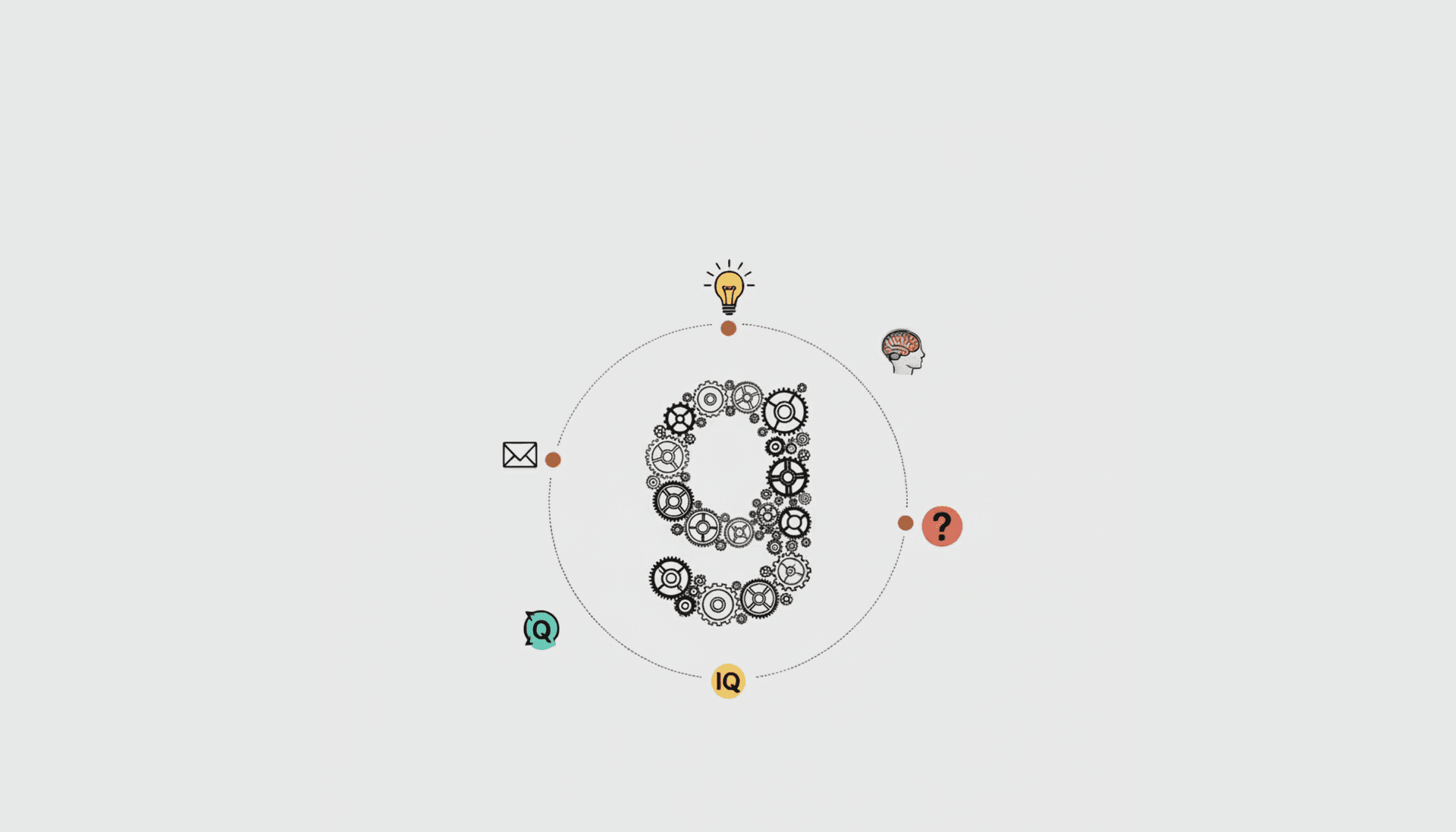
Many psychologists who study human intelligence discuss the “g factor” or simply “g”. For outsiders, this terminology raises some questions: What is the g factor? What does g stand for? How does it relate to intelligence? Are IQ and g the same thing?


The g Factor and General Intelligence


The g factor originates in an article published by Charles Spearman in 1904. In this article, Spearman discovered that performance on a series of educational and psychological tests was positively correlated for every test. In other words, examinees who did well on one test tended to perform well on all of the others -- even though some of the tests didn’t seem very academic or resemble school tests at all. To try to explain this tendency, Spearman invented a new mathematical procedure called “factor analysis” and used it to argue that the consistent performance across tests had a common cause: an unobserved variable or “factor” underlying all the tests. Spearman called this factor a “general factor,” which was later abbreviated to g. Sometimes it is also called “Spearman’s g” in his honor.

In his article, Spearman equated g to general intelligence and stated that the reason some students did better on the tests were because they had higher intelligence. (Conversely, those who did not do as well had lower general intelligence.) The claim that g and intelligence are the same thing has been a point of contention among psychologists, but many argue that the characteristics of g and intelligence are so similar that they are functionally the same.


Take our professional IQ test

Want to know your IQ? Try the first ever professional online IQ test.

Try our IQ test
Author
Dr. Russell T. WarneChief Scientist

Contact

Table of Contents

  • The
  • Does
  • Limits of IQ
Article Categories
All ArticlesUnderstanding IQ ScoresTaking an IQ TestRIOT-Specific InformationGeneral IQ & IntelligenceAdvanced Topics & ResearchIQ Scores & InterpretationMensa & High-IQ SocietiesOnline IQ Tests IQ Test Basics & FundamentalsAverage IQ & DemographicsFamous People & IQHistory & Origins Of IQ TestingAccuracy, Reliability & CriticismSpecial Population & Related ConditionsImproving IQ / PreparationSpecific IQ Tests & FormatsIQ Testing for HR & RecruitmentSkills Assessment
Related Articles
Does Dyslexia Affect IQ Tests?What Raises Your IQ Score the Most?When Is Cognitive Testing Used?What Does a Cognitive Function Test Measure?What Is the Stanford-Binet Test?Is IQ Malleable?Is it Difficult to Measure Intelligence?Are There Multiple Intelligences in the Human Mind?Is Intelligence Too Complex to Summarize with One Number?Is Intelligence Whatever Collection of Tasks a Psychologist Puts on a Test?Breaking the Intelligence & IQ TabooA Comprehensive History of IQ TestsThe Pro-Human Aspects of Intelligence ResearchWhat is an IQ Test? A Beginner's Guide.Resources to Learn About IQ and IntelligenceStudying IQ MattersWhat Is a Cognitive Test?What Is an Aptitude Test?The Search For Albert Einstein’s IQEQ TestEmotional IntelligenceIs Intelligence Hereditary?Multiple IntelligencesThe g FactorTheories of IntelligenceHistory of IQ TestsWhat is IQ? What is Intelligence?Is IQ the Same as Intelligence?
Take our IQ tests

Basic IQ Test

5 subtests + 5 cognitive abilities

Take the IQ test

Features

  • ~13 Minutes
  • IQ score
  • Cognitive abilities breakdown
  • ±5.6 IQ margin of error

5/15 Subtests

Learn more
Vocabulary
Matrix Reasoning
SToVeS
Visual Reversal
Symbol Search
Most comprehensive

Full IQ Test

15 subtests + all cognitive abilities

Take the IQ test

Features

  • ~52 Minutes
  • IQ score
  • Cognitive abilities breakdown
  • ±3.7 IQ margin of error

15/15 Subtests

Learn more
Vocabulary, Information, Analogies
Matrix Reasoning, Visual Puzzles, Figure Weights
Object Rotation, SToVeS, Spatial Orientation
Computation Span, Exposure Memory, Visual Reversal
Symbol Search, Abstract Matching
Simple Reaction Time, Choice Reaction Time
Compare all tests
Does
g
Exist?


Finding a factor in a dataset is not sufficient to prove that the factor corresponds to a real entity. Fundamentally, a factor is just a group of variables that correlate strongly enough to form a group. Additional data must be gathered to show that the factor is measuring something real.

The evidence is overwhelming that g is real. The most compelling evidence is that scores that measure g, such as IQ scores, correlate with biological variables, including brain size, brain functioning, reaction time, and DNA variants. If g were a statistical artifact or an illusion, it shouldn’t correlate with any of those things. And yet it does.


Limits of IQ


While almost all experts on intelligence agree that g is real and that IQ measures it well, they also acknowledge that other cognitive abilities matter. General intelligence is just that: general. IQ is good for predicting general life outcomes, but in both school and the workplace, other cognitive abilities matter, too. This is why many IQ tests, including the Reasoning and Intelligence Online Test (RIOT), report an overall IQ score to measure g and subscores to measure other abilities. The RIOT, for example, reports scores for Verbal Reasoning, Fluid Reasoning, Spatial Ability, Working Memory, Processing Speed, and Reaction Time -- in addition to IQ.