Mental acuity means sharpness of thinking: attention, memory, and processing speed. Learn what mental acuity is, what dulls it, and how it is measured.
Dr. Russell T. WarneChief Scientist
Share
"Mental acuity" means sharpness and quickness of thinking: how well your attention, memory, and processing speed are working right now. It is an everyday phrase rather than a formal scientific term. The APA Dictionary of Psychology defines "acuity" as "sharpness of perception," and mental acuity borrows that meaning for the mind. This article explains how acuity differs from intelligence, what genuinely dulls it, what protects it, and how clinicians measure it.
What mental acuity means
The phrase does not appear in the APA Dictionary of Psychology at all; the dictionary's entries jump from "mental accounting" straight to "mental age." The nearest formal anchor is the entry for "acuity": "sharpness of perception. Whereas visual acuity is sharpness of vision and auditory acuity sharpness of hearing, sensory acuity is the precision with which any sensory stimulation is perceived." When people say mental acuity, they are applying that idea of sharpness to thought.
Everyday displays of acuity are easy to recognize: noticing a wrong figure in a spreadsheet instantly, following a fast conversation, or recalling where you left your keys. These acts lean on attention, processing speed, and "working memory" (the mental workspace that holds information in mind), the components of cognition most sensitive to fatigue and health.
Acuity, intelligence, and cognition are different ideas
The APA dictionary defines "intelligence" as "the ability to derive information, learn from experience, adapt to the environment, understand, and correctly utilize thought and reason," and "cognition" as "all forms of knowing and awareness, such as perceiving, conceiving, remembering, reasoning, judging, imagining, and problem solving." Cognition is the umbrella; intelligence is a person's general ability level across it.
The useful distinction is between a trait and a state. Intelligence, in the sense measured by IQ tests, is a stable general ability that changes little across adulthood. Mental acuity, as most people use the phrase, is the state-like sharpness of your cognition at this moment, and it genuinely fluctuates with sleep, health, and age. After a bad night, your acuity is dulled while your underlying intelligence is unchanged.
What dulls mental acuity
Sleep loss hits attention hardest
The best-documented short-term cause of dulled thinking is sleep deprivation. A meta-analysis of 70 studies covering 147 cognitive tests examined what happens after less than 48 hours without sleep. "Effect sizes" (standardized measures of how large a difference is) ranged from small and nonsignificant for reasoning accuracy (g = -0.13) to large for lapses in simple attention (g = -0.78). In other words, the foggy feeling after a sleepless night is mostly your attention failing. The ability to reason is largely intact; the ability to stay locked on takes the big hit.
Normal aging: different abilities, different timelines
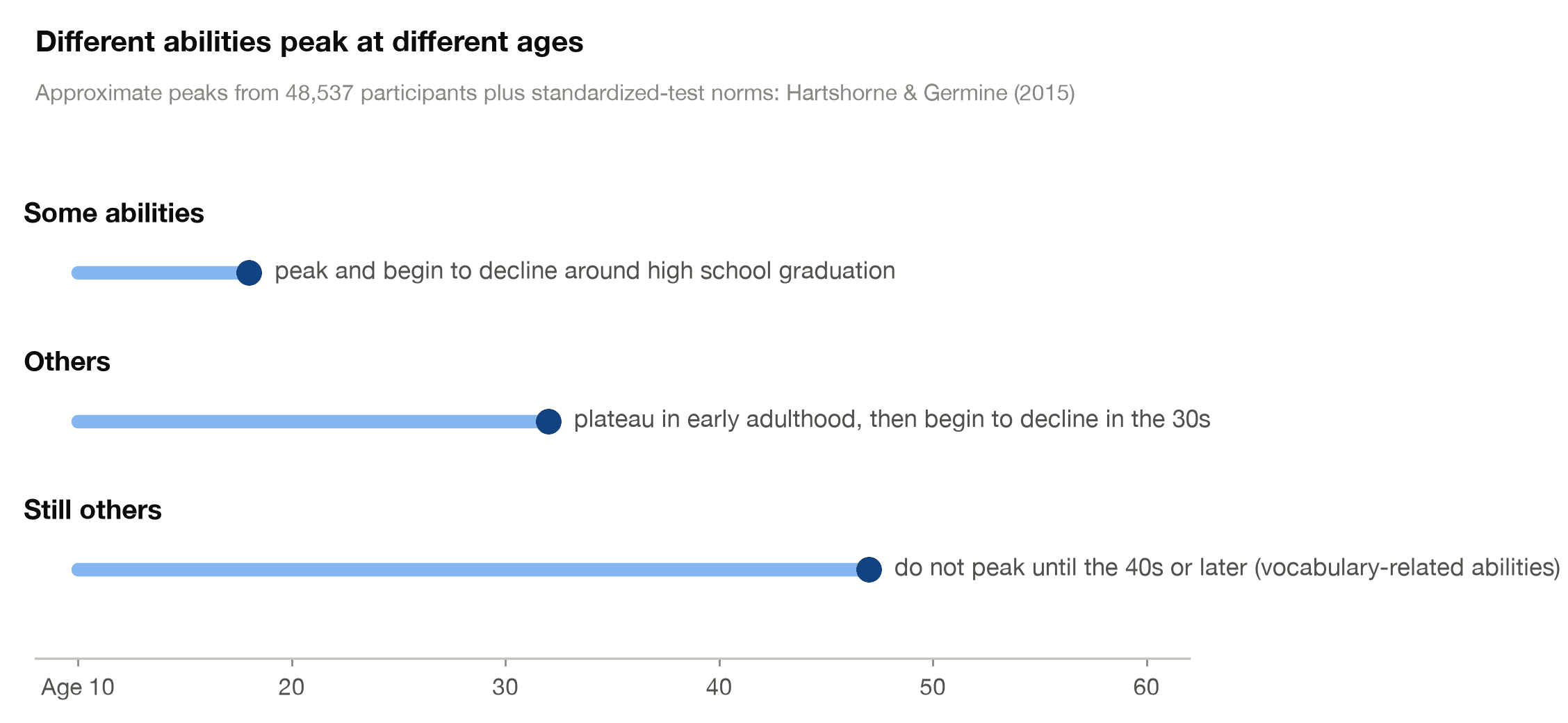
Over decades, age matters, though there is no single decline. Cross-sectional comparisons consistently find that increased age is associated with lower cognitive performance even between ages 18 and 60, and longitudinal studies partly mask the change because people improve with practice each time they retake a test. A study of 48,537 online participants, combined with norms from standardized IQ and memory tests, found that abilities are not synchronized: some peak and begin to decline around high school graduation, some plateau in early adulthood and begin declining in the 30s, and others, including vocabulary, do not peak until the 40s or later.
What protects acuity, and what does not
Aerobic exercise: a real but specific benefit
The strongest experimental evidence concerns exercise in older adults. A randomized controlled trial with 120 older adults found that aerobic exercise training increased the size of the anterior "hippocampus" (a brain structure central to memory) by about 2%, effectively reversing 1 to 2 years of age-related volume loss, with improvements in spatial memory. That is a protection effect on memory in aging; it does not show that exercise raises intelligence.
Brain games sharpen the game, and little else
Commercial programs promise to boost mental sharpness with daily puzzles. The most comprehensive scientific review of that industry found extensive evidence that brain-training improves performance on the trained tasks, less evidence that it improves closely related tasks, and little evidence that it improves distantly related tasks or everyday cognitive performance. Practicing a game sharpens that game. We cover the evidence in detail in our articles on brain-training apps and IQ and on whether chess makes you smarter.
How mental acuity is measured
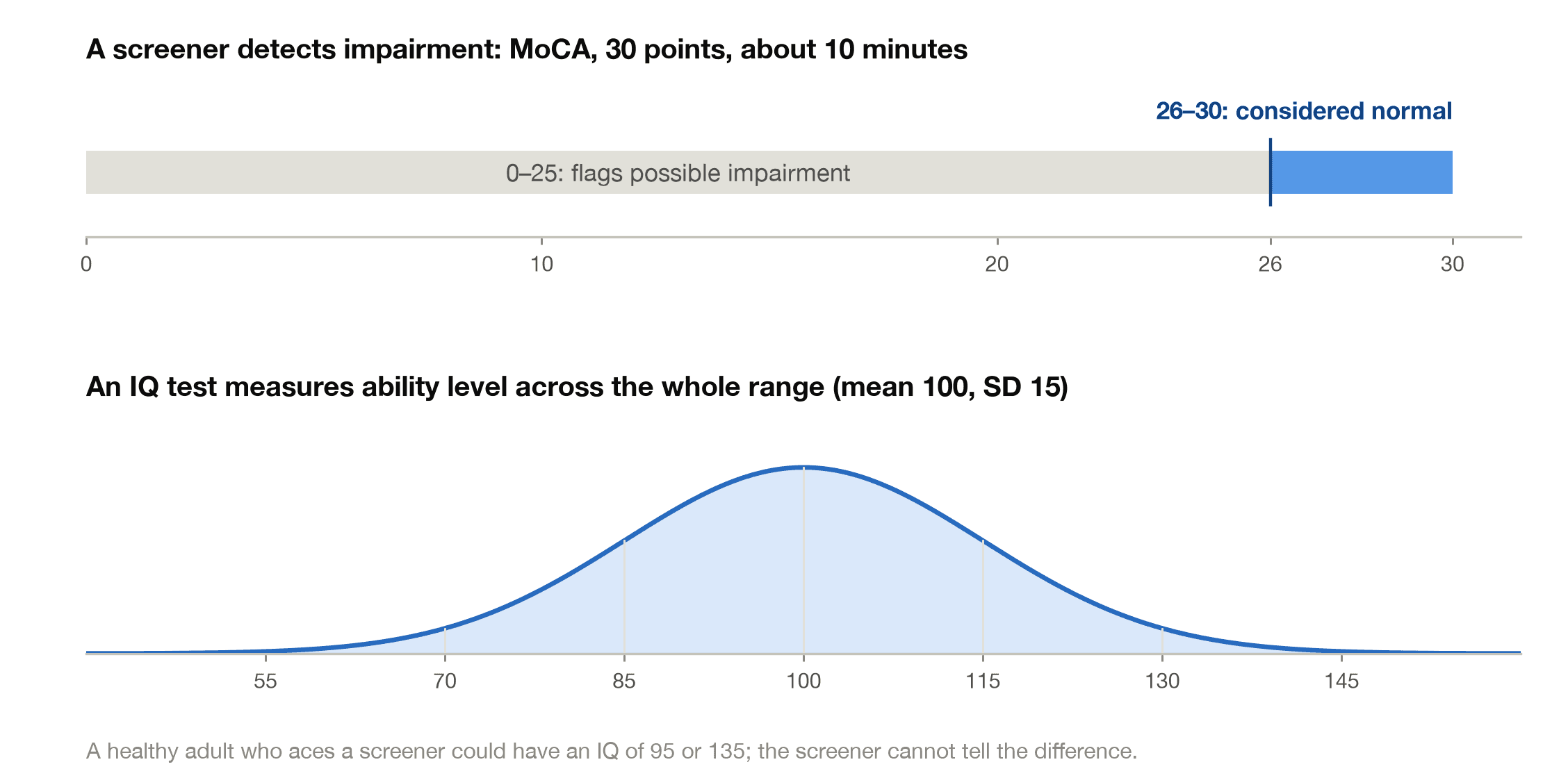
Clinicians assess acuity with brief "cognitive screeners." As MedlinePlus puts it, cognitive testing checks for problems with cognition, which "includes thinking, learning, remembering, and using judgment and language." The common instruments are the Montreal Cognitive Assessment (MoCA), the Mini-Mental State Exam (MMSE), and the Mini-Cog. The MoCA, developed in 2005, takes about 10 minutes, is scored out of 30 points, and treats 26 or higher as normal; the MMSE, from 1975, works similarly, with lower scores prompting evaluation for impairment such as dementia.
A screener is not an IQ test
Screeners are designed to detect impairment, so they are deliberately easy for healthy adults; nearly everyone without a problem lands near the ceiling. A healthy adult who aces the MoCA has told you nothing about whether their IQ is 95 or 135. Measuring your ability level across reasoning, memory, and speed requires a full-scale test built for the whole range. Our guide to cognitive function tests explains what each kind of instrument can and cannot tell you.
Frequently asked questions
Is mental acuity the same as IQ?
No. IQ measures your level of general cognitive ability, which is highly stable in adults. Mental acuity usually refers to how sharp your thinking is right now, which fluctuates with sleep, health, and age even while underlying intelligence stays the same.
What causes loss of mental acuity?
The best-documented short-term cause is sleep loss: a meta-analysis of 70 studies found large deficits in sustained attention after sleep deprivation. Over decades, normal aging lowers performance on speed and reasoning measures, with different abilities declining on different timelines.
How is mental acuity tested?
Clinicians use brief screeners such as the MoCA (10 minutes, 30 points, 26 and above considered normal), the MMSE, or the Mini-Cog to check for impairment. Measuring ability level requires a full-scale cognitive test rather than a screener.
Can brain games improve mental acuity?
The most comprehensive review found extensive evidence that brain-training improves the trained tasks and little evidence it improves everyday cognitive performance. Practicing a game sharpens that game, and the gains largely stay there.
At what age does mental acuity decline?
There is no single age. Large-scale data show some abilities peak around the end of high school, others plateau into the 30s, and some, like vocabulary, keep improving into the 40s or later. Cross-sectional declines in speed are measurable even between 18 and 60.
The takeaway
Mental acuity is the sharpness of your thinking today, and it responds to how you sleep, move, and age. Protecting it means guarding sleep and staying physically active, and it does not mean buying puzzle subscriptions. If what you actually want to know is your ability level, a screener or a brain game cannot say. A properly normed instrument such as the Reasoning and Intelligence Online Test from RIOT IQ measures reasoning, memory, and speed across the whole range; you can take the free IQ test to see where you stand.
References
1. American Psychological Association. (2018). Acuity. In APA dictionary of psychology.dictionary.apa.org
2. American Psychological Association. (2018). Intelligence. In APA dictionary of psychology.dictionary.apa.org
3. Lim, J., & Dinges, D. F. (2010). A meta-analysis of the impact of short-term sleep deprivation on cognitive variables. Psychological Bulletin, 136(3), 375-389. pubmed.ncbi.nlm.nih.gov
4. Erickson, K. I., Voss, M. W., Prakash, R. S., et al. (2011). Exercise training increases size of hippocampus and improves memory. Proceedings of the National Academy of Sciences, 108(7), 3017-3022. pmc.ncbi.nlm.nih.gov
5. Salthouse, T. A. (2009). When does age-related cognitive decline begin? Neurobiology of Aging, 30(4), 507-514. pmc.ncbi.nlm.nih.gov
6. Hartshorne, J. K., & Germine, L. T. (2015). When does cognitive functioning peak? The asynchronous rise and fall of different cognitive abilities across the life span. Psychological Science, 26(4), 433-443. pubmed.ncbi.nlm.nih.gov
7. Simons, D. J., Boot, W. R., Charness, N., Gathercole, S. E., Chabris, C. F., Hambrick, D. Z., & Stine-Morrow, E. A. L. (2016). Do "brain-training" programs work? Psychological Science in the Public Interest, 17(3), 103-186. pubmed.ncbi.nlm.nih.gov
8. National Library of Medicine. (n.d.). Cognitive testing. MedlinePlus. medlineplus.gov