What is fluid intelligence? The ability to reason through novel problems without learned knowledge. How tests measure it, how it changes with age, and more.
Dr. Russell T. WarneChief Scientist
Share
Fluid intelligence, abbreviated “Gf,” is the ability to reason through problems you have never seen before: spotting patterns, drawing inferences, and working out relationships without relying on learned knowledge. It is one half of the classic pair proposed by psychologist Raymond Cattell, alongside “crystallized intelligence,” the knowledge and skills you accumulate over a lifetime. Fluid reasoning sits at the core of every modern IQ test, peaks early in adulthood, and predicts how quickly people learn genuinely new things.
What Fluid Intelligence Is
Cattell introduced the fluid-crystallized distinction formally in 1963, and it remains one of the most replicated structures in the science of intelligence. Fluid ability is what you deploy when the problem is novel: no vocabulary, no facts, no practiced routine will hand you the answer. Modern ability models, such as the Cattell-Horn-Carroll framework used by today's major tests, keep Gf as one of the broadest, most central capacities, closely tied to “general intelligence” itself.
A useful shorthand: fluid intelligence is mental horsepower applied to the unfamiliar, while crystallized intelligence is the library you have already built. The two work together constantly. Solving a physics problem uses learned formulas (crystallized) and on-the-spot reasoning about this particular setup (fluid). We compare the pair in depth in our article on fluid vs. crystallized intelligence.
How Tests Measure Fluid Reasoning
Because fluid ability must be tested with unfamiliar material, test makers rely on abstract tasks that require no schooling to attempt.
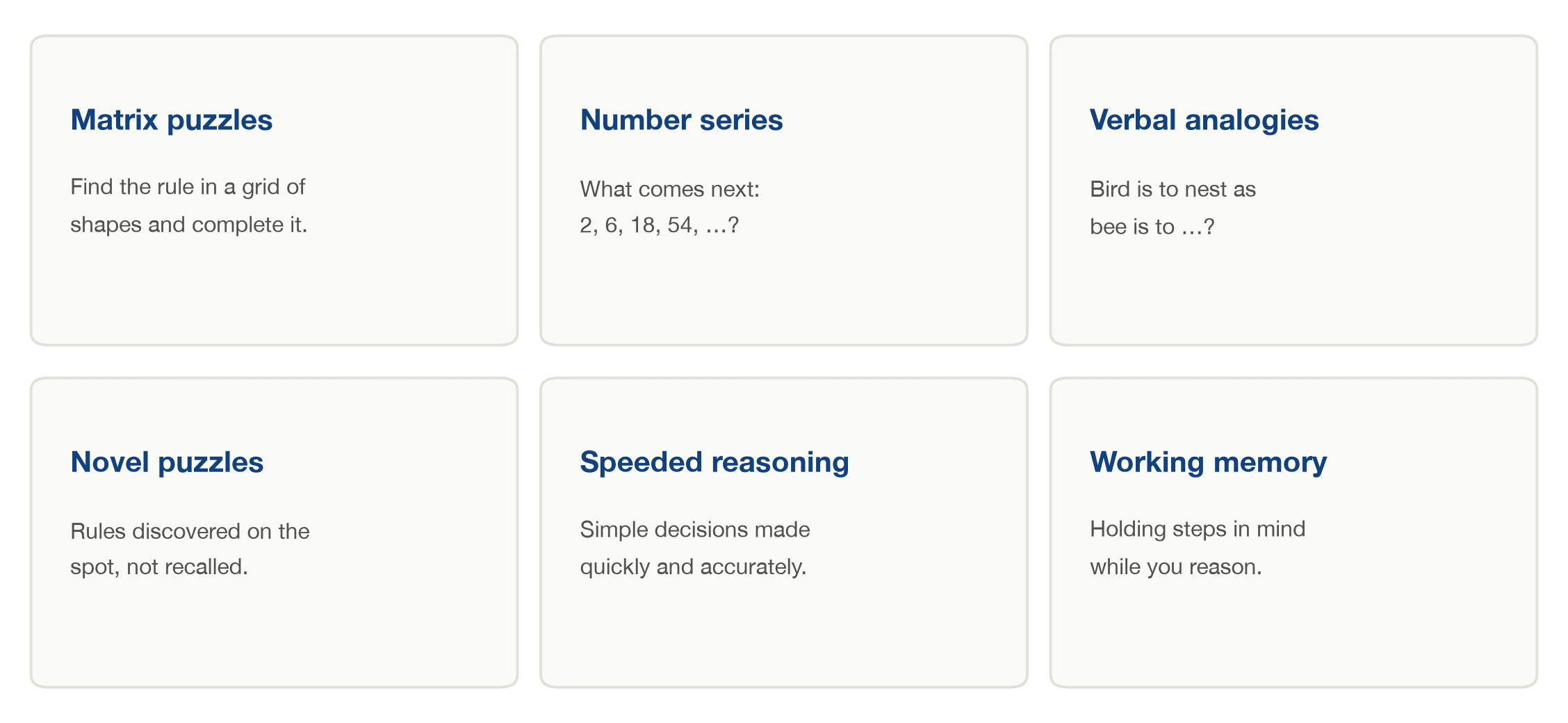
• Matrix reasoning: A grid of shapes follows hidden rules and one cell is missing. Raven-style matrices are the canonical Gf task; our step-by-step matrix guide shows how the rules layer together.
• Series completion: Continue a sequence of numbers, letters, or figures by inferring the rule that generates it.
• Analogies: Map a relationship from one pair onto another, with content kept simple so reasoning, not vocabulary, does the work.
On a full IQ battery these tasks contribute to a composite score scaled so the population average is 100 with a “standard deviation,” a measure of spread, of 15 points. Our guide to the IQ scale explains how to read those numbers, and our overview of IQ test question types shows where fluid tasks sit among the rest.
Fluid Intelligence and Working Memory
If you watch someone solve a hard matrix item, the bottleneck is rarely seeing the shapes; it is holding several candidate rules in mind while testing each one. That capacity, “working memory,” turns out to be fluid reasoning's closest partner. The classic analysis of the Raven matrices by Carpenter, Just, and Shell found that what separates high scorers is precisely the ability to manage multiple goals and sub-results at once without losing track. Later research confirmed the two abilities correlate strongly, though they are not identical: working memory is the mental workspace, and fluid intelligence is what you build in it.
How Fluid Intelligence Changes With Age
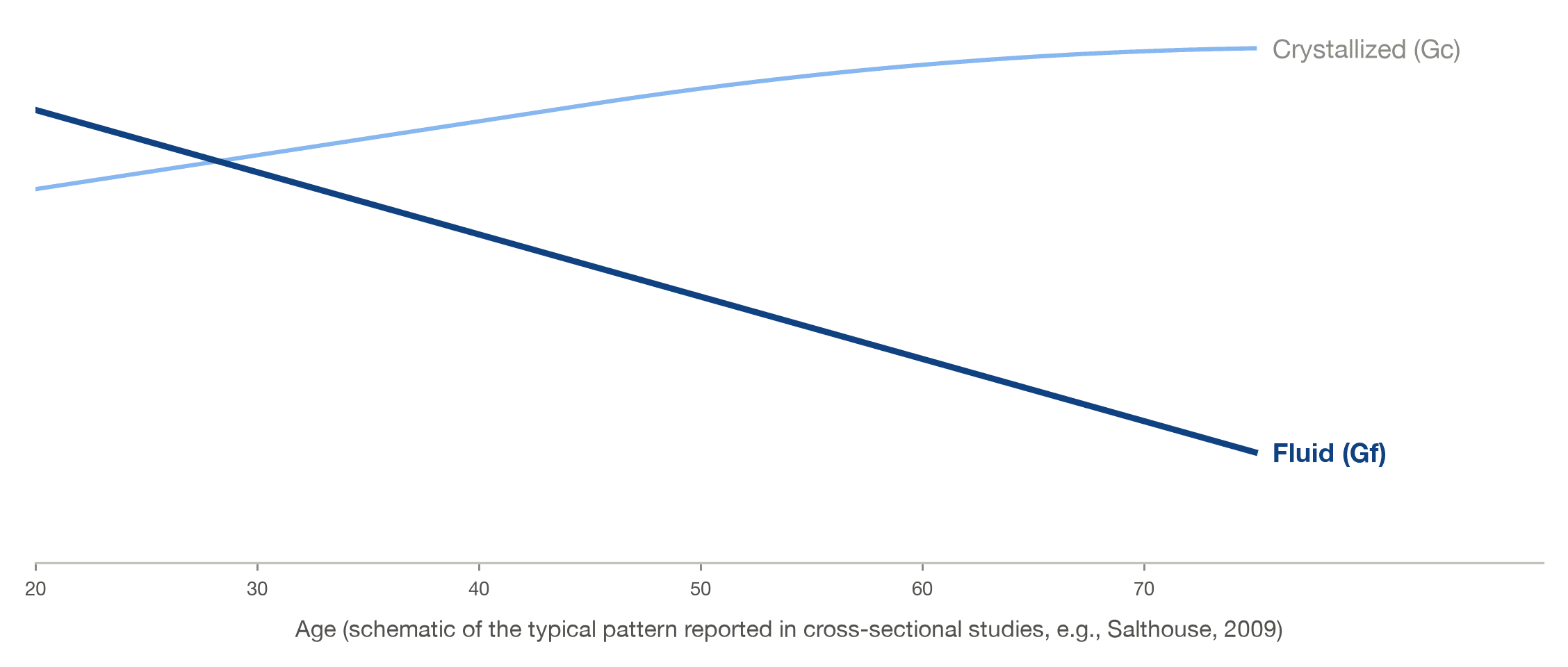
Fluid and crystallized abilities follow strikingly different lifespan paths. Cross-sectional studies repeatedly find that average performance on novel reasoning tasks peaks in the twenties and declines gradually for the rest of adult life, while knowledge-based performance holds steady or keeps rising into the sixties. Psychologist Timothy Salthouse's analyses place the start of the fluid decline earlier than most people expect, in healthy adults in their late twenties and thirties.
Two cautions keep this in perspective. The decline is an average across people, with wide individual variation, and everyday competence often keeps improving because growing crystallized knowledge compensates. An experienced fifty-year-old engineer usually out-solves a quick twenty-year-old novice on real problems; the novelty advantage only shows when nobody's library applies.
Can You Improve Fluid Intelligence?
This is one of the most studied questions in psychology, and the honest summary is: not much, so far. A wave of excitement followed early reports that intensive working memory training could raise fluid scores, but larger and better-controlled studies deflated the claim. A meta-analytic review by Melby-Lervåg and Hulme found training improves the trained tasks with little durable transfer to broader reasoning. What does move measured performance is less glamorous: adequate sleep, managed stress, physical health, and familiarity with test formats so the format itself is not the obstacle.
Education deserves its own mention. Schooling reliably raises measured intelligence, on the order of one to five IQ points per additional year in a large meta-analysis, with the clearest gains on knowledge-loaded measures. Whether it rewrites underlying fluid capacity is debated; what is not debated is that education builds the crystallized side of the ledger and sharpens the reasoning habits tests reward.
See Your Own Fluid Reasoning Score
The Reasoning and Intelligence Online Test, developed by a team led by intelligence researcher Dr. Russell T. Warne, measures fluid reasoning as one of five reported domains, so you can see it alongside your verbal, spatial, memory, and speed scores rather than as a single blended number. Take the RIOT IQ test to get your profile.
Frequently Asked Questions
What is fluid intelligence in simple terms?
It is your ability to figure out new problems on the spot, using logic and pattern-spotting rather than anything you memorized.
What is an example of fluid intelligence?
Solving a matrix puzzle you have never seen, inferring the rule in a number series, or navigating an unfamiliar city's transit map on the first try.
At what age does fluid intelligence peak?
On average in the twenties, with gradual decline afterward. Crystallized knowledge keeps growing for decades, which cushions everyday performance.
Is fluid intelligence the same as IQ?
Not exactly. IQ is a composite of several abilities, but fluid reasoning correlates so strongly with the general factor that matrix-style tasks are the heart of most tests.
Can fluid intelligence be trained?
Trained tasks improve; broad transfer has not held up in rigorous studies. Health, sleep, and format familiarity are the levers that reliably help your measured score.
References
1. American Educational Research Association, American Psychological Association, & National Council on Measurement in Education. (2014). Standards for educational and psychological testing. American Educational Research Association. testingstandards.net
3. Cattell, R. B. (1963). Theory of fluid and crystallized intelligence: A critical experiment. Journal of Educational Psychology, 54(1), 1–22. doi.org/10.1037/h0046743
4. McGrew, K. S. (2009). CHC theory and the human cognitive abilities project: Standing on the shoulders of the giants of psychometric intelligence research. Intelligence, 37(1), 1–10. doi.org/10.1016/j.intell.2008.08.004
5. Melby-Lervåg, M., & Hulme, C. (2013). Is working memory training effective? A meta-analytic review. Developmental Psychology, 49(2), 270–291. doi.org/10.1037/a0028228
6. Ritchie, S. J., & Tucker-Drob, E. M. (2018). How much does education improve intelligence? A meta-analysis. Psychological Science, 29(8), 1358–1369. doi.org/10.1177/0956797618774253