Creatine has little effect on IQ: the largest trial found about 1 IQ point on Raven's matrices, and small memory gains are uncertain outside older adults.
Dr. Russell T. WarneChief Scientist
Share
Creatine does not meaningfully raise IQ in healthy adults: the largest and best-controlled trial found a gain of about 1 IQ point on a reasoning test, too small to distinguish from zero. Small improvements in short-term memory have been reported, mostly in older adults and in people short of sleep, but the European Food Safety Authority reviewed the evidence in 2024 and concluded that a cause-and-effect link between creatine and better cognition has not been established.
This page covers the 2003 trial that started the "creatine makes you smarter" idea, the larger replication that shrank it, what the meta-analyses actually found (and why two of them were criticised for double counting), and the groups where a small effect is most plausible.
Why people think creatine might boost intelligence
Creatine is best known as a sports supplement. The body makes some of it and gets the rest from meat and fish, and it helps cells recycle ATP, the molecule that carries energy. The brain is an energy-hungry organ, so the idea that topping up creatine might help it work faster is reasonable on paper. Supplementation does appear to raise brain creatine a little: one imaging study cited by later researchers found an 8.7% rise after four weeks of high-dose supplementation.
The claim took off with a 2003 study by Caroline Rae and colleagues at the University of Sydney. They gave 45 young vegetarian adults creatine or a placebo for six weeks each, in random order, under double-blind conditions. On both a working-memory task (repeating strings of digits backwards) and Raven's Advanced Progressive Matrices, a classic test of abstract reasoning, creatine produced large improvements (p < 0.0001). Vegetarians were chosen because they eat little creatine and have lower levels in their muscles, so they seemed most likely to benefit.
Later researchers estimated the size of the Rae effect at roughly one standard deviation. On the IQ scale, where a "standard deviation" (the typical spread of scores around the average) is 15 points, that would be about 15 points from a supplement, which is larger than almost any intervention in the intelligence literature. Results that large from small samples are usually a warning sign, and in this case the replication bore that out.
What the best trial found
In 2023 Julia Sandkühler and colleagues published the largest creatine and cognition trial to date. It was preregistered, randomised, double-blind and placebo-controlled, and it copied the Rae design closely: six weeks of creatine and six weeks of placebo, the same backward digit span task and the same 10-minute sets of Raven's matrices. About half of the 123 participants were vegetarians and half ate meat.
The effects were small:
• Raven's matrices: 0.23 more puzzles solved on creatine, a standardised effect of 0.09. The authors translated this into about 1 IQ point, and it was not statistically significant (p = 0.33).
• Backward digit span: 0.41 more correct items, an effect of 0.17, or about 2.5 IQ points by the same conversion. This bordered on significance (p = 0.064).
• Eight other cognitive tests: no sign of improvement on any of them.
• Diet: vegetarians did not benefit more than meat-eaters.
Bayesian analysis gave weak support for a small benefit, and side effects were reported about four times as often on creatine as on placebo. The authors' conclusion was cautious: creatine "might have a small beneficial effect", and larger studies are needed to confirm or rule it out.
The vegetarian question has an earlier answer too. Benton and Donohoe gave 128 young women either creatine or a placebo for five days. Creatine did not change verbal fluency or vigilance, but it improved memory in vegetarians and not in meat-eaters. Vegetarians have lower creatine in blood and muscle, but studies cited by the Sandkühler team found brain creatine levels comparable to those of omnivores, which may explain why the vegetarian advantage has not held up consistently.
What the meta-analyses show
Several reviews have pooled the small trials, and their headline numbers need careful reading.
A 2018 systematic review by Avgerinos and colleagues found only six randomised trials in healthy people, with 281 participants in total. It reported some evidence for better short-term memory and reasoning, conflicting results in other areas, and no change in young people's performance.
A 2023 meta-analysis by Prokopidis and colleagues pooled eight trials on memory and found a small overall benefit (standardised mean difference 0.29, about 4 IQ-point equivalents). Almost all of it came from older adults aged 66 to 76 (0.88); in people aged 11 to 31 the effect was essentially zero (0.03). A 2024 meta-analysis by Xu and colleagues pooled 16 trials with 492 participants and reported gains in memory, attention time and processing speed, but no effect on overall cognitive function or executive function.
Both meta-analyses were later criticised for the same statistical problem. Many trials report several related memory tests from the same people, and treating each test as an independent result counts those participants more than once and makes the evidence look more precise than it is. A 2026 commentary reported that when Prokopidis and colleagues reanalysed their data properly, the overall memory effect was no longer significant except in older adults. The European Food Safety Authority, assessing a company's application to market creatine for cognition, said no conclusions could be drawn from the Xu meta-analysis for the same reason. Looking at the trials themselves, the panel noted that memory effects appeared only in two studies using 20 g a day for five to seven days and not at lower doses or longer use, and it rejected the health claim.
Where creatine might matter
The most plausible place for a real effect is the brain under strain.
• Sleep deprivation: in a 2024 study by Gordji-Nejad and colleagues, 15 young adults took a single unusually large dose of creatine or a placebo during a night of sleep deprivation. Creatine changed energy-related chemistry in the brain, measured by magnetic resonance spectroscopy, and improved processing speed and short-term memory compared with placebo. It is a small study and needs replication.
• Older adults: a 2026 systematic review by Marshall and colleagues found six studies with 1,542 participants aged 55 and over. Five reported a positive link between creatine and cognition, especially memory and attention, but only two were supplementation trials (the other four estimated creatine from diet) and three of the six were rated poor in quality.
Neither of these shows that creatine raises IQ. Better performance when exhausted is a recovery toward normal, and the older-adult evidence concerns memory more than reasoning. Like the brief lift from caffeine described in our page on caffeine and IQ, any creatine effect looks state-dependent and small. Iron deficiency is a different case, because there a genuine shortage is common and correcting it raises children's test scores in randomised trials. The wider picture on food and the brain is in our overview of whether diet or nutrition affects IQ.
The confounds and caveats to keep in mind:
• Small samples: most trials have fewer than 50 people, so one or two chance results can dominate a pooled estimate.
• Many outcomes: studies often measure a dozen tasks, and a few will look significant by chance.
• Age: in the memory meta-analysis the benefit was concentrated in adults aged 66 to 76, with none in people aged 11 to 31, so results from one age group do not transfer to another.
• Industry interest: creatine is sold widely as a supplement, and the 2024 EFSA assessment was triggered by a manufacturer's application.
Anyone considering creatine for a medical reason, including memory problems, should talk to a GP or pharmacist first.
Frequently asked questions
Does creatine increase IQ?
There is no good evidence that it does. The largest trial found about 1 IQ point on Raven's matrices, which was not statistically significant, and the 2003 study that reported a large gain has not been replicated.
Does creatine help vegetarians think better?
One small study found better memory in vegetarians on creatine, but the larger 2023 trial found that vegetarians benefited no more than meat-eaters. Brain creatine in vegetarians appears similar to that of omnivores.
Does creatine improve memory?
Possibly a little, mainly in older adults. Meta-analyses that reported memory gains were criticised for counting participants more than once, and the overall effect weakened when that was corrected.
Can creatine help when you are sleep deprived?
One small 2024 study of 15 people found better processing speed and short-term memory after a single large dose during a night without sleep. That is a recovery effect under stress, and it has not yet been replicated.
Is creatine approved as a brain supplement?
No. In 2024 the European Food Safety Authority concluded that a cause-and-effect relationship between creatine and improved cognitive function has not been established.
The takeaway
Creatine is a well-studied sports supplement, and the evidence does not support it as an intelligence booster. The study that launched the idea found an effect that would equal about 15 IQ points, and a careful replication with nearly three times as many participants found about 1. Small gains in memory are plausible for older adults and for brains running short of sleep, and the research there is still thin. Your reasoning ability is far better measured than supplemented, and if you want to know where yours stands you can take a full-length online IQ test.
References
1. Rae, C., Digney, A. L., McEwan, S. R., & Bates, T. C. (2003). Oral creatine monohydrate supplementation improves brain performance: A double-blind, placebo-controlled, cross-over trial. Proceedings of the Royal Society B: Biological Sciences, 270(1529), 2147-2150. [doi.org/10.1098/rspb.2003.2492](. doi.org
2. Sandkühler, J. F., Kersting, X., Faust, A., Königs, E. K., Altman, G., Ettinger, U., Lux, S., Philipsen, A., Müller, H., & Brauner, J. (2023). The effects of creatine supplementation on cognitive performance: A randomised controlled study. BMC Medicine, 21, 440. [doi.org/10.1186/s12916-023-03146-5](. doi.org
3. Benton, D., & Donohoe, R. (2011). The influence of creatine supplementation on the cognitive functioning of vegetarians and omnivores. British Journal of Nutrition, 105(7), 1100-1105. [doi.org/10.1017/S0007114510004733](. doi.org
4. Avgerinos, K. I., Spyrou, N., Bougioukas, K. I., & Kapogiannis, D. (2018). Effects of creatine supplementation on cognitive function of healthy individuals: A systematic review of randomized controlled trials. Experimental Gerontology, 108, 166-173. [doi.org/10.1016/j.exger.2018.04.013](. doi.org
5. Prokopidis, K., Giannos, P., Triantafyllidis, K. K., Kechagias, K. S., Forbes, S. C., & Candow, D. G. (2023). Effects of creatine supplementation on memory in healthy individuals: A systematic review and meta-analysis of randomized controlled trials. Nutrition Reviews, 81(4), 416-427. [doi.org/10.1093/nutrit/nuac064](. doi.org
6. Xu, C., Bi, S., Zhang, W., & Luo, L. (2024). The effects of creatine supplementation on cognitive function in adults: A systematic review and meta-analysis. Frontiers in Nutrition, 11, 1424972. [doi.org/10.3389/fnut.2024.1424972](. doi.org
7. Eckert, I., & Pascher, E. (2023). Letter to the Editor: Double-counting due to inadequate statistics leads to false-positive findings in "Effects of creatine supplementation on memory in healthy individuals". Nutrition Reviews, 81(11), 1495-1496. [doi.org/10.1093/nutrit/nuac108](. doi.org
8. Citherlet, T. (2026). Commentary: The effects of creatine supplementation on cognitive function in adults: A systematic review and meta-analysis. Frontiers in Nutrition, 13, 1716285. [doi.org/10.3389/fnut.2026.1716285](. doi.org
9. EFSA Panel on Nutrition, Novel Foods and Food Allergens (NDA), Turck, D., Bohn, T., et al. (2024). Creatine and improvement in cognitive function: Evaluation of a health claim pursuant to Article 13(5) of Regulation (EC) No 1924/2006. EFSA Journal, 22(11), e9100. [doi.org/10.2903/j.efsa.2024.9100](. doi.org
10. Gordji-Nejad, A., Matusch, A., Kleedörfer, S., Jayeshkumar Patel, H., Drzezga, A., Elmenhorst, D., Binkofski, F., & Bauer, A. (2024). Single dose creatine improves cognitive performance and induces changes in cerebral high energy phosphates during sleep deprivation. Scientific Reports, 14, 4937. [doi.org/10.1038/s41598-024-54249-9](. doi.org
11. Marshall, S., Kitzan, A., Wright, J., Bocicariu, L., & Nagamatsu, L. S. (2026). Creatine and cognition in aging: A systematic review of evidence in older adults. Nutrition Reviews, 84(2), 333-344. [doi.org/10.1093/nutrit/nuaf135](. doi.org
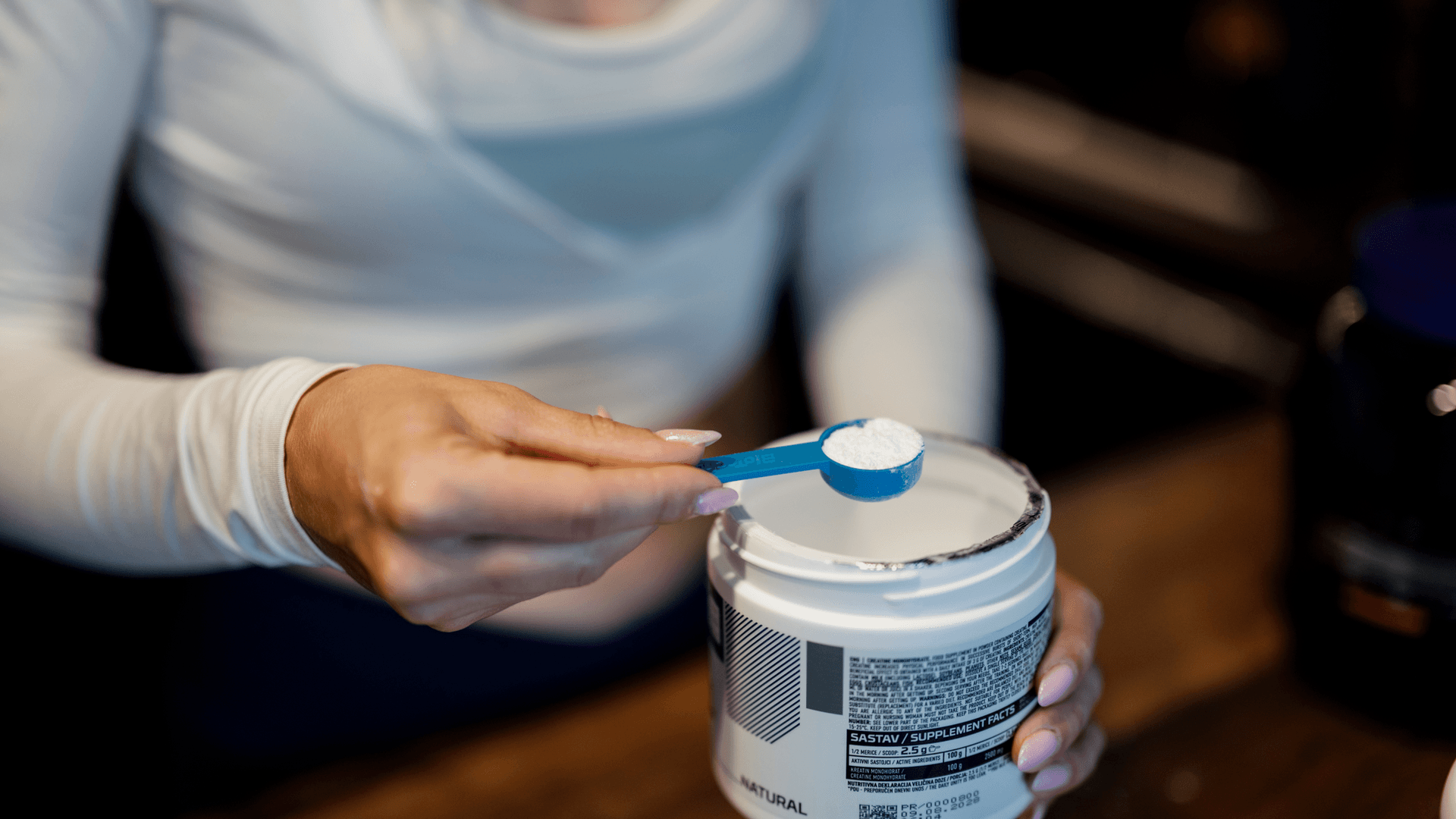
Hero image: User measures a scoop of protein powder from a container in a kitchen, by Shixart1985, CC BY 2.0. Via Wikimedia Commons.
Take our professional IQ test
Want to know your IQ? Try the first ever professional online IQ test.