Cannabis and IQ: Does Smoking Weed Lower Your IQ? | Riot IQ
Oct 9, 2026·Advanced Topics & Research
Cannabis and IQ: Does Smoking Weed Lower Your IQ?
Cannabis and IQ: frequent youth use is linked to an IQ drop of about 2 points on average, and twin studies suggest family factors explain much of it.
Dr. Russell T. WarneChief Scientist
Share
Frequent cannabis use in adolescence is linked to a small drop in IQ, about 2 points on average across seven longitudinal studies that tested people before and after they started using. Whether cannabis itself causes that drop is still unsettled, because twin studies find that users decline about as much as their non-using brothers and sisters, which points to family background rather than the drug.
The cannabis IQ question became famous in 2012, when a New Zealand study reported an 8-point decline in people who had used heavily since their teens. This page explains what that study found, what twin and sibling studies added, why cigarette smoking and family background complicate the picture, and what the pooled evidence says. It describes research findings and does not give advice about using or avoiding cannabis.
What the Dunedin study found
The study behind most headlines is Meier and colleagues' 2012 analysis of the Dunedin cohort, about 1,037 people born in Dunedin, New Zealand, in 1972-73 and followed to age 38. They took IQ tests in childhood (ages 7 to 13), before anyone used cannabis, and again at 38. Cannabis use and dependence were assessed at ages 18, 21, 26, 32 and 38.
People who never used cannabis gained slightly, from an average of 99.84 in childhood to 100.64 at 38. People diagnosed with "cannabis dependence", a clinical pattern of compulsive use despite harm, at three or more of the five assessments fell from 99.68 to 93.93. That is a decline of 0.38 standard deviations, or about 6 IQ points, in a group of 38 people. Among the 23 people who started before 18 and kept using to 38, the decline was about 8 points. The association held after controlling for years of education, and adolescent-onset users who quit did not fully recover.
A 2022 follow-up of the same cohort at age 45 found that long-term users had declined by an average of 5.5 IQ points from childhood. The researchers reported that this could not be explained by tobacco, alcohol or other drug use, childhood socioeconomic status, low childhood self-control, or family history of substance dependence.
These are careful studies with rare strengths: a full birth cohort, 94% retention at 45, and IQ measured before exposure. Their weakness is size. The heaviest-use groups held a few dozen people, and in an observational design anything that changes along with heavy cannabis use over 25 years can show up as a cannabis effect.
What twin and sibling studies show
The strongest test of whether cannabis causes IQ decline is to compare people who share most of their background. If cannabis lowers IQ, the twin who uses should decline more than the twin who does not. The same logic runs through the designs described in our article on what twin studies reveal about IQ.
• Two American twin samples: Jackson and colleagues (2016) followed 789 twins in Southern California and 2,277 in Minnesota, testing IQ at 9 to 12, before cannabis use, and again at 17 to 20. Users declined more on vocabulary than non-users, by roughly 3 to 4 points. However, there was no dose-response pattern, meaning heavier use did not predict larger drops, and twins who used did not decline significantly more than their abstinent co-twins.
• An English and Welsh twin cohort: Meier and colleagues (2018) studied 1,989 twins from the E-Risk study. Adolescents with cannabis dependence at 18 already scored 5.61 points lower at age 12, before they started, and 7.34 points lower at 18. They did not show greater decline from 12 to 18, and within twin pairs, the heavier-using twin performed similarly to the co-twin on five of six executive function tests.
Both studies point the same way. Young people who go on to use cannabis heavily tend to score lower before they ever use it, and the extra decline that appears in whole-population comparisons largely disappears within families. The authors of the 2018 paper concluded that short-term adolescent use does not appear to cause IQ decline, even at the level of dependence.
There is a caveat that cuts the other way. The twin studies followed people only to about age 18 to 20, so they cannot rule out effects from decades of heavy use like the Dunedin group's.
Confounds that complicate the picture
Three alternative explanations come up again and again in this literature.
• Socioeconomic status: In 2013, economist Ole Rogeberg ran a simulation in which low socioeconomic status both raised the chance of heavy cannabis use and slowly pulled adult IQ downward. His model reproduced the Dunedin pattern with no cannabis effect at all, and he argued that the true effect "could be zero". The Dunedin team replied in the same journal that socioeconomic status did not explain their results in the actual data, and the 2022 follow-up controlled for childhood socioeconomic status directly.
• Cigarette smoking: Mokrysz and colleagues (2016) followed 2,235 English teenagers from the Avon Longitudinal Study of Parents and Children. After adjusting for IQ at age 8, those who had used cannabis 50 or more times scored 2.9 points lower at 15 than never-users. Adding cigarette and alcohol use and other confounds shrank that gap to 0.1 points (p = 0.941). Cigarette use had the largest influence, and among teenagers who had never tried cannabis, cigarette users still scored lower, which suggests a shared risk profile.
• Recent use: A 2018 meta-analysis of 69 cross-sectional studies by Scott and colleagues found a small overall cognitive deficit in frequent young users (d = -0.25, about 4 points on an IQ-style scale). In the 15 studies that required more than 72 hours of abstinence before testing, the deficit shrank to d = -0.08 and was not statistically different from zero. Part of what looks like lasting damage may be lingering intoxication or withdrawal on test day.
These confounds also sit behind other substance research. Our page on IQ and alcoholism covers the parallel debate over drinking, where the same question of cause and selection arises.
What the meta-analyses add up to
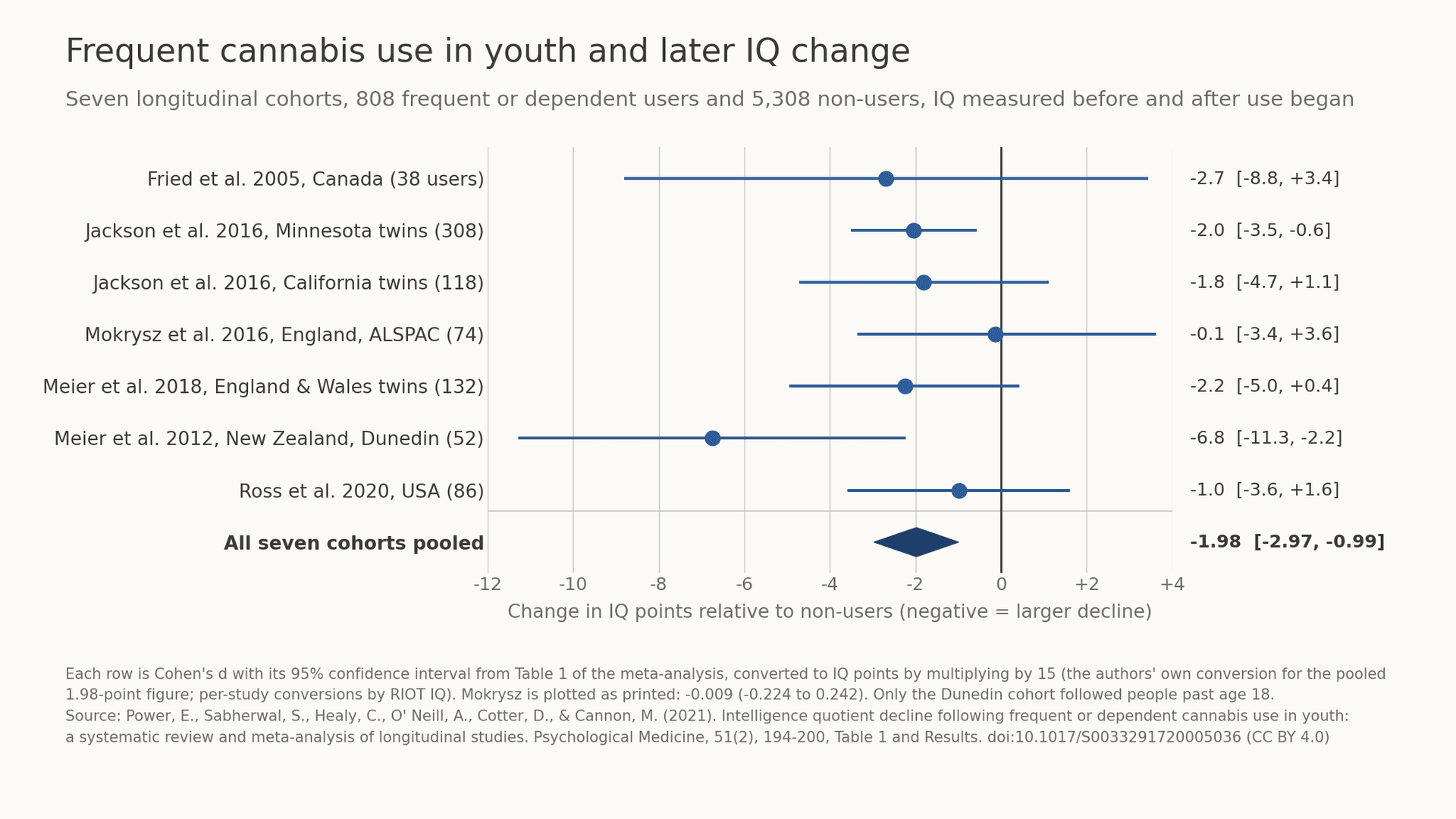
The best summary so far is a 2021 meta-analysis by Power and colleagues in Psychological Medicine. They included only studies that measured IQ both before and after cannabis exposure in people who were not in treatment, which left seven cohorts with 808 frequent or dependent users and 5,308 controls from the UK, the USA, Canada and New Zealand.
The pooled effect was a "Cohen's d", a standardized difference between groups, of -0.132 (95% confidence interval -0.198 to -0.066). The authors converted this to a decline of 1.98 IQ points (95% CI 0.99 to 2.97), with almost no variation between studies beyond chance (I² = 0.2%). In exploratory analyses, the drop appeared in verbal IQ (about 2.9 points) and not in performance IQ, which fits the twin studies' finding that vocabulary, a form of crystallized intelligence, is where users fall behind.
Two points help in reading that result. First, a 2-point average is small. It is smaller than the margin of error around one person's IQ score, and it describes group averages. Second, it is an average of associations, and only the Dunedin cohort, which followed people longest, showed a large drop (about 6.8 points in this analysis). Six of the seven cohorts stopped at about age 18, so the meta-analysis says little about what decades of heavy use do.
The honest summary is that heavy adolescent use predicts slightly lower later IQ, that much of the gap is present before use begins, and that the best family-based designs find little extra decline attributable to cannabis itself. The question of long-term, daily, high-potency use over many years remains open.
If cannabis use feels hard to control, a family doctor or an addiction medicine specialist can assess for cannabis use disorder. In the United States, the SAMHSA National Helpline offers free, confidential referrals at 1-800-662-4357.
Frequently asked questions
Does smoking weed lower your IQ?
Frequent youth use is linked to an IQ about 2 points lower on average, across seven longitudinal studies. Twin studies suggest much of this reflects family background, so a causal effect is unproven.
How many IQ points does cannabis cost?
The pooled estimate is about 2 points. The largest figure, about 8 points, came from 23 people in New Zealand who were dependent from adolescence to age 38.
Does IQ come back after quitting cannabis?
In the Dunedin study, adolescent-onset users who quit did not fully recover. Cross-sectional studies find that short-term deficits largely fade after more than 72 hours without use.
Is adolescent cannabis use worse than adult use?
The Dunedin study found larger declines in people who started before 18. The twin studies of teenagers did not find extra decline within families, so the evidence is mixed.
Do people who use cannabis have lower IQs to begin with?
Often, yes. In the E-Risk twin study, teenagers who later became dependent scored about 5.6 points lower at age 12, before use began, and the Minnesota twin sample showed a similar pre-existing gap.
The takeaway
The cannabis IQ link is real as an association and small on average, about 2 points for frequent use in youth. The headline 8-point figure comes from a small group of long-term, dependent users in one cohort, and twin and sibling studies suggest that much of the gap reflects who tends to use cannabis heavily. Long-term heavy use over decades is the least understood part. If you want a reliable baseline of your own reasoning ability, take a full-length online IQ test.
References
1. Meier, M. H., Caspi, A., Ambler, A., Harrington, H., Houts, R., Keefe, R. S. E., McDonald, K., Ward, A., Poulton, R., & Moffitt, T. E. (2012). Persistent cannabis users show neuropsychological decline from childhood to midlife. Proceedings of the National Academy of Sciences, 109(40), E2657-E2664. [doi.org/10.1073/pnas.1206820109](. doi.org
2. Meier, M. H., Caspi, A., Knodt, A. R., Hall, W., Ambler, A., Harrington, H., Hogan, S., Houts, R. M., Poulton, R., Ramrakha, S., Hariri, A. R., & Moffitt, T. E. (2022). Long-term cannabis use and cognitive reserves and hippocampal volume in midlife. American Journal of Psychiatry, 179(5), 362-374. [doi.org/10.1176/appi.ajp.2021.21060664](. doi.org
3. Jackson, N. J., Isen, J. D., Khoddam, R., Irons, D., Tuvblad, C., Iacono, W. G., McGue, M., Raine, A., & Baker, L. A. (2016). Impact of adolescent marijuana use on intelligence: Results from two longitudinal twin studies. Proceedings of the National Academy of Sciences, 113(5), E500-E508. [doi.org/10.1073/pnas.1516648113](. doi.org
4. Meier, M. H., Caspi, A., Danese, A., Fisher, H. L., Houts, R., Arseneault, L., & Moffitt, T. E. (2018). Associations between adolescent cannabis use and neuropsychological decline: A longitudinal co-twin control study. Addiction, 113(2), 257-265. [doi.org/10.1111/add.13946](. doi.org
5. Rogeberg, O. (2013). Correlations between cannabis use and IQ change in the Dunedin cohort are consistent with confounding from socioeconomic status. Proceedings of the National Academy of Sciences, 110(11), 4251-4254. [doi.org/10.1073/pnas.1215678110](. doi.org
6. Moffitt, T. E., Meier, M. H., Caspi, A., & Poulton, R. (2013). Reply to Rogeberg and Daly: No evidence that socioeconomic status or personality differences confound the association between cannabis use and IQ decline. Proceedings of the National Academy of Sciences, 110(11), E980-E982. [doi.org/10.1073/pnas.1300618110](. doi.org
7. Mokrysz, C., Landy, R., Gage, S. H., Munafò, M. R., Roiser, J. P., & Curran, H. V. (2016). Are IQ and educational outcomes in teenagers related to their cannabis use? A prospective cohort study. Journal of Psychopharmacology, 30(2), 159-168. [doi.org/10.1177/0269881115622241](. doi.org
8. Scott, J. C., Slomiak, S. T., Jones, J. D., Rosen, A. F. G., Moore, T. M., & Gur, R. C. (2018). Association of cannabis with cognitive functioning in adolescents and young adults: A systematic review and meta-analysis. JAMA Psychiatry, 75(6), 585-595. [doi.org/10.1001/jamapsychiatry.2018.0335](. doi.org
9. Power, E., Sabherwal, S., Healy, C., O' Neill, A., Cotter, D., & Cannon, M. (2021). Intelligence quotient decline following frequent or dependent cannabis use in youth: A systematic review and meta-analysis of longitudinal studies. Psychological Medicine, 51(2), 194-200. [doi.org/10.1017/S0033291720005036](. doi.org
10. Substance Abuse and Mental Health Services Administration. (n.d.). SAMHSA's National Helpline. [samhsa.gov](. samhsa.gov
Figure by RIOT IQ. Data from Power et al. (2021), Psychological Medicine 51(2), 194-200, Table 1 and Results (doi.org/10.1017/S0033291720005036), CC BY 4.0.
Take our professional IQ test
Want to know your IQ? Try the first ever professional online IQ test.