Hair Color and Intelligence: Is the Dumb Blonde Stereotype True? | Riot IQ
Oct 11, 2026·Advanced Topics & Research
Hair Color and Intelligence: Is the Dumb Blonde Stereotype True?
There is no meaningful link between hair color and intelligence. In the largest US study, blonde women averaged IQ 103.2, slightly above other hair colors.
Dr. Russell T. WarneChief Scientist
Share
There is no meaningful link between hair color and intelligence, and the one large study to test the "dumb blonde" stereotype found the opposite of what it predicts: blonde white women in a US national sample averaged an IQ of 103.2, about half a point above brown-haired women and 2 to 3 points above red- and black-haired women. Those gaps are small, come from a single study, and are far too modest to tell you anything about one person.
This page covers that study and its limits, where the stereotype comes from, what experiments show about its effects, what genetics says about hair color, and the confounds that could create a small difference.
What the largest study found
The only large data set to compare measured intelligence across hair colors is the National Longitudinal Survey of Youth 1979 (NLSY79), a nationally representative US survey that has followed 12,686 people since 1979, when they were 14 to 21 years old. In 1985 the survey asked each respondent, "What is your natural hair color?" In 1980, about 94% of them had taken a battery of ten aptitude tests for the US military, and four of those tests make up the Armed Forces Qualification Test (AFQT), which researchers often use as a stand-in for IQ.
In 2016 the economist Jay Zagorsky of Ohio State University combined the two in a paper in the Economics Bulletin titled "Are blondes really dumb?" He limited the analysis to white, non-Hispanic respondents (to keep differences in ancestry from driving the result), adjusted AFQT scores for age, and rescaled them so that the full sample had a mean of 100 and a standard deviation of 15. The averages below sit slightly above 100 because the groups dropped from the comparison scored lower on average.
• Women: blonde women averaged 103.2 (597 women), brown-haired women 102.7 (2,205), red-haired women 101.2 (118) and black-haired women 100.5 (77). The blonde and brown averages were statistically indistinguishable, and on median scores brown-haired women came out slightly ahead.
• Men: the order flipped at the top. Brown-haired men averaged 104.4 (2,074 men) and blond men 103.9 (475), followed by red-haired men at 100.5 (94) and black-haired men at 100.1 (187).
• The tails: 7.2% of blonde women scored 85 or below, compared with 11.4% of brown-haired women, and 4.3% of blonde women scored 125 or above, against 4.0% of brown-haired women.
In effect-size terms, the blonde-brunette difference among women is about 0.03 standard deviations, close to zero. The largest gaps, between blonde or brown hair and black hair, are 2 to 4 points, at most about a quarter of a standard deviation, and they rest on groups of fewer than 200 people.
Why one study cannot settle it
Zagorsky's paper is useful mainly because it refutes the stereotype in a large, representative sample. It is weaker evidence that blondes are smarter, for several reasons.
• Self-reported hair color: the survey relied on people's own reports. Zagorsky noted that more women than men called themselves blonde and fewer called themselves black-haired, which suggests that around 3.5% of women gave their current, possibly dyed, color.
• Small comparison groups: the red- and black-haired groups were small, so their averages are less precise. Zagorsky also used one-sided significance tests, which make modest differences easier to call significant.
• No controls: the paper reports raw averages. It does not adjust for parental education, income, region or other family differences.
• One cohort, one country: the results describe white Americans born in the late 1950s and early 1960s. No comparable replication in another population appears to have been published.
Zagorsky did test one environmental explanation. At age 14, blonde women had grown up with slightly more reading material at home (2.44 of three items such as newspapers, magazines and a library card, against 2.39 for brown-haired women). He stressed that this did not rule out other explanations, and the difference is tiny.
Where the dumb blonde stereotype comes from
The idea is cultural and has no basis in psychological research. Zagorsky points to Hollywood characters, from Marilyn Monroe in Gentlemen Prefer Blondes to the Legally Blonde films, and to joke books: he counted about 25 on Amazon with "blonde" in the title, against two for brunettes. The folklorist Stanoy Stanoev, writing in 2010, noted that dumb blonde jokes became a fixture of international joke collections from the beginning of the 1990s, and he identified Monroe as the most complete embodiment of the Hollywood blonde, a mix of innocence and sexual playfulness.
The stereotype also ties in with a broader bias. People tend to judge attractive faces as smarter than they are, and blonde hair has long been treated as a beauty standard in the United States. Our article on attractiveness and intelligence explains why that halo effect does not reflect any real difference in ability. With blondes, the halo seems to run the other way, toward an image of beauty without brains.
What experiments show about the stereotype's effects
Although the stereotype is false, it can still affect how people are judged and how they perform:
• Hiring judgments: in a 1996 study in Psychology of Women Quarterly, Diana Kyle and Heike Mahler had 136 college students review the same résumé for a staff accountant job, paired with a photograph of the same applicant depicted with brunette, red or blonde hair. As a brunette she was rated more capable and assigned a higher salary.
• Test performance: Clémentine Bry, Alice Follenfant and Thierry Meyer reported in 2008 that priming participants with the dumb blonde stereotype changed their performance on a general knowledge test. Participants who had been led to think of themselves in terms of their relationships with others did worse than a control group, while those focused on their own individuality did not, and in one study they did better.
Experiments of this kind show that the stereotype can shape how people are judged, and sometimes how they perform. They say nothing about whether blonde people are any different in ability.
What genetics says about hair color
Hair color is strongly heritable. A 2018 genome-wide study by Pirro Hysi and colleagues, covering almost 300,000 people of European descent, found 124 regions of the genome associated with hair color. A second 2018 study by Michael Morgan and colleagues in UK Biobank found that the MC1R gene, long known as the main cause of red hair, explains 73% of the SNP-based heritability of red hair (the genetic contribution captured by common variants), and that blonde hair is linked to more than 200 genetic variants along a continuum from black through brown to blonde.
The genes these studies identified are mainly involved in producing melanin pigment and in hair growth and texture. I know of no study showing that the variants that lighten or darken hair influence intelligence, and the NLSY79 pattern is easier to explain by small differences in family background between groups. Eye color raises the same question and gets much the same answer, as our article on IQ and eye color shows.
Ancestry is the main confound to watch. Hair color differs between populations, and so do average socioeconomic circumstances, so any study that mixes populations can produce a hair color "effect" that really reflects ancestry or wealth. Zagorsky restricted his sample to white respondents for that reason, and even within one ancestry group, regional and family differences can create small gaps.
Frequently asked questions
Are blondes less intelligent?
No. In the largest study to test the stereotype, blonde white women had an average IQ of 103.2, slightly higher than women with other hair colors, although the difference from brown-haired women was not statistically significant.
Which hair color is the most intelligent?
None in any meaningful sense. Blonde women and brown-haired men scored highest in one US study, but the differences were a few points at most and have not been replicated.
Are redheads smarter?
There is no evidence that they are. In the NLSY79 data, red-haired women and men averaged slightly lower than blonde and brown-haired groups, but the samples were small.
Where does the dumb blonde stereotype come from?
It comes from popular culture, including Hollywood characters and jokes that spread internationally in the 1990s. It has no support in intelligence research.
Can dyeing your hair change how smart people think you are?
It might affect first impressions. In one experiment, the same woman was rated more capable for an accounting job when shown with brunette hair, which reflects a bias in the raters.
The takeaway
Hair color tells you nothing useful about intelligence. The one large data set on the question showed that the dumb blonde stereotype is a myth, and the small differences it found between hair colors are within what family background and measurement quirks could produce. Many popular beliefs about intelligence fall apart in a similar way, as our list of common myths about IQ tests shows. If you want to know where your own reasoning ability stands, an online IQ test built by psychometricians will tell you far more than any mirror.
References
1. Bry, C., Follenfant, A., & Meyer, T. (2008). Blonde like me: When self-construals moderate stereotype priming effects on intellectual performance. Journal of Experimental Social Psychology, 44(3), 751-757. [doi.org/10.1016/j.jesp.2007.06.005](. doi.org
2. Hysi, P. G., Valdes, A. M., Liu, F., Furlotte, N. A., Evans, D. M., Bataille, V., ... Spector, T. D. (2018). Genome-wide association meta-analysis of individuals of European ancestry identifies new loci explaining a substantial fraction of hair color variation and heritability. Nature Genetics, 50(5), 652-656. [doi.org/10.1038/s41588-018-0100-5](. doi.org
3. Kyle, D. J., & Mahler, H. I. M. (1996). The effects of hair color and cosmetic use on perceptions of a female's ability. Psychology of Women Quarterly, 20(3), 447-455. [doi.org/10.1111/j.1471-6402.1996.tb00311.x](. doi.org
4. Morgan, M. D., Pairo-Castineira, E., Rawlik, K., Canela-Xandri, O., Rees, J., Sims, D., Tenesa, A., & Jackson, I. J. (2018). Genome-wide study of hair colour in UK Biobank explains most of the SNP heritability. Nature Communications, 9, 5271. [doi.org/10.1038/s41467-018-07691-z](. doi.org
5. Stanoev, S. (2010). Dumb blondes and democracy. Folklore: Electronic Journal of Folklore, 46, 43-60. [doi.org/10.7592/fejf2010.46.stanoev](. doi.org
6. Zagorsky, J. L. (2016). Are blondes really dumb? Economics Bulletin, 36(1), 401-410. [accessecon.com](. accessecon.com
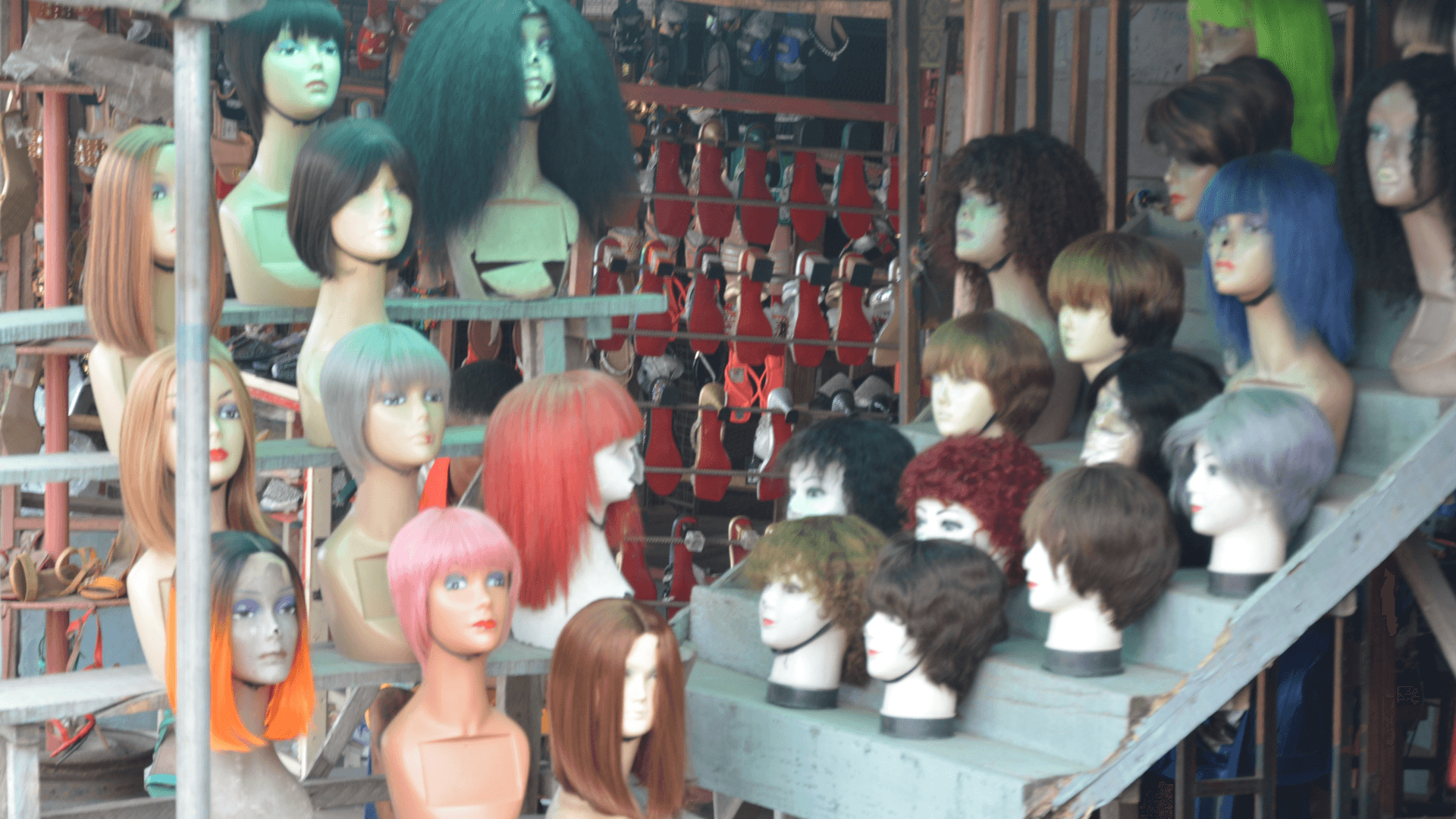
Hero image: Wig collection, by Photogbeleyi, CC BY-SA 4.0. Via Wikimedia Commons.
Take our professional IQ test
Want to know your IQ? Try the first ever professional online IQ test.