Breastfeeding and IQ: What the Best Studies Actually Show
Breastfeeding IQ studies find breastfed children score about 3 points higher on average, but sibling and randomized studies cut the gap to 1 point or less.
Dr. Russell T. WarneChief Scientist
Share
Breastfed children score about 3 IQ points higher than formula-fed children on average, according to the largest meta-analysis, but the gap shrinks when the mother's own IQ is controlled and falls to about 1 point or less in sibling comparisons and in a large randomized trial. The honest answer to the breastfeeding IQ question is that there may be a small real effect, most visible on verbal tests, and that most of the raw gap reflects differences between the families who breastfeed and those who do not.
This is one of the most studied questions in child development, and the studies disagree in a way that teaches a useful lesson about research design. This page covers the headline meta-analysis, the randomized trial, the sibling studies, why the raw gap is so easy to misread, and what the evidence does and does not tell an individual family.
What the largest studies find
The best-known summary is a 2015 meta-analysis by Bernardo Horta, Christian Loret de Mola and Cesar Victora. It pooled 17 studies with 18 estimates and found that breastfed participants scored 3.44 IQ points higher on average (95% confidence interval 2.30 to 4.58). That is about a quarter of a standard deviation. The authors only included studies that had adjusted for home stimulation or interaction, so this is already a partly adjusted figure.
The key number in that paper is the second one. In studies that also controlled for the mother's IQ, the advantage fell to 2.62 points (1.25 to 3.98). The authors concluded the association was probably causal, citing a randomized trial in support. Other researchers read the same drop as a sign that confounding explains much of the gap, which is the argument the rest of this page tests.
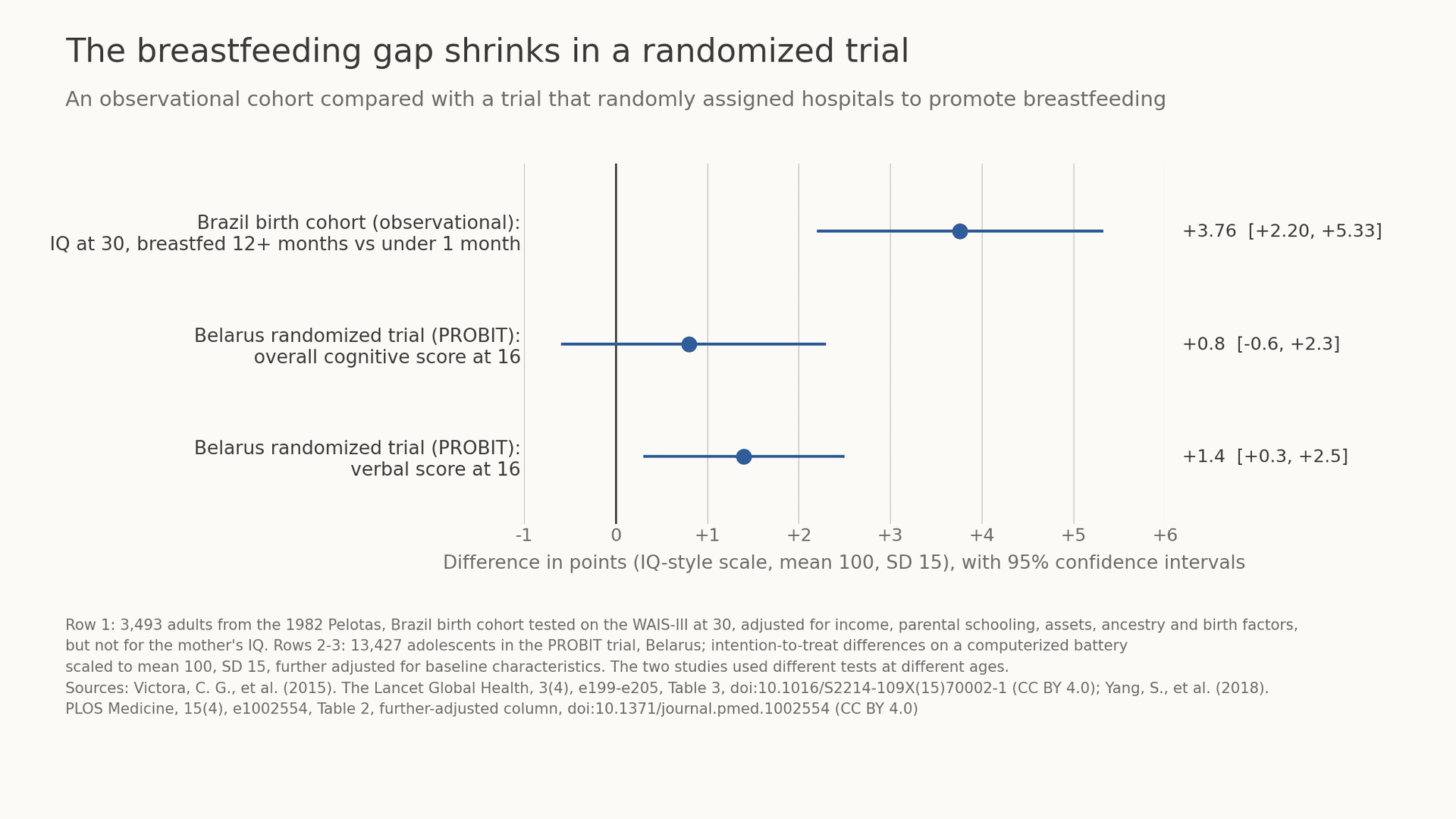
The longest follow-up comes from the 1982 birth cohort in Pelotas, Brazil, also led by Victora. Of 5,914 babies enrolled at birth, 3,493 took the Wechsler Adult Intelligence Scale at age 30. After adjustment for ten confounders, adults who had been breastfed for 12 months or more scored 3.76 points higher (2.20 to 5.33) than those breastfed for less than a month. The researchers chose Pelotas because, in 1982, breastfeeding there was not strongly tied to family wealth, which should reduce one major source of bias. Their adjustments did not include the mother's IQ.
The randomized trial: PROBIT
You cannot ethically assign babies to breastfeeding or formula. What you can do is randomize support for breastfeeding. The Promotion of Breastfeeding Intervention Trial (PROBIT) randomly assigned 31 Belarusian maternity hospitals and their clinics either to a breastfeeding promotion program modeled on the WHO and UNICEF Baby-Friendly Hospital Initiative or to usual care. It enrolled 17,046 healthy breastfeeding infants.
The program worked as intended. At 3 months, 43.3% of the program group were exclusively breastfed, compared with 6.4% of the control group. At age 6.5, Michael Kramer and colleagues reported that the program group scored higher on the Wechsler Abbreviated Scale of Intelligence: 7.5 points on verbal IQ (0.8 to 14.3), 2.9 on performance IQ (-3.3 to 9.1) and 5.9 on full-scale IQ (-1.0 to 12.8). Only the verbal difference was statistically clear. A later paper from the same team noted two weaknesses of that wave: test scores clustered heavily by clinic, and the pediatricians who gave the tests knew which group each child was in.
The age 16 follow-up, published by Seungmi Yang and colleagues in 2018, fixed both problems with a computerized, self-administered battery scaled like an IQ test (mean 100, standard deviation 15). It tested 13,427 adolescents, about 79% of those originally randomized. The overall cognitive score differed by 0.8 points (-0.6 to 2.3), and the only domains with a clear advantage were verbal function (1.4 points, 0.3 to 2.5) and memory (1.2 points, 0.01 to 2.4). The authors concluded there was no benefit of the program on overall neurocognitive function and that any lasting effect appeared to be limited to verbal skills and to shrink with age.
The chart above sets the Brazilian cohort estimate beside the trial's age 16 results. The two studies used different tests at different ages, so the comparison is rough, but the direction is clear.
Sibling studies and the maternal IQ problem
The strongest reason to doubt the raw gap is that the mothers who breastfeed differ from those who do not. Geoff Der, David Batty and Ian Deary showed this directly in 2006 using the 1979 U.S. National Longitudinal Survey of Youth, with 5,475 children of 3,161 mothers.
• Maternal IQ predicts breastfeeding: The mother's IQ predicted whether she breastfed better than her race, education, age, poverty, smoking, home environment or the child's birth weight did. A one standard deviation advantage in maternal IQ more than doubled the odds of breastfeeding.
• The gap mostly vanished with adjustment: Before adjustment, breastfed children scored about 4 points higher. After full adjustment the difference was 0.52 points (-0.19 to 1.23), small and not statistically significant.
• Siblings agreed: Comparisons of siblings who were and were not breastfed, plus a meta-analysis of studies that controlled for parental intelligence, pointed the same way.
Cynthia Colen and David Ramey extended the sibling design in 2014 with 8,237 children aged 4 to 14 from the same survey, including 1,773 children from 665 families in which one sibling was breastfed and another was not. Between families, breastfed children did better on 10 of 11 outcomes, including vocabulary and reading tests. Within families, the estimates shrank sharply (the vocabulary coefficient fell by 78%) and none remained statistically significant.
Sibling designs have their own limits. A mother may breastfeed one child and not another for reasons, such as a premature birth or illness, that also affect development. Even so, the pattern across designs is consistent: the more completely a study controls for family background, the smaller the breastfeeding IQ gap becomes.
Why the raw gap is so easy to misread
Parents who breastfeed for longer tend, in most high-income countries, to have more education, higher incomes and higher IQs on average. All three predict children's test scores through many routes, including genes the parents pass on, as twin studies have shown for decades. A simple comparison of breastfed and formula-fed children mixes the effect of milk with the effect of everything else those families share. The general link between IQ and socioeconomic status is the reason this matters.
Press coverage tends to report the raw or lightly adjusted number, and "breastfed babies are smarter" is a tidier headline than "the effect is between zero and a couple of points, depending on design." Both research teams discuss plausible biological routes for a small effect, such as the long-chain fatty acids in breast milk, and the separate question of whether fatty acid supplements help is covered in our page on diet, nutrition and IQ. The PROBIT authors also raise a social route, since breastfeeding may come with more verbal exchange and closer mother-infant interaction, which would fit the clearest effect showing up on verbal scores.
For context, a gap of 1 point is well inside the measurement error of any single IQ test, and the PROBIT authors noted that the effect at 16 was modest next to other influences such as the family's socioeconomic position. None of this changes the many other reasons health bodies recommend breastfeeding, which are outside the scope of an IQ article. Feeding decisions are best discussed with a pediatrician, midwife or lactation consultant.
Frequently asked questions
Does breastfeeding raise IQ?
It may raise it slightly. Observational studies find about 3 points, but the randomized PROBIT trial found about 1 point overall at age 16, with the clearest effect on verbal skills.
How many IQ points does breastfeeding add?
The 2015 meta-analysis put the average gap at 3.44 points, falling to 2.62 in studies that controlled for maternal IQ. Sibling studies and the randomized trial put the effect closer to 0 to 1.5 points.
Why do sibling studies find a smaller effect?
Siblings share the same mother, home and family income, so comparing them removes most of the background differences between families that breastfeed and families that do not. When those differences are removed, most of the gap goes with them.
Are formula-fed children less intelligent?
As a group, the difference is small and largely explained by family background, and it says nothing about any individual child. Many formula-fed children outscore breastfed ones.
Does breastfeeding for longer matter?
In the Brazilian cohort, the adjusted IQ gap at 30 grew with duration, from 0.4 points for 1 to 3 months of breastfeeding to 3.8 points for 12 months or more. That pattern comes from an observational study that did not adjust for maternal IQ, so it cannot show cause.
The takeaway
The breastfeeding IQ gap is real in the raw data and mostly explained by who breastfeeds. The best-controlled evidence, from sibling comparisons and the PROBIT randomized trial, leaves room for a small effect of about a point, mainly on verbal ability, and little support for the 3 to 7 point figures that circulate in headlines. Adult intelligence reflects a long list of genetic and environmental influences, and infant feeding is a minor one. If you are curious about your own reasoning abilities, you can take a full-length online IQ test built on modern norms.
References
1. Horta, B. L., Loret de Mola, C., & Victora, C. G. (2015). Breastfeeding and intelligence: A systematic review and meta-analysis. Acta Paediatrica, 104(S467), 14-19. [doi.org/10.1111/apa.13139](. doi.org
2. Victora, C. G., Horta, B. L., Loret de Mola, C., Quevedo, L., Pinheiro, R. T., Gigante, D. P., Gonçalves, H., & Barros, F. C. (2015). Association between breastfeeding and intelligence, educational attainment, and income at 30 years of age: A prospective birth cohort study from Brazil. The Lancet Global Health, 3(4), e199-e205. [doi.org/10.1016/S2214-109X(15)70002-1](. doi.org
3. Kramer, M. S., Aboud, F., Mironova, E., Vanilovich, I., Platt, R. W., Matush, L., Igumnov, S., Fombonne, E., Bogdanovich, N., Ducruet, T., Collet, J.-P., Chalmers, B., Hodnett, E., Davidovsky, S., Skugarevsky, O., Trofimovich, O., Kozlova, L., & Shapiro, S. (2008). Breastfeeding and child cognitive development: New evidence from a large randomized trial. Archives of General Psychiatry, 65(5), 578-584. [doi.org/10.1001/archpsyc.65.5.578](. doi.org
4. Yang, S., Martin, R. M., Oken, E., Hameza, M., Doniger, G., Amit, S., Patel, R., Thompson, J., Rifas-Shiman, S. L., Vilchuck, K., Bogdanovich, N., & Kramer, M. S. (2018). Breastfeeding during infancy and neurocognitive function in adolescence: 16-year follow-up of the PROBIT cluster-randomized trial. PLOS Medicine, 15(4), e1002554. [doi.org/10.1371/journal.pmed.1002554](. doi.org
5. Der, G., Batty, G. D., & Deary, I. J. (2006). Effect of breast feeding on intelligence in children: Prospective study, sibling pairs analysis, and meta-analysis. BMJ, 333(7575), 945. [doi.org/10.1136/bmj.38978.699583.55](. doi.org
6. Colen, C. G., & Ramey, D. M. (2014). Is breast truly best? Estimating the effects of breastfeeding on long-term child health and wellbeing in the United States using sibling comparisons. Social Science & Medicine, 109, 55-65. [doi.org/10.1016/j.socscimed.2014.01.027](. doi.org
Figure by RIOT IQ. Data from Victora et al. (2015), The Lancet Global Health 3(4), Table 3 (doi.org/10.1016/S2214-109X(15)70002-1), and Yang et al. (2018), PLOS Medicine 15(4), Table 2 (doi.org/10.1371/journal.pmed.1002554), both CC BY 4.0.
Take our professional IQ test
Want to know your IQ? Try the first ever professional online IQ test.