Air Pollution and IQ: How Much Does Dirty Air Lower Intelligence?
Air pollution and IQ: high prenatal exposure was linked to 4-point lower child IQ, and children at polluted schools gained about a third less in working memory.
Dr. Russell T. WarneChief Scientist
Share
Air pollution is linked to lower IQ and slower cognitive development, though the effects found so far are modest: in New York, children with high prenatal exposure to combustion pollutants scored about 4 points lower in IQ at age 5, and in Barcelona children at more polluted schools improved about a third less in working memory over a year. Studies of adults point the same way, with pollution on exam day lowering scores slightly and long-term exposure linked to faster decline in later life.
This page covers the prenatal and school studies, the natural experiments that come closest to proving cause, what pollution does to older adults, and the confounds that make the evidence harder to read than the headlines suggest.
What the studies of children show
The best-known prenatal study comes from Frederica Perera and colleagues at Columbia University. They fitted pregnant, non-smoking Black and Dominican-American women in New York City with personal air monitors to measure their exposure to "polycyclic aromatic hydrocarbons" (PAHs), a family of pollutants released when fossil fuel, tobacco and other organic material burn incompletely. Recruiting non-smokers removed the most obvious rival exposure, maternal smoking. At age 5, 249 of the children took the Wechsler Preschool and Primary Scale of Intelligence.
Children whose mothers' exposure was above the median scored 4.31 points lower in full-scale IQ and 4.67 points lower in verbal IQ than less-exposed children. That was after adjustment for the mother's own intelligence, the quality of the home environment, exposure to tobacco smoke and other factors, which matters because parents' IQ is passed on to children through both genes and upbringing.
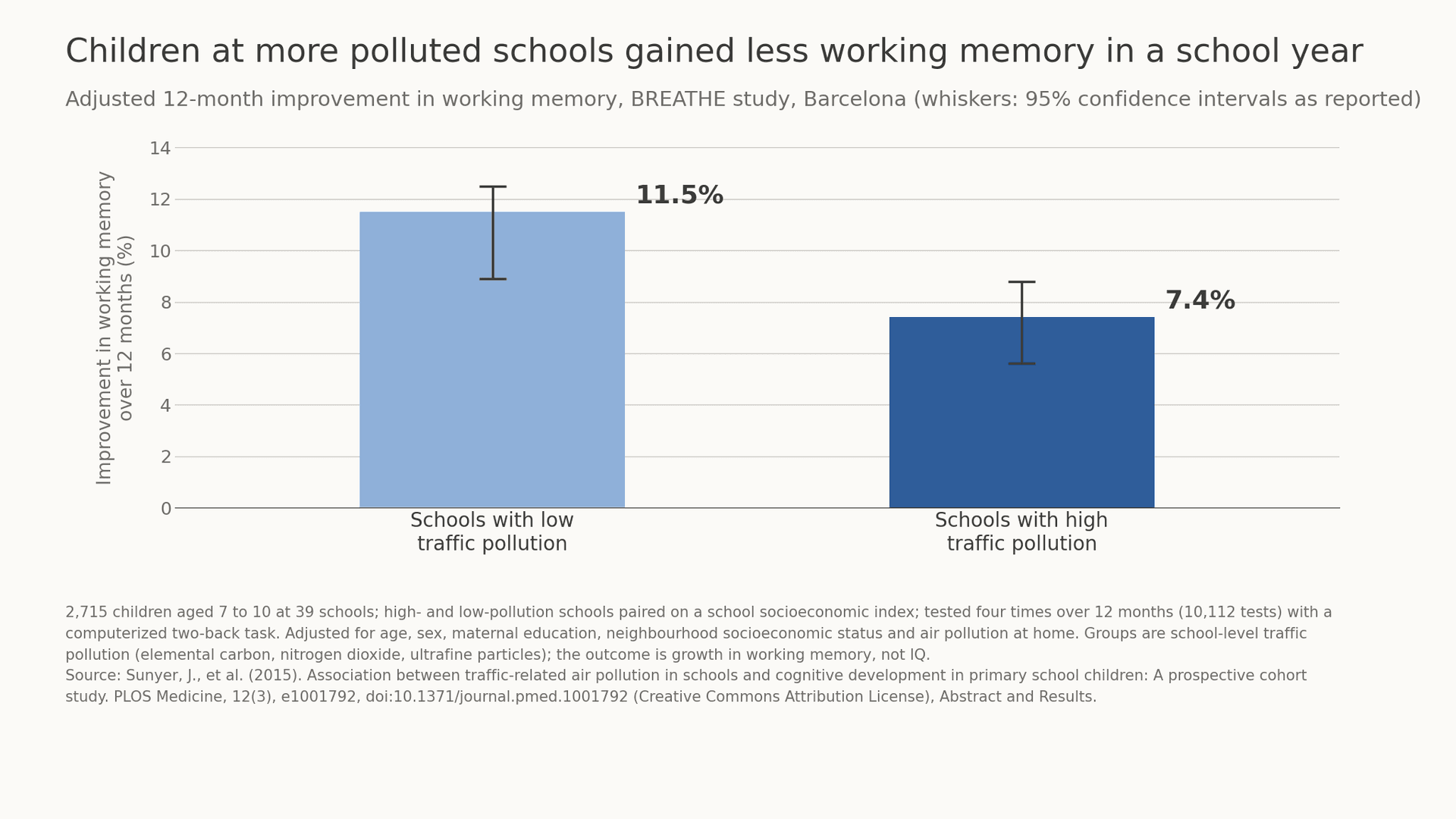
The BREATHE study in Barcelona looked at schools rather than homes. Jordi Sunyer and colleagues tested 2,715 children aged 7 to 10 at 39 schools four times over a year. Schools were recruited in pairs, one with high and one with low traffic pollution, matched on a school socioeconomic index. Children at the more polluted schools improved 7.4% in working memory over the 12 months, compared with 11.5% at the cleaner schools, as the chart above shows. Moving from the cleanest quarter of classrooms to the most polluted quarter, measured by indoor elemental carbon (which in Barcelona comes almost entirely from diesel vehicles), cut the gain in working memory by 13%.
Two cautions apply to both studies. Neither measured full-scale IQ in a large representative sample, and both are observational, so families who live or study in polluted places may differ in other ways. In BREATHE the high-pollution schools had more children of foreign origin (19% against 11%) and fewer mothers with a university degree (55% against 62%), although the authors adjusted for maternal education and the results held in several sensitivity analyses.
Natural experiments: what happens when the air gets cleaner
Observational studies cannot fully rule out confounding, so researchers have looked for situations in which pollution changed for reasons unrelated to the people breathing it.
• Air filters in Los Angeles schools: The Aliso Canyon gas leak near Los Angeles, the largest in US history, ran from October 2015 to February 2016. At the end of January 2016 the gas company and the Los Angeles Unified School District placed air filters in every classroom of the schools within five miles of the leak, 1,756 filters across 18 schools, and in none beyond. Michael Gilraine compared schools just inside the five-mile line with those just outside and found that mathematics and English scores rose by about 0.20 standard deviations. Natural gas was not detected inside the schools, so he concluded the filters worked by removing ordinary pollutants.
• Pollution on exam day in Israel: Avraham Ebenstein, Victor Lavy and Sefi Roth compared the same students across the multiple high-stakes matriculation exams they sat between 2000 and 2002. On days with more fine particulate pollution (PM2.5) students scored lower, by about 4% of a standard deviation for each standard-deviation rise in pollution. Because the exam results count toward university admission, students who happened to sit them on polluted days had less post-secondary education and lower earnings by 2010.
These designs are much harder to explain away, and they show that pollution affects test performance. They measure school achievement and exam scores rather than IQ, and the Israeli effect is a temporary dip on the day of the test. A 0.20 standard-deviation gain is equivalent to 3 points on a 15-point scale, which would be large for an IQ change, so the filter result should be read as a gain in learning and test performance rather than in measured intelligence.
Air pollution and the ageing brain
The brain may be vulnerable again in later life. Xin Zhang, Xi Chen and Xiaobo Zhang matched a nationally representative longitudinal survey in China to air-quality readings at the exact time and place of each person's cognitive tests. Long-term exposure lowered verbal and mathematics scores, and the verbal effect grew with age, especially for men and the less educated. The authors estimated that cutting annual PM10 to the US Environmental Protection Agency standard of 50 micrograms per cubic metre would move a person from the median to the 63rd percentile on the verbal test and to the 58th percentile in mathematics. By our conversion, the verbal shift is about a third of a standard deviation.
In the United States, Jennifer Weuve and colleagues followed 19,409 women aged 70 to 81 in the Nurses' Health Study. Each additional 10 micrograms per cubic metre of long-term PM2.5 exposure was linked to faster decline over two years, a difference the authors equated to being about two years older. A systematic review of 18 studies led by Melinda Power found that almost all reported at least one harmful association between a pollutant and a dementia-related outcome, and judged that unmeasured confounding was unlikely to explain them. The same review noted that few studies tracked change within the same person, the kind of evidence that best supports cause.
Confounds and how big the effect really is
Air pollution belongs on any list of environmental factors that influence IQ, but the size of its effect in everyday conditions is still uncertain. The main problems:
• Social class: where families live and which schools children attend are tied to income and parental education, which predict test scores on their own, and studies can only partly adjust for them.
• Parental IQ: few studies can adjust for it; the New York PAH study did, which is part of why it is cited so often.
• Mixed exposures: traffic brings noise along with particles, which is why BREATHE measured classroom noise and adjusted for it. Leaded petrol once added lead to exhaust as well, and lead's effect on IQ is covered in our page on lead exposure.
• Outcome: many studies measure working memory, attention or school grades rather than full-scale IQ, so their results cannot simply be translated into IQ points.
Parents worried about a child's development should speak to a paediatrician, and adults concerned about memory or thinking should see a GP.
Frequently asked questions
Does air pollution lower IQ?
The evidence suggests it can. A New York study found that children with high prenatal exposure to combustion-related PAHs scored about 4 points lower in IQ at age 5, and studies of older adults link long-term exposure to faster cognitive decline.
How much IQ do you lose from air pollution?
Nobody knows a single number. The New York estimate of about 4 points compares high and low exposure in one city, and other studies measure working memory or school scores rather than IQ.
Does PM2.5 affect the brain?
Studies link PM2.5 to lower exam scores on polluted days and faster decline in older women. In the Nurses' Health Study, each 10 micrograms per cubic metre was associated with decline equal to about two years of ageing.
Do air purifiers improve test scores?
In Los Angeles, schools that received classroom air filters after a gas leak saw mathematics and English scores rise by about 0.20 standard deviations compared with similar schools just outside the five-mile zone. That is one natural experiment, and it measured achievement rather than IQ.
Is air pollution worse for children or adults?
Both groups appear vulnerable. The strongest concern is for exposure before birth and in childhood, while the brain is developing, and again in later life, when long-term exposure is linked to faster decline.
The takeaway
Air pollution is one of the more credible environmental influences on cognition, but the effects are smaller and less certain than headlines suggest. The best estimates are about 4 IQ points for high prenatal exposure in one New York cohort, slower working-memory growth in Barcelona schoolchildren, a temporary dip on polluted exam days and somewhat faster decline in later life. The natural experiments with air filters and exam days show that cleaner air helps test performance, which is reason enough to take it seriously. If you would like a careful measure of your own reasoning abilities, try an online IQ test built by psychometricians.
References
1. Perera, F. P., Li, Z., Whyatt, R., Hoepner, L., Wang, S., Camann, D., & Rauh, V. (2009). Prenatal airborne polycyclic aromatic hydrocarbon exposure and child IQ at age 5 years. Pediatrics, 124(2), e195-e202. [doi.org/10.1542/peds.2008-3506](. doi.org
2. Sunyer, J., Esnaola, M., Alvarez-Pedrerol, M., Forns, J., Rivas, I., López-Vicente, M., Suades-González, E., Foraster, M., Garcia-Esteban, R., Basagaña, X., Viana, M., Cirach, M., Moreno, T., Alastuey, A., Sebastian-Galles, N., Nieuwenhuijsen, M., & Querol, X. (2015). Association between traffic-related air pollution in schools and cognitive development in primary school children: A prospective cohort study. PLOS Medicine, 12(3), e1001792. [doi.org/10.1371/journal.pmed.1001792](. doi.org
3. Gilraine, M. (2020). Air filters, pollution, and student achievement (EdWorkingPaper No. 20-188). Annenberg Institute at Brown University. [edworkingpapers.com](. edworkingpapers.com
4. Ebenstein, A., Lavy, V., & Roth, S. (2016). The long-run economic consequences of high-stakes examinations: Evidence from transitory variation in pollution. American Economic Journal: Applied Economics, 8(4), 36-65. [doi.org/10.1257/app.20150213](. doi.org
5. Zhang, X., Chen, X., & Zhang, X. (2018). The impact of exposure to air pollution on cognitive performance. Proceedings of the National Academy of Sciences, 115(37), 9193-9197. [doi.org/10.1073/pnas.1809474115](. doi.org
6. Weuve, J., Puett, R. C., Schwartz, J., Yanosky, J. D., Laden, F., & Grodstein, F. (2012). Exposure to particulate air pollution and cognitive decline in older women. Archives of Internal Medicine, 172(3), 219-227. [doi.org/10.1001/archinternmed.2011.683](. doi.org
7. Power, M. C., Adar, S. D., Yanosky, J. D., & Weuve, J. (2016). Exposure to air pollution as a potential contributor to cognitive function, cognitive decline, brain imaging, and dementia: A systematic review of epidemiologic research. NeuroToxicology, 56, 235-253. [doi.org/10.1016/j.neuro.2016.06.004](. doi.org
Figure by RIOT IQ. Data from Sunyer et al. (2015), PLOS Medicine 12(3), e1001792 (doi.org/10.1371/journal.pmed.1001792), Creative Commons Attribution License.
Take our professional IQ test
Want to know your IQ? Try the first ever professional online IQ test.