Jun 19, 2026·Average IQ & DemographicsTop 10 Environmental Factors That Influence IQ
Can your environment change your intelligence? Discover the top 10 factors that impact IQ scores. Read the full article and take the RIOT IQ test today!
Dr. Russell T. WarneChief Scientist
The science of intelligence has made one fact very clear over the past century: genes matter enormously for IQ, but they are not the whole story. Heritability estimates for intelligence typically fall between 50% and 60% in adults — meaning that roughly half of the variation in IQ scores among people in typical, non-deprived environments is explained by genetic differences. The other half is explained by the environment.
That environmental half is the subject of this article. Some environmental influences on IQ are dramatic — raising or lowering scores by a dozen points or more. Others are subtler. Some operate before birth; others accumulate across childhood. Some are reversible; many are not. Understanding which factors matter — and by how much — is essential for anyone trying to think clearly about intelligence.
This article focuses on factors that have genuine scientific evidence behind them. That means large, well-designed studies, meta-analyses where they exist, and replication across different populations. It does not mean cherry-picking dramatic claims from individual studies or overstating what the evidence supports. The goal is an accurate picture of what the research shows, not a motivational one.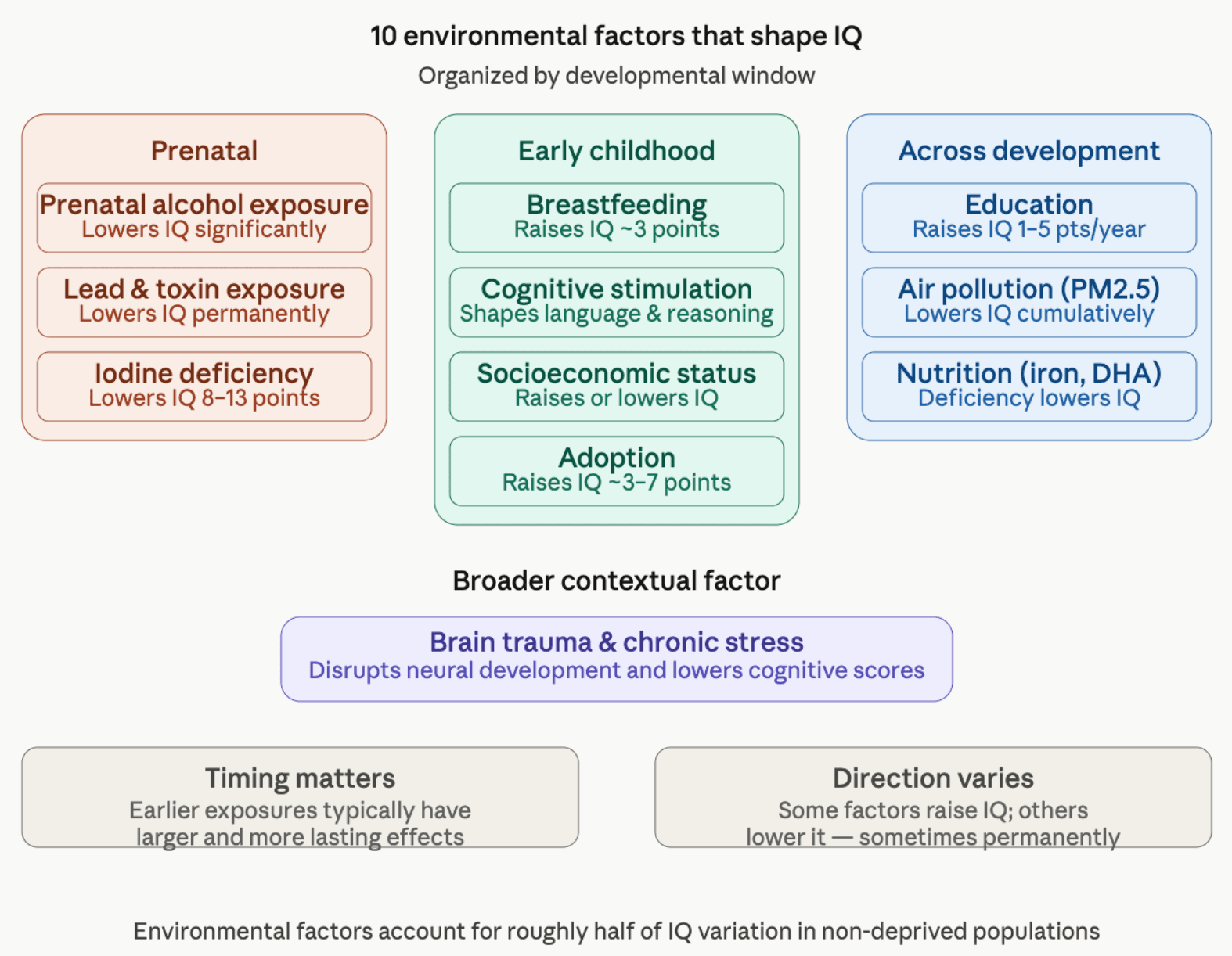 A few important qualifications before getting into the specific factors: First, the effects described here are averages across populations, not guarantees for individuals. Second, many of these factors co-occur and interact — a child raised in poverty is more likely to have multiple risk factors simultaneously, making it difficult to isolate any single cause. Third, for some factors, the evidence is causal; for others, it is strongly correlational but harder to establish as a direct cause. These distinctions are noted where they matter.
1. Education
Of all the environmental influences on IQ, formal schooling has the strongest and most consistent evidence behind it. A major meta-analysis by Ritchie and Tucker-Drob, covering 42 data sets and over 600,000 participants, found that each additional year of schooling is associated with an increase of approximately 1 to 5 IQ points, with a central estimate around 3.4 points per year. This is not merely a correlation between smarter students staying in school longer — the researchers used quasi-experimental designs (including compulsory schooling laws and school entry cutoff dates) that allow for causal inference. The mechanism likely involves a combination of direct cognitive practice — working with abstract information, solving novel problems, holding instructions in working memory — alongside the exposure to scientific and logical reasoning that schools transmit. Interestingly, the gains appear to be somewhat stronger in the earlier years of schooling, which aligns with what is known about sensitive periods in cognitive development. Later years of schooling continue to benefit IQ, but the returns are somewhat smaller.
One important caveat: it is not entirely clear how much of the schooling-related IQ gain reflects genuine increases in general intelligence versus increases in specific academic skills that also appear on IQ tests — what intelligence researchers call "hollow gains," where the score rises without a corresponding rise in underlying reasoning ability. Schooling likely operates through both pathways to some degree. Still, the effect is real, replicable, and large enough to matter for real-world outcomes.
2. Lead exposure
Lead is the best-studied environmental neurotoxin with respect to IQ. The evidence that childhood lead exposure lowers intelligence is overwhelming, and it has been accumulating since the 1970s. A landmark meta-analysis found that an increase in blood lead from 10 to 20 micrograms per deciliter (µg/dL) is associated with a loss of approximately 2.6 IQ points. A long-term study following 565 children into adulthood found that for every 5 µg/dL increase in childhood blood lead, a person lost about 1.5 IQ points by age 38 — along with measurable declines in occupational status. The population-level consequences are staggering. A 2022 study published in PNAS estimated that as of 2015, more than half of all Americans alive had been exposed to clinically concerning levels of lead in childhood — a consequence of leaded gasoline use in the mid-20th century. The researchers calculated that this exposure cost the U.S. population an estimated 824 million IQ points in total, or nearly three points per person on average. Those born during peak leaded-gasoline use in the 1960s may have lost as many as six IQ points on average; children with the highest exposures lost even more. The mechanism is direct neurotoxicity. Lead interferes with synapse formation, disrupts neurotransmitter systems, and causes oxidative damage in the developing brain. Unlike some other environmental influences, the IQ losses from lead exposure are largely irreversible once sustained. The policy lesson — removing lead from gasoline, paint, and drinking water — is one of the clearest examples of an environmental intervention with measurable cognitive benefits at the population level.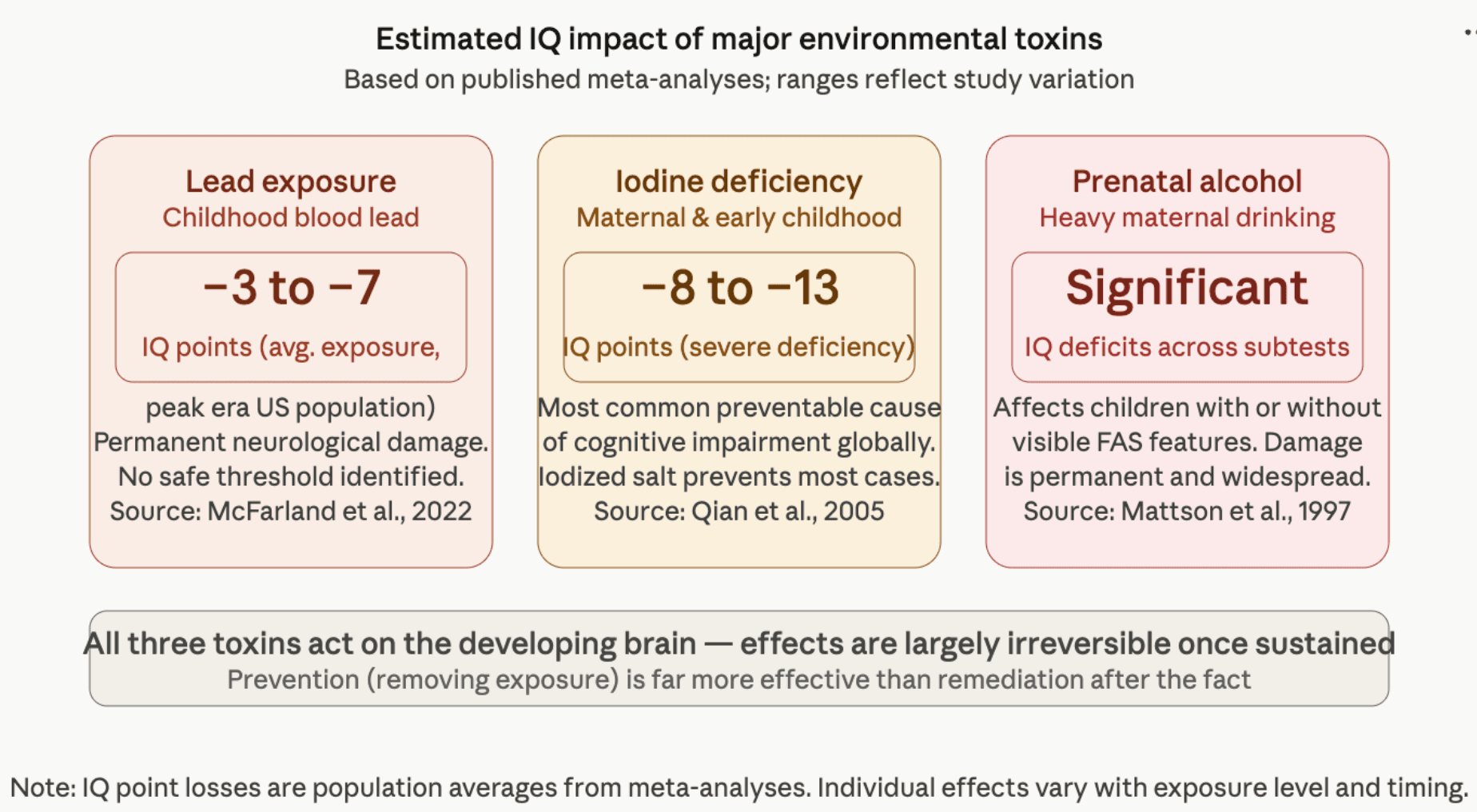
3. Iodine deficiency
Iodine deficiency is the most common preventable cause of cognitive impairment in the world, yet it receives far less attention in Western discussions of IQ and environment than lead or education. Iodine is essential for the production of thyroid hormones, which play a critical role in fetal brain development and the myelination of nerve fibers. When a pregnant woman or young child does not get enough iodine, the consequences for cognitive development can be severe and permanent.
A meta-analysis of studies conducted in China found that severe iodine deficiency was associated with a loss of approximately 12.45 IQ points in affected children. A broader review of studies covering children under five estimated that iodine-deficient children score between 8 and 13 IQ points lower than iodine-adequate peers, depending on the severity of the deficiency and the timing of exposure. The effects are largest when iodine deficiency occurs during the first trimester of pregnancy, when the fetal brain is in its most rapid developmental phase. The good news is that iodine deficiency is almost entirely preventable through iodized salt programs, which have been highly effective in countries that have implemented them. In regions where iodization programs have been introduced, subsequent birth cohorts show measurable IQ gains. This is one of the clearest examples of a simple, low-cost public health intervention producing large cognitive benefits at the population level.
4. Prenatal alcohol exposure
Alcohol is a well-established teratogen — a substance that disrupts fetal development — and its effects on the developing brain are among the most studied in all of developmental neuroscience. Heavy prenatal alcohol exposure causes a spectrum of outcomes collectively known as fetal alcohol spectrum disorders (FASD), ranging from full fetal alcohol syndrome (FAS) with characteristic facial features and growth deficiencies to subtler cognitive and behavioral impairments in children without visible physical signs.
Critically, research comparing children with and without visible FAS features found that both groups showed significant IQ deficits relative to matched controls. The absence of FAS features does not mean the developing brain was unaffected. A hierarchical meta-analysis combining data from six large U.S. longitudinal cohorts with over 2,200 participants confirmed that prenatal alcohol exposure is associated with impairments in IQ, memory, executive function, and sustained attention — after controlling for potential confounders. The mechanism involves alcohol crossing the placental and blood-brain barriers to directly disrupt neural development, including synaptogenesis, neurogenesis, and the formation of key brain structures such as the corpus callosum and cerebellum. The damage accumulates throughout the pregnancy, with no established safe level of alcohol consumption during gestation. This is one of the few environmental risk factors for which the effect is clear enough to support an unambiguous public health recommendation.
5. Breastfeeding
The relationship between breastfeeding and cognitive development has been studied extensively for several decades, and the findings are remarkably consistent. A meta-analysis of 17 studies published in Acta Paediatrica by Horta and colleagues found that breastfed children achieved IQ scores averaging 3.44 points higher than non-breastfed children. Importantly, studies that controlled for maternal IQ — an important confounder, since more intelligent mothers are both more likely to breastfeed and to pass on high-IQ genes — still found a benefit of approximately 2.6 points. Evidence from a randomized controlled trial of breastfeeding promotion further supports a causal interpretation. The biological mechanism likely involves long-chain polyunsaturated fatty acids in breast milk, particularly docosahexaenoic acid (DHA) and arachidonic acid (AA). These fatty acids are critical components of brain cell membranes and play a central role in brain development — a point that also has implications for the nutrition discussion later in this article. Formula-fed infants tend to have lower circulating concentrations of DHA, which may account for part of the cognitive gap.
Three points of nuance deserve mention. First, the effect size is modest — 2 to 3 points — and within the range of other environmental influences. Second, breastfeeding is correlated with many other positive parenting behaviors, so isolating its specific contribution is methodologically challenging. Third, access to breastfeeding and its duration are themselves influenced by socioeconomic factors, which complicates population-level comparisons.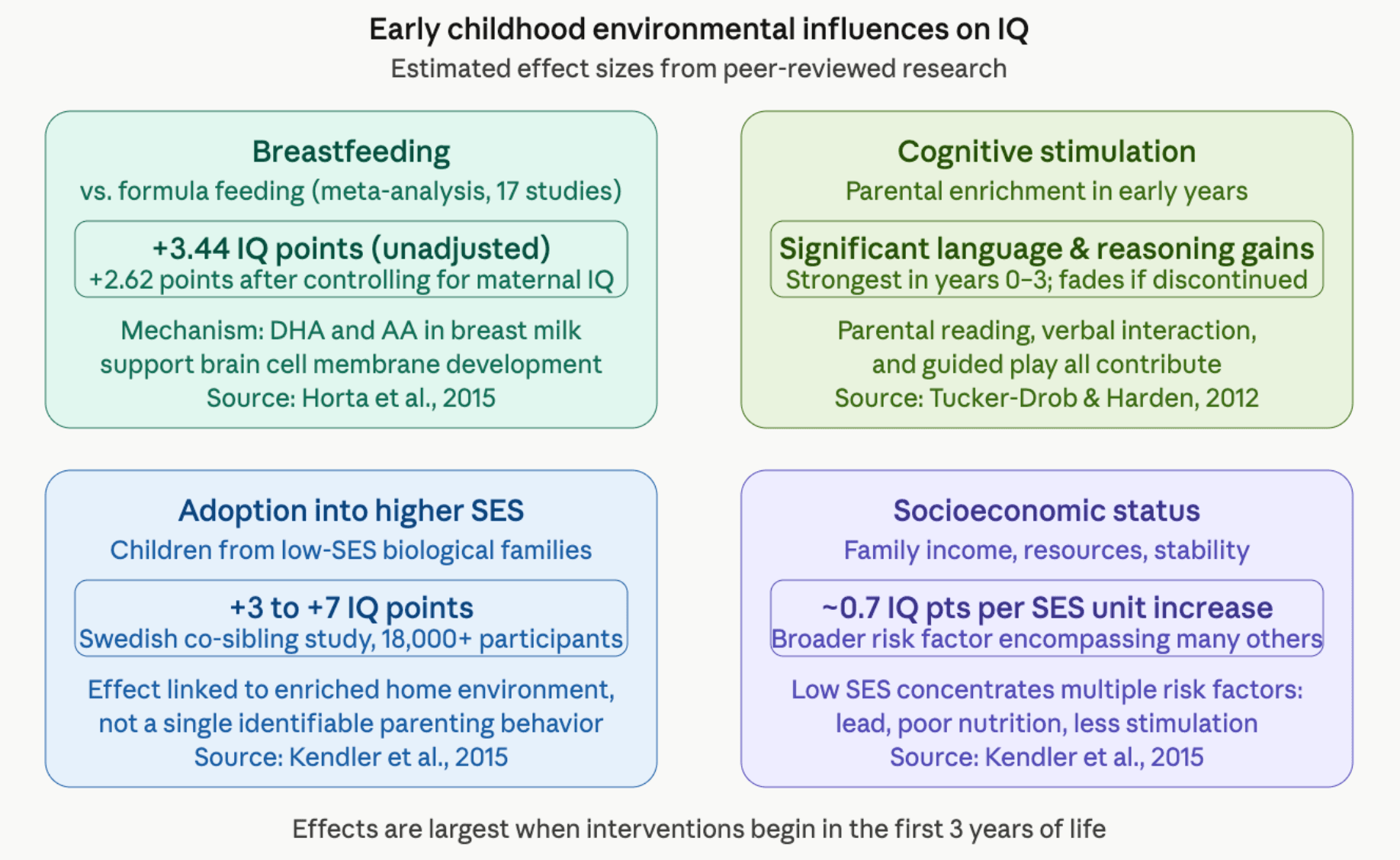
6. Cognitive stimulation in the home
The quality of cognitive stimulation a child receives in early life — through parental verbal interaction, access to books and learning materials, guided play, and educational engagement — is one of the most consistently identified environmental predictors of later IQ. This is distinct from formal schooling; it refers to what happens in the home environment before and alongside school.
Research using longitudinal data from 650 identical and fraternal twin pairs found that parental cognitive stimulation at age two predicted reading ability at age four, even after controlling for the child's own cognitive ability at two. The effect operated through a family-level environmental pathway — not through genetic transmission — which strengthens the case for a causal role of parental behavior in shaping early cognitive development. The effects of early cognitive stimulation are largest in the first three years of life, when the brain is in its most rapid developmental phase and most sensitive to environmental input. The Jamaica Stimulation Study — which provided weekly home visits and structured play for stunted children aged 9 to 24 months — produced lasting gains in cognition, academic achievement, and adult earnings that persisted for at least 20 years. Notably, in the Jamaica study, cognitive stimulation and nutritional supplementation produced larger combined gains than either intervention alone, a finding taken up again in the discussion of nutrition below. Gains from stimulation programs tend to fade if enriched environments are not maintained, which suggests that sustained engagement matters more than any single intervention.
7. Socioeconomic status
Socioeconomic status (SES) — encompassing family income, parental education, neighborhood quality, and access to resources — is perhaps the broadest environmental predictor of IQ in childhood. It is less a single cause and more an umbrella variable that bundles together many of the other factors on this list: families in poverty are more likely to be exposed to environmental lead, less likely to have access to high-quality nutrition, more likely to experience chronic stress, and less likely to provide cognitively stimulating home environments.
The Swedish co-sibling adoption study published in PNAS, using data from over 18,000 participants, estimated that each unit increase on a standardized SES scale is associated with approximately 0.7 additional IQ points. That same study is discussed in greater detail in the section on adoption below, since it was specifically designed to separate SES effects from genetic inheritance. A French cross-fostering study found that children adopted into higher-SES homes from low-SES origins had IQs averaging about 12–15 points higher in adolescence than those adopted into lower-SES homes. What makes SES tricky to interpret is precisely this bundling problem. When researchers try to identify which specific features of SES-enriched environments raise IQ, the results are frustratingly diffuse. Higher-SES families differ from lower-SES families in dozens of ways simultaneously — neighborhood safety, school quality, exposure to toxins, nutritional resources, parenting style, access to healthcare — and disentangling these individual contributions has proven very difficult. The practical implication is that improving children's environments probably requires addressing multiple risk factors simultaneously rather than optimizing any single one.
8. Adoption
Adoption studies are one of the most powerful research designs available for studying environmental effects on IQ, because they allow researchers to separate genetic inheritance from the rearing environment. When children with low-SES biological parents are adopted into higher-SES homes, researchers can observe what happens to cognitive development when genes are held roughly constant while the environment improves substantially.
The evidence is consistent: adoption into enriched environments raises IQ. As noted above, the PNAS co-sibling study estimated an average IQ gain of approximately 3 IQ points from adoption into a more prosperous home. The French late adoption study found that children with borderline IQs (below 86) who were adopted after early childhood into higher-SES homes averaged IQs of about 98 in adolescence, compared to 85 for their counterparts in lower-SES adoptive homes — a gap of about 13 points. The adoption design is what makes these estimates credible: it is not that smarter children were selected into better homes, but that children with similar genetic backgrounds diverged cognitively as a function of the environment they were raised in. It is worth noting that psychologists do not know exactly what adoptive families are doing that raises their children's IQ. The improvement is real and replicable, but isolating the specific parenting behaviors, neighborhood features, or resource access that drive it has not been achieved. The best summary advice for raising IQ through environmental means remains something close to "live in a home that would qualify to adopt a child" — which is a real finding, but an unsatisfying one from a policy standpoint.
9. Air pollution (PM2.5)
Air pollution is a more recently recognized environmental threat to cognitive development, and the research has grown substantially in the past decade. A 2024 systematic review and meta-analysis examined six studies across geographically diverse populations and found that each 1 µg/m³ increase in fine particulate matter (PM2.5) concentration is associated with a 0.27-point decrease in full-scale IQ in children. Every single study in the review found a negative association between PM2.5 exposure and cognitive function. To put that figure in context: the World Health Organization's guideline for annual average PM2.5 exposure is 5 µg/m³, yet the WHO estimates that 99% of the world's population breathes air exceeding this threshold. The average PM2.5 concentration across the studies in the meta-analysis was 30.4 µg/m³ — more than six times the WHO guideline. The IQ consequences at that level of exposure are not trivial.
The mechanism involves PM2.5 particles — which are small enough to penetrate deep into the lungs and enter the bloodstream — crossing the blood-brain barrier, likely via the olfactory bulb. Once in the brain, they trigger neuroinflammation, disrupt white matter development, and may contribute to long-term neurodegenerative processes. Children are particularly vulnerable because they breathe faster relative to their body size, and because their brains are still developing through adolescence. Prenatal and early childhood exposures appear to carry the largest long-term cognitive consequences.
10. Nutrition (iron, DHA, and general undernutrition)
Beyond iodine, several other nutritional factors have documented effects on cognitive development and IQ. The two most well-supported are iron and docosahexaenoic acid (DHA).
Iron deficiency is the most common micronutrient deficiency worldwide, and it has particularly serious consequences for the developing brain. Iron plays a critical role in myelination and in the synthesis of dopamine and serotonin — neurotransmitters essential for attention and learning. Severe iron deficiency anemia in infancy is associated with measurable deficits in cognitive development that can persist even after iron status is corrected, suggesting that there are sensitive windows during which the deficiency does irreversible harm.
DHA is the fatty acid introduced in the context of breastfeeding. Its role in brain development extends beyond the breast milk question: adequate DHA intake during the third trimester of pregnancy and the first two years of life matters regardless of feeding method. Inadequate DHA intake during these periods is associated with poorer performance on measures of cognitive and visual development, and ensuring sufficient prenatal DHA is a meaningful nutritional target even for families who formula-feed.
More broadly, protein-energy malnutrition in the first two years of life impairs brain growth directly. As noted in the discussion of cognitive stimulation, the Jamaica Stimulation Study found that nutritional supplementation and cognitive enrichment combined produced larger gains than either alone — evidence that these factors interact rather than simply add together.
A Note on Two Additional Factors: Brain Trauma and Chronic Stress
Brain trauma and chronic early-life stress deserve mention alongside the primary ten, though they are harder to quantify with the same precision.
Traumatic brain injury (TBI) from accidents, physical abuse, or sports injuries can directly lower IQ by destroying neurons and disrupting white matter connectivity. The effects are severity-dependent, and injuries sustained before age three tend to carry the largest long-term cognitive consequences, even though younger brains show greater plasticity overall. Moderate-to-severe TBI is associated with measurable IQ declines that can persist for years, though neuropsychological rehabilitation may help partially.
Chronic early-life stress — including poverty, neglect, abuse, and family instability — affects cognitive development through different pathways. The primary mechanism involves dysregulation of the hypothalamic-pituitary-adrenal (HPA) axis and elevated cortisol. Chronically elevated cortisol damages the hippocampus and impairs the prefrontal cortex systems that govern working memory and executive function. Extreme early neglect — documented most extensively in studies of children raised in institutional care settings — is associated with severe IQ deficits, though some recovery is possible with early placement into enriched family environments.
What the Pattern Reveals
Looking across all ten of these factors, several themes emerge.
First, timing matters. Many of the largest effects — prenatal alcohol exposure, lead poisoning, iodine deficiency, early cognitive stimulation — operate most powerfully during the prenatal period and the first three years of life. The developing brain is not uniformly sensitive to environmental inputs throughout childhood; there are critical and sensitive windows during which disruptions cause disproportionately large and often irreversible harm.
Second, the distinction between factors that raise IQ and factors that lower it is asymmetric in an important sense. Negative environmental factors — toxins, deficiencies, trauma — can produce large drops in IQ, sometimes exceeding 10 to 15 points under severe conditions. Positive environmental factors — enriched homes, breastfeeding, schooling — tend to produce smaller and more gradual gains. This asymmetry suggests that the environment plays a larger role in preventing cognitive harm than in actively raising intelligence above a genetically set ceiling.
Third, these factors rarely operate in isolation. Low-SES children are more likely to be exposed to environmental lead, less likely to receive cognitively stimulating parenting, more likely to experience nutritional deficiencies, and more likely to experience chronic stress. The IQ gaps observed across socioeconomic groups are almost certainly the product of these overlapping environmental disadvantages accumulating across development, not any single factor in isolation.
Understanding IQ as a Measured Outcome
IQ scores are not a perfect window into underlying cognitive ability — they are measurements made under particular conditions and circumstances. Environmental factors can influence IQ scores by genuinely changing the underlying cognitive abilities being measured, or through the hollow gains discussed in the education section — where the score rises without a corresponding rise in underlying reasoning ability. Lead exposure and prenatal alcohol are more likely to impair actual cognitive ability directly; education's effects are probably a mixture of both.
This distinction matters for how results are interpreted, but it does not diminish the practical significance of the research. Whether a child's measured IQ is 15 points lower due to lead poisoning because their neurons were damaged, or due to some artifact in measurement, the consequences for their educational prospects and life outcomes are real and measurable. IQ scores, despite their imperfections, are among the most valid and well-validated measurements in all of psychology — and the environmental factors that depress them deserve to be taken seriously.
Measuring Intelligence Accurately
Understanding the environmental factors that shape intelligence makes one thing clear: IQ scores obtained under meaningful conditions, using a well-constructed professional test, carry real information about a person's cognitive functioning. That information is worth having — whether someone is trying to understand their own cognitive profile, a parent is trying to understand a child's abilities, or a clinician is conducting a comprehensive psychological assessment.
The Reasoning and Intelligence Online Test (RIOT) was developed to bring that kind of professional-quality measurement to the online environment for the first time. Created after 15 years of research in intelligence testing and psychometrics, it was designed to meet the standards set by the American Educational Research Association, American Psychological Association, and the National Council on Measurement in Education — the same standards applied to traditional in-person IQ tests. Its norm sample is representative of the U.S. population, which means scores can be meaningfully interpreted against a real baseline rather than against whoever happened to seek out a test online.
Sources
Ritchie, S. J., & Tucker-Drob, E. M. (2018). How much does education improve intelligence? A meta-analysis. Psychological Science, 29(8), 1358–1369. https://doi.org/10.1177/0956797618774253 McFarland, M. J., et al. (2022). Half of US population exposed to adverse lead levels in early childhood. PNAS, 119(11). https://doi.org/10.1073/pnas.2118631119 Reuben, A., et al. (2017). Association of childhood blood lead levels with cognitive function and socioeconomic status at age 38 years and lifetime economic outcomes. JAMA, 317(12), 1244–1251. https://doi.org/10.1001/jama.2017.1712 Schwartz, J. (1994). Low-level lead exposure and children's IQ: A meta-analysis and search for a threshold. Environmental Research, 65(1), 42–55. https://pubmed.ncbi.nlm.nih.gov/8162884/ Horta, B. L., et al. (2015). Breastfeeding and intelligence: A systematic review and meta-analysis. Acta Paediatrica, 104(S467), 14–19. https://onlinelibrary.wiley.com/doi/10.1111/apa.13139 Qian, M., et al. (2005). The effects of iodine on intelligence in children: A meta-analysis of studies conducted in China. Asia Pacific Journal of Clinical Nutrition, 14(1), 32–42. https://pubmed.ncbi.nlm.nih.gov/15734706/ Grantham-McGregor, S., et al. (1997). Nutritional supplementation, psychosocial stimulation, and mental development of stunted children: The Jamaican Study. The Lancet. https://www.povertyactionlab.org/policy-insight/encouraging-early-childhood-stimulation-parents-and-caregivers-improve-child Tucker-Drob, E. M., & Harden, K. P. (2012). Early childhood cognitive development and parental cognitive stimulation: Evidence for reciprocal gene-environment transactions. Developmental Science, 15(2), 250–259. https://pubmed.ncbi.nlm.nih.gov/22356180/ Kendler, K. S., et al. (2015). Family environment and the malleability of cognitive ability: A Swedish national home-reared and adopted-away cosibling control study. PNAS, 112(15), 4612–4617. https://doi.org/10.1073/pnas.1417106112 Duyme, M., et al. (1999). How can we boost IQs of "dull children"? A late adoption study. PNAS, 96(15), 8790–8794. https://doi.org/10.1073/pnas.96.15.8790 Mattson, S. N., et al. (1997). Heavy prenatal alcohol exposure with or without physical features of fetal alcohol syndrome leads to IQ deficits. Journal of Pediatrics, 131(5), 718–721. https://doi.org/10.1001/archpedi.1997.02170380014003 Eckhardt, C. L., et al. (2021). Effects of prenatal alcohol exposure on cognitive and behavioral development: Findings from a hierarchical meta-analysis of data from six prospective longitudinal U.S. cohorts. Alcoholism: Clinical and Experimental Research. https://www.ncbi.nlm.nih.gov/pmc/articles/PMC8602737/ Gong, Q., et al. (2023). Iodine and mental development of children 5 years old and under: A systematic review and meta-analysis. Nutrients. https://www.ncbi.nlm.nih.gov/pmc/articles/PMC3705354/ Landrigan, P. J., et al. (2024). Quantifying the association between PM2.5 air pollution and IQ loss in children: A systematic review and meta-analysis. Environmental Health. https://www.ncbi.nlm.nih.gov/pmc/articles/PMC11572473/ Warne, R. T. (2025). Technical manual for the Reasoning and Intelligence Online Test, version 1.0. RIOT IQ.
Take our professional IQ test
Want to know your IQ? Try the first ever professional online IQ test.
AuthorDr. Russell T. WarneChief Scientist
