Why do some tests show an average IQ in India of 75 to 83? We explain cross-cultural testing challenges and why comparing Wechsler scores across nations is flawed.
Dr. Russell T. WarneChief Scientist
Share
For tests designed for use in India (such as the Indian versions of the Wechsler tests), the average IQ is 100. This is because IQ test creators set 100 as the average for the population that their test is designed for. So, the average Indian has an IQ of 100 when compared to others in India. The same is true for tests designed for other countries.
Because each country’s test is calibrated so that 100 is average for each nation, the scores from different tests designed for different countries are usually not comparable. For example, a 100 on the Mexican edition of the Wechsler Adult Intelligence Scale (WAIS) is not equivalent to a 100 on the Indian edition of the WAIS.
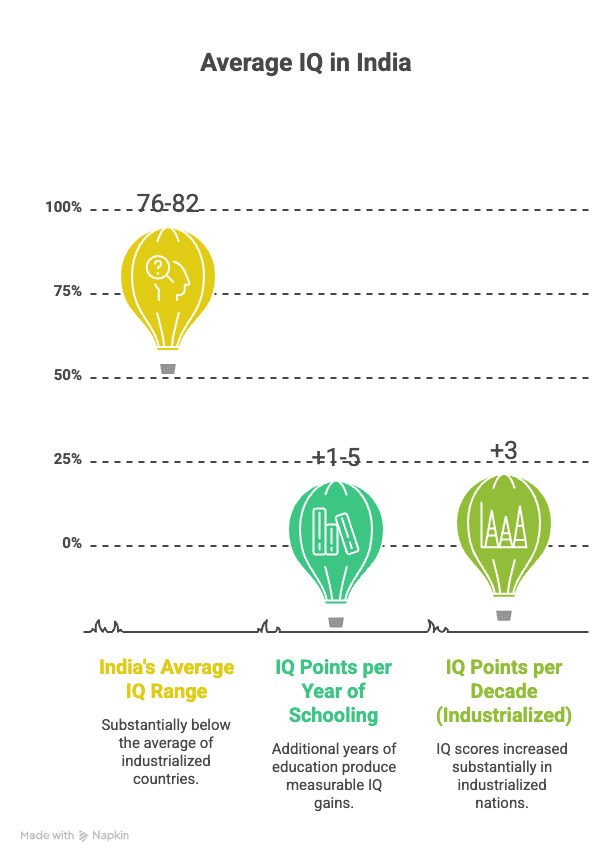
Even if the IQ estimates from non-verbal tests are seen as credible, the reported averages do not indicate that Indian populations have lower innate cognitive capacity. Intelligence experts all agree that IQ is partially the result of environmental influences. As the environment in India improves (through more schooling, better health, improved nutrition, etc.), it is reasonable to expect the average IQ in India to increase.
Regional variations follow similar patterns—states with better educational systems, higher economic development, and improved health indicators show higher average scores. Studies tracking Indian samples over time have shown score increases, known as theFlynn Effect, which are consistent with environmental improvements as educational access has expanded and the economic situation has improved.
How Should These IQs Be Interpreted?
Cross-national IQ data provide information about how populations perform on the formal, standardized tasks found on tests. The scores on these tests do correlate with a lot of important country characteristics, such as economic growth, educational indicators, national health and life expectancy, and more. These variables show that--all things being equal--it is better to have a population that can successfully solve these problems than one that can’t. There is a legitimate argument about whether this ability is the same as intelligence in some countries. Regardless of interpretation, national IQ scores are not fixed characteristics, but indicators of current abilities, which will likely change as those conditions improve.
Within India, IQ tests function as elsewhere—measuring cognitive abilities that predict educational and occupational outcomes. Individual Indians score across the full range of IQ scores, and the country produces world-class scientists, engineers, physicians, and scholars in every field. Population averages obscure the tremendous individual variation within any country.
For understanding individual cognitive abilities, professionally developed assessments provide meaningful information regardless of population averages. TheReasoning and Intelligence Online Test (RIOT) measures multiple cognitive abilities, providing detailed individual profiles. Developed by Dr. Russell T. Warne with over 15 years of experience in intelligence research, the RIOT meets professional standards established by the American Educational Research Association, American Psychological Association, and National Council on Measurement in Education, offering a meaningful assessment of individual abilities independent of national statistics.
Watch “What Your Genes Say About Your IQ: The Truth About Polygenic Scores” with Yujing Lin on the Riot IQ YouTube channel to explore factors researchers consider when studying IQ differences across populations.
Take our professional IQ test
Want to know your IQ? Try the first ever professional online IQ test.