What is the average IQ? The global mean is 100, with a normal IQ score falling between 85 & 115. Learn how standard deviation defines your intelligence ranking.
Dr. Russell T. WarneChief Scientist
Share
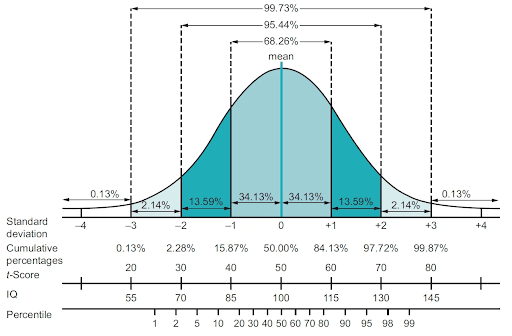
IQ tests are designed to have an IQ of 100 as the average score. Numbers below 100 are below the average, and numbers above 100 are above the average. The spread of scores around that average is measured by a statistic called the “standard deviation.” For IQ scores, the standard deviation is 15. That means that scores that are 15 points below or above 100 (i.e., 85 or 115) are said to be “one standard deviation away from the mean.”
When displayed on a graph, IQ scores form a bell-shaped curve called a “normal distribution” (shown below) that is centered at 100. As the graph shows, 68% of people have an IQ score between 85 and 115, which many people would consider a normal range because it is within 1 standard deviation of the average. With a broader definition of “normal,” the percentage would increase. For example, if the “normal” range is considered to be within 2 standard deviations of the average (i.e., between 70 and 130), then 95% of people have an IQ within the “normal” range.
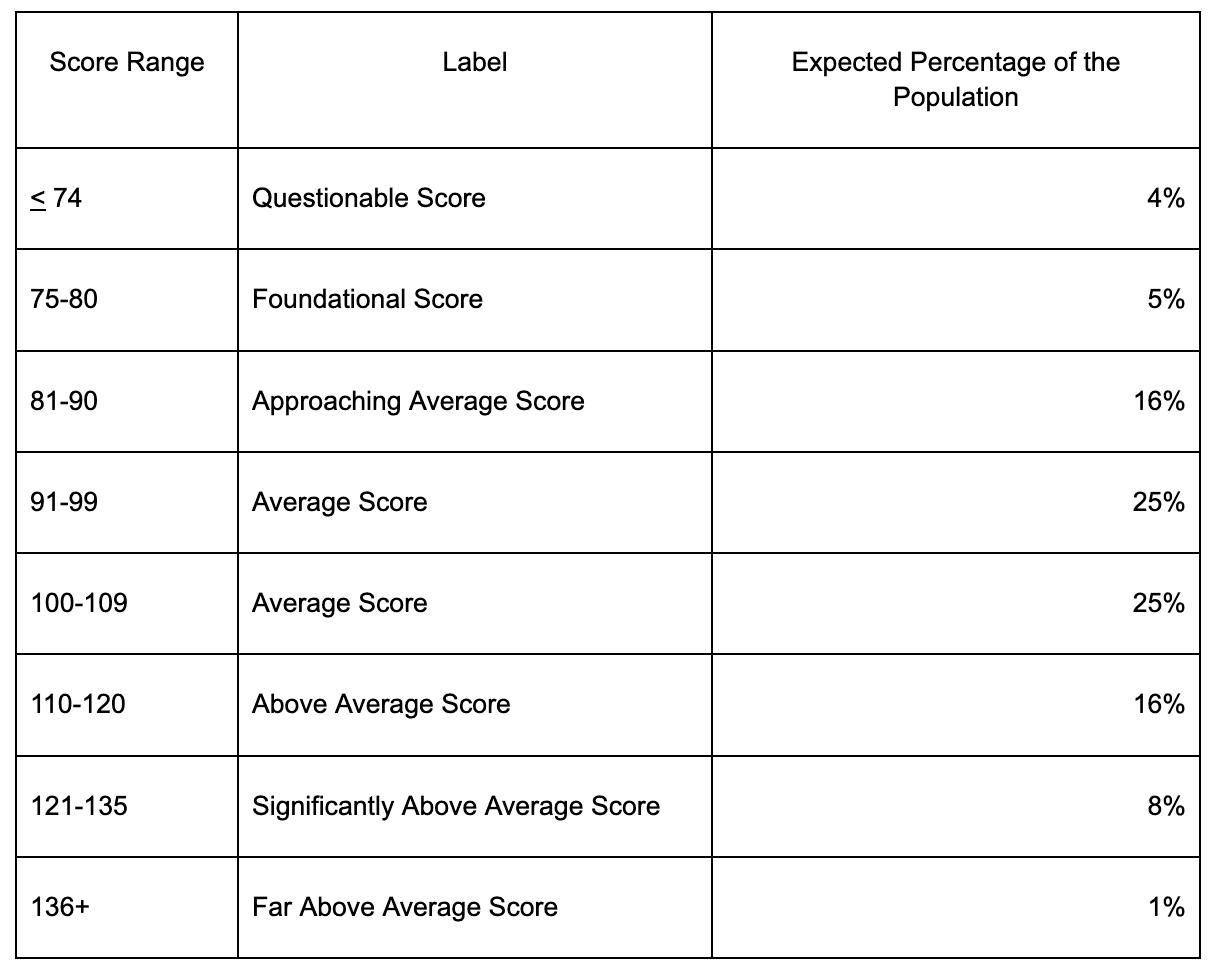
This means that what is considered a “normal” score (and the number of people with a “normal” score) depends on how the range of “normal” is defined. For the Reasoning and Intelligence Online Test, the “average” range is 91 to 109 (in other words, within 9 IQ points of the exact average of 100). Half of the population has an IQ in that range. But there is no reason why a “normal” range has to be defined this way.
Watch “What Does an IQ Test Measure?” with Dr. Russell T. Warne on the Riot IQ YouTube channel to understand how average and normal IQ scores are defined.
Take our professional IQ test
Want to know your IQ? Try the first ever professional online IQ test.