Iodine and IQ: How Much Iodine Deficiency Lowers Intelligence
Iodine deficiency lowers IQ: a meta-analysis found deficient young children scored 7 to 8 points lower, and severe deficiency in China cost about 12 points.
Dr. Russell T. WarneChief Scientist
Share
Iodine deficiency lowers IQ: a meta-analysis of studies in young children found that iodine-deficient children scored about 7 to 8 points lower than children who got enough iodine, and studies from severely deficient regions of China found gaps of about 12 points. The harm is done mostly before birth and in infancy, so the strongest evidence concerns severe deficiency, while the effect of the mild deficiency found in some wealthy countries is still unsettled.
This page covers what the meta-analyses found, what iodized salt did to test scores in the United States, the newer research on mild deficiency in pregnancy, and whether giving iodine raises a child's IQ.
What the meta-analyses found
Iodine is needed to make thyroid hormones, which the developing brain depends on. The World Health Organization (WHO) describes the most critical period as running from the second trimester of pregnancy to the third year after birth. Severe deficiency can cause "cretinism," a condition of profoundly delayed mental and motor development, yet WHO notes that the subtler loss of cognitive capacity spread across whole deficient populations matters more for public health.
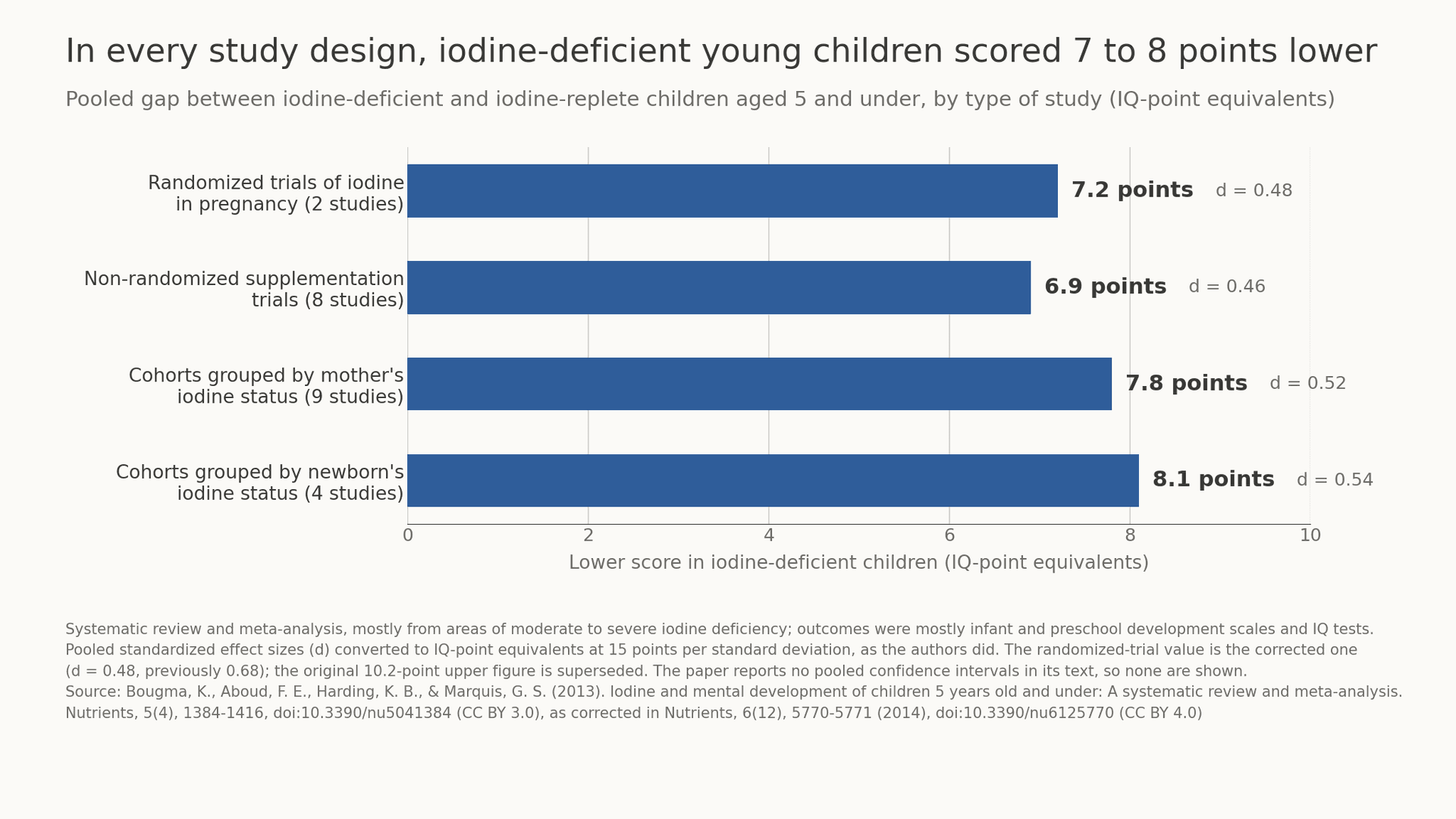
The most careful pooled estimate for young children comes from Karim Bougma and colleagues at McGill University, who reviewed studies of children aged 5 and under. They grouped the studies into four designs: randomized trials that gave iodine to pregnant women, nonrandomized supplementation trials, cohort studies that sorted children by their mother's iodine status, and cohort studies that sorted them by their own status as newborns. The pooled effects ranged from 0.46 to 0.54 standard deviations, which the authors converted at 15 points per standard deviation into a gap of 6.9 to 8.1 IQ points. The chart above shows all four.
A 2014 correction matters for anyone quoting this paper. One standard error had not been converted into a standard deviation, and fixing it lowered the randomized-trial estimate from 0.68 to 0.48. The original abstract's upper figure of 10.2 points no longer applies, and the authors' best estimate for supplementation became 0.50, or 7.5 points.
Older meta-analyses that included older children and adults came out higher. Bougma's team summarizes a 1994 review of 18 studies that put the gap at 13.5 points, while warning that most of those studies compared villages that differed naturally in iodine supply and may have differed in many other ways. A 2005 meta-analysis of 37 Chinese studies covering 12,291 children found that children in iodine-sufficient communities scored 12.45 points higher than those in severely deficient areas with no supplementation.
Most of this evidence comes from places where deficiency was moderate to severe and goitre was common. The 7- to 8-point figure describes what that level of deficiency does, and it should not be applied to the milder deficiency discussed further down.
What iodized salt did in the United States
In the early twentieth century, goitre (an enlarged thyroid caused by too little iodine) was common in parts of the United States where soil and water were low in iodine. Iodized salt was introduced in 1924, explicitly to reduce goitre, and spread over a short period.
Economists James Feyrer, Dimitra Politi and David Weil used this as a natural experiment. They measured how common goitre had been in 151 regions from the physical exams of World War I draftees, then followed men born before and after 1924 into World War II enlistment records. Assignment to the Army Air Forces depended partly on an intelligence test, and men born after iodization in the most goitre-prone areas became markedly more likely to be assigned there.
Translating that into IQ, the authors estimated a rise of about one standard deviation, or 15 points, for the quarter of the population most deficient in iodine, and about 3.5 points nationally. That is roughly a decade's worth of the twentieth-century rise in scores known as the Flynn effect. The estimate is indirect, inferred from military assignment, and the authors set aside their larger estimates as implausible.
The Chinese meta-analysis found a similar pattern over time. The gain was largest, 12 to 17 points depending on the test, for children born more than 3.5 years after an iodine supplementation programme began.
Iodization also had a cost. A sudden large intake after chronic deficiency can cause iodine-induced hyperthyroidism, and the same economists estimated at least 10,000 thyroid-related deaths from 1925 to 1942, mostly among older people in deficient regions. Worldwide, WHO estimated in 2007 that about 70% of households used iodized salt, while about 31% of the world's population still had insufficient iodine intake.
Does mild iodine deficiency in pregnancy lower IQ?
This is where the evidence becomes mixed. WHO classifies a pregnant population as iodine sufficient when its median urinary iodine concentration is between 150 and 249 micrograms per liter, and the studies below asked what happens to children whose mothers fall short of that.
The study that drew attention to the issue came from the Avon Longitudinal Study of Parents and Children (ALSPAC) in England. Sarah Bath and colleagues measured iodine in urine samples from 1,040 women in the first trimester; the group's median of 91.1 micrograms per liter classed it as mildly to moderately deficient. After adjustment for 21 possible confounders, children of women below the WHO cut-off were more likely to score in the lowest quarter for verbal IQ at age 8 (odds ratio 1.58, 95% confidence interval 1.09 to 2.30) and for reading accuracy at 9. Scores worsened stepwise as maternal iodine fell.
In Tasmania, Kristen Hynes and colleagues followed children whose mothers had been pregnant during a period of mild deficiency. At age 9, children of mothers below 150 micrograms per liter scored 10.0% lower in spelling and 7.6% lower in grammar on national tests, even though the children themselves grew up with enough iodine. Only the spelling gap survived adjustment for the mother's occupation and education.
A larger pooled analysis tempered these findings. Deborah Levie and colleagues combined individual data on 6,180 mother-child pairs from cohorts in the Netherlands, Spain and England, in which 27% to 61% of women fell below the WHO-based cut-off. Low maternal iodine was not significantly linked to nonverbal IQ (-0.6 points, 95% CI -1.7 to 0.4) or verbal IQ (-0.6 points, -1.3 to 0.1). An association with verbal IQ appeared only when the urine sample was taken in roughly the first 14 weeks of pregnancy.
The one large trial found no benefit. Sueppong Gowachirapant and colleagues randomly assigned 832 mildly deficient pregnant women in Bangalore and Bangkok to a daily iodine supplement or a placebo. At ages 5 to 6, verbal IQ averaged 89.5 in the iodine group and 90.2 in the placebo group, a difference of -0.7 points (95% CI -2.9 to 1.5), with no gain in performance IQ either. Levie's team suggested that the trial, which enrolled women up to 14 weeks of pregnancy, may have started too late to catch the most sensitive window.
Can iodine raise a child's IQ?
When children are genuinely deficient, giving iodine helps. In a double-blind trial in rural Albania, Michael Zimmermann and colleagues gave 310 children aged 10 to 12, most of whom had goitre, either an oral dose of iodized oil or a placebo. After 24 weeks, the iodine group did significantly better on 4 of 7 cognitive and motor tests, including Raven's Coloured Progressive Matrices, a nonverbal reasoning test. The trial did not report a change in IQ points.
There is no trial evidence that extra iodine raises IQ in children or adults who already get enough, and the pregnancy trial above found no gain even with mild deficiency. Iodine works like many items on the list of environmental factors that influence IQ: correcting a real deficiency prevents a loss, and adding more on top of an adequate intake has not been shown to add points. It is the reverse of lead exposure, where any added amount does harm.
Confounding is the main weakness of the observational studies. Bougma's team pointed out that communities with and without enough iodine may differ in many other ways that affect children's development. The stronger cohort studies measured factors such as the mother's education directly (the ALSPAC analysis adjusted for 21 of them), and the effects they report are smaller than those from village comparisons.
WHO's recommended daily intake is 150 micrograms for adults and 250 micrograms during pregnancy and breastfeeding. Anyone who is pregnant or planning a pregnancy and is unsure about iodine should raise it with their obstetric clinician or midwife, who can take diet and thyroid health into account.
Frequently asked questions
How many IQ points does iodine deficiency cost?
In young children, a corrected meta-analysis put the gap at about 6.9 to 8.1 points across four kinds of study. Studies of severely deficient regions in China found gaps of about 12 points.
Does iodized salt raise IQ?
Iodized salt prevents the loss that deficiency causes. A US study estimated that the introduction of iodized salt in 1924 raised IQ by about 15 points in the most deficient quarter of the country, an indirect estimate based on military records.
Does mild iodine deficiency in pregnancy lower a child's IQ?
The evidence is mixed. Some cohorts link it to lower verbal IQ and reading scores, but a pooled analysis of 6,180 pairs found only small differences, and the one large supplement trial found no benefit.
Should I take iodine during pregnancy?
That is a question for your obstetric clinician or midwife. WHO recommends a daily intake of 250 micrograms during pregnancy, and a clinician can judge whether your diet already provides it.
Can adults raise their IQ with iodine?
There is no evidence that it can. The brain is most sensitive to iodine before birth and in early childhood, and trials show benefits only in children who were deficient.
The takeaway
Iodine deficiency is one of the best documented causes of preventable IQ loss. In young children from deficient areas the gap is about 7 to 8 points, and in the most severely affected regions it can reach 12 or more, which is why iodized salt was one of the most successful public health measures of the last century. Whether mild deficiency in pregnancy lowers IQ is still an open question, and extra iodine has not been shown to raise the scores of people who already get enough. If you are curious where your own reasoning abilities stand, you can try an online IQ test built by psychometricians.
References
1. Bougma, K., Aboud, F. E., Harding, K. B., & Marquis, G. S. (2013). Iodine and mental development of children 5 years old and under: A systematic review and meta-analysis. Nutrients, 5(4), 1384-1416. [doi.org/10.3390/nu5041384](. doi.org
2. Bougma, K., Aboud, F. E., Harding, K. B., & Marquis, G. S. (2014). Correction: Bougma, K., et al. Iodine and mental development of children 5 years old and under: A systematic review and meta-analysis. Nutrients, 6(12), 5770-5771. [doi.org/10.3390/nu6125770](. doi.org
3. World Health Organization, UNICEF, & ICCIDD. (2007). Assessment of iodine deficiency disorders and monitoring their elimination: A guide for programme managers (3rd ed.). World Health Organization. [iris.who.int](. iris.who.int
4. Qian, M., Wang, D., Watkins, W. E., Gebski, V., Yan, Y. Q., Li, M., & Chen, Z. P. (2005). The effects of iodine on intelligence in children: A meta-analysis of studies conducted in China. Asia Pacific Journal of Clinical Nutrition, 14(1), 32-42. [apjcn.nhri.org.tw](. apjcn.nhri.org.tw
5. Feyrer, J., Politi, D., & Weil, D. N. (2017). The cognitive effects of micronutrient deficiency: Evidence from salt iodization in the United States. Journal of the European Economic Association, 15(2), 355-387. [doi.org/10.1093/jeea/jvw002](. doi.org
6. Bath, S. C., Steer, C. D., Golding, J., Emmett, P., & Rayman, M. P. (2013). Effect of inadequate iodine status in UK pregnant women on cognitive outcomes in their children: Results from the Avon Longitudinal Study of Parents and Children (ALSPAC). The Lancet, 382(9889), 331-337. [doi.org/10.1016/S0140-6736(13)60436-5](. doi.org
7. Hynes, K. L., Otahal, P., Hay, I., & Burgess, J. R. (2013). Mild iodine deficiency during pregnancy is associated with reduced educational outcomes in the offspring: 9-year follow-up of the gestational iodine cohort. Journal of Clinical Endocrinology and Metabolism, 98(5), 1954-1962. [doi.org/10.1210/jc.2012-4249](. doi.org
8. Levie, D., Korevaar, T. I. M., Bath, S. C., Murcia, M., Dineva, M., Llop, S., Espada, M., van Herwaarden, A. E., de Rijke, Y. B., Ibarluzea, J. M., Sunyer, J., Tiemeier, H., Rayman, M. P., Guxens, M., & Peeters, R. P. (2019). Association of maternal iodine status with child IQ: A meta-analysis of individual participant data. Journal of Clinical Endocrinology and Metabolism, 104(12), 5957-5967. [doi.org/10.1210/jc.2018-02559](. doi.org
9. Gowachirapant, S., Jaiswal, N., Melse-Boonstra, A., Galetti, V., Stinca, S., Mackenzie, I., Thomas, S., Thomas, T., Winichagoon, P., Srinivasan, K., & Zimmermann, M. B. (2017). Effect of iodine supplementation in pregnant women on child neurodevelopment: A randomised, double-blind, placebo-controlled trial. The Lancet Diabetes & Endocrinology, 5(11), 853-863. [doi.org/10.1016/S2213-8587(17)30332-7](. doi.org
10. Zimmermann, M. B., Connolly, K., Bozo, M., Bridson, J., Rohner, F., & Grimci, L. (2006). Iodine supplementation improves cognition in iodine-deficient schoolchildren in Albania: A randomized, controlled, double-blind study. American Journal of Clinical Nutrition, 83(1), 108-114. [doi.org/10.1093/ajcn/83.1.108](. doi.org
Figure by RIOT IQ. Data from Bougma et al. (2013), Nutrients 5(4), 1384-1416 (doi.org/10.3390/nu5041384), CC BY 3.0, as corrected in Nutrients 6(12), 5770-5771 (2014), CC BY 4.0.
Take our professional IQ test
Want to know your IQ? Try the first ever professional online IQ test.