Cat Owners and Intelligence: Are Cat People Really Smarter Than Dog People? | Riot IQ
Oct 11, 2026·Advanced Topics & Research
Cat Owners and Intelligence: Are Cat People Really Smarter Than Dog People?
Cat owners intelligence claims rest on one small study of 66 cat-loving students; larger studies find modest personality gaps and no reliable IQ difference.
Dr. Russell T. WarneChief Scientist
Share
There is no reliable evidence that cat owners are more intelligent than dog owners. The claim traces back to one survey of college students in which the 66 self-described "cat people" scored higher than 352 "dog people" on a brief reasoning scale, and no larger study has shown a meaningful IQ gap between people who prefer cats and people who prefer dogs.
What research does show is a set of modest personality differences, and a few household patterns (education, living space, living alone) that can make one group look different from the other. This page covers the study behind the headlines, the much larger personality research, what is known about pets and thinking skills in children and older adults, and the confounds that make "cat people are smarter" so easy to believe.
Where the "cat people are smarter" claim comes from
In May 2014, psychologist Denise Guastello of Carroll University presented a survey of about 600 college students at the annual meeting of the Association for Psychological Science. According to press coverage of the talk, about 60% of the students called themselves dog people and 11% called themselves cat people. Dog lovers came out livelier and more rule-following. Cat lovers came out more introverted, more open-minded and more sensitive, and they "scored higher on intelligence" (Rettner, 2014). At that point the finding was an unpublished conference presentation, and the press reports gave no effect size.
The work was later published. Guastello, Guastello and Guastello (2017) analyzed 418 undergraduates who completed the Sixteen Personality Factors Questionnaire (16PF), which includes "a brief measure of general intelligence" alongside 15 personality traits. The 66 cat people scored higher on general intelligence, abstractedness and self-reliance. The 352 dog people scored higher on warmth, liveliness, rule consciousness and social boldness.
Several features of that study limit what it can say about IQ.
• The comparison group is small: 66 cat people is a modest sample, and we found no replication using a full-length intelligence test.
• The test is short: a brief reasoning scale inside a personality questionnaire is much less reliable than a full IQ battery, so small group differences on it carry a lot of measurement error.
• No size reported in the summary: the published abstract says which traits differed between the groups but not by how much, so the reasoning gap could be small.
• The sample is narrow: all participants were undergraduates, who are already selected for academic ability. Guastello herself noted that the results may not apply to other age groups.
What larger studies show: personality, not IQ
A much larger study of "dog people" and "cat people" did not measure intelligence at all. Gosling, Sandy and Potter (2010) had 4,565 people complete the Big Five Inventory online and classify themselves as a dog person, a cat person, both or neither. Dog people scored higher on extraversion, agreeableness and conscientiousness, and lower on neuroticism and openness, than cat people. The differences held after controlling for sex differences in pet preference.
Could those personality gaps produce an IQ gap? Only a tiny one. In a meta-analysis of 162,636 people, openness was the strongest Big Five correlate of intelligence at ρ = .20, and neuroticism was next at ρ = -.09 (Anglim et al., 2022). Cat people's higher openness would nudge their average reasoning score up, and their higher neuroticism would nudge it down, so the two largely offset. Any net difference would likely be small and would apply only to group averages. Gosling put it this way to CNN: knowing someone's pet preference is a reasonable "best guess" only "if you knew nothing else about them" (Landau, 2010).
The introversion part of the story deserves a note too. Popular articles often link cat ownership, introversion and intelligence in a single chain. Our article on IQ and introversion covers what the research says about that half of the chain.
Does owning a pet change how well you think?
A separate question is whether living with an animal affects cognitive ability. The evidence here comes from children and older adults, and none of it supports pets as an IQ booster.
• Children, systematic review: Purewal and colleagues (2017) reviewed 22 studies of pet ownership and child development. Only three looked at cognitive development, most studies were cross-sectional, and the authors called for well-designed research on "mainstream cognitive outcomes such as executive function, memory and IQ."
• Children, a large birth cohort: the same team then analyzed about 14,000 children in the UK's Avon Longitudinal Study of Parents and Children (Purewal et al., 2024). After adjusting for confounders, they found little evidence that pet ownership was linked to cognitive outcomes such as attention and working memory. Pet ownership was associated with slightly better early language and prosocial behaviour, and also with lower educational attainment across several subjects.
• Older adults living alone: in 7,945 adults aged 50 and older from the English Longitudinal Study of Ageing, pet owners showed slower decline in verbal memory and verbal fluency over about eight years, but only among those who lived alone. The difference was small (about 0.02 standard deviations per year), and the authors stressed that unmeasured confounding cannot be ruled out (Li et al., 2023).
• Long-term owners in the US: in 1,369 adults from the Health and Retirement Study, people aged 65 and over who had owned a pet for more than five years had higher composite cognitive scores than non-owners, with no difference below age 65. The authors named selection effects as one possible explanation (Applebaum et al., 2023).
The pattern in older adults fits a social-contact explanation at least as well as a cognitive one. Living alone is a known risk factor for loneliness, which our article on IQ and loneliness discusses, and a pet may soften it. None of these studies measured IQ, and none showed that getting a pet raises anyone's reasoning ability.
The confounds behind cat-versus-dog comparisons
Choosing a cat or a dog is tied up with circumstances that also relate to test scores.
• Education: in a random sample of 2,980 UK households, homes where someone held a university degree were more likely to own cats and less likely to own dogs (Murray et al., 2010). Because education and IQ are correlated, any survey that compares cat and dog owners without controlling for education can pick up an education gap and call it an intelligence gap.
• Housing and lifestyle: the same study found that households with gardens were more likely to own both cats and dogs, and dog ownership rose with household size. Space, travel and allergies decide many pet choices, as psychologist Hal Herzog pointed out to CNN (Landau, 2010).
• Self-identification versus ownership: Gosling's participants were sorted by what they called themselves, not what animal they owned. A "cat person" in a survey may own a dog, or no pet at all.
• Who answers online surveys: volunteer samples are self-selected, so the people who choose to take a "cat or dog?" quiz may differ from the general population in ways that matter for test performance.
Frequently asked questions
Are cat owners smarter than dog owners?
Not in any way that has been reliably shown. One study of 418 students found 66 cat people scored higher on a brief reasoning scale, but there is no replicated evidence of an IQ difference in the general population.
Are dog owners less intelligent?
No. Dog people in the research tend to be more extraverted, agreeable and conscientious, which are personality traits and say nothing about lower reasoning ability.
Does owning a pet make you smarter?
There is no evidence that it raises IQ. A large UK cohort found little link between pet ownership and children's cognitive outcomes, and the older-adult studies on slower memory decline are observational.
Why do people think cat owners are introverts?
Two studies found cat people were more introverted or less extraverted than dog people on average. The differences are modest and describe groups, not individuals.
Do cat people have a higher IQ because they are more open-minded?
Not in any meaningful way. Cat people score higher on openness, which correlates about .20 with intelligence, but they also score higher on neuroticism, which correlates slightly negatively, so the two effects largely cancel.
The takeaway
The cat owners intelligence claim rests on one small student sample and a brief reasoning scale. Larger studies show that cat lovers and dog lovers differ a little in personality, and that pet ownership tracks education, housing and living arrangements, which can easily masquerade as an intelligence difference. Whichever animal you prefer, it tells you very little about your IQ. If you want an actual measure of your reasoning ability, a professionally developed IQ test gives you a normed score instead of a guess.
References
1. Rettner, R. (2014, May 27). Dog people vs. cat people: Who's more outgoing? More intelligent? Live Science. [livescience.com](. livescience.com
2. Guastello, A. D., Guastello, D. D., & Guastello, S. J. (2017). Personality differences between dog people and cat people. Human-Animal Interaction Bulletin, hai.2017.0003. [doi.org/10.1079/hai.2017.0003](. doi.org
3. Gosling, S. D., Sandy, C. J., & Potter, J. (2010). Personalities of self-identified "dog people" and "cat people". Anthrozoös, 23(3), 213-222. [doi.org/10.2752/175303710X12750451258850](. doi.org
4. Anglim, J., Dunlop, P. D., Wee, S., Horwood, S., Wood, J. K., & Marty, A. (2022). Personality and intelligence: A meta-analysis. Psychological Bulletin, 148(5-6), 301-336. [doi.org/10.1037/bul0000373](. doi.org
5. Landau, E. (2010, January 13). How are dog people and cat people different? CNN. [cnn.com](. edition.cnn.com
6. Purewal, R., Christley, R., Kordas, K., Joinson, C., Meints, K., Gee, N., & Westgarth, C. (2017). Companion animals and child/adolescent development: A systematic review of the evidence. International Journal of Environmental Research and Public Health, 14(3), 234. [doi.org/10.3390/ijerph14030234](. doi.org
7. Purewal, R., Christley, R., Kordas, K., Joinson, C., Meints, K., Gee, N., & Westgarth, C. (2024). Companion animals and child development outcomes: Longitudinal and cross-sectional analysis of a UK birth cohort study. BMC Pediatrics, 24, 578. [doi.org/10.1186/s12887-024-05049-7](. doi.org
8. Li, Y., Wang, W., Zhu, L., Yang, L., Wu, H., Zhang, X., Guo, L., & Lu, C. (2023). Pet ownership, living alone, and cognitive decline among adults 50 years and older. JAMA Network Open, 6(12), e2349241. [doi.org/10.1001/jamanetworkopen.2023.49241](. doi.org
9. Applebaum, J. W., Shieu, M. M., McDonald, S. E., Dunietz, G. L., & Braley, T. J. (2023). The impact of sustained ownership of a pet on cognitive health: A population-based study. Journal of Aging and Health, 35(3-4), 230-241. [doi.org/10.1177/08982643221122641](. doi.org
10. Murray, J. K., Browne, W. J., Roberts, M. A., Whitmarsh, A., & Gruffydd-Jones, T. J. (2010). Number and ownership profiles of cats and dogs in the UK. Veterinary Record, 166(6), 163-168. [doi.org/10.1136/vr.b4712](. doi.org
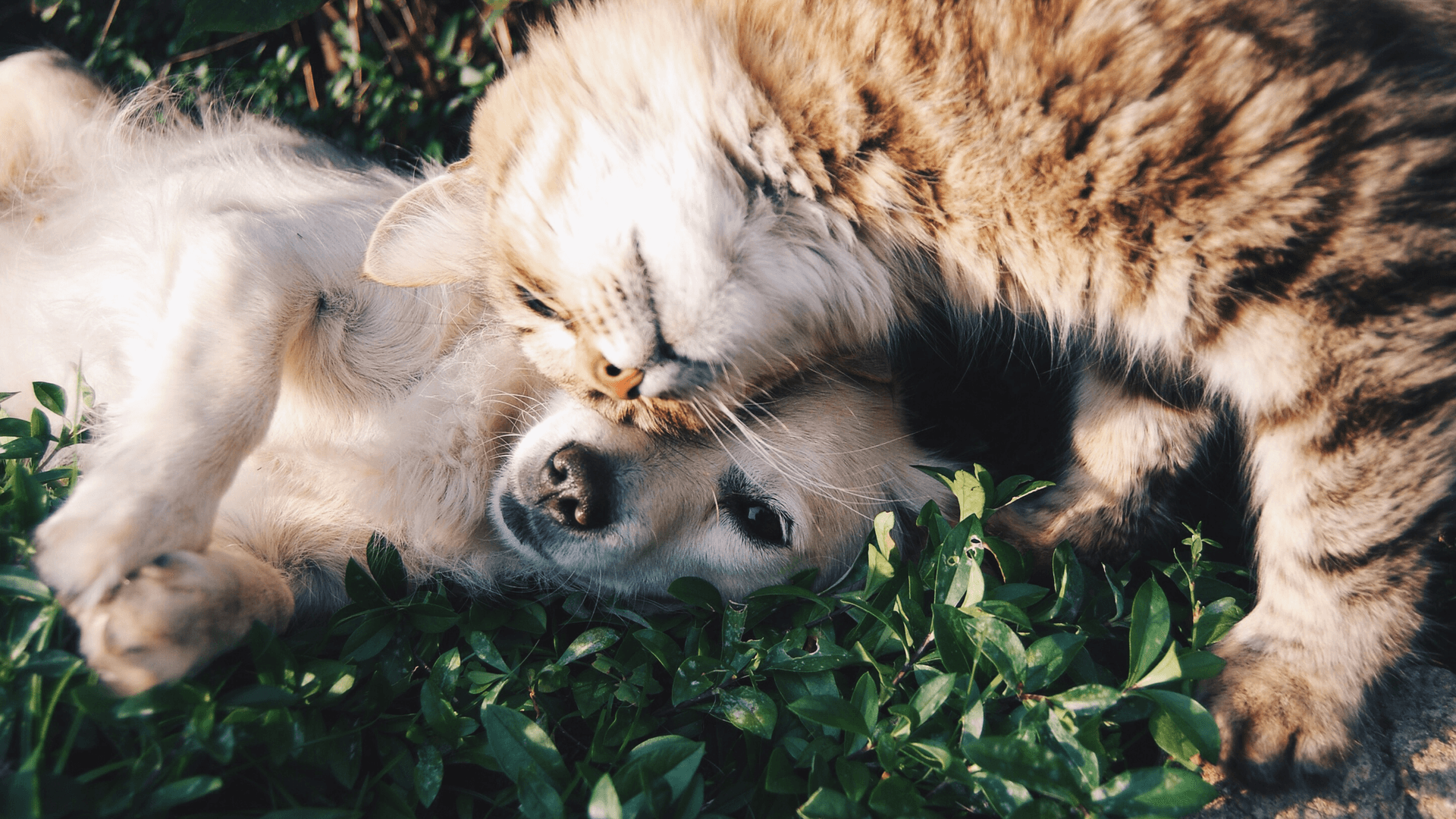
Hero image: Real life best friends, by Krista Mangulsone, CC0. Via Wikimedia Commons.
Take our professional IQ test
Want to know your IQ? Try the first ever professional online IQ test.