Humility and Intelligence: Are Humble People Smarter?
Humility and intelligence are barely related: across 23 studies and 32,165 people, humility correlated r = .02 with IQ. Intellectual humility is mixed.
Dr. Russell T. WarneChief Scientist
Share
Humility is barely related to intelligence. A 2022 meta-analysis of 23 studies and 32,165 people found a correlation of r = .02 between the personality trait of honesty-humility and intelligence, and studies of "intellectual humility", the willingness to accept that your beliefs might be wrong, report links with IQ that range from zero to small and positive.
So humble people are not reliably smarter, and smart people are not reliably humble. This article explains how psychologists define and measure humility, what the studies linking it to IQ actually found, why the idea of the humble genius is so appealing, and what intellectual humility does predict.
What psychologists mean by humility
Researchers study two related traits, and it helps to keep them apart.
• General humility: in the HEXACO model of personality, "honesty-humility" is one of six broad traits. According to the scale's authors, people who score high on its modesty facet see themselves as ordinary people without any claim to special treatment.
• Intellectual humility: this is narrower and concerns how people hold their beliefs. Leary and colleagues (2017), who developed one widely used scale, defined it as the degree to which people recognize that their beliefs might be wrong. In their studies, intellectually humble people were more open and curious, more tolerant of ambiguity and less dogmatic.
A 2022 review in Nature Reviews Psychology by Porter and colleagues compared the many definitions in use and concluded that their common element is a "metacognitive" ability, meaning thinking about one's own thinking: recognizing the limits of one's beliefs and knowledge.
Most of this research relies on questionnaires, which raises an obvious problem. Porter and colleagues noted that humility is a socially desirable trait, which makes it hard to measure by self-report, although self-ratings do agree modestly with ratings from peers. Some researchers have turned to behavioral measures instead, such as whether a person hands a question to someone more knowledgeable.
How humility relates to IQ
The best evidence on general humility comes from a large meta-analysis of personality and intelligence by Anglim and colleagues (2022).
• Honesty-humility: across 23 studies (N = 32,165), the correlation with general intelligence was .02. The HEXACO modesty facet correlated .01.
• Modesty on the NEO questionnaire: the modesty facet of the NEO personality inventory showed a small negative correlation with intelligence, -.08, across 26 studies (N = 28,635). The authors traced this to a handful of items about ordinary self-belief: intelligent people are a little more likely to say they are better than some others, but that tendency did not extend to narcissism or arrogance.
A correlation of .02 means that IQ and humility share less than one tenth of one percent of their variation. A correlation of -.08 is still small: scaled to IQ, it amounts to roughly 1 IQ point of difference for every standard deviation of modesty.
Intellectual humility has been studied in much smaller samples, and the results are mixed. Porter and colleagues classified the evidence on cognitive ability as "mixed" and its clarity as "unclear".
• A positive link: Zmigrod and colleagues (2019) tested 108 adults online. Higher scores on a short nine-item version of Raven's matrices, a test of fluid reasoning, predicted higher intellectual humility, mainly respect for other people's viewpoints and openness to revising one's own. Cognitive flexibility predicted humility more strongly than intelligence did, and either one was enough: people high on both were no humbler than people high on just one.
• No link with ability: in five studies with 1,189 participants, Krumrei-Mancuso and colleagues (2020) found that intellectual humility was associated with more general knowledge but was unrelated to cognitive ability and went with slightly lower grades.
• In children: a study of 127 children aged 6 to 8 by Danovitch and colleagues (2019) found that greater intellectual humility, measured partly by willingness to hand science questions to experts, was associated with higher intelligence.
Taken together, intellectual humility may have a small positive relation with reasoning ability, but the studies are small, use different measures and do not agree. The more consistent finding is the link with accumulated knowledge, which fits with intellectual humility's ties to curiosity, a trait covered in our article on curiosity and intelligence.
Why the "humble genius" idea is so appealing
The image of the brilliant person who insists they know very little is an old one, and it has a modern echo in research on self-assessment. People often point to the finding that poor performers overestimate themselves while strong performers slightly underestimate themselves, an idea known as the Dunning-Kruger effect. Our article on what the Dunning-Kruger effect research actually shows covers the debate over how much of that pattern is a statistical artifact.
Miscalibrated self-assessment is a different thing from intellectual humility. Krumrei-Mancuso and colleagues found that intellectually humble people were less likely to claim knowledge they did not have, which is accurate self-knowledge. They also found that humble people tended to underestimate their cognitive ability, which is not. Humility describes a stance toward one's beliefs, and it is perfectly possible to be very bright and dogmatic, or of average ability and open-minded.
There is also a selection effect in which examples we notice. Famous scientists who spoke modestly about the limits of knowledge are widely quoted, while equally able people who were arrogant are remembered for different reasons, or not at all.
What intellectual humility does predict
Intellectual humility appears to matter more for how people handle disagreement than for how well they reason on a test.
• Openness to opposing views: Porter and Schumann (2018) found that people higher in intellectual humility were more willing to learn about the other side's views during disagreements, and in one study exposed themselves to a greater share of opposing political perspectives.
• Judging arguments on their merits: in Leary and colleagues' studies, intellectually humble participants were more attuned to the strength of persuasive arguments and less likely to call politicians who changed their minds "flip-floppers".
• Learning-related habits: Krumrei-Mancuso and colleagues found links with reflective thinking, need for cognition, curiosity and an intrinsic motivation to learn.
Intellectual humility also seems to be changeable. In Porter and Schumann's fourth study, reading that intelligence can be developed, as opposed to being fixed, increased intellectual humility and in turn openness to opposing views. That was a short-term effect in a single study, so it should not be taken as proof that lasting change is easy.
The confounds cut both ways. Porter and colleagues cautioned that because most of this work is correlational, apparent benefits of intellectual humility could reflect agreeableness, intelligence or general virtuousness. In Zmigrod's sample, education was correlated with Raven's scores (r = .31) but not with intellectual humility (r = .06), and the study adjusted for age, sex and education.
Frequently asked questions
Are humble people more intelligent?
Not in any meaningful way. General humility correlated .02 with intelligence in a meta-analysis of 23 studies, and the evidence for intellectual humility is mixed.
Are very intelligent people arrogant?
Not on average. Intelligent people are slightly more likely to agree that they are better than some others, but intelligence is essentially unrelated to narcissism and arrogance in the personality literature.
What is intellectual humility?
It is the recognition that your beliefs and knowledge might be wrong or incomplete. Researchers describe it as a metacognitive ability, a way of thinking about one's own thinking.
Is intellectual humility the same as low confidence?
No. It concerns openness to being wrong about beliefs. In one set of studies it went with more accurate claims about one's knowledge, though also with underestimating one's ability.
Can intellectual humility be increased?
Possibly. One experiment found that reading about intelligence as something that can be developed raised intellectual humility in the short term, but lasting effects have not been shown.
The takeaway
Humility is a poor guide to IQ. General humility and intelligence are essentially uncorrelated, and intellectual humility shows only small and inconsistent links with reasoning ability, along with a clearer link to knowledge and curiosity. What intellectual humility does seem to shape is how people handle evidence and disagreement. If you want to know where your reasoning ability actually stands, without relying on your own estimate, you can take the RIOT IQ test.
References
1. Anglim, J., Dunlop, P. D., Wee, S., Horwood, S., Wood, J. K., & Marty, A. (2022). Personality and intelligence: A meta-analysis. Psychological Bulletin, 148(5-6), 301-336. [doi.org/10.1037/bul0000373](. doi.org
2. Leary, M. R., Diebels, K. J., Davisson, E. K., Jongman-Sereno, K. P., Isherwood, J. C., Raimi, K. T., Deffler, S. A., & Hoyle, R. H. (2017). Cognitive and interpersonal features of intellectual humility. Personality and Social Psychology Bulletin, 43(6), 793-813. [doi.org/10.1177/0146167217697695](. doi.org
3. Porter, T., Elnakouri, A., Meyers, E. A., Shibayama, T., Jayawickreme, E., & Grossmann, I. (2022). Predictors and consequences of intellectual humility. Nature Reviews Psychology, 1(9), 524-536. [doi.org/10.1038/s44159-022-00081-9](. doi.org
4. Zmigrod, L., Zmigrod, S., Rentfrow, P. J., & Robbins, T. W. (2019). The psychological roots of intellectual humility: The role of intelligence and cognitive flexibility. Personality and Individual Differences, 141, 200-208. [doi.org/10.1016/j.paid.2019.01.016](. doi.org
5. Krumrei-Mancuso, E. J., Haggard, M. C., LaBouff, J. P., & Rowatt, W. C. (2020). Links between intellectual humility and acquiring knowledge. The Journal of Positive Psychology, 15(2), 155-170. [doi.org/10.1080/17439760.2019.1579359](. doi.org
6. Danovitch, J. H., Fisher, M., Schroder, H., Hambrick, D. Z., & Moser, J. (2019). Intelligence and neurophysiological markers of error monitoring relate to children's intellectual humility. Child Development, 90(3), 924-939. [doi.org/10.1111/cdev.12960](. doi.org
7. Porter, T., & Schumann, K. (2018). Intellectual humility and openness to the opposing view. Self and Identity, 17(2), 139-162. [doi.org/10.1080/15298868.2017.1361861](. doi.org
8. Lee, K., & Ashton, M. C. (n.d.). Scale descriptions: HEXACO Personality Inventory-Revised. The HEXACO Personality Inventory. [hexaco.org/scaledescriptions](. hexaco.org
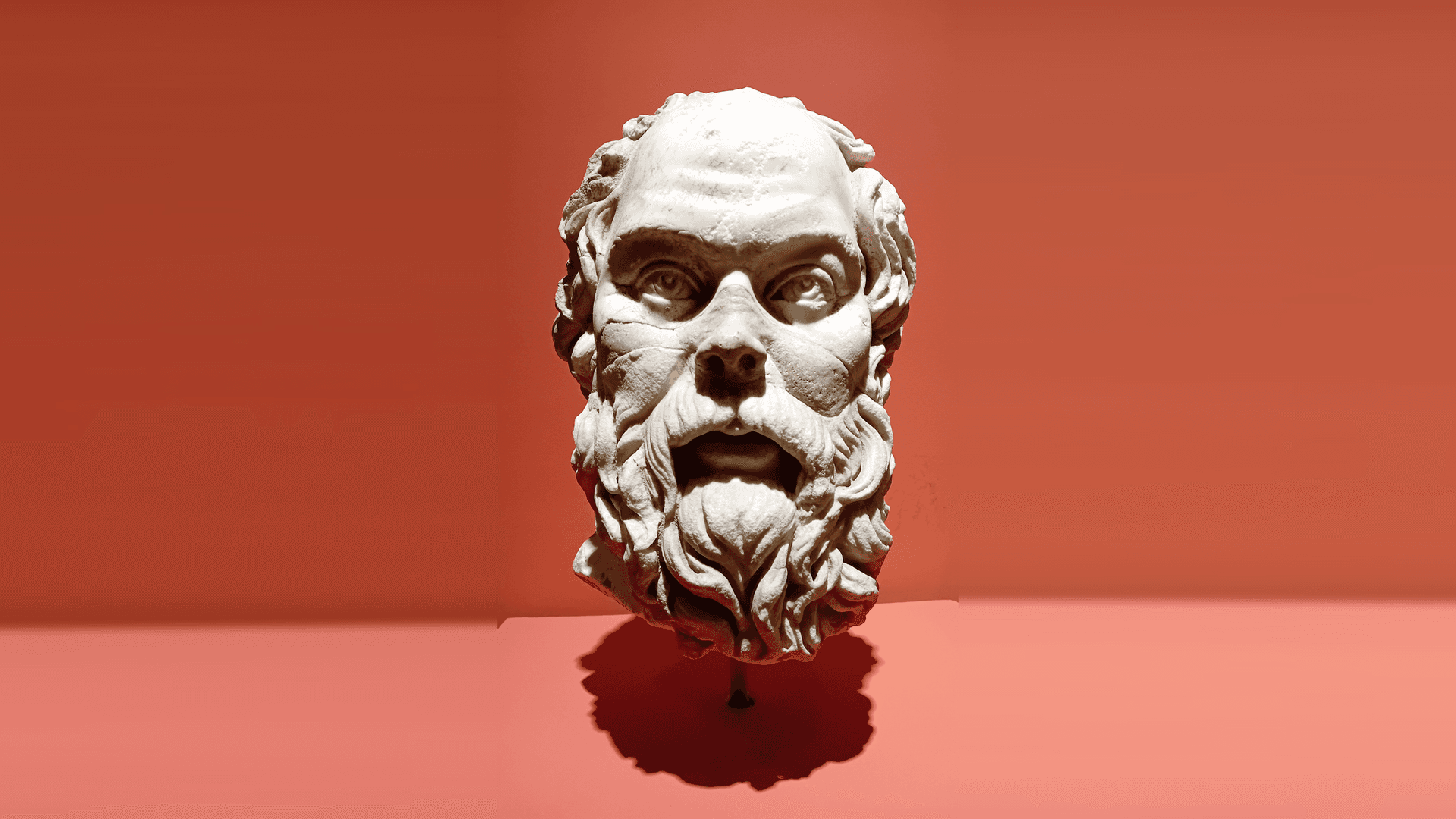
Hero image: Bust of Socrates in Ephesus Museum, Selçuk, Turkey (Roman marble), photograph by Yalgin, CC0. Via Wikimedia Commons.
Take our professional IQ test
Want to know your IQ? Try the first ever professional online IQ test.