Doodling and Intelligence: Is Doodling a Sign of a Smart Mind?
Doodling and intelligence are not linked in any study of adults. Drawing skill in childhood predicts IQ only modestly (r = .20), and doodling rarely aids memory.
Dr. Russell T. WarneChief Scientist
Share
Doodling is not a known sign of high intelligence. No study I could find has linked adults' doodling habits to IQ scores, and the closest evidence, children's skill at drawing a human figure, correlates only modestly with later intelligence (about r = .20 a decade on).
The popular idea rests mostly on a single 2010 experiment suggesting that doodling helps people remember what they hear, and that result has not held up well in later studies. This article covers what the research says about doodling and IQ, whether doodling helps attention and memory, why the "doodlers are smart" claim spread, and the limits of the evidence.
What the research shows about doodling and intelligence
There is no direct study of doodling frequency and IQ in a large adult sample. The evidence that exists comes from two neighbouring questions: whether drawing ability tracks intelligence, and what kind of person tends to doodle.
• Children's drawing skill: Arden and colleagues (2014) studied 7,752 pairs of twins in the UK. At age 4, children drew a picture of a child, scored for whether body parts such as the head, arms and feet were present and correct. Drawing scores correlated .33 with general intelligence at age 4 and .20 with intelligence at age 14. To convert that second figure to IQ points, multiply the correlation by the IQ standard deviation of 15: a child one standard deviation above average in drawing would be expected to score about 3 IQ points above average ten years later. That is a real link, though a small one. It also concerns how accurately a young child draws a figure, which is a different thing from how often an adult doodles.
• Drawing tests as IQ measures: Imuta and colleagues (2013) tested the Draw-A-Person Intellectual Ability Test against Wechsler IQ tests. In 100 children aged 4 to 5, the correlation was .30. In 100 adults it was .10 and not statistically significant, and the two tests placed only 51% of adults in the same ability category. The authors concluded that practitioners should not rely on figure drawings to assess intelligence.
• The habit of doodling: Spencer-Mueller and Fenske (2024) asked 172 Canadian undergraduates how often they doodle. A stronger doodling habit correlated .23 with self-reported lapses of attention and .25 with attention-related everyday errors, and essentially zero (r = -.04) with how much of a lecture they later remembered. Those self-reported slips are a close cousin of the absent-minded lapses covered in our article on forgetfulness and intelligence.
Put together, the evidence gives no reason to read a margin full of spirals as a mark of high ability. If anything, frequent doodling travels with slightly more mind-wandering, though these correlations are small and rest on self-report.
Does doodling help you pay attention and remember?
This is the question most of the research has actually tested, and the answer has shifted over time.
The study behind most headlines is Andrade (2010). Forty participants listened to a monotonous mock telephone message and wrote down the names of people coming to a party. Half were randomly assigned to shade in printed shapes while they listened. The doodling group did better at the monitoring task and recalled 29% more information on a surprise memory test. Andrade suggested that doodling might help by reducing daydreaming, a habit discussed in our article on daydreaming and IQ.
Later experiments have been less kind.
• Free doodling versus shading shapes: Boggs, Cohen and Marchand (2017) randomly assigned 93 undergraduates to listen to a conversation while doing nothing, shading shapes, doodling freely or taking notes. Free doodlers scored significantly lower on the recall quiz than those who shaded shapes or took notes.
• Doodling versus drawing the content: Meade, Wammes and Fernandes (2019) ran three experiments. Free-form doodling led to the poorest recall of target words, structured doodling (shading shapes) produced recall similar to simply writing the words, and drawing a picture of each word produced the best memory.
• A direct replication: Spencer-Mueller and Fenske (2024) repeated Andrade's procedure with 50 students after first boring them with a 15-minute lecture. Doodling gave no memory benefit, and a Bayesian analysis strongly favoured no effect. In a second experiment, 172 students heard 45 minutes of the same lecture. Doodling did not reduce boredom or mind-wandering, and note-takers showed the best attention and retention.
A plausible explanation is that free doodling is a second task competing for the same limited mental workspace, often called working memory, that listening and remembering also need. Simple shading of shapes may demand so little that it neither helps nor hurts much. The most reliable way to remember a lecture in these studies was to engage with the content itself, by writing or drawing it.
Why people think doodling signals a clever mind
The belief has a few understandable sources.
• A memorable number: "Doodlers remember 29% more" is a clean, quotable result from a randomized experiment, and it travels well. The null results arrived seven to fourteen years later.
• A grain of truth about drawing: since the 1920s, psychologists have used children's drawings of people to estimate intelligence, as both the Arden and Imuta papers describe, and drawing skill in young children does correlate modestly with IQ. That finding is easy to stretch into a claim about adults who sketch in meetings, which it does not support.
• Brain-imaging headlines: a 2017 pilot study by Kaimal and colleagues used near-infrared light to record activity in the front of the brain in 26 adults during three drawing tasks. Each task activated a region linked to reward, compared with rest. Doodling showed the most activation, but the differences between the drawing tasks were not statistically significant. The study says something about enjoyment, and nothing about intelligence.
Confounds and limits of the doodling research
The doodling literature is small, and several features make it easy to over-read.
• Small student samples: most experiments use a few dozen to a couple of hundred undergraduates. That leaves wide uncertainty and says little about other ages or settings.
• What counts as doodling: shading printed shapes, free-form sketching and drawing the lesson content are very different tasks, and the studies show they have different effects. Headlines rarely say which one was tested.
• Skill versus habit: the IQ correlations involve children's drawing accuracy on a standardized task. How often an adult doodles is a separate behaviour, and the one study measuring it found small links to inattention and none to lecture memory.
• Age: figure drawing tracked IQ modestly in 4-year-olds but was unrelated to IQ in adults in the Imuta study, so childhood findings should not be applied to grown-ups.
• Attention difficulties: a habit of fidgeting and doodling can sit alongside wider problems with focus. If trouble concentrating is long-standing and shows up at work, at school and at home, a family doctor or licensed psychologist can assess it, and our article on ADHD and IQ explains how attention problems relate to test scores.
Frequently asked questions
Is doodling a sign of intelligence?
No. No study has linked how often adults doodle to their IQ, and in one study of 172 students a doodling habit went with slightly more attention lapses and no better memory.
Is doodling good for the brain?
There is little evidence either way. A small pilot study found that doodling activated a reward-related brain region, but it did not measure any cognitive benefit.
Does doodling help you remember things?
Usually not. The original 2010 study found a 29% recall advantage for shading shapes, but later experiments, including a direct replication, found no benefit, and free-form doodling tended to hurt recall.
Do children's drawings reveal their IQ?
Only loosely. In a large twin study, drawing scores at age 4 correlated .20 with intelligence at age 14, about 3 IQ points per standard deviation, which is far too weak to judge an individual child.
Should students doodle in class?
The best evidence favours note-taking. Students who wrote notes remembered more of a lecture and reported less mind-wandering than students who doodled.
The takeaway
Doodling tells you very little about how intelligent someone is. The one well-replicated link involves young children's drawing accuracy, and it is modest; the claim that doodling boosts memory comes from one small study that later experiments have not confirmed. If you want a measure of reasoning ability rather than a guess from a notebook margin, try an online IQ test built by psychometricians.
References
1. Andrade, J. (2010). What does doodling do? Applied Cognitive Psychology, 24(1), 100-106. [doi.org/10.1002/acp.1561](. doi.org
2. Arden, R., Trzaskowski, M., Garfield, V., & Plomin, R. (2014). Genes influence young children's human figure drawings and their association with intelligence a decade later. Psychological Science, 25(10), 1843-1850. [doi.org/10.1177/0956797614540686](. doi.org
3. Imuta, K., Scarf, D., Pharo, H., & Hayne, H. (2013). Drawing a close to the use of human figure drawings as a projective measure of intelligence. PLoS ONE, 8(3), e58991. [doi.org/10.1371/journal.pone.0058991](. doi.org
4. Spencer-Mueller, E. K., & Fenske, M. J. (2024). Note-taking for the win: Doodling does not reduce boredom or mind-wandering, nor enhance attention or retention of information. Quarterly Journal of Experimental Psychology, 77(8), 1780-1796. [doi.org/10.1177/17470218231222402](. doi.org
5. Boggs, J. B., Cohen, J. L., & Marchand, G. C. (2017). The effects of doodling on recall ability. Psychological Thought, 10(1), 206-216. [hdl.handle.net/20.500.12034/1496](. hdl.handle.net
6. Meade, M. E., Wammes, J. D., & Fernandes, M. A. (2019). Comparing the influence of doodling, drawing, and writing at encoding on memory. Canadian Journal of Experimental Psychology, 73(1), 28-36. [doi.org/10.1037/cep0000170](. doi.org
7. Kaimal, G., Ayaz, H., Herres, J., Dieterich-Hartwell, R., Makwana, B., Kaiser, D. H., & Nasser, J. A. (2017). Functional near-infrared spectroscopy assessment of reward perception based on visual self-expression: Coloring, doodling, and free drawing. The Arts in Psychotherapy, 55, 85-92. [doi.org/10.1016/j.aip.2017.05.004](. doi.org
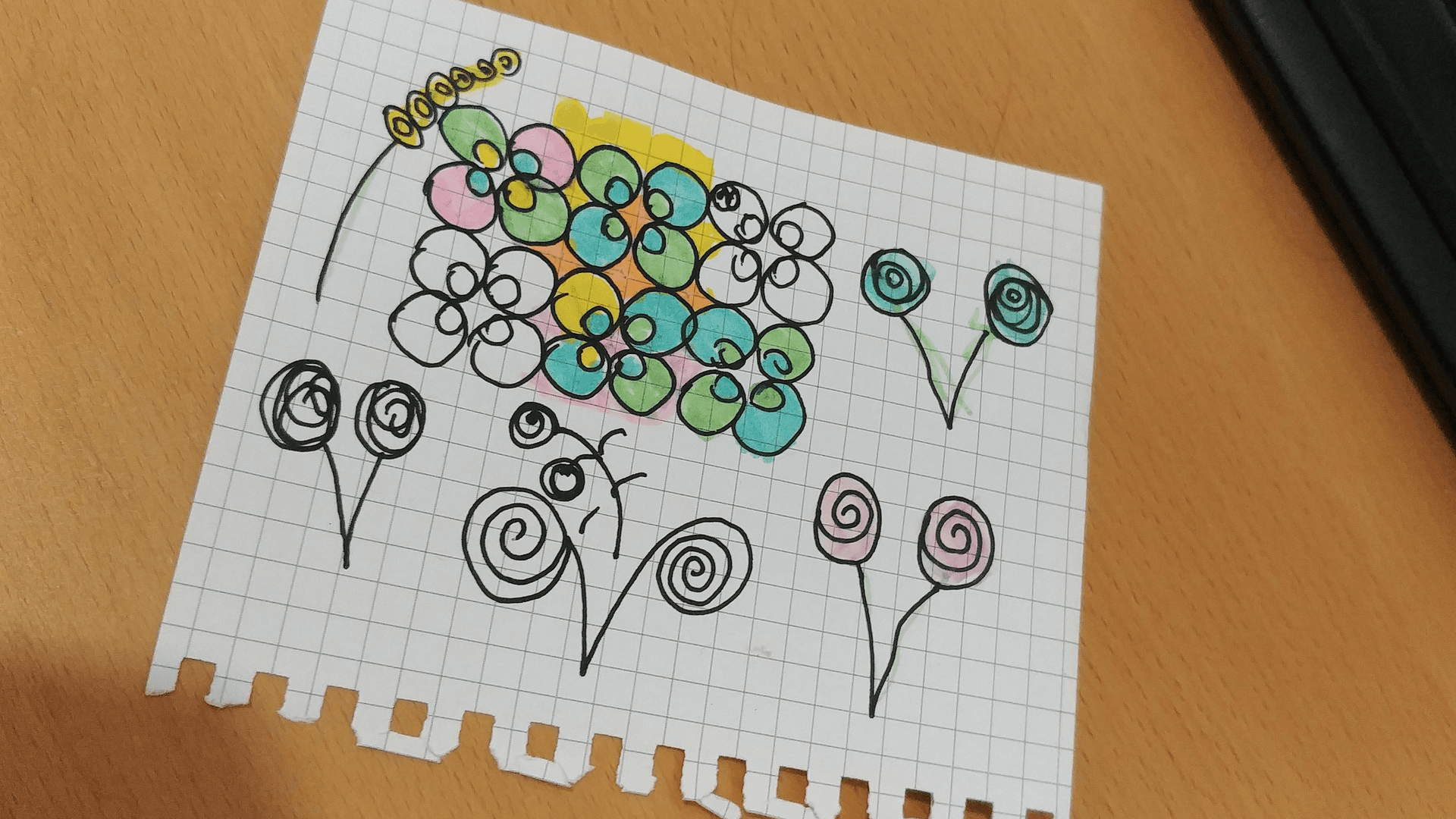
Hero image: Scribbles of flowers and circles 02, by Chenspec, CC BY-SA 4.0. Via Wikimedia Commons.
Take our professional IQ test
Want to know your IQ? Try the first ever professional online IQ test.