Jul 2, 2026·Advanced Topics & ResearchWhat Is the Flynn Effect and Why Are IQ Scores Rising?
Discover the Flynn effect and why average IQ scores rose dramatically over the 20th century. Read the full article and take the professional RIOT IQ test!
Dr. Russell T. WarneChief Scientist
One of the most fascinating phenomena in all of psychology is the Flynn effect: the tendency for average performance on IQ tests to increase over time. Named after the philosopher and researcher James Flynn, who brought it to widespread attention in the 1980s, the Flynn effect raises profound questions about what IQ tests measure, how intelligence develops, and whether people today are truly smarter than their grandparents.
I have studied this phenomenon throughout my career, and it is a topic I address in my book In the Know: Debunking 35 Myths about Human Intelligence. The Flynn effect is genuinely important, but it is also widely misunderstood. Many popular accounts get the basic facts wrong, exaggerate its implications, or draw conclusions that the data do not support. A careful look at the evidence reveals a more nuanced and ultimately more interesting story.
The Basic Finding
James Flynn published two landmark articles in the 1980s documenting a striking trend. In the first, published in 1984, he showed that American IQ test performance had been rising steadily over decades. In the second, published in 1987, he extended the finding to 13 additional industrialized countries. The pattern was remarkably consistent: IQ scores were rising at an average rate of approximately 3 points per decade, or about 15 points per generation. Taken at face value, the numbers led to absurd conclusions. If a 15-point gain per generation were real and reflected genuine increases in intelligence, it would mean that the average person from the early 20th century would score in the bottom 2% by today's standards, roughly at the threshold for intellectual disability. Projecting further back, it would imply that people 150 years ago were unable to function in daily life. That clearly was not the case. Victorian-era scientists, engineers, and writers produced work of extraordinary sophistication. Something other than raw intelligence had to be driving the score increases.
Common Misconceptions
Before examining the causes and implications of the Flynn effect, it is important to correct several misconceptions that persist in popular discussions.
First, James Flynn did not discover the phenomenon. Rising IQ scores were first noticed in the 1930s, decades before Flynn began his career (Rodgers, 2015). The most well-known early observation was the finding that World War II soldiers scored higher on military intelligence tests than World War I soldiers (Tuddenham, 1948). Flynn's contribution was to systematize the evidence and bring it to the attention of a broad audience, not to discover it. Second, Flynn did not name the effect after himself. Richard Herrnstein and Charles Murray coined the term "the Flynn effect" in their 1994 book The Bell Curve.
Third, and most importantly, the Flynn effect does not represent a genuine increase in intelligence. It reflects an increase in IQ test performance. Understanding why requires grasping the distinction between g (general intelligence) and the non-g abilities that also contribute to IQ scores, which is the subject of the next section.
Why Rising Scores Do Not Mean Rising Intelligence
IQ tests measure a mixture of g (which many researchers consider equivalent to general intelligence) and non-g cognitive abilities. The Flynn effect operates primarily on the non-g contributions to IQ. These non-g factors include familiarity with abstract problem-solving formats, exposure to formal education, test-taking sophistication, and even increased willingness to guess on difficult items (Brouwers et al., 2014). This is a critical distinction. When two people take the same IQ test in the same year, the difference in their scores is a meaningful reflection of their relative cognitive ability. But when scores from different decades are compared, the comparison breaks down because the non-g composition of the scores has changed over time. Earlier and later test takers are not performing on an equivalent footing: the later generation has been shaped by environmental conditions that improved performance on the specific tasks that IQ tests happen to measure. For this reason, IQ scores cannot be meaningfully compared across different time periods (Wicherts et al., 2004).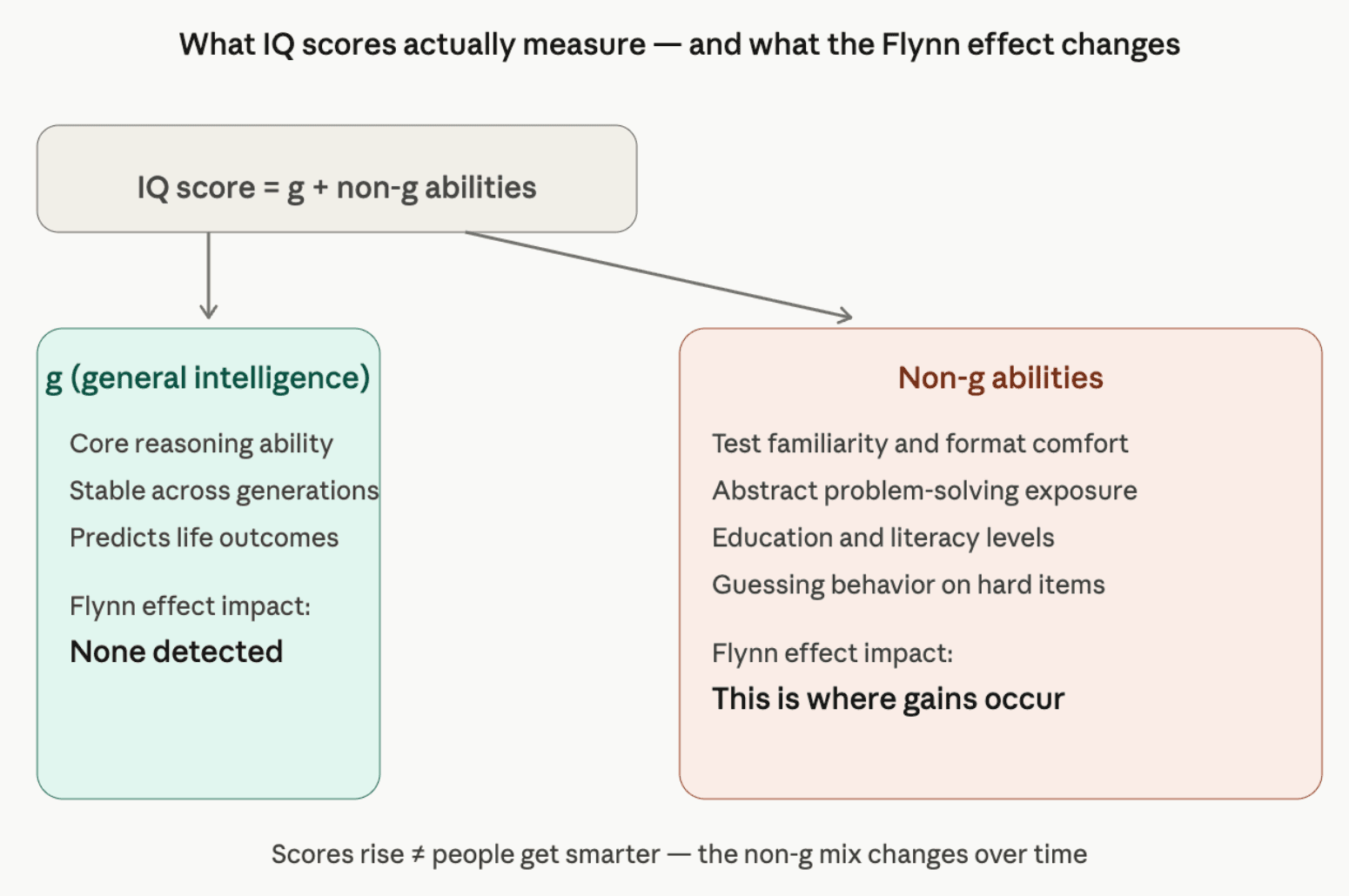
What Caused the Flynn Effect?
If the Flynn effect does not reflect a genuine increase in intelligence, what is driving the rise in test performance? The answer is multifactorial, and no single cause accounts for the entire trend.
Education is among the most important contributors. Over the 20th century, the average years of schooling increased dramatically in virtually every industrialized country. Formal education exposes students to the kinds of abstract, systematic thinking that IQ tests measure: categorizing objects, identifying patterns, reasoning about hypothetical scenarios, and manipulating symbols. Changes in school curricula have also played a role, as modern curricula place greater emphasis on abstract and analytical thinking compared to earlier decades (Warne et al., 2025). Nutrition has also improved substantially. Reductions in malnutrition, micronutrient deficiencies, and childhood infectious diseases over the 20th century have allowed more children to develop to their full cognitive potential. These improvements are particularly important at the lower end of the IQ distribution, where environmental deprivation has the greatest impact. As fewer children experience severe nutritional deficits, the average IQ rises, not because anyone is getting smarter, but because fewer people are being held below their potential.
Reduced exposure to environmental toxins, particularly lead, is another contributing factor. Lead exposure during childhood is a well-documented cause of cognitive impairment. The removal of lead from gasoline and paint in industrialized countries eliminated a significant source of IQ-lowering exposure for millions of children.
Increased cognitive stimulation from the modern environment also likely plays a role. Daily life in the 21st century requires substantially more interaction with abstract symbols, written text, visual media, and technology than daily life a century ago. This environmental complexity may train people in the kinds of abstract reasoning that IQ tests assess, even outside of formal schooling.
The Reverse Flynn Effect
One of the most discussed recent developments in this field is the observation that IQ scores have stopped rising, and in some countries have begun to decline. This "reverse Flynn effect" has been documented in several northern European countries, including Norway, Germany, France, and Denmark.
The most rigorous study of this phenomenon was conducted by Bratsberg and Rogeberg (2018), published in the Proceedings of the National Academy of Sciences. Using military conscription data covering three decades of Norwegian birth cohorts (1962–1991), they found that IQ scores peaked among men born in the mid-1970s and declined thereafter at a rate of approximately 6 to 7 IQ points per generation. Crucially, the decline was observed within families: brothers born later scored lower than brothers born earlier, even though they shared the same parents and the same family genetics. This rules out genetic explanations for the decline and establishes that, like the original Flynn effect, the reversal is environmentally caused. What environmental changes might be responsible? In Norway, performance on a mathematics calculation subtest has decreased since schools began allowing students to use calculators in math classes (Warne, in press). In Kuwait, the implementation of a new educational curriculum may have led to a decrease in IQs (Dutton et al., 2017). These examples illustrate the same principle that drives the original Flynn effect, but in reverse: when society stops emphasizing the specific abilities that IQ tests measure, scores decline, without anyone actually becoming less intelligent.
What the Flynn Effect Means for IQ Testing
The most direct practical consequence of the Flynn effect is that IQ tests must be re-normed periodically, typically every 10 to 20 years. Because average test performance changes over time, the norm sample that defines what "average" means must be updated to reflect current performance levels. If an examinee takes a test with outdated norms, their score will be inflated relative to what they would receive on a test with current norms. Professional test creators, including the publishers of major tests like the Wechsler scales, routinely update their norms for this reason.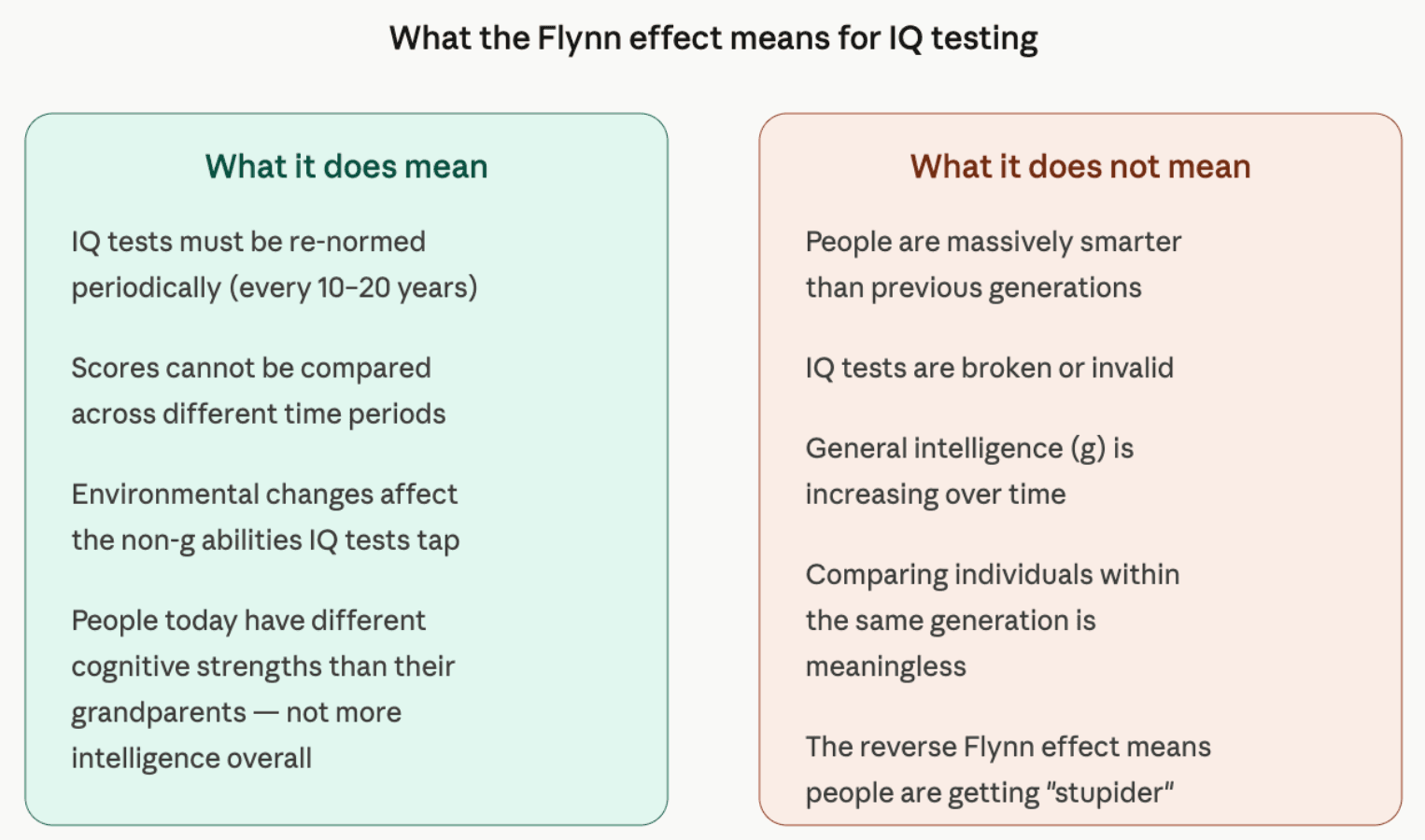
Does the Flynn Effect Invalidate IQ Tests?
Some critics have argued that the Flynn effect proves IQ tests do not really measure intelligence. This conclusion does not follow from the evidence.
Charles Spearman recognized over a century ago that the specific content of IQ tests does not matter, as long as the tasks require thinking, judgment, and reasoning. He called this principle the "indifference of the indicator." The Flynn effect is consistent with this principle: the non-g factors that change over time are not the core of what IQ tests measure. They are the medium through which intelligence expresses itself, and that medium shifts with environmental conditions. The underlying ability being measured, g, remains stable. The Flynn effect is a phenomenon about shifting environmental contexts, not a flaw in the instruments themselves.
Putting It All Together
The Flynn effect is one of the most interesting findings in intelligence research, but its implications are more modest than many popular accounts suggest. The gains in IQ test performance over the 20th century were real, substantial, and consistent across countries, but they reflected changes in the environmental factors that shape non-g cognitive abilities, not an increase in general intelligence. The reverse Flynn effect in several developed countries confirms this interpretation from the opposite direction.
For IQ testing, the phenomenon reinforces a principle that professional test creators have always understood: scores are meaningful within the context in which they are obtained, and norms must be kept current. Within that framework, IQ scores remain among the most reliable, valid, and predictive measures in all of psychology.
Take the First-Ever Professional Online IQ Test
The Reasoning and Intelligence Online Test (RIOT) is the first online IQ test that meets professional standards for psychological assessment. It was created by Dr. Russell Warne, who has over 15 years of experience in intelligence research and is the author of In the Know: Debunking 35 Myths about Human Intelligence (Cambridge University Press). What makes the RIOT different from the countless online IQ tests found with a quick internet search? Most of those tests are created by amateurs without proper training in psychometrics. The RIOT clearly stands out as the first-ever professional online IQ test. The RIOT underwent the same rigorous development process as traditional in-person IQ tests used by psychologists, including expert review, the first-ever proper U.S.-based online norm sample, and compliance with educational and psychological testing standards from APA, AERA, and NCME.
References
Bratsberg, B., & Rogeberg, O. (2018). Flynn effect and its reversal are both environmentally caused. Proceedings of the National Academy of Sciences, 115(26), 6674–6678. https://doi.org/10.1073/pnas.1718793115 Brouwers, S. A., Van de Vijver, F. J. R., & Van Hemert, D. A. (2014). "That is, the answer is closest to D": Item response theory analyses of increases in guessing behavior on intelligence tests over time. Intelligence, 43, 130–137. https://doi.org/10.1016/j.intell.2013.12.004 Flynn, J. R. (1984). The mean IQ of Americans: Massive gains 1932 to 1978. Psychological Bulletin, 95(1), 29–51. https://doi.org/10.1037/0033-2909.95.1.29 Flynn, J. R. (1987). Massive IQ gains in 14 nations: What IQ tests really measure. Psychological Bulletin, 101(2), 171–191. https://doi.org/10.1037/h0090408 Rodgers, J. L. (2015). The well-known Flynn effect was the discovery (not just the publication) of the slow-moving nature of IQ gains. Intelligence, 49, 1–5. https://doi.org/10.1016/j.intell.2013.03.008 Wicherts, J. M., Dolan, C. V., Hessen, D. J., Oortwijn, M. B., Van den Berg, S. M., & Sarris, W. E. (2004). Are intelligence tests measurement invariant over time? Investigating the nature of the Flynn effect. Intelligence, 32(5), 509–537. https://doi.org/10.1016/j.intell.2004.07.002 Warne, R. T. (2020). In the know: Debunking 35 myths about human intelligence. Cambridge University Press. https://doi.org/10.1017/9781108593298
Take our professional IQ test
Want to know your IQ? Try the first ever professional online IQ test.
AuthorDr. Russell T. WarneChief Scientist
