🇺🇸The official website of Riot IQ
Log in
  • Home
  • About

Measure your
intelligence online.

Google

Assessments

  • All IQ Tests
  • Basic IQ Test
  • Full IQ Test
  • Custom IQ Test
  • Free IQ Test

Our Socials

  • X
  • YouTube
  • Facebook
  • LinkedIn

Other IQ Tests

  • WAIS-V
  • SB-5
  • Raven's 2
  • RIAS-2
  • CogAT 9
  • WISC-V

Community

  • Join Subreddit
  • Join Discord

Other Pages

  • Test Manual
  • Administer IQ Tests
  • About Us
  • Articles
  • Data
  • FAQ

Research

  • What do polygenic scores really predict?
  • Working speed and ability on the RIOT

Intelligence Journals & Organizations

  • Human Intelligence Research & Education (HIRE) Foundation
  • International Society for Intelligence Research (ISIR)
  • Intelligence & Cognitive Abilities Journal (ICA)
  • Intelligence Journal
  • Mensa Foundation

Contact

  • Email
  • Support

News & Press

  • International Society for Intelligence Research
  • American Thinker
  • Mensa Foundation (1/2)
  • Mensa Northern New Jersey
  • The University of Western Australia
  • Prolific
  • Quillette
  • Brainz

Our Articles

  • Gmatclub (1/2)
  • ApolloTechnical
  • LessWrong
  • Psychreg
  • Study in Switzerland
  • SuccessConsciousness
  • Creative Organizational Design (1/2)
  • ABNewsWire
  • Vanderbilt University

Our Articles

  • The Globe and Mail
  • Barchart
  • Journal
  • Mensa Foundation (2/2)
  • Psychologs
  • Creative Organizational Design (2/2)
  • AZBigMedia
  • Thoughts on Life and Love
  • Anxiety and Depression Association of America

Our Articles

  • Before It's News
  • Siglo XXI
  • TechBullion
  • Medium
  • Gmatclub (2/2)
  • MSN
  • National Review
  • Minding the Campus
  • Launching Next

Our Articles

  • Comparing Cronbach’s Alpha and McDonald’s Omega Reliability
  • Breaking the Intelligence & IQ Taboo
  • What is the Flynn Effect?
  • A Comprehensive History of IQ Tests
  • The 15 Subtests of the RIOT

Our Articles

  • How to Take an IQ Test
  • How to Calculate IQ
  • What is the RIOT IQ Test?
  • The Pro-Human Aspects of Intelligence Research
  • What is an IQ Test? A Beginner's Guide.

Our Articles

  • 5 Best IQ Tests in 2025
  • Cognitive Profiles on the RIOT IQ Test Results
  • 6 Cognitive Abilities of the RIOT
  • Are There Any Professional and Real Online IQ Tests?

Our Articles

  • Resources to Learn About IQ and Intelligence
  • Studying IQ Matters
  • The Search for Albert Einstein's IQ
  • Do Non-g Gains from the Flynn Effect Matter?

Riot IQ © 2026

  • Terms of Service
  • Privacy Policy
  • BAA Agreement
  • Test Administrator Terms
  • Terms of Service
  • •Privacy Policy
  • •BAA Agreement
  • •Test Administrator Terms

Table of Contents

  • Cognitive Development and IQ
  • The Deviation IQ
  • Cognitive Development in Adulthood
Sep 10, 2025·Advanced Topics & Research

Cognitive Development

Explore how IQ scores evolved from Binet’s mental age and quotient IQ to modern deviation IQ, showing child development, adult comparisons, and age-related changes.

Dr. Russell T. WarneChief Scientist

Share
Cognitive Development
One of the insights that the first IQ test creator, Alfred Binet, was that children’s minds develop as they get older. An implication of that insight was that the cognitive abilities of smarter children would resemble those of children older than them. (Likewise, Binet believed that the cognitive abilities of less intelligent children would resemble the abilities of children like them.) Binet was correct in his beliefs about cognitive development during childhood, as many parents can confirm. 


Cognitive Development and IQ

Binet’s insight into how children can be compared to other children at different ages led to the concept of “mental age,” where a child’s test performance would be expressed in terms of the average age of children who performed equally well. Originally, IQs were calculated by dividing the mental age by the child’s actual (i.e., chronological age) and multiplying by 100. Today, the formula that produces this IQ is called a “quotient IQ.” For quotient IQs, an IQ of 100 is average at any age, and children with scores higher than 100 performed as well on the test as older children. On the other hand, children whose scores are less than 100 perform as well as children who were younger than them.


The Deviation IQ

Binet only studied cognitive development in childhood, but it is clear that the cognitive development doesn’t continue in adulthood. If it did, then a 40-year-old would be as noticeably smarter than a 35-year-old as a 10-year-old and a 5-year-old. For this reason, the quotient IQs never fully made sense for adults. (The problem was temporarily “solved” by setting every adult’s chronological age to 16 for calculation purposes, but this was never very satisfactory.) This is one of the reasons why test creators changed to a “deviation IQ.” In this method, examinees are compared to one another, and the number of standard deviations above or below the average is calculated for each examinee. In a normal distribution (pictured below), 68% of people have a score within +1 standard deviation, and 95% have a score within +2 standard deviations. These scores are then converted to IQs that have an average of 100, with each standard deviation being a 15-point span. 
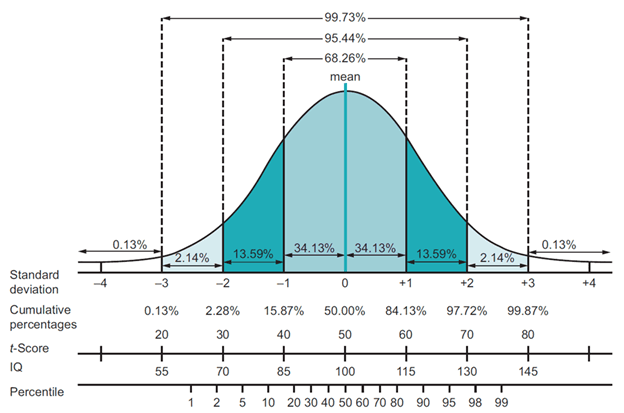
  
Deviation IQs are more complicated to calculate, but they make sense for calculating IQs for adults. They also solve other problems from quotient IQs. For example, quotient IQs could not be compared across ages. An IQ of 120 did not mean the same thing at age 5 and age 12. Because of the problems with quotient IQs, every IQ test has used deviation IQs in its score calculations. But the term “IQ,” which originally stood for “intelligence quotient” stuck around.
One important fact to note with deviation IQs is that they make relative comparisons, not absolute ones. In other words, they state how well an examinee performed on a test compared to other people in their age group. That is very valuable information, but it ignores the year-to-year growth that occurs throughout childhood. With deviation scores, a child who performs as well as the average child in their age group receives a score of 100, even though a 16-year-old child with an IQ of 100 has much more impressive cognitive abilities than an 8-year-old with an IQ. Absolute comparisons like these require other scores and calculations.


Cognitive Development in Adulthood

Although cognitive abilities do not grow from year to year in adults, that does not mean development stops. Adults still learn new information, especially if they attend college or expose themselves to information by reading or engaging in educational activities. In late adulthood, What does occur in adulthood, though, is some decline in late adulthood. Even when dementia is not present, older adults experience noticeable declines -- especially in processing speed, working memory, and fluid reasoning. Still, it is not all bad news for seniors. Learned knowledge, verbal abilities, and certain memory tasks do not decline until very late in life (the mid-to late 80s, on average). Using a deviation IQ to compare adults to those in their age group controls for these changes that occur in adulthood.

Take our professional IQ test

Want to know your IQ? Try the first ever professional online IQ test.

Try our IQ test
Author
Dr. Russell T. WarneChief Scientist

Contact

Table of Contents

  • Cognitive Development and IQ
  • The Deviation IQ
  • Cognitive Development in Adulthood
Article Categories
All ArticlesUnderstanding IQ ScoresTaking an IQ TestRIOT-Specific InformationGeneral IQ & IntelligenceAdvanced Topics & ResearchIQ Scores & InterpretationMensa & High-IQ SocietiesOnline IQ Tests IQ Test Basics & FundamentalsAverage IQ & DemographicsFamous People & IQHistory & Origins Of IQ TestingAccuracy, Reliability & CriticismSpecial Population & Related ConditionsImproving IQ / PreparationSpecific IQ Tests & FormatsIQ Testing for HR & RecruitmentSkills Assessment
Related Articles
What Is the Difference Between Intellectual Disability and Learning Disability? What Jobs Need High Spatial Ability?Is IQ Correlated With Dementia?Does High IQ Actually Correlate With Higher Salary After Age 30?High IQ vs. High EQ: Which One Predicts Long-Term Relationship Happiness?Are You Left-Brained or Right-Brained? What Neuroscience Actually SaysWhat Does Too Much Screen Time Do to Children's Brains?Types of IQ: The Quotients Explained (IQ, EQ, SQ, AQ, CQ)What Is the Dunning-Kruger Effect? What the Research Actually ShowsSame Test, Different Patterns: How ADHD and Autism Show Up Differently Across IQ SubtestsGeneral Intelligence vs. Multiple Intelligences: What Each Theory Gets RightNeuroplasticity in Your 30s and 40s: What the Science Actually SaysThe G-Factor vs. Gardner's Multiple Intelligences: What the Evidence Actually ShowsCan Hyperlexia Make You Seem Smarter Than You Actually Are?Is There a Correlation Between IQ and Reaction Time?Can Exercise Affect Your IQ Score?How Does IQ Change as a Person Ages?What Is the Flynn Effect and Why Are IQ Scores Rising?What Part of the Brain Controls IQ and Cognitive Function?Unlocking Your Potential: The Role of Online IQ TestingLogical Reasoning on an IQ Test: How It's Defined, Measured, and Why It Predicts So MuchThe Science Behind IQ Tests: Understanding Intelligence AssessmentExploring the Controversies Surrounding IQ TestsThe Future of IQ Testing: Trends and InnovationsVisual & Spatial Reasoning: What It Is and Why It Shows Up on an IQ TestFluid vs. Crystallized Intelligence: What the Difference Actually MeansIs Everyone About as Smart as I Am???Does Intelligence Research Undermine the Fight against Inequality?Does Intelligence Research Lead to Negative Social Policies?Do Past Controversies Taint Modern Research on Intelligence?Should Controversial or Unpopular Ideas Be Held to a Higher Standard of Evidence?Does Stereotype Threat Explain Score Gaps among Demographic Groups?Do Unique Influences Operate on One Group’s Intelligence Test Scores?Are Racial/Ethnic Group IQ Differences Completely Environmental in Origin?Do Males and Females Have the Same Distribution of IQ Scores?Is Emotional Intelligence a Real Ability that Is Helpful in Life?Is Very High Intelligence More Beneficial than Moderately High Intelligence?Are Intelligence Tests Designed to Create or Perpetuate a False Meritocracy?Is Intelligence Important in the Workplace?Do IQ Scores Just Measure How Good Someone is at Taking Tests?Are Admissions Tests A Barrier to College for Underrepresented Students? Do Non-Cognitive Variables Have Powerful Effects on Academic Achievement?Can Effective Schools Make Every Child Academically Proficient?Is Every Child Gifted?Does Improvability of IQ Mean Intelligence Can Be Equalized?Can Braining-Training Programs Raise IQ?Can Social Interventions Drastically Raise IQ?Are Genes Important for Determining Intelligence?Is Raising IQ Possible?Does IQ Reflect A Person’s Socioeconomic Status?Are Intelligence Tests Biased Against Diverse Populations?Is Practical Intelligence a Real Ability Separate from General Intelligence?Is Intelligence Just A Western Concept?Does IQ Correspond to Brain Anatomy or Functioning?Measuring Cognitive Aging with Memory and Processing Speed TasksComparing Cronbach’s Alpha and McDonald’s Omega ReliabilityWhat is the Flynn Effect? Is the World’s Collective IQ Increasing or Decreasing?How Do You Test Cognitive Functions?Does High IQ Correlate with Success?Creating an IQ TestIncreasing Your IQCulture-Fair Intelligence TestsFlynn EffectCognitive DevelopmentIQ Test QualityDo Non-g Gains from the Flynn Effect Matter?
Take our IQ tests

Basic IQ Test

5 subtests + 5 cognitive abilities

Take the IQ test

Features

  • ~13 Minutes
  • IQ score
  • Cognitive abilities breakdown
  • ±5.6 IQ margin of error

5/15 Subtests

Learn more
Vocabulary
Matrix Reasoning
SToVeS
Visual Reversal
Symbol Search
Most comprehensive

Full IQ Test

15 subtests + all cognitive abilities

Take the IQ test

Features

  • ~52 Minutes
  • IQ score
  • Cognitive abilities breakdown
  • ±3.7 IQ margin of error

15/15 Subtests

Learn more
Vocabulary, Information, Analogies
Matrix Reasoning, Visual Puzzles, Figure Weights
Object Rotation, SToVeS, Spatial Orientation
Computation Span, Exposure Memory, Visual Reversal
Symbol Search, Abstract Matching
Simple Reaction Time, Choice Reaction Time
Compare all tests