Does a Rubik's Cube Make You Smarter? What Cubing Says About IQ
Does a Rubik's cube make you smarter? No study shows cubing raises IQ, but people with higher reasoning ability learn to solve the cube faster.
Dr. Russell T. WarneChief Scientist
Share
Solving a Rubik's cube has never been shown to make anyone smarter, and no study has measured IQ before and after learning to cube. The evidence runs mainly the other way: in a training study of 79 novices, reasoning and spatial ability explained 30% to 35% of the differences in how well people learned to solve the cube, which corresponds to a correlation of roughly 0.55 to 0.6 (the square root of the share of variance explained).
The cube is a genuinely hard spatial problem, and speedcubers who solve it in a few seconds are impressive. This page covers what solving the cube actually requires, what the small body of research on cubers shows, the nearest real evidence from spatial training, and why being able to solve a Rubik's cube is a weak sign of a high IQ.
What solving a Rubik's cube involves
A standard 3x3 cube has about 4.3 x 10^19 possible arrangements, roughly 43 quintillion. A team of mathematicians and programmers used about a billion seconds of computer time donated by Google to prove that every one of those positions can be solved in 20 moves or fewer, a figure cubers call "God's number." No human solves the cube that way. People rely on methods that break the problem into stages.
• Beginner methods: The cube is solved layer by layer, usually starting with a cross on one face. At each stage the solver recognizes a pattern and applies a memorized sequence of turns, called an "algorithm," that moves a few pieces without disturbing the solved ones. The training course in one psychology study used a seven-step method taught by short videos.
• Speedcubing methods: Competitive solvers use the same basic idea with many more memorized algorithms, plus planning ahead during the inspection period of less than 15 seconds that competition rules allow before each timed solve.
• Official records: The World Cube Association, which governs competitions, ranks most events by an average of five solves with the best and worst removed. As of October 2026, the 3x3 single-solve world record is 2.51 seconds, set by Xuanyi Geng of China at the Guangzhou Grand Open in October 2026, and the average record is 3.51 seconds, set by Yiheng Wang of China in June 2026.
Much of cube skill is therefore learned knowledge (which algorithm fits which pattern) combined with fast recognition and finger dexterity.
Smarter people learn the cube faster
The best study of cube learning took people who had never solved one and taught them. Meinz, Hambrick and colleagues trained 79 undergraduates using the seven-step video course in a single session of up to six hours. Before training, the participants took tests of "fluid intelligence" (the ability to solve new problems), including Raven's matrices, paper folding and mental rotation, plus measures of working memory, grit, growth mindset and personality.
The results were clear. Higher fluid intelligence predicted how efficiently and accurately people solved, with the reasoning and spatial composite accounting for 30% to 35% of the variance in cube performance. Working memory did not add prediction, and none of the personality or motivation measures was related to cube skill. The average participant mastered between two and three of the seven steps, which shows how demanding the task is for beginners.
A second study points the same way. Daniels, Moreau and Macnamara randomly assigned 133 adults with no recent cube experience to practise on cubes of different sizes before a four-minute test on a 5x5 cube. The order of practice made no difference, and scores on Raven's Advanced Progressive Matrices correlated r = 0.24 with test performance.
These studies explain the popular impression that cubers are smart. People who find the cube easy to learn tend to have higher reasoning and spatial ability to begin with, and they are more likely to stick with it. That is selection, and it says nothing about whether the cube raised anyone's ability. The same selection pattern shows up with pencil-and-paper puzzles such as crosswords and sudoku, whose regular solvers also tend to score higher on cognitive tests.
Does cubing improve spatial skills?
There is almost no direct research on this question. The closest is a master's thesis by Valerie at the University of Minnesota. Eighth-grade students who received four class sessions of cube instruction improved more on a two-dimensional mental rotation test than a comparison group (Cohen's d = 0.59) and also showed more improvement on a three-dimensional test. Students were not randomly assigned, the comparison group was tested in a different semester, and more than 100 students were dropped for missing a session or test. It is an interesting pilot. It is not strong evidence.
The nearest solid evidence comes from spatial training in general. Uttal and colleagues meta-analyzed 217 studies and found an average training effect of g = 0.47 relative to control groups. The gains lasted after training ended and transferred to other spatial tasks that were not directly trained. That is a real effect on spatial tests, and our article on how to improve spatial reasoning skills covers what kinds of practice help.
Better performance on mental rotation tests is not the same as higher intelligence. Spatial ability is one part of the broad picture an IQ test captures, as explained in our page on visual-spatial reasoning and why it shows up on an IQ test. A gain of half a standard deviation on one trained kind of task does not translate into half a standard deviation (7.5 points) on a full-scale IQ score. A second-order meta-analysis by Sala and colleagues, covering training with working-memory tasks, chess, music and video games, found that practice transfers to closely related tasks and that effects on other abilities vanish once placebo effects and publication bias are accounted for.
Does solving a Rubik's cube mean you have a high IQ?
No. Being able to solve the cube mainly shows that someone has learned a method and practised it until it stuck. The Meinz study shows that higher ability makes learning faster and easier, and that learning takes time even for capable adults: most of its participants had not finished all seven steps after up to six hours. The study did not identify any minimum IQ needed to learn the cube.
Solving speed is an even weaker sign. Elite speedcubing depends heavily on extensive practice, memorized algorithms, recognition speed and hand skill. A 2025 study by Zarei and colleagues recorded brain activity in 13 experienced speedcubers while they planned and executed solves and did tasks of planning, visuospatial judgment and fine motor skill. It linked their cube performance to brain signals associated with visuomotor integration and planning. It did not measure IQ, and with 13 participants it cannot say how speedcubers compare with anyone else.
If you want to know how strong your spatial and reasoning abilities are, a cube timer will not tell you. A properly normed test that samples several abilities will.
Frequently asked questions
Does a Rubik's cube make you smarter?
There is no evidence that it does. No study has measured IQ before and after learning the cube, and research on cognitive training finds that practice mostly improves the practised skill.
Are people who can solve a Rubik's cube smarter?
On average they may be somewhat higher in reasoning and spatial ability, because those abilities make the cube easier to learn. Learning a beginner method mostly takes patience and practice, so solving it is not proof of a high IQ.
Can the Rubik's cube improve spatial reasoning?
Possibly on closely related tasks such as mental rotation. One non-randomized school study found gains, and spatial training in general improves spatial test scores, but no randomized trial has tested the cube itself.
How fast is the Rubik's cube world record?
As of October 2026, the official 3x3 single-solve record is 2.51 seconds and the average-of-five record is 3.51 seconds, according to the World Cube Association.
Is speedcubing a sign of genius?
No. Speedcubing records reflect long practice, memorized algorithms and fast hands. "Genius" has no scientific definition, and speed on one puzzle says little about general intelligence.
The takeaway
The Rubik's cube is a good test of patience and a satisfying hobby, but there is no evidence that it raises intelligence. People with stronger reasoning and spatial skills learn it faster, which is why cubers have a reputation for being smart. Cube practice may sharpen closely related spatial skills, and that is about as far as the evidence goes. For a measure of your reasoning ability that does not depend on practice with one puzzle, take the RIOT IQ test.
References
1. Meinz, E. J., Hambrick, D. Z., Leach, J. J., & Boschulte, P. J. (2023). Ability and nonability predictors of real-world skill acquisition: The case of Rubik's Cube solving. Journal of Intelligence, 11(1), 18. [doi.org/10.3390/jintelligence11010018](. doi.org
2. Rokicki, T., Kociemba, H., Davidson, M., & Dethridge, J. (2014). The diameter of the Rubik's Cube group is twenty. SIAM Review, 56(4), 645-670. [doi.org/10.1137/140973499](. doi.org
4. World Cube Association. (2026). Records: 3x3x3 Cube. [worldcubeassociation.org/results/records](. worldcubeassociation.org
5. Daniels, J. S., Moreau, D., & Macnamara, B. N. (2022). Learning and transfer in problem solving progressions. Journal of Intelligence, 10(4), 85. [doi.org/10.3390/jintelligence10040085](. doi.org
6. Valerie, J. (2020). Supporting middle school students' spatial skills through Rubik's Cube play [Master's thesis, University of Minnesota]. University of Minnesota Digital Conservancy. [hdl.handle.net/11299/215041](. hdl.handle.net
7. Uttal, D. H., Meadow, N. G., Tipton, E., Hand, L. L., Alden, A. R., Warren, C., & Newcombe, N. S. (2013). The malleability of spatial skills: A meta-analysis of training studies. Psychological Bulletin, 139(2), 352-402. [doi.org/10.1037/a0028446](. doi.org
8. Sala, G., Aksayli, N. D., Tatlidil, K. S., Tatsumi, T., Gondo, Y., & Gobet, F. (2019). Near and far transfer in cognitive training: A second-order meta-analysis. Collabra: Psychology, 5(1), 18. [doi.org/10.1525/collabra.203](. doi.org
9. Zarei, A. A., Frederiksen, C. R., Jensen, M. B., & Oliveira, A. S. (2025). The electrocortical activity of elite Rubik's cube athletes while solving the cube. Experimental Brain Research, 243(6), 155. [doi.org/10.1007/s00221-025-07104-w](. doi.org
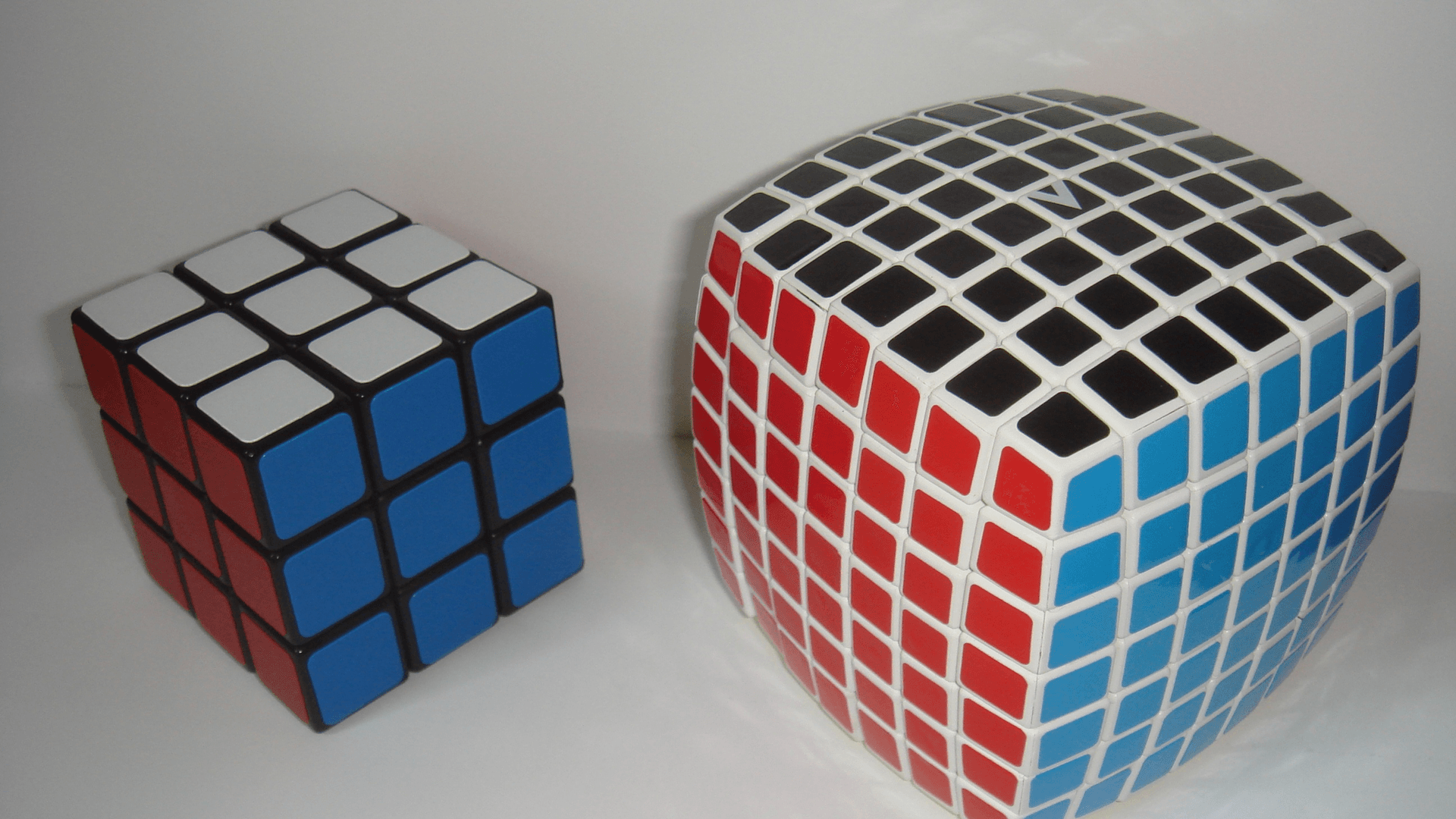
Hero image: 3x3x3 standard cube and 7x7x7 v-cube, by Matfald, CC BY-SA 3.0. Via Wikimedia Commons.
Take our professional IQ test
Want to know your IQ? Try the first ever professional online IQ test.