Brain Size and IQ: Do Bigger Brains Mean Higher Intelligence?
Brain size and IQ are linked, but weakly: across 88 studies the correlation is about r = .24, so brain volume accounts for roughly 6% of IQ differences.
Dr. Russell T. WarneChief Scientist
Share
People with bigger brains do score slightly higher on IQ tests, but the link is weak: a meta-analysis of 88 studies found a correlation of about r = .24 between brain volume and IQ, which means brain size accounts for roughly 6% of the differences in scores between people. In plain numbers, a person whose brain is one standard deviation larger than average would be expected to score about 4 IQ points higher, with huge overlap.
This page covers what the largest MRI studies show, whether the link holds between brothers and sisters, why men's larger brains do not translate into a matching IQ gap, and what Einstein's brain and animal brains can and cannot tell us.
What the largest studies show
Scientists have suspected a link between head size and intelligence for more than 150 years, but early work relied on skull measurements and brains weighed after death. Modern studies use "MRI" (magnetic resonance imaging) to measure the brains of living people.
Jakob Pietschnig and colleagues gathered 88 studies covering 148 samples and more than 8,000 people, including unpublished results obtained directly from researchers. The overall correlation was r = .24, and it held for children and adults, for verbal and performance IQ, and for both sexes. They also found signs that small, null results had often gone unreported, so the published literature had overstated the link, though it survived every correction for that bias.
Two large studies from UK Biobank, a database of middle-aged and older British adults, give similar answers:
• Nave and colleagues (2019): a preregistered study of 13,608 adults found r = .19 between total brain volume and a fluid reasoning test, after controlling for sex, age, height, socioeconomic status and genetic ancestry. The link was driven mainly by grey matter.
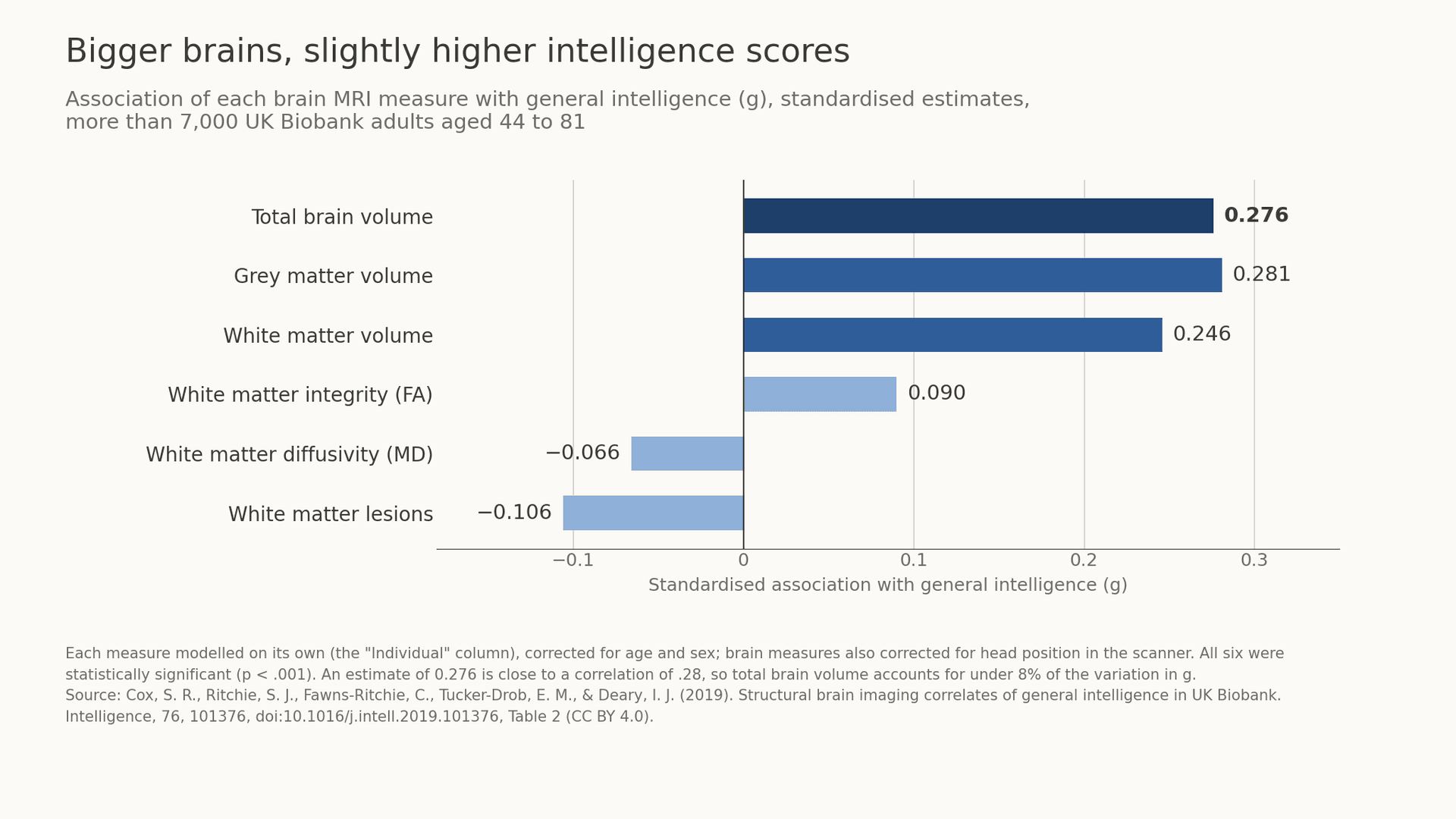
• Cox and colleagues (2019): with at least 7,201 participants who completed four cognitive tests, the association between total brain volume and a "general intelligence factor" (g, the shared core of performance across different tests) was r = .276. Grey matter volume showed about the same association (.281), white matter volume a little less (.246), and other white matter measures much less.
The figure on this page shows the Cox results. A correlation near .2 to .3 is respectable by the standards of psychology and is small in human terms. Brain volume is one ingredient among many, and knowing someone's brain size tells you very little about their IQ.
Does the bigger-brained sibling have the higher IQ?
A correlation across unrelated people can be produced by anything that affects both brain growth and test scores, such as childhood nutrition, health or family income. A strong test is to compare siblings, who share their family environment and half their genes on average. If the brother or sister with the larger brain also tends to score higher, family-level confounds cannot explain the link.
Two early sibling studies, each with only about 35 pairs, found no clear within-family association. James Lee and colleagues revisited the question with far larger samples. In 1,022 participants from the Human Connectome Project, the sibling with the larger brain did tend to have the higher IQ, with a within-family correlation of 0.18 after correction for measurement error. In 2,698 twins and siblings from Minnesota, head circumference showed a within-family correlation of 0.19 with IQ. Genetic analyses in the same paper, linking variants for head size with years of education, showed the pattern expected if brain size has a modest causal influence on intelligence.
A within-family correlation of about .18 corresponds to roughly 3 IQ points for a one standard deviation difference in brain size. The link is real, and it is small.
Body size is the obvious confound in all of this, since taller people have larger heads and also score slightly higher on average. Studies such as Nave's control for height directly, and the link survives. Our page on height and IQ covers that relationship separately.
Men have bigger brains, so why no matching IQ gap?
The sex difference in brain size is large. In the largest single study of 5,216 UK Biobank adults, men's total brain volume averaged 1,234 cubic centimetres and women's 1,116, a difference of 1.41 standard deviations. On the reasoning test in the same sample, the gap was far smaller: men scored higher by 0.18 standard deviations, about 3 IQ points, on a short 13-item test.
If brain volume carried as much weight between the sexes as it does within them, a brain gap that size would predict a test-score gap roughly twice as large as the one observed (1.41 multiplied by Cox's .276 gives about 0.39 standard deviations). Two findings help explain the mismatch:
• The association is the same within each sex: Cox and colleagues found no sex differences in how strongly brain volume related to g, and Pietschnig's meta-analysis also found the link generalized across sex.
• Brains differ in more than size: women had greater average cortical thickness, and most of the sex differences in smaller structures deep in the brain traced back to overall size.
The distributions also overlap considerably on every brain measure, so many women have larger brains than many men.
The brain size literature has also been misused to rank groups of people, which is one reason modern researchers emphasize that brain size is a weak proxy for any one person's ability. Pietschnig's team concluded that it is not warranted to treat brain size as a direct stand-in for intelligence differences.
Einstein's brain and animal brains
Albert Einstein's brain is the most famous counterexample. Removed at his death in 1955 at age 76, it weighed 1,230 grams. Dean Falk and colleagues, who studied newly found photographs of it, describe its size as unexceptional, while noting unusual features in its folding patterns, including the prefrontal cortex and the parietal lobes. A single brain cannot test a statistical relationship, but Einstein's case is a reminder that structure and organization matter as well as volume.
Across species, the picture is different again. Among primates, Robert Deaner and colleagues found that overall brain size predicted cognitive ability better than the "encephalization quotient", a measure that adjusts brain size for body size. Comparisons between species are a separate question from why one person scores higher than another.
For a wider look at how intelligence relates to brain structure and function beyond total volume, see our page on IQ and brain anatomy. Brain size is also partly heritable, which is one route by which genes influence IQ, a topic covered in is IQ genetic.
Frequently asked questions
Does brain size affect IQ?
Slightly. The best estimates put the correlation between brain volume and IQ at about .2 to .3, and sibling studies suggest part of that link is causal, worth roughly 3 to 4 IQ points per standard deviation of brain size.
Do people with bigger heads have higher IQs?
On average, by a small amount. Head circumference correlated about 0.19 with IQ within families in a Minnesota sample of 2,698 twins and siblings, but head size is a poor guide to any one person's ability.
How big was Einstein's brain?
It weighed 1,230 grams at his death at age 76, which researchers describe as unexceptional in size. Studies of it have focused on unusual folding patterns instead.
Are men smarter because their brains are bigger?
No. Men's brains average about 10% larger, yet in the same UK Biobank sample men outscored women by only about 3 IQ points on one short reasoning test, and the brain-IQ link is equally strong within each sex.
Why is the link between brain size and IQ so weak?
Volume is only one feature of a brain. In UK Biobank, total volume, grey and white matter and white matter quality together accounted for 5.4% of the differences in general intelligence in middle-aged adults and 13.6% in older adults.
The takeaway
Bigger brains go with slightly higher IQ scores. The link is consistent across the largest MRI studies and holds within families, but at r = .2 to .3 it explains well under a tenth of the differences between people, and brain size says almost nothing about one person's ability. To measure the ability directly, take a full-length online IQ test.
References
1. Pietschnig, J., Penke, L., Wicherts, J. M., Zeiler, M., & Voracek, M. (2015). Meta-analysis of associations between human brain volume and intelligence differences: How strong are they and what do they mean? Neuroscience & Biobehavioral Reviews, 57, 411-432. [doi.org/10.1016/j.neubiorev.2015.09.017](. doi.org
2. Nave, G., Jung, W. H., Karlsson Linnér, R., Kable, J. W., & Koellinger, P. D. (2019). Are bigger brains smarter? Evidence from a large-scale preregistered study. Psychological Science, 30(1), 43-54. [doi.org/10.1177/0956797618808470](. doi.org
3. Cox, S. R., Ritchie, S. J., Fawns-Ritchie, C., Tucker-Drob, E. M., & Deary, I. J. (2019). Structural brain imaging correlates of general intelligence in UK Biobank. Intelligence, 76, 101376. [doi.org/10.1016/j.intell.2019.101376](. doi.org
4. Lee, J. J., McGue, M., Iacono, W. G., Michael, A. M., & Chabris, C. F. (2019). The causal influence of brain size on human intelligence: Evidence from within-family phenotypic associations and GWAS modeling. Intelligence, 75, 48-58. [doi.org/10.1016/j.intell.2019.01.011](. doi.org
5. Ritchie, S. J., Cox, S. R., Shen, X., Lombardo, M. V., Reus, L. M., Alloza, C., Harris, M. A., Alderson, H. L., Hunter, S., Neilson, E., Liewald, D. C. M., Auyeung, B., Whalley, H. C., Lawrie, S. M., Gale, C. R., Bastin, M. E., McIntosh, A. M., & Deary, I. J. (2018). Sex differences in the adult human brain: Evidence from 5216 UK Biobank participants. Cerebral Cortex, 28(8), 2959-2975. [doi.org/10.1093/cercor/bhy109](. doi.org
6. Falk, D., Lepore, F. E., & Noe, A. (2013). The cerebral cortex of Albert Einstein: A description and preliminary analysis of unpublished photographs. Brain, 136(4), 1304-1327. [doi.org/10.1093/brain/aws295](. doi.org
7. Deaner, R. O., Isler, K., Burkart, J., & van Schaik, C. (2007). Overall brain size, and not encephalization quotient, best predicts cognitive ability across non-human primates. Brain, Behavior and Evolution, 70(2), 115-124. [doi.org/10.1159/000102973](. doi.org
Figure by RIOT IQ. Data from Cox et al. (2019), Intelligence 76, 101376 (doi.org/10.1016/j.intell.2019.101376), Table 2, CC BY 4.0.
Take our professional IQ test
Want to know your IQ? Try the first ever professional online IQ test.