Fish Oil and IQ: Does Omega-3 or DHA Make You Smarter?
Fish oil does not reliably raise IQ. The largest pregnancy trial found no IQ gain at age 7, and pooled infant trials put any benefit at 0 to about 3 points.
Dr. Russell T. WarneChief Scientist
Share
Fish oil does not reliably raise IQ. In the largest trial, 2,399 Australian women took DHA-rich fish oil or a vegetable-oil placebo in pregnancy, and their children's IQ at age 7 did not differ; meta-analyses of all randomized trials put any benefit to children somewhere between zero and about 3 IQ points, depending on which trials are counted.
This page covers why fish oil is expected to help the brain, what the trials in pregnancy, infancy, childhood and later life found, and why the observational studies that started the idea are hard to interpret.
Why fish oil is supposed to boost IQ
Fish oil supplies two long-chain omega-3 fats, "DHA" (docosahexaenoic acid) and "EPA" (eicosapentaenoic acid). DHA is a building block of the developing brain. The brain grows rapidly during the last three months of pregnancy and the first months after birth, with a large increase in its DHA content, and the fetus depends on the mother for its supply.
Observational studies added to the appeal. In the Avon Longitudinal Study of Parents and Children, a British cohort of 11,875 pregnant women, children of mothers who ate no seafood in pregnancy were more likely to score in the bottom quarter for verbal IQ than children of mothers who ate more than 340 grams a week (odds ratio 1.48), after adjustment for 28 possible confounders. Families who eat more fish differ in many ways that statistics capture only partly, so studies like this cannot show that the omega-3 itself made the difference. Fish also carries mercury, which complicates any comparison of fish eaters with non-eaters.
Marketing did the rest. The Cochrane review of infant formula notes that manufacturers added these fats to formula and marketed the products as giving full-term babies a developmental advantage. Our broader page on whether diet or nutrition affects IQ summarizes omega-3 alongside other nutrients; this page looks at the trials in more depth.
Fish oil in pregnancy: what the trials found
The study most often quoted comes from Norway. Ingrid Helland and colleagues randomly assigned pregnant women to 10 mL a day of cod liver oil or corn oil from week 18 of pregnancy until 3 months after birth. At age 4, the 48 tested children in the cod liver oil group scored 106.4 on the mental processing composite of the Kaufman Assessment Battery for Children, against 102.3 for the 36 in the corn oil group, a gap of about 4 points. Only 84 of the 590 women recruited had a child who completed testing at that age. When the team retested 143 children at age 7, they found no significant difference in IQ between the groups.
The DOMInO trial in Australia was far larger. Maria Makrides and colleagues gave 2,399 women 800 mg of DHA a day, or matched vegetable-oil capsules, from before 21 weeks of pregnancy until birth. At 18 months, 726 children were assessed, and their cognitive scores were virtually identical (adjusted mean difference 0.01 points, 95% confidence interval -1.36 to 1.37). The 7-year follow-up, led by Jacqueline Gould, measured IQ with the Wechsler Abbreviated Scale of Intelligence and again found no effect. A later review by the same research group notes that parents in the DHA group reported more behavioural and executive-function problems at ages 4 and 7.
The Cochrane review by Philippa Middleton and colleagues pooled 70 randomized trials involving 19,927 women. Omega-3 in pregnancy lowered the risk of preterm birth (risk ratio 0.89), but the authors found very few differences between groups in children's cognition, IQ or other development, mostly on low- or very-low-quality evidence. The benefit of fish oil in pregnancy appears to lie in preventing early births, and whether to take it is a question for a midwife or obstetrician.
Fish oil for babies and children
Formula trials point the same way. A 2017 Cochrane review by Bhavesh Jasani and colleagues pooled 15 trials with 1,889 full-term infants given formula with or without added long-chain fats. Mental development scores at 18 months were the same (mean difference 0.06 points), follow-ups at 3, 6 and 9 years showed no benefit, and the authors concluded that routine supplementation of term formula could not be recommended. The comparison with breastfed babies is covered in our page on breastfeeding and IQ.
Two meta-analyses that pooled every kind of early supplementation show how fragile any IQ effect is:
• Shulkin and colleagues (2018): 38 trials in mothers, preterm infants and term infants. The pooled IQ difference from the 7 trials that measured IQ was 0.20 points (95% confidence interval -1.56 to 1.96), essentially zero.
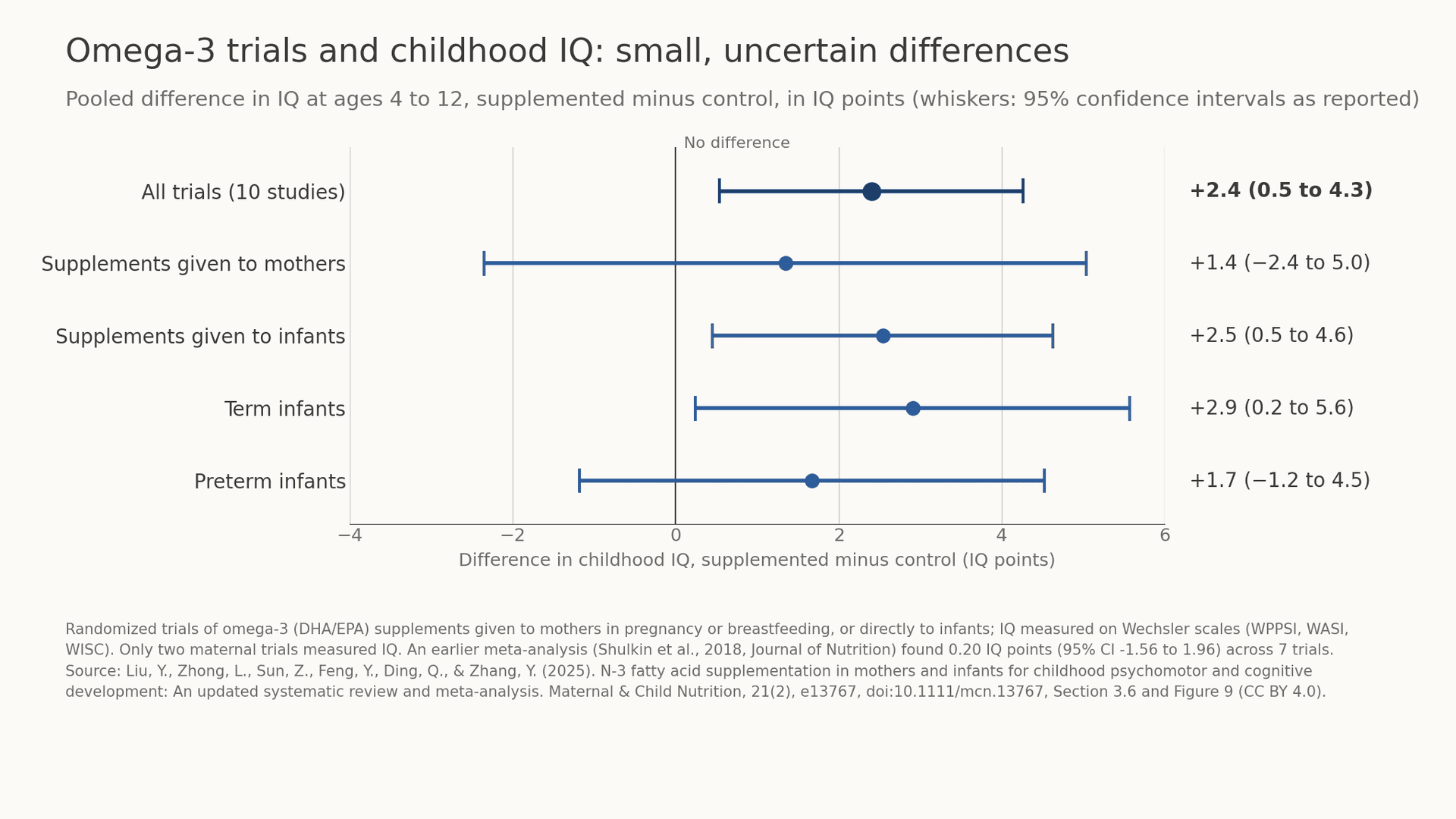
• Liu and colleagues (2025): most of the same trials plus 11 newer ones, 47 in all. The pooled IQ difference across 10 studies was 2.40 points (0.54 to 4.26), with the clearest result for supplements given directly to term infants (2.91 points, 0.24 to 5.57). Supplements given to mothers showed no clear effect (1.35 points, -2.35 to 5.04), heterogeneity was high, and only 8 of the 47 trials were at low risk of bias in every domain.
A shift from 0.2 to 2.4 points after adding a handful of trials, with wide confidence intervals and mixed trial quality, is a signal worth testing in a large trial with IQ as its main outcome, and too weak to treat as an established benefit.
In school-age children the evidence is thin. The NEMO trial gave 396 Australian and 384 Indonesian children aged 6 to 10 a drink with or without 88 mg of DHA and 22 mg of EPA a day for a year. The omega-3 had no effect on any cognitive test, and no treatment changed general intelligence.
Fish oil for adults and older adults
There is no good trial evidence that fish oil raises IQ in healthy adults. Most adult trials ask instead whether it slows cognitive decline. In the AREDS2 trial, 3,501 people with age-related macular degeneration and an average age of 72.7 were tested by telephone every two years for five years. Those given 1 g a day of omega-3 fats declined at the same rate as those who were not (yearly change -0.19 versus -0.18 on a composite score). A Cochrane review by Emma Sydenham and colleagues found no difference in a standard cognitive screening test across 3,221 healthy older people after 24 to 40 months of supplementation (mean difference -0.07 points).
The confounds that explain the gap between observational studies and trials:
• Family background and education: mothers who eat more fish or take supplements tend to be better educated and better off, and those advantages pass to children.
• Parental IQ: brighter parents make different food choices and pass on genes that affect their children's scores.
• Baseline nutrition: most trials ran in well-nourished, high-income populations, where extra DHA may add little. Populations with very low fish intake are under-studied.
• Age at testing: infant development scales were designed to detect delays and may miss small differences, while many trials never followed children to an age when IQ is stable.
Anyone considering supplements in pregnancy or for a child should talk to a midwife, obstetrician, paediatrician or GP, who can weigh diet, fish intake and medical history.
Frequently asked questions
Does fish oil increase IQ?
Not reliably. The largest pregnancy trial found no IQ difference at age 7, and pooled trials put any effect on children's IQ between zero and about 3 points, with low confidence.
Does taking fish oil during pregnancy make your baby smarter?
The best trials say no. A Cochrane review of 70 trials found very few differences in children's cognition or IQ, although omega-3 in pregnancy did lower the risk of preterm birth.
Is DHA in baby formula worth it for IQ?
A Cochrane review of 15 trials in full-term babies found no difference in mental development at 18 months and no benefit in follow-ups to age 9.
Can omega-3 make adults smarter?
There is no trial evidence that it raises IQ in healthy adults. In older adults, large trials found that omega-3 supplements did not slow cognitive decline.
Is eating fish better than fish oil capsules?
Observational studies link fish eating in pregnancy with better child outcomes, but fish eaters differ in many ways, and fish also contains mercury. The trials of capsules alone show little effect on IQ.
The takeaway
Fish oil is a sensible part of the story of brain development, and DHA matters for the growing brain. The randomized trials, though, show that adding more to a reasonably good diet does little or nothing for IQ in children or adults. The most positive meta-analysis finds about 2 to 3 points from infant supplements, a fragile result that earlier analyses did not find. If you are curious where your own reasoning skills stand, try a professionally developed IQ test.
References
1. Helland, I. B., Smith, L., Saarem, K., Saugstad, O. D., & Drevon, C. A. (2003). Maternal supplementation with very-long-chain n-3 fatty acids during pregnancy and lactation augments children's IQ at 4 years of age. Pediatrics, 111(1), e39-e44. [doi.org/10.1542/peds.111.1.e39](. doi.org
2. Helland, I. B., Smith, L., Blomén, B., Saarem, K., Saugstad, O. D., & Drevon, C. A. (2008). Effect of supplementing pregnant and lactating mothers with n-3 very-long-chain fatty acids on children's IQ and body mass index at 7 years of age. Pediatrics, 122(2), e472-e479. [doi.org/10.1542/peds.2007-2762](. doi.org
3. Makrides, M., Gibson, R. A., McPhee, A. J., Yelland, L., Quinlivan, J., Ryan, P., & DOMInO Investigative Team. (2010). Effect of DHA supplementation during pregnancy on maternal depression and neurodevelopment of young children: A randomized controlled trial. JAMA, 304(15), 1675-1683. [doi.org/10.1001/jama.2010.1507](. doi.org
4. Gould, J. F., Treyvaud, K., Yelland, L. N., Anderson, P. J., Smithers, L. G., McPhee, A. J., & Makrides, M. (2017). Seven-year follow-up of children born to women in a randomized trial of prenatal DHA supplementation. JAMA, 317(11), 1173-1175. [doi.org/10.1001/jama.2016.21303](. doi.org
5. Gawlik, N. R., Anderson, A. J., Makrides, M., Kettler, L., & Gould, J. F. (2020). The influence of DHA on language development: A review of randomized controlled trials of DHA supplementation in pregnancy, the neonatal period, and infancy. Nutrients, 12(10), 3106. [doi.org/10.3390/nu12103106](. doi.org
6. Middleton, P., Gomersall, J. C., Gould, J. F., Shepherd, E., Olsen, S. F., & Makrides, M. (2018). Omega-3 fatty acid addition during pregnancy. Cochrane Database of Systematic Reviews, 2018(11), CD003402. [doi.org/10.1002/14651858.CD003402.pub3](. doi.org
7. Hibbeln, J. R., Davis, J. M., Steer, C., Emmett, P., Rogers, I., Williams, C., & Golding, J. (2007). Maternal seafood consumption in pregnancy and neurodevelopmental outcomes in childhood (ALSPAC study): An observational cohort study. The Lancet, 369(9561), 578-585. [doi.org/10.1016/S0140-6736(07)60277-3](. doi.org
8. Jasani, B., Simmer, K., Patole, S. K., & Rao, S. C. (2017). Long chain polyunsaturated fatty acid supplementation in infants born at term. Cochrane Database of Systematic Reviews, 2017(3), CD000376. [doi.org/10.1002/14651858.CD000376.pub4](. doi.org
9. Shulkin, M., Pimpin, L., Bellinger, D., Kranz, S., Fawzi, W., Duggan, C., & Mozaffarian, D. (2018). n-3 fatty acid supplementation in mothers, preterm infants, and term infants and childhood psychomotor and visual development: A systematic review and meta-analysis. The Journal of Nutrition, 148(3), 409-418. [doi.org/10.1093/jn/nxx031](. doi.org
10. Liu, Y., Zhong, L., Sun, Z., Feng, Y., Ding, Q., & Zhang, Y. (2025). N-3 fatty acid supplementation in mothers and infants for childhood psychomotor and cognitive development: An updated systematic review and meta-analysis. Maternal & Child Nutrition, 21(2), e13767. [doi.org/10.1111/mcn.13767](. doi.org
11. Osendarp, S. J., Baghurst, K. I., Bryan, J., Calvaresi, E., Hughes, D., Hussaini, M., Karyadi, S. J., van Klinken, B. J., van der Knaap, H. C., Lukito, W., Mikarsa, W., Transler, C., Wilson, C., & NEMO Study Group. (2007). Effect of a 12-mo micronutrient intervention on learning and memory in well-nourished and marginally nourished school-aged children: 2 parallel, randomized, placebo-controlled studies in Australia and Indonesia. The American Journal of Clinical Nutrition, 86(4), 1082-1093. [doi.org/10.1093/ajcn/86.4.1082](. doi.org
12. Chew, E. Y., Clemons, T. E., Agrón, E., Launer, L. J., Grodstein, F., Bernstein, P. S., & Age-Related Eye Disease Study 2 (AREDS2) Research Group. (2015). Effect of omega-3 fatty acids, lutein/zeaxanthin, or other nutrient supplementation on cognitive function: The AREDS2 randomized clinical trial. JAMA, 314(8), 791-801. [doi.org/10.1001/jama.2015.9677](. doi.org
13. Sydenham, E., Dangour, A. D., & Lim, W. S. (2012). Omega 3 fatty acid for the prevention of cognitive decline and dementia. Cochrane Database of Systematic Reviews, 2012(6), CD005379. [doi.org/10.1002/14651858.CD005379.pub3](. doi.org
Figure by RIOT IQ. Data from Liu et al. (2025), Maternal & Child Nutrition 21(2), e13767 (doi.org/10.1111/mcn.13767), CC BY 4.0.
Take our professional IQ test
Want to know your IQ? Try the first ever professional online IQ test.