Aug 3, 2026·Special Population & Related ConditionsDoes Diet or Nutrition Affect IQ?
Does what you eat change your intelligence? Discover how early nutrition, micronutrients, omega-3s, and diet quality impact IQ. Try the RIOT test!
Dr. Russell T. WarneChief Scientist

The relationship between what we eat and how well we think is one of the more robustly supported — and most practically actionable — findings in the cognitive development literature. Taking an IQ test produces a number that reflects your cognitive performance on a given day under specific conditions. What that number would have been, had your earliest nutritional environment been different, is a question the research has started to answer with considerable specificity.
The short answer is yes — diet and nutrition affect cognitive performance and, through early developmental pathways, measured IQ. But the magnitude, timing, and direction of those effects differ enormously depending on whether we're talking about early childhood development, adolescent cognitive growth, adult cognitive maintenance, or specific nutrient deficiencies versus general dietary quality. This article covers all four dimensions.
The Largest Effects: Specific Nutrient Deficiencies in Early Life
The biggest, most robustly documented nutritional effects on IQ don't come from enrichment — they come from the correction of specific deficiencies that suppress cognitive development below its genetic potential. I covered this in the "What Raises Your IQ the Most?" article in this series, but the findings merit revisiting here in the context of dietary mechanisms specifically.
Iodine is the single most consequential nutritional variable for population-level IQ. Iodine deficiency results in a global loss of 10–15 IQ points at a population level and constitutes the world's greatest single cause of preventable brain damage. Adequate iodine is required for thyroid hormone production during fetal and early childhood brain development. Even mild gestational iodine deficiency produces measurable cognitive and educational deficits that persist into adolescence. The implications for public health are direct: salt iodization programs in iodine-deficient regions produce some of the largest average IQ gains of any single intervention in any population.
Iron deficiency in early childhood is similarly damaging. Iron is required for myelin synthesis and dopamine metabolism — both critical for the cognitive systems that develop most rapidly in the first three years of life. Malnourished children had poorer verbal ability, global IQ, reading ability, spatial ability, and school performance by age 11 compared to those with adequate nutrition — a finding from a 1,559-child longitudinal study in Mauritius that tracked from age 3 to 11. A 55-year longitudinal study, the Barbados Nutrition Study, documented impaired attention and executive function in adults who had been malnourished during childhood — demonstrating that early nutritional deficits leave cognitive traces that persist across the lifespan.
The mechanism for these effects is developmental: the brain grows most rapidly during the first 1,000 days of life, from conception through age two. Nutritional inadequacy during this window doesn't just impair current functioning — it alters the structural development of neural systems in ways that later nutritional remediation cannot fully reverse. This is what the research means when it describes early nutritional deprivation as producing a "cumulative disadvantage."
Dietary Patterns in Childhood: The Direction of Effects
Beyond specific micronutrients, the broader pattern of what children eat consistently associates with cognitive performance — and a 2026 finding from Neuroscience News sharpens the timing of this association considerably.
Dietary patterns at age two are strong predictors of cognitive performance and IQ four to five years later. The "unhealthy" pattern — characterized by snacks, soft drinks, candies, and sausages — was consistently linked to lower IQ outcomes. The finding also revealed an asymmetry worth naming: while unhealthy foods actively hindered cognitive development, a healthy diet of fruits and vegetables didn't necessarily boost IQ above average in this sample — largely because these foods are already common in early childhood environments. This asymmetry reflects the deficit-correction principle: nutrition matters most at the bottom, where deficiency is suppressing development below potential.
A population-based cohort study of children in the UK — published in the Journal of Epidemiology and Community Health — found that dietary patterns at ages 6, 15, and 24 months were associated with IQ at age 8, with the relationship appearing as early as the first year of life. A 2024 cross-sectional study involving 562 Taiwanese schoolchildren aged 6–12 found that higher food intake frequency — particularly breakfast consumption — was positively associated with intelligence scores, while skipping meals was negatively associated with cognitive performance.
Research on Chinese adolescents using data from the China Family Panel Studies found that three dietary patterns — "High protein," "High fat," and "High salt-oil" — showed differential associations with cognitive ability, with the protein-rich pattern showing the most favorable cognitive associations and the high-fat and high-salt patterns showing less favorable ones. A 2024 study from the University of Tokyo published in Frontiers in Nutrition found macronutrient intake significantly associated with intelligence and neural development in adolescents, with protein intake showing the strongest positive relationship with cognitive performance and brain structural measures.
Omega-3 Fatty Acids: What the Meta-Analyses Show
Omega-3 fatty acids — particularly DHA (docosahexaenoic acid) and EPA (eicosapentaenoic acid) — are among the most studied nutritional variables in cognitive development research, and the findings are more nuanced than popular supplementation marketing suggests.
DHA is a structural component of brain cell membranes, particularly in the prefrontal cortex and visual system. It is critical for synaptogenesis — the formation of connections between neurons — during rapid brain growth periods. The question is whether supplementation above typical dietary intake actually improves cognitive outcomes in children who are not deficient.
The most recent comprehensive meta-analysis — covering 38 trials published in Maternal & Child Nutrition in 2024 — found that n-3 PUFA supplementation improved childhood psychomotor and visual development, with term infants who received supplementation showing higher IQ scores in later childhood than infants without additional supplementation. However, the same meta-analysis found no significant effects on global IQ in preterm infants — suggesting that timing and baseline DHA status matter considerably.
A separate meta-analysis of omega-3 supplementation in youths found no main effect of omega-3 fatty acid supplementation on domain-specific cognitive test performance across eight cognitive domains — a finding that reflects the general principle that supplementation in populations without genuine deficiency produces smaller effects than supplementation in deficient populations. DHA plays a vital role in brain structure and function by supporting membrane integrity and neuronal activity, and may exert neuroprotective effects through anti-inflammatory mechanisms — but the cognitive benefit of adding DHA above an adequate baseline is considerably more modest than its importance during deficiency states.
The practical implication: adequate omega-3 intake — through dietary fish consumption, fortified foods, or supplementation particularly during pregnancy and early infancy — is well-supported by the evidence. Supplementing heavily above adequate dietary intake in healthy non-deficient populations shows more limited cognitive returns.
Ultra-Processed Foods: The Emerging Evidence
One of the most consistent and concerning patterns in recent nutritional cognitive research is the negative association between ultra-processed food consumption and cognitive performance — an association that appears across age groups and multiple cognitive domains.
The Flynn Effect — the rise of approximately 2.2 IQ points per decade across much of the 20th century — is partially attributed to improved nutrition across developed populations. Scientists attribute this historic rise to improved nutrition and mental stimulation among children, consistent with the documented relationship between reductions in micronutrient deficiency and rising population cognitive scores. The reverse — a dietary transition toward ultra-processed foods — has been proposed as one contributor to the Flynn Effect reversal documented in Germany and other developed nations.
A 2025 cross-sectional study of community-dwelling adults aged 65 and older, published on MedRxiv, found that diet quality and nutrient intake were meaningfully associated with cognitive performance on standardized assessments, with plant-rich dietary patterns reducing neuroinflammation and processed, high-fat diets associated with heightened inflammatory signaling and accelerated neurodegeneration. The inflammatory pathway is the proposed mechanism: ultra-processed foods high in refined sugars, trans fats, and artificial additives drive systemic inflammation that reaches the brain through the gut-brain axis, increasing neuroinflammation and disrupting the neurotransmitter systems underlying attention and working memory.
What Diet Can and Cannot Do for Adult IQ
For adults in reasonably healthy conditions — not suffering specific micronutrient deficiencies, not severely malnourished — the honest magnitude of dietary effects on measured IQ is considerably more modest than the effects documented in early childhood developmental research.
The general principle that applies here is the same one that applies to exercise and sleep: diet is a suppressor when poor and a maintainer when adequate, not a significant enhancer above a healthy baseline. A healthy adult who switches from a poor diet to a Mediterranean-style diet will likely experience improvements in energy, mood, and sustained attention — all of which can improve performance on cognitively demanding tasks, including IQ subtests. But those improvements reflect the removal of diet-related suppressors rather than the creation of new cognitive capacity.
The domains most sensitive to adult dietary effects are processing speed and working memory — the same domains most sensitive to sleep deprivation and chronic stress. Adequate blood glucose, stable insulin response, and reduced neuroinflammation all support these domains. A diet high in refined carbohydrates and sugar creates the blood glucose volatility that impairs sustained attention and working memory on the timescale of hours — which is why testing after a high-sugar meal typically produces worse performance on timed cognitive subtests than testing after a protein-and-fat-rich meal that stabilizes blood glucose.
The Practical Summary
Ranked by the magnitude and timing of documented cognitive effects:
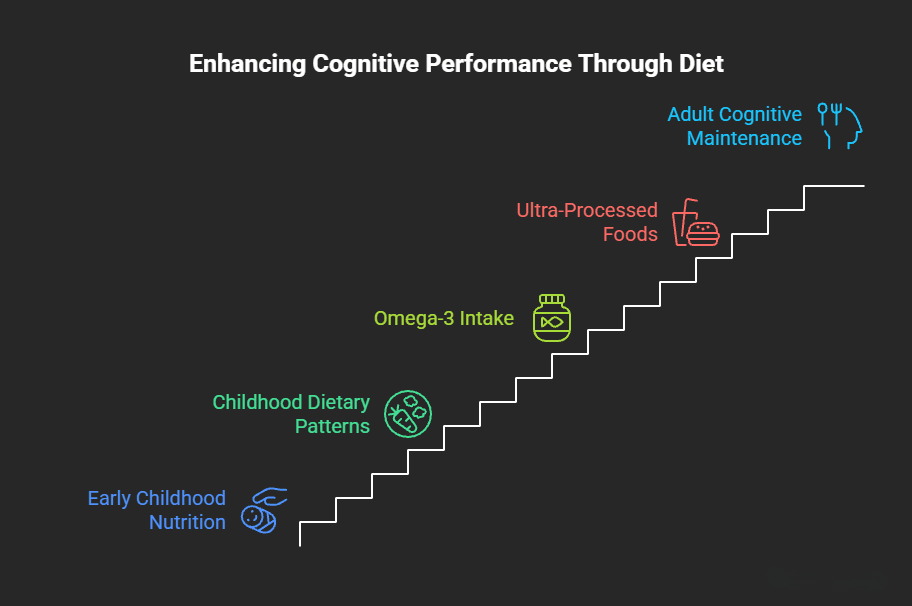
Early childhood (birth to age 5): The highest-impact window. Adequate iodine and iron are foundational — their absence produces irreversible cognitive deficits that no later intervention can fully repair. Dietary pattern quality in the first two years is a measurable predictor of IQ four to five years later. DHA adequacy, particularly during pregnancy and the first year, supports neural development through mechanisms that supplement evidence partially confirms.
School age and adolescence: Dietary quality continues to associate with cognitive performance. Protein adequacy supports neural development; ultra-processed food consumption associates negatively with cognitive outcomes; breakfast consumption consistently associates with better cognitive performance on school days.
Adulthood: Effects are more modest and concentrated in the domains most sensitive to metabolic and inflammatory disruption — processing speed and working memory. Blood glucose stability around testing improves performance on timed subtests. Anti-inflammatory dietary patterns associate with slower cognitive decline, particularly in aging populations.
What no dietary intervention reliably produces in healthy adults: A general IQ increase above a healthy nutritional baseline. The dramatic gains in the early childhood literature reflect correction of deficits, not enrichment above adequacy.
The Takeaway
Diet and nutrition do affect IQ — but the magnitude, mechanism, and practical implications differ substantially depending on the developmental stage and the specific nutritional variable in question. The largest documented effects come from correcting iodine and iron deficiency in early childhood, where the impact on population-level IQ rivals any other single environmental intervention. The most consistent adult effects concentrate in processing speed and working memory through blood glucose stability and neuroinflammation pathways. Ultra-processed food consumption shows consistent negative associations across age groups. Omega-3 adequacy matters most during prenatal and infant development, with more modest effects from supplementation above adequate intake.
If you want to understand where your current cognitive profile sits across the processing speed, working memory, and other domains most sensitive to dietary quality — and have a baseline against which the effects of dietary changes could theoretically be measured — the RIOT gives you a domain-level picture that reveals each index separately.
References
Neuroscience News. (2026). Early Life Diets Quietly Shape IQ Years Later — dietary patterns at age 2 predict IQ at 7. https://neurosciencenews.com/toddler-diet-iq-cognition-30124/
ScienceDirect / Nutrition and Brain Health. (2024). The dynamic influence of nutrition on prolonged cognitive healthspan — Mauritius malnutrition longitudinal study, Barbados Nutrition Study. https://www.sciencedirect.com/science/article/pii/S2772408524001376
PubMed Central / Nutrients. (2021). Association between dietary patterns and cognitive ability in Chinese children aged 10–15 — China Family Panel Studies, N=2029. https://www.ncbi.nlm.nih.gov/pmc/articles/PMC8642971/
Frontiers in Nutrition. (2024). Macronutrient intake is associated with intelligence and neural development in adolescents — University of Tokyo study. https://www.frontiersin.org/journals/nutrition/articles/10.3389/fnut.2024.1349738/full
Wiley / Maternal & Child Nutrition. (2024). N-3 Fatty Acid Supplementation in Mothers and Infants for Childhood Psychomotor and Cognitive Development — meta-analysis of 38 trials. https://doi.org/10.1111/mcn.13767
PubMed / PLoS ONE. (2020). Omega-3 and its domain-specific effects on cognitive test performance in youths: A meta-analysis — no main effect in non-deficient populations. https://pubmed.ncbi.nlm.nih.gov/32070694/
PubMed Central. (2012). Fortified iodine milk improves iodine status and cognitive abilities in schoolchildren — 10–15 IQ point population loss from iodine deficiency. https://www.ncbi.nlm.nih.gov/pmc/articles/PMC4812403/
Blue Book Services / Alliance for Food and Farming. (2024). The impact of nutrition on IQ — Flynn Effect 2.2 points per decade partially attributed to improved nutrition. https://www.bluebookservices.com/aff-the-impact-of-nutrition-on-iq/
Take our professional IQ test
Want to know your IQ? Try the first ever professional online IQ test.
AuthorDr. Russell T. WarneChief Scientist