Oct 5, 2026·Special Population & Related Conditions
Alcoholism and IQ: Does Lower Intelligence Raise the Risk, and Does Drinking Lower IQ?
Alcoholism and IQ are linked both ways: lower IQ at 18 predicts higher alcohol use disorder risk, and heavy drinking adds to cognitive decline later.
Dr. Russell T. WarneChief Scientist
Share
Alcoholism and IQ are linked in both directions: young adults with lower IQ scores have a higher risk of later alcohol use disorder, and people who develop alcohol-related disorders show somewhat more decline in test scores over the following decades. The picture has a twist: in British cohort studies, children with higher IQ grew up to drink more, and in one of them they also reported more drinking problems.
This article covers the large conscript studies that link IQ at 18 to later alcohol problems, the findings that point the other way, what heavy drinking does to test scores and how much recovers with abstinence, and how to read an IQ score from someone with a drinking problem. It is about the drinker's own IQ. Alcohol exposure before birth is a separate question, covered in our article on fetal alcohol spectrum disorder.
Lower IQ at 18 predicts more alcohol use disorder
The strongest evidence comes from Scandinavian countries, where nearly all young men once took an intelligence test at military conscription and can be followed through national health registers.
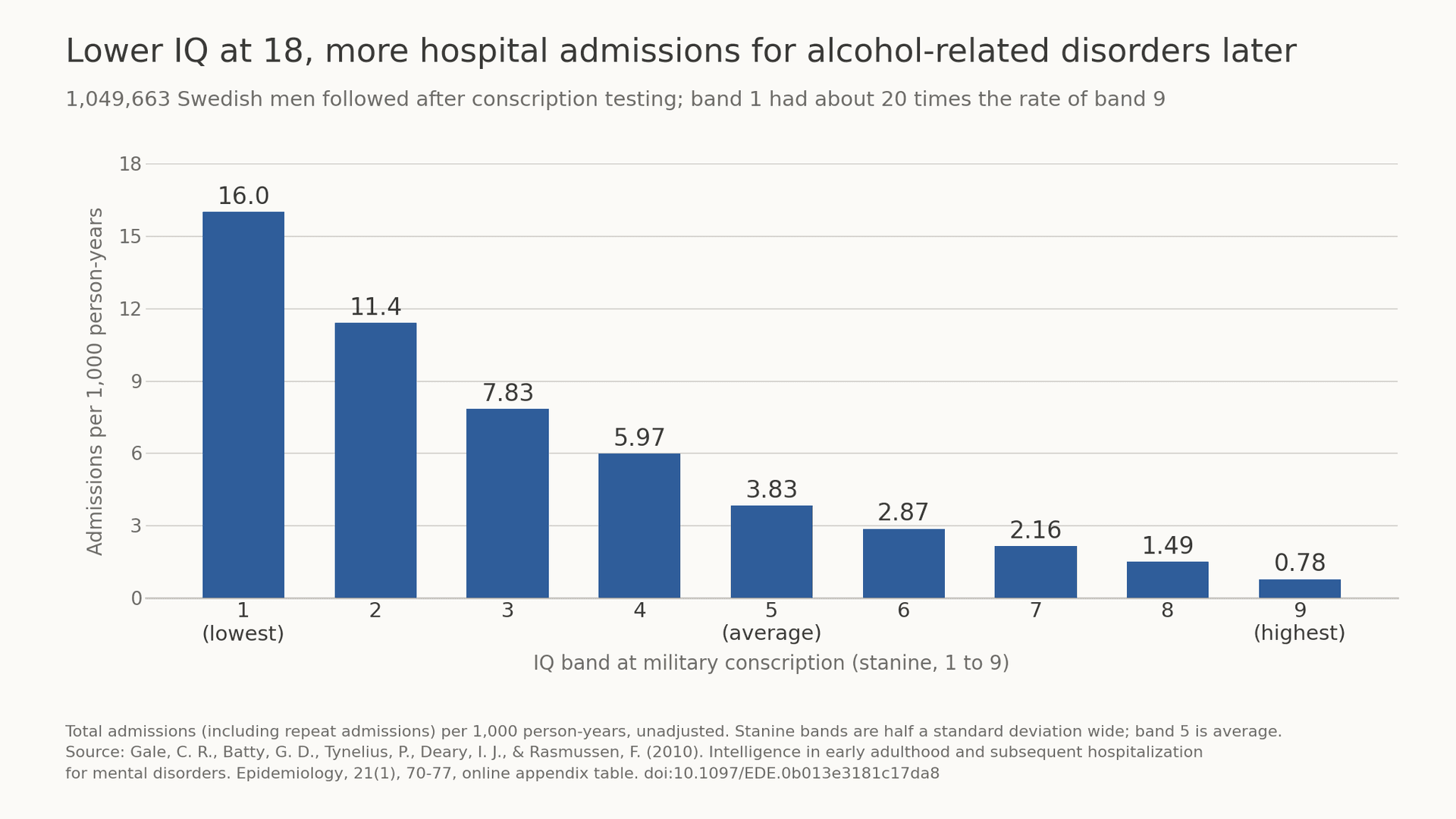
In the study shown in the chart above, Gale and colleagues followed 1,049,663 Swedish men tested at a mean age of 18.3 for an average of 22.6 years, after excluding anyone with a psychiatric diagnosis at conscription. Alcohol-related disorders were the most common reason for psychiatric admission, affecting 22,804 men (2.2%). Each standard deviation lower on the IQ test went with a 1.75 times higher risk of admission, and the admission rate fell steadily across all nine IQ bands, from 16.0 per 1,000 person-years in the lowest band to 0.78 in the highest. The scores are reported as "stanines", a nine-point scale explained in our guide to what a stanine score is.
Other cohorts agree on the direction and add detail:
• Swedish men followed for 37 years: Among 49,321 conscripts, each step down the nine-point IQ scale raised the unadjusted risk of alcohol-related hospital admission by 29%. After also adjusting for education, socioeconomic position and income at age 40, the increase shrank to 6%, which suggests that much of the link runs through the jobs and social position that IQ helps people reach.
• Siblings and twins: Kendler and colleagues studied 554,644 Swedish men and found that each standard deviation higher in IQ went with roughly half the risk of alcohol use disorder (hazard ratio 0.54). Comparing cousins, siblings and identical twins who differed in IQ, they estimated a weaker but still protective effect (0.72 for identical twins), which they read as partly shared family background and partly a direct effect of cognitive ability.
• Danish men: In 3,287 men from Copenhagen, each standard deviation lower in IQ raised the odds of alcohol use disorder by 69%. The link was much stronger in men without other psychiatric disorders than in men with them.
None of these studies shows that a low score causes drinking problems in any one person. A "hazard ratio" compares the rate of an outcome between groups (1.0 means equal rates), and in the million-man study most men even in the lowest IQ band never had an alcohol-related admission.
Why higher childhood IQ also predicts drinking more
The British birth cohorts tell a different story. In the 1970 British Cohort Study, Batty and colleagues linked mental ability tests taken at age 10 to drinking reported at age 30 by 8,170 cohort members. Higher childhood ability went with more frequent drinking and higher average intake, as well as more self-reported problem drinking. Per standard deviation of ability, the odds of problem drinking rose by 38% in women and 17% in men.
Satoshi Kanazawa and Josephine Hellberg used British and American cohort data to argue that more intelligent people are drawn to "evolutionarily novel" behaviors, including drinking alcohol. That is one theory about why the association exists. Their data show that brighter children grew up to consume more alcohol, and they do not test the evolutionary explanation directly.
Two things help reconcile the findings. The British studies mostly measured how often and how much people drink. The Scandinavian studies mostly counted hospital admissions and registered diagnoses, the severe end of the spectrum. Even in Sweden the pattern is not uniform: in a survey of 49,321 conscripts, lower IQ went with heavier drinking and more binge drinking at the time of conscription. A plausible summary is that higher IQ may go with more regular drinking while lower IQ goes with more of the harm that leads to treatment.
Does heavy drinking lower IQ?
Most studies compare people with and without drinking problems at one point in time, which mixes two things: the lower starting IQ described above and any damage from alcohol. A Danish study separated them by retesting 2,499 men in their early 60s with the same test they had taken at conscription around age 20. Men with alcohol-related hospital diagnoses had started lower (95.0 versus 100.5) and also declined more over four decades (8.5 points versus 4.8). The extra decline remained after adjusting for baseline IQ, education, smoking and other illnesses. The authors concluded that the lower average IQ in alcohol use disorder reflects both lower premorbid ability and greater decline.
How much recovers after stopping drinking is less settled.
• Stavro and colleagues (2013): Pooling 62 studies across 12 cognitive domains, including IQ, they found moderate impairment during the first year of abstinence and only small differences after more than a year, suggesting that much of the deficit fades with sustained sobriety.
• Crowe and colleagues (2020): An updated meta-analysis of 34 studies (2,786 participants) restricted to standardized neuropsychological tests found that deficits, especially in memory, persisted even after more than a year of abstinence.
At the severe end, Korsakoff syndrome, a memory disorder caused by thiamine deficiency and often associated with long-term heavy drinking, shows how an IQ score can miss serious damage: in one group of 16 patients described in a review by Kopelman, average full-scale IQ was 105 while the average memory index was about 55.
Reading an IQ score in someone who drinks heavily
Because ability, social circumstances and alcohol effects overlap, a single IQ score from a person with an alcohol use disorder needs careful interpretation:
• Timing: Scores taken soon after detoxification reflect the early-abstinence dip in the meta-analyses, so they may understate the person's settled ability.
• Premorbid ability: Clinicians can estimate earlier ability with a reading-based test, as in the Korsakoff studies, and compare it with current scores.
• Other conditions: In the Swedish million-man study, 42% of men admitted for alcohol-related disorders also had a mood disorder diagnosis and 42% another substance use disorder, and either can lower scores.
• Memory versus reasoning: A normal IQ does not rule out alcohol-related memory problems, so memory testing matters as much as the full-scale score.
A family doctor or an addiction specialist is the right first contact for concerns about drinking, and a clinical neuropsychologist can carry out a full assessment of the kind described in our guide to neuropsychological testing.
Frequently asked questions
Does a low IQ cause alcoholism?
Not directly. Lower IQ at 18 predicts a higher risk of alcohol use disorder in large studies, but much of the link runs through adult social position and family background, and most men even in the lowest IQ band were never admitted to hospital for alcohol.
Do smarter people drink more?
In British cohorts, children with higher ability grew up to drink more often and in larger amounts. Severe alcohol-related disorders are still more common at lower IQ levels in the large Scandinavian studies.
Does drinking lower your IQ?
Long-term heavy drinking is linked to extra decline: Danish men with alcohol-related disorders lost about 8.5 points over four decades compared with 4.8 points in other men.
Does IQ come back after you stop drinking?
Some recovery is likely. One meta-analysis found most deficits shrink after a year of abstinence, while a later one found memory problems often persist.
Can an IQ test detect alcohol-related brain damage?
Not on its own. In Korsakoff syndrome, full-scale IQ can stay in the average range while memory is severely impaired, so a neuropsychological assessment is needed.
The takeaway
Alcoholism and IQ influence each other. In about a million Swedish men, alcohol-related admissions fell steadily with each step up in IQ at 18, and twin comparisons suggest part of that link is a real effect of cognitive ability. Heavy drinking then adds measurable decline, some of which fades with long abstinence. The British finding that bright children grow up to drink more is a reminder that drinking frequency and alcohol use disorder are different outcomes. If you want a clear baseline of your own reasoning ability, you can take the RIOT IQ test, which reports your score against a defined norm group.
References
1. Gale, C. R., Batty, G. D., Tynelius, P., Deary, I. J., & Rasmussen, F. (2010). Intelligence in early adulthood and subsequent hospitalization for mental disorders. Epidemiology, 21(1), 70-77. [doi.org/10.1097/EDE.0b013e3181c17da8](. doi.org
2. Sjölund, S., Allebeck, P., & Hemmingsson, T. (2012). Intelligence quotient (IQ) in adolescence and later risk of alcohol-related hospital admissions and deaths: 37-year follow-up of Swedish conscripts. Addiction, 107(1), 89-97. [doi.org/10.1111/j.1360-0443.2011.03544.x](. doi.org
3. Kendler, K. S., Ohlsson, H., Sundquist, J., & Sundquist, K. (2017). School achievement, IQ, and risk of alcohol use disorder: A prospective, co-relative analysis in a Swedish national cohort. Journal of Studies on Alcohol and Drugs, 78(2), 186-194. [doi.org/10.15288/jsad.2017.78.186](. doi.org
4. Just-Østergaard, E., Flensborg-Madsen, T., Knop, J., Sørensen, H. J., Becker, U., & Mortensen, E. L. (2019). Intelligence in young adulthood and alcohol use disorders in a prospective cohort study of Danish men: The role of psychiatric disorders and parental psychiatric history. BMJ Open, 9(9), e028997. [doi.org/10.1136/bmjopen-2019-028997](. doi.org
5. Batty, G. D., Deary, I. J., Schoon, I., Emslie, C., Hunt, K., & Gale, C. R. (2008). Childhood mental ability and adult alcohol intake and alcohol problems: The 1970 British Cohort Study. American Journal of Public Health, 98(12), 2237-2243. [doi.org/10.2105/AJPH.2007.109488](. doi.org
6. Kanazawa, S., & Hellberg, J. E. E. U. (2010). Intelligence and substance use. Review of General Psychology, 14(4), 382-396. [doi.org/10.1037/a0021526](. doi.org
7. Sjölund, S., Hemmingsson, T., & Allebeck, P. (2015). IQ and level of alcohol consumption: Findings from a national survey of Swedish conscripts. Alcoholism: Clinical and Experimental Research, 39(3), 548-555. [doi.org/10.1111/acer.12656](. doi.org
8. Grønkjær, M., Flensborg-Madsen, T., Osler, M., Sørensen, H. J., Becker, U., & Mortensen, E. L. (2019). Intelligence test scores before and after alcohol-related disorders: A longitudinal study of Danish male conscripts. Alcoholism: Clinical and Experimental Research, 43(10), 2187-2195. [doi.org/10.1111/acer.14174](. doi.org
9. Stavro, K., Pelletier, J., & Potvin, S. (2013). Widespread and sustained cognitive deficits in alcoholism: A meta-analysis. Addiction Biology, 18(2), 203-213. [doi.org/10.1111/j.1369-1600.2011.00418.x](. doi.org
10. Crowe, S. F., Cammisuli, D. M., & Stranks, E. K. (2020). Widespread cognitive deficits in alcoholism persistent following prolonged abstinence: An updated meta-analysis of studies that used standardised neuropsychological assessment tools. Archives of Clinical Neuropsychology, 35(1), 31-45. [doi.org/10.1093/arclin/acy106](. doi.org
11. Kopelman, M. D. (2023). Observations on the clinical features of the Wernicke-Korsakoff syndrome. Journal of Clinical Medicine, 12(19), 6310. [doi.org/10.3390/jcm12196310](. doi.org
Figure by RIOT IQ. Data from Gale, Batty, Tynelius, Deary & Rasmussen (2010), Epidemiology 21(1), 70-77, online appendix table (doi.org/10.1097/EDE.0b013e3181c17da8).
Take our professional IQ test
Want to know your IQ? Try the first ever professional online IQ test.