Oct 7, 2026·Special Population & Related Conditions
Sickle Cell Disease and IQ: What Stroke, Silent Infarcts and Processing Speed Mean for Scores
Sickle cell IQ research finds scores about 4 to 7 points below healthy peers on average without brain injury, with much larger gaps after a stroke.
Dr. Russell T. WarneChief Scientist
Share
On average, children and adults with sickle cell disease score somewhat lower on IQ tests than healthy comparison groups, by about 4 to 7 points when the brain looks normal on MRI and by much more after a stroke. Most people with sickle cell disease still score within the broad average range, and the size of any gap depends heavily on whether the brain has been injured and on the family's circumstances.
This article covers what the research shows about sickle cell IQ scores, how overt strokes and "silent cerebral infarcts" change the picture, which thinking skills are most affected, and why the numbers are harder to pin down than they look. It describes research findings and does not offer medical advice. Families with concerns should start with their sickle cell care team, usually led by a hematologist, and ask about a referral to a pediatric or clinical neuropsychologist.
What IQ scores look like in sickle cell disease
Sickle cell disease is an inherited blood disorder in which red blood cells can take a rigid sickle shape, block small blood vessels and break down early. The brain is one of the organs most at risk, and that is why IQ has been studied in this condition for decades.
Three meta-analyses give a consistent picture:
• Children without brain injury: Schatz and colleagues pooled studies of children with no evidence of cerebral infarction and found a small but reliable gap, about 4.3 IQ points below control groups. They also found that tests of specific abilities picked up differences more sensitively than overall IQ.
• Children grouped by MRI findings: Kawadler and colleagues analyzed 19 studies that used Wechsler IQ tests and MRI. Children with no infarct on MRI scored about 7 points below healthy controls. Children with silent infarcts scored about 6 points below those without, and children who had a stroke scored about 10 points below those with silent infarcts.
• All ages and domains: Prussien and colleagues combined 110 studies with 3,600 participants with sickle cell disease. Deficits relative to test norms appeared in every cognitive domain and every age group, and they grew in size from no infarct, to silent infarct, to overt stroke.
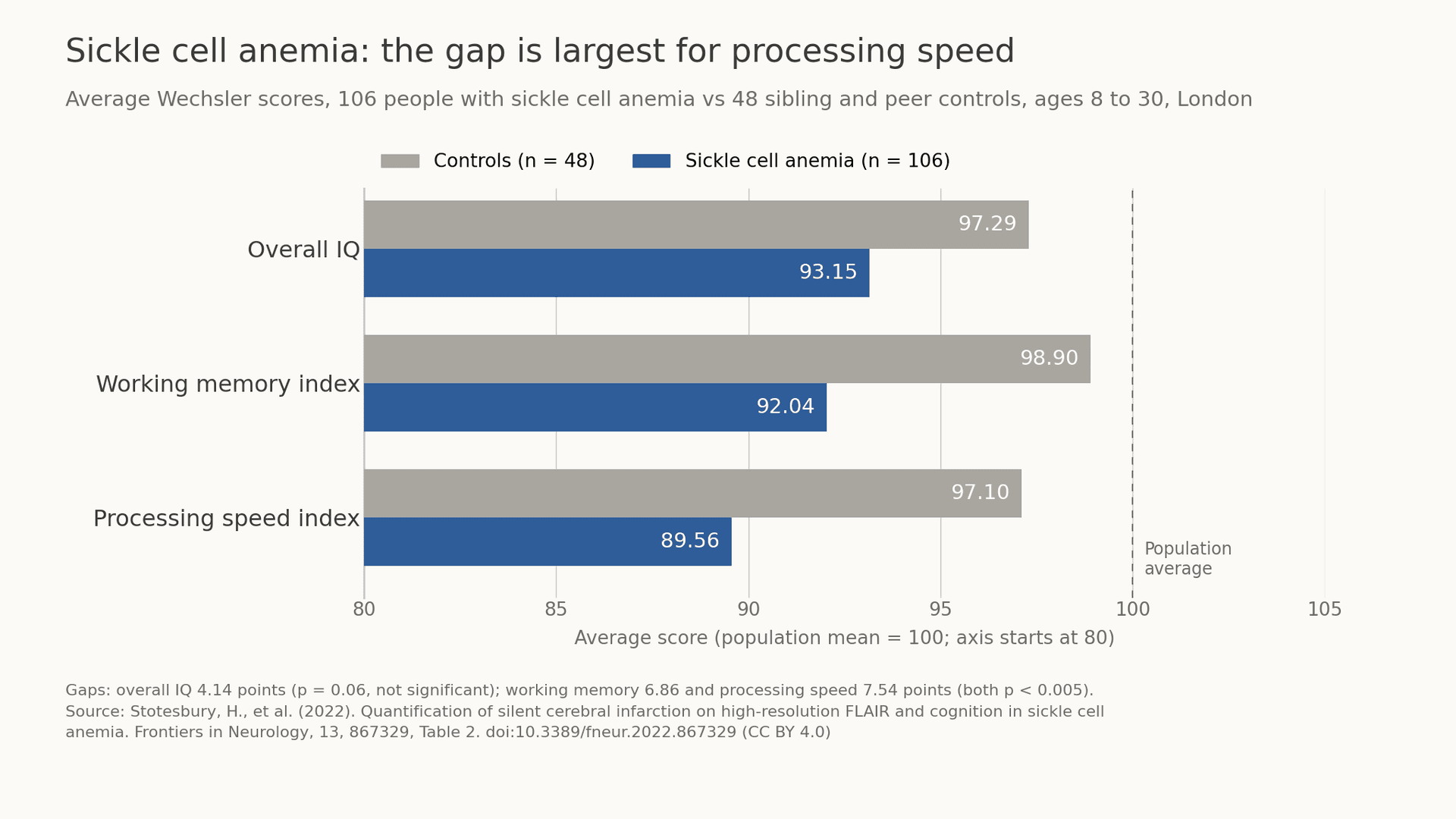
The chart above shows what a typical modern comparison looks like. In a London study of 106 people with sickle cell anemia (the most common and usually most severe form) and 48 siblings and race-matched peers, the patients averaged 93 on an overall IQ measure against 97 for controls. That 4-point gap did not quite reach statistical significance. Working memory and processing speed showed larger and clearer gaps.
The spread around those averages is wide. In an Italian clinic sample of 68 children, mostly first-generation immigrants, the 49 children tested on the WISC-III averaged 86.9, with a standard deviation of 16.3 points, and a quarter of the whole group scored below 75. Spreads that wide mean a diagnosis of sickle cell disease tells you very little about any one child's score.
Stroke, silent infarcts and the size of the gap
Brain injury is the main reason the averages differ so much between studies.
An overt stroke is the kind with obvious symptoms, such as weakness on one side of the body or trouble speaking. In an MRI substudy of the Cooperative Study of Sickle Cell Disease, 9 of 194 children aged 6 to 12 (4.6%) had a history of stroke, all with the most common genotype, and they scored significantly lower than children with silent infarcts or normal scans on most neuropsychological measures. Our article on IQ after a stroke covers stroke and cognition more broadly. Since the late 1990s, screening with transcranial Doppler ultrasound has been used to find children at the highest risk, after the STOP trial reported a 92% difference in stroke risk between high-risk children who received regular transfusions and those on standard care.
A silent cerebral infarct is a small area of injury that shows up on MRI but causes no obvious symptoms. These are common. A 2020 meta-analysis by Houwing and colleagues put the pooled prevalence at 29.5% in people with the most severe genotypes, compared with 9.8% in control subjects. In the Cooperative Study, children with silent infarcts did worse than children with normal scans on arithmetic, vocabulary and visual-motor speed.
The link between silent infarcts and IQ is less settled than it once looked. In the London study shown in the chart, the share of patients classified as having silent infarcts ranged from 24% to 42% depending on which radiological definition was used. With high-resolution scanning, the researchers found no group-level link between lesion presence, number or volume and overall cognition. Silent infarcts still matter clinically, but their presence on a scan is a rough guide to a person's thinking skills.
Processing speed and the profile beneath the full-scale score
The full-scale IQ is an average of several index scores, and in sickle cell disease the indexes are often uneven. The clearest and most repeated finding is slower processing speed, the ability to do simple visual tasks quickly and accurately. Our guide to the Processing Speed Index explains how that score is built.
Adults show the same pattern. Vichinsky and colleagues tested 149 adults with sickle cell anemia who had no history of neurological problems and 47 community controls, with both groups stratified by age, sex and education. Adjusted full-scale IQ averaged 90.47 in patients and 95.66 in controls, a gap of about 5 points. The processing speed gap was more than twice as large: 86.50 against 97.95. In an earlier study of 83 patients and 32 sibling controls, the same London group found that a 4-point full-scale gap disappeared statistically once processing speed was taken into account, which suggests slower speed explains much of the lower overall score.
Researchers think several mechanisms contribute:
• Low oxygen delivery: In the King study described below, each 1% drop in hemoglobin oxygen saturation went with about 0.75 fewer IQ points.
• White matter changes: In that 2018 study, slower processing speed tracked lower integrity in white matter that looked normal on standard scans, and patients with and without silent infarcts had similarly low processing speed.
• Anemia and age: In the adult study, anemia was linked to poorer cognitive performance in older patients.
The pattern across childhood is also worth knowing. In the Prussien meta-analysis, gaps in full-scale IQ, verbal and perceptual reasoning, and executive function were larger in school-aged samples than in preschool samples. Adult samples showed smaller gaps than school-aged ones, but the authors judged that this was probably due to which adults take part in research, so it should not be read as recovery.
Why the numbers are hard to pin down
Several features of this research make the averages less precise than they appear.
• Family circumstances: King and colleagues tested 150 children with sickle cell anemia in the Silent Infarct Transfusion trial. When the head of household had no college education, the child's full-scale IQ was 6.2 points lower on average, a larger effect than having a silent infarct (5.2 points). Family income also mattered. The general relationship between IQ and socioeconomic status applies here as it does elsewhere.
• Choice of comparison group: Studies that compare patients with siblings share family background, which makes the gap a cleaner estimate of the disease's effect. Studies that compare patients with test norms can mix disease effects with differences in schooling, income and neighborhood.
• Short-form tests and language: Many studies use two- or four-subtest screening versions of the Wechsler scales, which give an estimated IQ with more measurement error than a full battery. In the Italian sample, most children spoke three languages at home and verbal IQ was lower than performance IQ in about three quarters of them, a reminder that language background can shape scores.
• Illness on test day: Pain, fatigue, recent hospital stays and missed school can all lower performance on the day of testing. A single score taken during a difficult period may understate a person's usual ability.
• Who gets studied: Clinic samples may include more children with severe disease, while adult studies may leave out people who are too unwell to take part.
For families, the practical point is that a child's own testing matters far more than any average. A pediatric neuropsychologist can give a full assessment that separates processing speed and working memory from reasoning, and a school psychologist can use those results to plan support in the classroom.
Frequently asked questions
Does sickle cell disease lower IQ?
On average, yes, by a modest amount. Children with no visible brain injury score about 4 to 7 points below comparison groups, and the gap is much larger after an overt stroke.
Do silent strokes affect IQ in sickle cell disease?
Meta-analyses find that children with silent cerebral infarcts score about 6 points lower than children without them. Newer high-resolution MRI studies suggest the link depends a great deal on how the infarcts are defined.
Which thinking skills are most affected?
Processing speed shows the largest and most consistent gap, followed by working memory and executive function. Overall reasoning is often closer to average.
Does sickle cell trait affect IQ?
People with sickle cell trait carry one copy of the gene and do not have the disease. In the London study, controls with the trait did not differ significantly from other controls on IQ, working memory or processing speed.
Who should I see about thinking or learning problems in sickle cell disease?
Start with the sickle cell care team, usually led by a hematologist, who can review stroke screening and brain imaging history. A pediatric or clinical neuropsychologist can carry out a full cognitive assessment.
The takeaway
Sickle cell IQ research shows a consistent but modest gap in people without brain injury, a larger one after silent infarcts, and a substantial one after an overt stroke. Processing speed is usually the most affected skill, and family circumstances shape scores as much as some medical factors do. For anyone curious about their own reasoning ability outside a clinical setting, you can take the RIOT IQ test, which reports scores against a defined norm group but is not a substitute for a neuropsychological evaluation.
References
1. Kawadler, J. M., Clayden, J. D., Clark, C. A., & Kirkham, F. J. (2016). Intelligence quotient in paediatric sickle cell disease: A systematic review and meta-analysis. Developmental Medicine & Child Neurology, 58(7), 672-679. [doi.org/10.1111/dmcn.13113](. doi.org
2. Schatz, J., Finke, R. L., Kellett, J. M., & Kramer, J. H. (2002). Cognitive functioning in children with sickle cell disease: A meta-analysis. Journal of Pediatric Psychology, 27(8), 739-748. [doi.org/10.1093/jpepsy/27.8.739](. doi.org
3. Prussien, K. V., Jordan, L. C., DeBaun, M. R., & Compas, B. E. (2019). Cognitive function in sickle cell disease across domains, cerebral infarct status, and the lifespan: A meta-analysis. Journal of Pediatric Psychology, 44(8), 948-958. [doi.org/10.1093/jpepsy/jsz031](. doi.org
4. Stotesbury, H., Kawadler, J. M., Clayden, J. D., Saunders, D. E., Hood, A. M., Koelbel, M., ... Kirkham, F. J. (2022). Quantification of silent cerebral infarction on high-resolution FLAIR and cognition in sickle cell anemia. Frontiers in Neurology, 13, 867329. [doi.org/10.3389/fneur.2022.867329](. doi.org
5. Montanaro, M., Colombatti, R., Pugliese, M., Migliozzi, C., Zani, F., Guerzoni, M. E., ... Sainati, L. (2013). Intellectual function evaluation of first generation immigrant children with sickle cell disease: The role of language and sociodemographic factors. Italian Journal of Pediatrics, 39, 36. [doi.org/10.1186/1824-7288-39-36](. doi.org
6. Armstrong, F. D., Thompson, R. J., Wang, W., Zimmerman, R., Pegelow, C. H., Miller, S., ... Vass, K. (1996). Cognitive functioning and brain magnetic resonance imaging in children with sickle cell disease. Pediatrics, 97(6), 864-870. [doi.org/10.1542/peds.97.6.864](. doi.org
7. Adams, R. J., McKie, V. C., Hsu, L., Files, B., Vichinsky, E., Pegelow, C., ... Brambilla, D. (1998). Prevention of a first stroke by transfusions in children with sickle cell anemia and abnormal results on transcranial Doppler ultrasonography. New England Journal of Medicine, 339(1), 5-11. [doi.org/10.1056/NEJM199807023390102](. doi.org
8. Houwing, M. E., Grohssteiner, R. L., Dremmen, M. H. G., Atiq, F., Bramer, W. M., de Pagter, A. P. J., ... Cnossen, M. H. (2020). Silent cerebral infarcts in patients with sickle cell disease: A systematic review and meta-analysis. BMC Medicine, 18, 393. [doi.org/10.1186/s12916-020-01864-8](. doi.org
9. Vichinsky, E. P., Neumayr, L. D., Gold, J. I., Weiner, M. W., Rule, R. R., Truran, D., ... Armstrong, F. D. (2010). Neuropsychological dysfunction and neuroimaging abnormalities in neurologically intact adults with sickle cell anemia. JAMA, 303(18), 1823-1831. [doi.org/10.1001/jama.2010.562](. doi.org
10. Stotesbury, H., Kirkham, F. J., Kölbel, M., Balfour, P., Clayden, J. D., Sahota, S., ... Kawadler, J. M. (2018). White matter integrity and processing speed in sickle cell anemia. Neurology, 90(23), e2042-e2050. [doi.org/10.1212/WNL.0000000000005644](. doi.org
11. King, A. A., Strouse, J. J., Rodeghier, M. J., Compas, B. E., Casella, J. F., McKinstry, R. C., ... DeBaun, M. R. (2014). Parent education and biologic factors influence on cognition in sickle cell anemia. American Journal of Hematology, 89(2), 162-167. [doi.org/10.1002/ajh.23604](. doi.org
Figure by RIOT IQ. Data from Stotesbury et al. (2022), Frontiers in Neurology 13, 867329, Table 2 (doi.org/10.3389/fneur.2022.867329), CC BY 4.0.
Take our professional IQ test
Want to know your IQ? Try the first ever professional online IQ test.