Oct 7, 2026·Special Population & Related Conditions
Hypothyroidism and IQ: Can an Underactive Thyroid Affect Intelligence?
Hypothyroidism and IQ: an underactive thyroid can slow memory and thinking in adults, mostly reversibly, while mild cases show little or no measurable effect.
Dr. Russell T. WarneChief Scientist
Share
Hypothyroidism rarely lowers IQ in a lasting way. An untreated, clearly underactive thyroid can slow thinking and weaken memory in adults, and these effects largely improve once thyroid levels return to normal. Mild, or "subclinical," hypothyroidism shows little or no measurable effect on cognition in large studies of older adults.
Pregnancy is a separate question. One influential study found that children of women with untreated thyroid deficiency in pregnancy scored about 7 points lower on IQ tests, yet two large trials of screening and treatment in pregnancy found no IQ benefit for the children. This article walks through the research on adults, children and pregnancy, and what it means for anyone taking an IQ test. It describes research findings only. Questions about thyroid tests and treatment belong with a doctor, usually a family physician or an endocrinologist, and concerns about memory or thinking can be assessed by a clinical neuropsychologist.
Overt hypothyroidism in adults: slower thinking and weaker memory
The thyroid gland makes hormones that help regulate metabolism throughout the body, including the brain. In "overt" hypothyroidism, blood levels of thyroid hormone are low and the pituitary signal that drives the thyroid (thyroid-stimulating hormone, or TSH) is high. In "subclinical" hypothyroidism, TSH is high but thyroid hormone is still in the normal range. In the US national NHANES III survey of people aged 12 and older, about 4.6% had hypothyroidism: 0.3% overt and 4.3% subclinical.
A review by Mary Samuels describes slowing of thought and speech as common in overt hypothyroidism. Studies have reported lower scores on measures of general intelligence, attention, language, psychomotor speed and executive function, with memory, especially verbal memory, the most consistently affected. Samuels concluded that these problems are largely reversible with treatment, though perhaps not completely.
One of the more detailed studies, by Correia and colleagues in Dublin, tested 21 adults with overt hypothyroidism and 17 with subclinical hypothyroidism before treatment and again after 3 and 6 months, alongside healthy controls.
• Before treatment: People with overt hypothyroidism had deficits in spatial, associative and verbal memory. Attention and response inhibition did not differ from controls.
• After six months: Verbal memory had returned to normal. Spatial memory and associative memory remained impaired in the overt group.
A Dutch study by Wekking and colleagues of 141 people treated for primary hypothyroidism, all with normal thyroid levels at the time of testing, found poorer performance than population norms on a complex attention task and on verbal memory tests. The authors suggested that cognition may not be fully restored for everyone. Slowed thinking of this kind tends to show up on timed subtests, which is why a clinician may look at the processing speed index separately from the overall score.
What about "brain fog"?
Many people with treated hypothyroidism, including the autoimmune form known as Hashimoto's thyroiditis, describe "brain fog," a sense of sluggish, forgetful thinking. In an online survey of 5,170 people being treated for hypothyroidism who reported brain fog, Ettleson and colleagues found that fatigue and forgetfulness were the symptoms most often linked to it, and that 46.6% said it started before their diagnosis. Samuels also noted that cognitive complaints are more common when people know they have thyroid disease, regardless of their thyroid levels at the time. Brain fog is a real experience, and it is also not the same thing as a lower IQ. Persistent symptoms deserve a medical review, since other conditions can produce the same feeling.
Subclinical hypothyroidism: little measurable effect
Mild hypothyroidism is far more common than the overt form, and the evidence here is reassuring for most people.
• Older adults: A meta-analysis by Akintola and colleagues pooled 15 studies of 19,944 people over 60, of whom 1,199 had subclinical hypothyroidism. The pooled effect sizes for global cognition, executive function and memory were all essentially zero (for example -0.01 for the Mini-Mental State Examination), and four longitudinal studies showed no faster cognitive decline.
• People under 75 and higher TSH: A meta-analysis by Pasqualetti and colleagues of 13 studies found no significant effect overall. In people under 75, though, subclinical hypothyroidism was linked to higher odds of cognitive impairment (odds ratio 1.56) and dementia (odds ratio 1.81), and the risk rose with higher TSH levels. These are observational associations; the broader evidence on later-life risk is covered in our article on whether IQ is correlated with dementia.
• A treatment trial: In the Birmingham Elderly Thyroid study, a randomized trial of 94 people aged 65 and older with subclinical hypothyroidism, a year of thyroid hormone or placebo produced no significant difference on any cognitive measure.
Samuels summarized this literature as showing no major cognitive deficits in subclinical hypothyroidism, with small differences in memory and executive function on sensitive tests in some studies.
Hypothyroidism in children and teenagers
Hypothyroidism that is present at birth is a different condition with its own screening history, covered in our article on congenital hypothyroidism and IQ. When the thyroid becomes underactive later in childhood or adolescence, known as juvenile acquired hypothyroidism, the research base is much smaller. Rovet, Daneman and Bailey followed 23 children and adolescents from diagnosis through two years of treatment. Symptoms of the condition were associated with more distractibility, more hyperactivity and lower school achievement. Mild behavioral symptoms and poorer school achievement occurred in about a quarter of patients, mainly those with the most severe hypothyroidism at diagnosis. Severe behavioral reactions were uncommon.
For a child who is struggling at school, a pediatrician can check thyroid function, and a school or educational psychologist can assess learning.
Maternal hypothyroidism in pregnancy and child IQ
As Korevaar and colleagues note, the fetal thyroid is not fully functional until about weeks 18 to 20 of pregnancy, so early brain development depends largely on the mother's thyroid hormone. That is why maternal thyroid function has been studied so closely.
• Haddow and colleagues (1999): This US study measured TSH in stored blood from 25,216 pregnancies and tested the children at ages 7 to 9. The children of 62 women with high TSH scored about 4 points lower on full-scale IQ than matched controls, a difference that did not quite reach statistical significance. Among the 48 women who had not been treated during pregnancy, their children averaged 7 points lower, and 19% scored 85 or below compared with 5% of control children.
• Generation R (2016): In this Dutch cohort of 3,839 mother-child pairs, Korevaar and colleagues found an inverted U-shaped pattern: both low and high maternal free thyroxine in early pregnancy were linked to child IQ about 1.4 to 3.8 points lower. Maternal TSH was not associated with child IQ.
• The CATS trial (2012): Lazarus and colleagues randomized 21,846 pregnant women in the UK and Italy to immediate thyroid screening or stored blood tested after delivery. Women who screened positive in the screening group began thyroid hormone at a median of 13 weeks. At age 3, the children's mean IQ was 99.2 in the screening group and 100.0 in the control group, with no significant difference.
• The NICHD trial (2017): Casey and colleagues randomized 677 women with subclinical hypothyroidism and 526 with low free thyroxine to thyroid hormone or placebo, starting between 8 and 20 weeks. At age 5, children's IQ did not differ significantly between treatment and placebo groups in either trial.
The trials may have started treatment too late in pregnancy to make a difference, or the mildly abnormal levels they targeted may simply matter less than the clearer deficiency in Haddow's untreated group. The research does not settle which. Pregnant women with thyroid questions should take them to their obstetric team or an endocrinologist.
Frequently asked questions
Does hypothyroidism lower IQ?
Not usually in a lasting way. Overt hypothyroidism can slow thinking and weaken memory in adults, and these problems largely improve when thyroid levels return to normal.
Does subclinical hypothyroidism affect intelligence?
Large studies of older adults find essentially no difference in cognition. One meta-analysis found a link with cognitive impairment only in people under 75 and those with higher TSH levels.
Can hypothyroidism in pregnancy lower a child's IQ?
One study found children of women with untreated thyroid deficiency scored about 7 points lower. Two large randomized trials of screening or treatment in pregnancy found no IQ difference in the children.
Is Hashimoto's brain fog a sign of lower intelligence?
No. Brain fog is a feeling of slowed, forgetful thinking that many people report, and it does not mean their underlying ability has dropped.
Should I take an IQ test if my thyroid levels are off?
A score obtained while thyroid levels are clearly abnormal may understate your usual ability, especially on timed tasks. A doctor can tell you whether your levels are currently in range.
The takeaway
The link between hypothyroidism and IQ is mostly about temporary slowing. Overt hypothyroidism can impair memory and mental speed, and most of that improves once thyroid levels are back in range, though some people report lingering problems. Subclinical hypothyroidism has little measurable effect in most studies. In pregnancy, a striking early finding has not been matched by benefits in screening trials. If you would like a clear picture of your reasoning ability once you are feeling well, an online IQ test built by psychometricians can give you a reliable baseline.
References
1. Hollowell, J. G., Staehling, N. W., Flanders, W. D., Hannon, W. H., Gunter, E. W., Spencer, C. A., & Braverman, L. E. (2002). Serum TSH, T4, and thyroid antibodies in the United States population (1988 to 1994): National Health and Nutrition Examination Survey (NHANES III). Journal of Clinical Endocrinology & Metabolism, 87(2), 489-499. [doi.org/10.1210/jcem.87.2.8182](. doi.org
2. Samuels, M. H. (2014). Psychiatric and cognitive manifestations of hypothyroidism. Current Opinion in Endocrinology, Diabetes, and Obesity, 21(5), 377-383. [doi.org/10.1097/MED.0000000000000089](. doi.org
3. Correia, N., Mullally, S., Cooke, G., Tun, T. K., Phelan, N., Feeney, J., ... Gibney, J. (2009). Evidence for a specific defect in hippocampal memory in overt and subclinical hypothyroidism. Journal of Clinical Endocrinology & Metabolism, 94(10), 3789-3797. [doi.org/10.1210/jc.2008-2702](. doi.org
4. Wekking, E. M., Appelhof, B. C., Fliers, E., Schene, A. H., Huyser, J., Tijssen, J. G., & Wiersinga, W. M. (2005). Cognitive functioning and well-being in euthyroid patients on thyroxine replacement therapy for primary hypothyroidism. European Journal of Endocrinology, 153(6), 747-753. [doi.org/10.1530/eje.1.02025](. doi.org
5. Ettleson, M. D., Raine, A., Batistuzzo, A., Batista, S. P., McAninch, E., Teixeira, M. C. T. V., ... Bianco, A. C. (2022). Brain fog in hypothyroidism: Understanding the patient's perspective. Endocrine Practice, 28(3), 257-264. [doi.org/10.1016/j.eprac.2021.12.003](. doi.org
6. Akintola, A. A., Jansen, S. W., van Bodegom, D., van der Grond, J., Westendorp, R. G., de Craen, A. J., & van Heemst, D. (2015). Subclinical hypothyroidism and cognitive function in people over 60 years: A systematic review and meta-analysis. Frontiers in Aging Neuroscience, 7, 150. [doi.org/10.3389/fnagi.2015.00150](. doi.org
7. Pasqualetti, G., Pagano, G., Rengo, G., Ferrara, N., & Monzani, F. (2015). Subclinical hypothyroidism and cognitive impairment: Systematic review and meta-analysis. Journal of Clinical Endocrinology & Metabolism, 100(11), 4240-4248. [doi.org/10.1210/jc.2015-2046](. doi.org
8. Parle, J., Roberts, L., Wilson, S., Pattison, H., Roalfe, A., Haque, M. S., ... Hobbs, F. D. (2010). A randomized controlled trial of the effect of thyroxine replacement on cognitive function in community-living elderly subjects with subclinical hypothyroidism: The Birmingham Elderly Thyroid study. Journal of Clinical Endocrinology & Metabolism, 95(8), 3623-3632. [doi.org/10.1210/jc.2009-2571](. doi.org
9. Rovet, J. F., Daneman, D., & Bailey, J. D. (1993). Psychologic and psychoeducational consequences of thyroxine therapy for juvenile acquired hypothyroidism. The Journal of Pediatrics, 122(4), 543-549. [doi.org/10.1016/S0022-3476(05)83533-4](. doi.org
10. Haddow, J. E., Palomaki, G. E., Allan, W. C., Williams, J. R., Knight, G. J., Gagnon, J., ... Klein, R. Z. (1999). Maternal thyroid deficiency during pregnancy and subsequent neuropsychological development of the child. New England Journal of Medicine, 341(8), 549-555. [doi.org/10.1056/NEJM199908193410801](. doi.org
11. Korevaar, T. I. M., Muetzel, R., Medici, M., Chaker, L., Jaddoe, V. W. V., de Rijke, Y. B., ... Peeters, R. P. (2016). Association of maternal thyroid function during early pregnancy with offspring IQ and brain morphology in childhood: A population-based prospective cohort study. The Lancet Diabetes & Endocrinology, 4(1), 35-43. [doi.org/10.1016/S2213-8587(15)00327-7](. doi.org
12. Lazarus, J. H., Bestwick, J. P., Channon, S., Paradice, R., Maina, A., Rees, R., ... Wald, N. J. (2012). Antenatal thyroid screening and childhood cognitive function. New England Journal of Medicine, 366(6), 493-501. [doi.org/10.1056/NEJMoa1106104](. doi.org
13. Casey, B. M., Thom, E. A., Peaceman, A. M., Varner, M. W., Sorokin, Y., Hirtz, D. G., ... Eunice Kennedy Shriver National Institute of Child Health and Human Development Maternal-Fetal Medicine Units Network. (2017). Treatment of subclinical hypothyroidism or hypothyroxinemia in pregnancy. New England Journal of Medicine, 376(9), 815-825. [doi.org/10.1056/NEJMoa1606205](. doi.org
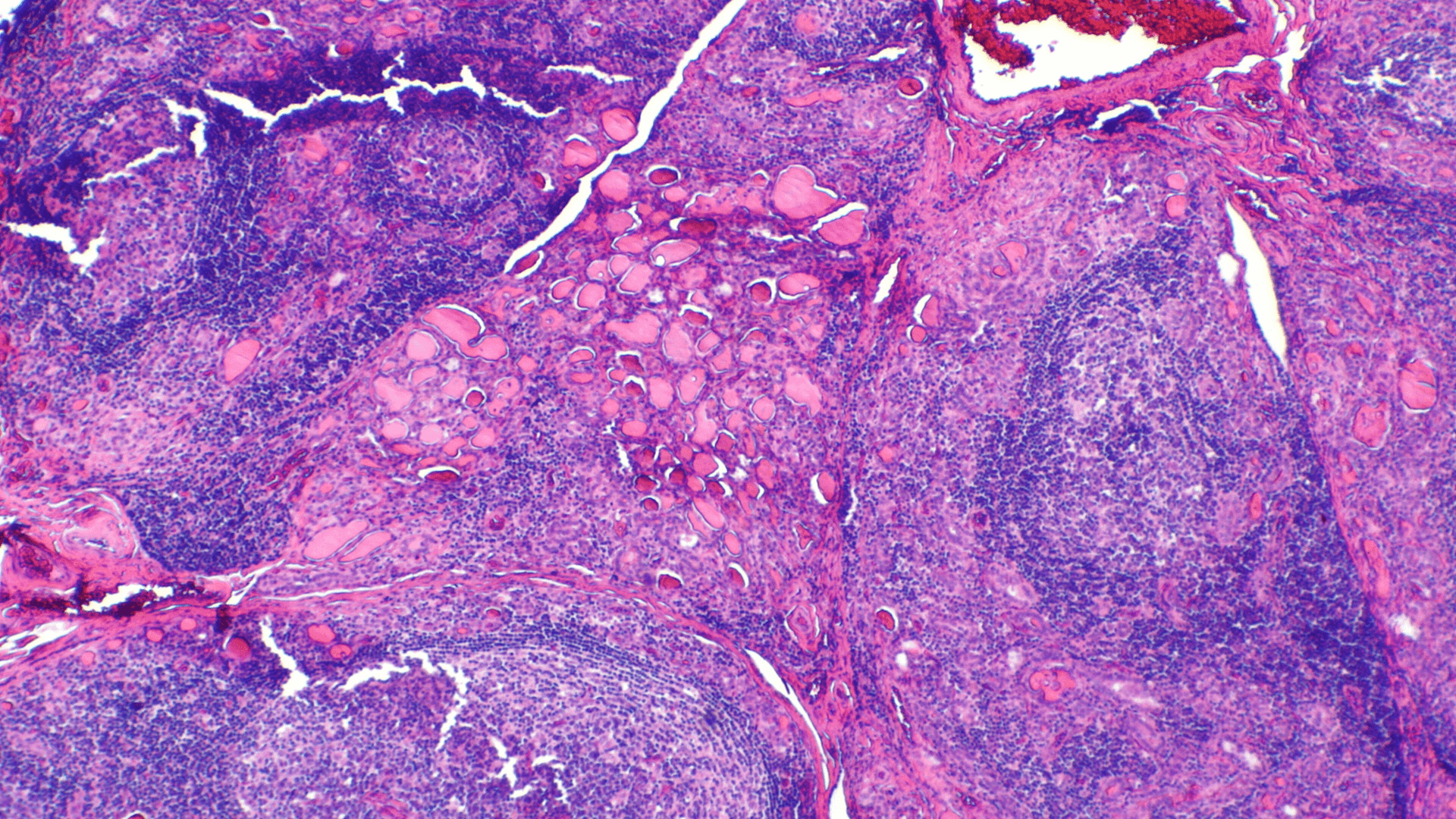
Hero image: Hashimoto thyroiditis -- low mag, by Librepath, licensed CC BY-SA 3.0 (creativecommons.org/licenses/by-sa/3.0). Via Wikimedia Commons.
Take our professional IQ test
Want to know your IQ? Try the first ever professional online IQ test.