Aug 9, 2026·Special Population & Related ConditionsHow Is Dyscalculia Diagnosed?
A dyscalculia test combines standardized math achievement testing, cognitive assessment, and history. See how clinicians diagnose math learning disorder.
Dr. Russell T. WarneChief Scientist

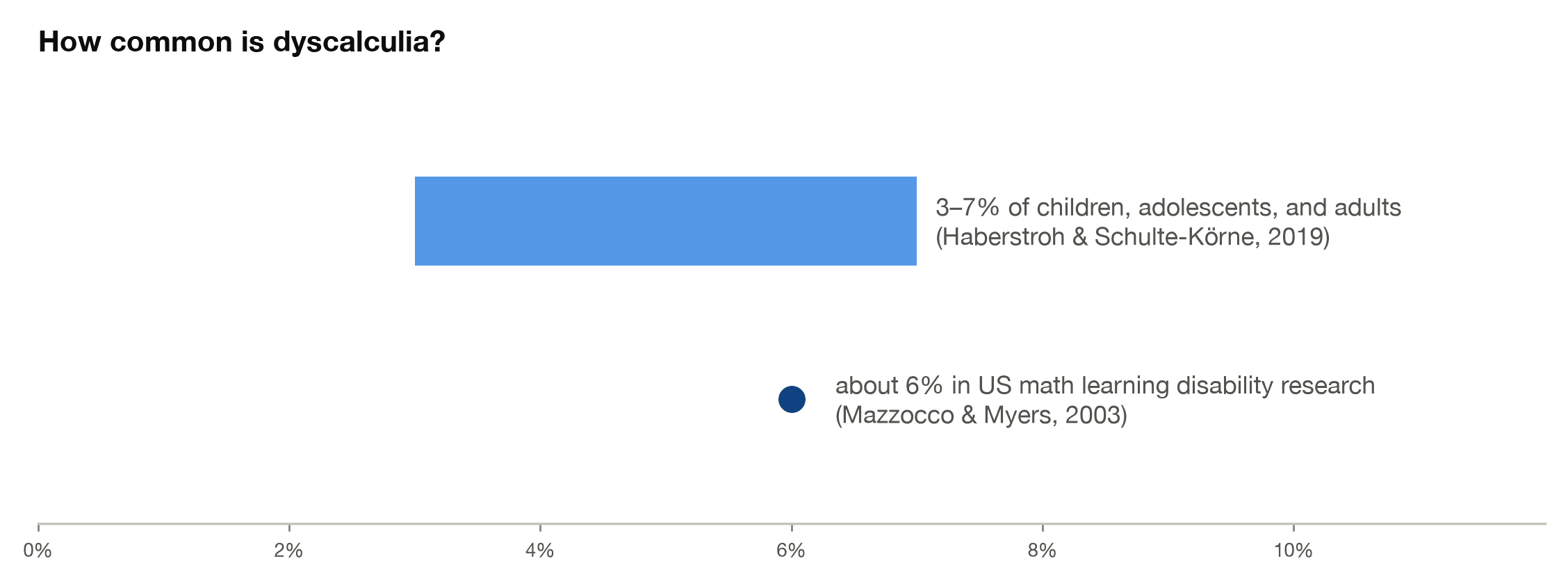
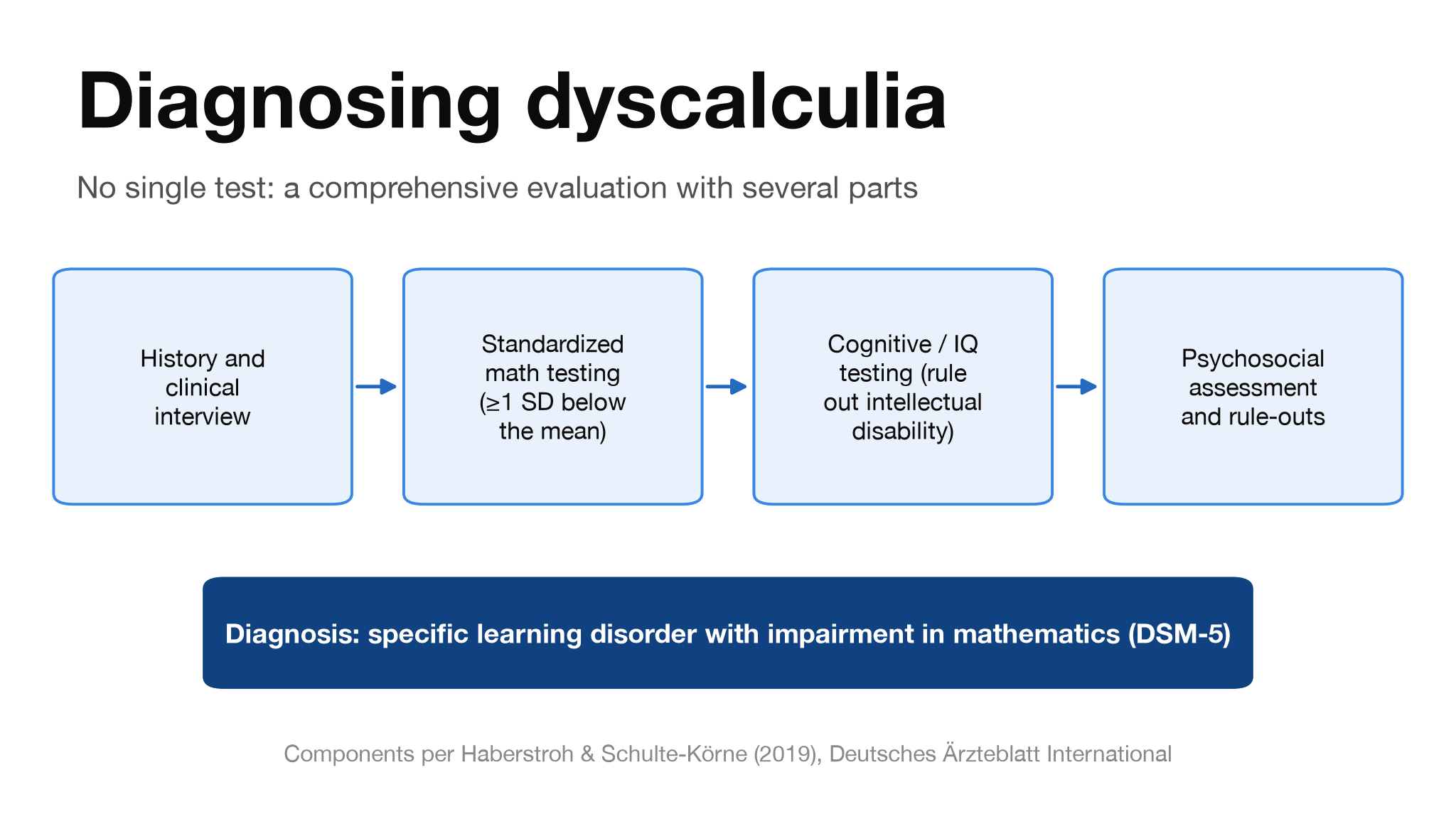
There is no single dyscalculia test. Diagnosis rests on a comprehensive evaluation: a standardized math achievement test showing performance well below the age or grade mean, plus cognitive testing, a clinical examination, and a thorough history. The formal name for the condition in the DSM-5, psychiatry's diagnostic manual, is "specific learning disorder with impairment in mathematics"; dyscalculia is the common label. Roughly 3 to 7 percent of children, adolescents, and adults are affected. This article explains what evaluators actually do, step by step, and how school identification differs from a clinical diagnosis.
What dyscalculia is, and what the DSM-5 calls it
In 2013 the DSM-5 combined the reading, writing, and math learning disorders into one overarching diagnosis, "specific learning disorder" (SLD), with a "specifier" naming the affected skill area: reading impairment covers dyslexia, written expression covers dysgraphia, and the mathematics specifier covers dyscalculia. The math specifier applies to people with significantly below-average skills in number sense, memorization of arithmetic facts, accurate or fluent calculation, or math reasoning. Dyslexia is the more familiar sibling condition; we compare the two in our article on
dyslexia and IQ tests.
Prevalence is substantial. A 2019 peer-reviewed review in Deutsches Ärzteblatt International reports that 3 to 7 percent of all children, adolescents, and adults have dyscalculia, and US research on math learning disability reports a similar figure of approximately 6 percent.
The components of a dyscalculia assessment
The 2019 review lays out the full evaluation: obligatory psychometric testing of arithmetic skills, a clinical examination, thorough history-taking, and further psychosocial assessment.
• History and clinical interview: School records, developmental history, family history, and a picture of how the math difficulty shows up day to day.
• Standardized math achievement testing: The psychometric core. The review's criterion is math performance at least one standard deviation below the age- or grade-appropriate mean on a standardized test. Instruments used in US research and practice include the KeyMath achievement test, the Test of Early Math Ability (TEMA), and the Woodcock-Johnson math subtests.
• Cognitive and IQ testing: A full evaluation includes a measure of general cognitive ability, for two reasons: the impaired math performance must not be attributable to low intelligence (the review applies the ICD-10 exclusion of IQ below 70), and the index-level profile anchors expectations for the student's other skills. Our guide to
interpreting IQ test results explains how to read such a profile.
• Psychosocial assessment and rule-outs: The evaluator weighs alternative explanations, such as inadequate instruction, anxiety, or other conditions, before concluding that the deficit is a specific learning disorder.
The rise and fall of the IQ-achievement discrepancy model
For decades, a child qualified as learning disabled only if achievement fell far below what an IQ score predicted, the "IQ-achievement discrepancy" model. Research gradually undermined it. Mazzocco and Myers, in a longitudinal study of math learning disability, summarize the verdict: little if any empirical support for the discrepancy-based model, and strong evidence of its inappropriateness; in their own data the discrepancy definition did not even separate more severe from less severe cases. Federal law followed. Since IDEA 2004, regulations state that schools must not be required to use a severe discrepancy between ability and achievement, must be permitted to use "response to intervention" (how a child responds to research-based instruction), and may use other research-based procedures such as analyzing patterns of strengths and weaknesses.
One point deserves care here. The discrepancy model failed; IQ testing did not. IQ tests remain reliable, valid measures of general cognitive ability. What the research rejected was the specific practice of requiring a large IQ-achievement gap before providing services. In a modern dyscalculia evaluation, cognitive testing still rules out intellectual disability, characterizes the ability profile around the math deficit, and anchors realistic expectations.
School identification vs. clinical diagnosis
Two systems run in parallel. A clinical diagnosis of specific learning disorder with impairment in mathematics is made by a qualified clinician, typically a psychologist, using DSM-5 criteria. Schools separately identify a "specific learning disability" under IDEA using criteria their state adopts, which may rely on response to intervention or other research-based procedures rather than a clinical diagnosis. A child can carry one label and not the other, which surprises many parents; the school process determines services, while the clinical diagnosis travels with the person. Dyscalculia can also co-occur with high ability, the situation covered in our article on
twice-exceptional students.
Frequently asked questions
Is there an official test for dyscalculia?
No single test exists. Diagnosis requires a standardized math achievement test showing performance at least one standard deviation below the age or grade mean, combined with a clinical examination, thorough history, and psychosocial assessment.
Who can diagnose dyscalculia?
Qualified clinicians such as psychologists make the formal DSM-5 diagnosis. Schools separately identify specific learning disabilities under IDEA using state criteria, which may use response to intervention rather than a clinical diagnosis.
Does dyscalculia mean a low IQ?
No. By definition the math impairment must not be attributable to low intelligence; the review criteria exclude cases explained by an IQ below 70. Many people with dyscalculia have average or above-average IQ scores; the diagnosis describes a specific weakness in math.
How common is dyscalculia?
A 2019 peer-reviewed review reports that 3 to 7 percent of children, adolescents, and adults have dyscalculia, and US research on math learning disability reports approximately 6 percent.
Is the IQ-achievement discrepancy model still used?
It has been largely retired. Research found little empirical support for it, and since IDEA 2004 federal regulations say schools must not be required to use a severe discrepancy and must be allowed to use response to intervention instead.
What separates dyscalculia from being bad at math?
Persistence and testing. Dyscalculia involves significantly below-average number sense, arithmetic facts, calculation, or math reasoning confirmed by standardized testing and history, and not explained by poor instruction or low general ability. Ordinary math struggles usually improve with instruction.
The takeaway
A trustworthy dyscalculia evaluation is built from several precise measurements rather than one impression: standardized math testing, cognitive testing, and a careful history. The cognitive piece matters because a defensible ability score is the backdrop against which a specific deficit becomes visible. Adults who want a validated baseline of their own general cognitive ability can take the Reasoning and Intelligence Online Test from RIOT IQ;
start the RIOT IQ test here.
References
1. American Psychiatric Association. (n.d.).
What is specific learning disorder? psychiatry.org2. Haberstroh, S., & Schulte-Körne, G. (2019).
The diagnosis and treatment of dyscalculia. Deutsches Ärzteblatt International, 116(7), 107-114.
pmc.ncbi.nlm.nih.gov3. Mazzocco, M. M. M., & Myers, G. F. (2003).
Complexities in identifying and defining mathematics learning disability in the primary school-age years. Annals of Dyslexia, 53, 218-253.
pmc.ncbi.nlm.nih.gov4. U.S. Department of Education. (2006).
34 CFR 300.307: Specific learning disabilities. Individuals with Disabilities Education Act.
sites.ed.govTake our professional IQ test
Want to know your IQ? Try the first ever professional online IQ test.
AuthorDr. Russell T. WarneChief Scientist