Oct 7, 2026·Special Population & Related Conditions
Parkinson's and Intelligence: Does Parkinson's Disease Affect IQ?
Parkinson's and intelligence: most people keep their general reasoning at diagnosis, but about a quarter without dementia have mild cognitive impairment.
Dr. Russell T. WarneChief Scientist
Share
Parkinson's disease does not erase intelligence, and most people keep their general reasoning ability around the time of diagnosis. Thinking problems are still common: about a quarter of people with Parkinson's who do not have dementia meet criteria for mild cognitive impairment, and the risk of dementia rises in the years after diagnosis.
There is also a surprising twist in the research on Parkinson's and intelligence. Large studies of young men tested at military conscription found that those with higher IQ scores were somewhat more likely to develop Parkinson's decades later. This page covers that finding and its limits, how common cognitive problems are, which abilities are affected, why standard IQ tests can mislead in Parkinson's, and how cognition changes over time.
Are people with higher IQ more likely to get Parkinson's?
Several very large studies point in that direction, which runs against the usual pattern where higher ability goes with better health. Fardell and colleagues linked IQ scores from the Swedish military conscription registry to later hospital and death records for 1,189,134 men. Of these, 1,724 developed Parkinson's at age 40 or older. Higher IQ was associated with a higher risk, with a hazard ratio of 1.35 for the high-IQ group compared with the low-IQ group. Strong scores on each of the verbal, logical, spatial and technical subtests showed the same pattern.
A second Swedish analysis of 1,259,485 men tested at ages 17 to 20 found a hazard ratio of 1.46 for the top third of IQ scores against the bottom third, among men diagnosed at a mean age of 53. In Denmark, Osler and colleagues followed 656,751 men tested around age 19 and found that higher intelligence, more education and greater height were each linked to a higher risk of Parkinson's. A Mendelian randomization study, which uses genetic variants as stand-ins for a trait, reported an odds ratio of 1.37 for genetically predicted IQ.
These findings need careful reading. The cohorts contained only men, and the Swedish ones mostly captured Parkinson's diagnosed in middle age, before the oldest ages at which the disease is most common. The absolute risk stayed small: in the Fardell study, fewer than 2 in 1,000 men developed the disease during follow-up. Smoking, which is linked to a lower risk of Parkinson's, was also less common among higher-IQ men in a subgroup of that study, and in the genetic study, adjusting for education and cognition largely removed the IQ effect. The reason for the link is not known, and no one should read their own IQ score as a forecast of Parkinson's.
How common thinking problems are in Parkinson's
Parkinson's is common and becoming more so. The Global Burden of Disease study estimated that 6.1 million people had it in 2016, up from 2.5 million in 1990. Movement symptoms such as tremor and slowness define the diagnosis, but cognition is often affected as well.
The best-known estimate of "mild cognitive impairment" in Parkinson's (often shortened to PD-MCI) comes from Aarsland and colleagues, who pooled 1,346 patients without dementia from 8 cohorts and applied one common definition: a score at least 1.5 standard deviations below age- and education-adjusted norms in at least one domain. They found that 25.8% met the definition. Memory impairment was the most frequent (13.3%), followed by visuospatial (11.0%) and attention or executive problems (10.1%). Mild cognitive impairment was more common in people who were older, male, depressed or more severely affected by motor symptoms. In a separate sample of 132 patients from two movement disorder centres, Hoops and colleagues found that about a third had a cognitive disorder: 17.4% mild cognitive impairment and 12.9% dementia.
Which abilities Parkinson's affects
Parkinson's tends to produce an uneven profile. The Cambridge CamPaIGN study followed a population-representative group of newly diagnosed patients and found two partly separate patterns.
• Frontal-executive problems: difficulty with planning, switching between tasks and holding information in mind. In CamPaIGN, performance on a planning task tracked a gene linked to dopamine, changed as the disease progressed, and did not predict dementia.
• Posterior cortical problems: trouble with tasks that rely on the back of the brain, such as naming as many words from a category as possible or copying a drawing. Three baseline measures (age 72 or older, producing fewer than 20 category words in 90 seconds, and being unable to copy two overlapping pentagons) together predicted dementia within 5 years with an odds ratio of 88.
This split matters for anyone trying to interpret a test report. Someone with mainly executive difficulties may struggle on planning and executive function tests while vocabulary and general knowledge stay close to their earlier level.
Why IQ tests can mislead in Parkinson's
Many IQ subtests are timed, and many require drawing, arranging blocks or speaking clearly. Parkinson's slows movement and can make handwriting small and speech quiet, so a low score may reflect the hands or voice more than the reasoning behind them. A 2025 expert review for the International Parkinson and Movement Disorder Society noted that visuospatial tests such as Wechsler Block Design and complex figure copying are affected by motor and drawing difficulties, and that language tests must be chosen to limit the effect of the soft, slurred speech the disease can cause. The same concern applies to the Processing Speed Index, which depends on fast pencil work.
For this reason, clinicians rarely rely on a full-scale IQ score in Parkinson's. The Movement Disorder Society's diagnostic criteria for PD-MCI recommend, for a full assessment, at least two tests in each of five domains: attention and working memory, executive function, language, memory and visuospatial function. Scores are judged against age- and education-appropriate norms, earlier test results where they exist, or an estimate of the person's ability before the illness. Brief screens are a first step only. In the Hoops study, the Montreal Cognitive Assessment worked as a screen for cognitive problems in Parkinson's and the Mini-Mental State Examination did not, though a positive result on either still needed a fuller assessment.
How cognition changes over time
Thinking problems usually increase as Parkinson's progresses, though the pace varies widely. In CamPaIGN, 17% of patients developed dementia within 5 years of diagnosis. At 10 years, 46% had dementia and 55% had died, yet 23% were doing well, alive and free of both dementia and postural instability (problems with balance). Older age, more severe motor impairment, posterior cortical deficits and a particular variant of the tau gene predicted dementia.
Over longer periods the numbers climb. In the Sydney multicenter study, 100 of 136 people had died 20 years after diagnosis, and 83% of the 36 survivors had dementia. Parkinson's disease dementia is covered in more depth on our page about whether IQ is correlated with dementia.
Anyone with Parkinson's who notices changes in memory, attention or planning should raise them with their neurologist or movement disorder specialist. A neuropsychologist can carry out a full assessment that accounts for motor slowing, and repeating it over time shows whether thinking is stable or changing.
Frequently asked questions
Does Parkinson's disease lower IQ?
Not for most people early on. About a quarter of people with Parkinson's who do not have dementia show mild cognitive impairment in specific areas, and the risk of dementia rises with time since diagnosis.
Are smart people more likely to get Parkinson's?
Large conscription studies of men found a modestly higher risk among those with higher young-adult IQ scores, with hazard ratios around 1.35 to 1.46. The absolute risk is small, and smoking and education may explain part of the link.
What thinking skills does Parkinson's affect first?
The most common problems are in memory, visuospatial skills, and attention and executive functions such as planning. Difficulties with tasks like naming words from a category or copying a drawing are linked to a higher risk of later dementia.
Can someone with Parkinson's take an IQ test?
Yes, but timed and drawing-based subtests can understate ability because of slowed movement. A neuropsychologist will choose tests and interpret results with those motor effects in mind.
Does everyone with Parkinson's get dementia?
No. In one 10-year study, 46% developed dementia and nearly a quarter were alive with intact cognition and preserved mobility. Risk grows with age and disease duration.
The takeaway
Parkinson's and intelligence are linked in two directions. Higher IQ in young adulthood is associated with a slightly higher risk of later Parkinson's in large studies of men, for reasons that are not settled. After diagnosis, general reasoning is usually preserved at first, while about a quarter of people without dementia have mild cognitive impairment, and dementia becomes common over decades. Because the disease slows movement and speech, timed and drawing-based subtests can understate a person's reasoning, so a neuropsychologist's assessment is far more informative than a single full-scale score. For adults without a neurological condition who want a benchmark of their reasoning, an online IQ test built by psychometricians is a good place to start.
References
1. Fardell, C., Torén, K., Schiöler, L., Nissbrandt, H., & Åberg, M. (2020). High IQ in early adulthood is associated with Parkinson's disease. Journal of Parkinson's Disease, 10(4), 1649-1656. doi.org
2. Longinetti, E., Zhan, Y., Sata, M., Larsson, H., D'Onofrio, B. M., Iso, H., Wirdefeldt, K., & Fang, F. (2021). Heart rate, intelligence in adolescence, and Parkinson's disease later in life. European Journal of Epidemiology, 36(10), 1055-1064. doi.org
3. Osler, M., Okholm, G. T., Villumsen, M., Rozing, M. P., & Jørgensen, T. S. H. (2022). Associations of young adult intelligence, education, height, and body mass index with subsequent risk of Parkinson's disease and survival: A Danish cohort study. Journal of Parkinson's Disease, 12(3), 1035-1043. doi.org
4. Shi, J., Tian, J., Fan, Y., Hao, X., Li, M., Li, J., ... Shi, C. (2022). Intelligence, education level, and risk of Parkinson's disease in European populations: A Mendelian randomization study. Frontiers in Genetics, 13, 963163. doi.org
5. GBD 2016 Parkinson's Disease Collaborators (Dorsey, E. R., Elbaz, A., et al.). (2018). Global, regional, and national burden of Parkinson's disease, 1990-2016: A systematic analysis for the Global Burden of Disease Study 2016. The Lancet Neurology, 17(11), 939-953. doi.org
6. Aarsland, D., Bronnick, K., Williams-Gray, C., Weintraub, D., Marder, K., Kulisevsky, J., ... Emre, M. (2010). Mild cognitive impairment in Parkinson disease: A multicenter pooled analysis. Neurology, 75(12), 1062-1069. doi.org
7. Hoops, S., Nazem, S., Siderowf, A. D., Duda, J. E., Xie, S. X., Stern, M. B., & Weintraub, D. (2009). Validity of the MoCA and MMSE in the detection of MCI and dementia in Parkinson disease. Neurology, 73(21), 1738-1745. doi.org
8. Williams-Gray, C. H., Evans, J. R., Goris, A., Foltynie, T., Ban, M., Robbins, T. W., ... Barker, R. A. (2009). The distinct cognitive syndromes of Parkinson's disease: 5 year follow-up of the CamPaIGN cohort. Brain, 132(11), 2958-2969. doi.org
9. Bezdicek, O., Biundo, R., Boelema, S., Cammisuli, D. M., Cholerton, B., Cronin-Golomb, A., ... Geurtsen, G. J. (2025). Neuropsychological tests of memory, visuospatial, and language function in Parkinson's disease: Review, critique, and recommendations. Movement Disorders, 40(5), 795-806. doi.org
10. Litvan, I., Goldman, J. G., Tröster, A. I., Schmand, B. A., Weintraub, D., Petersen, R. C., ... Emre, M. (2012). Diagnostic criteria for mild cognitive impairment in Parkinson's disease: Movement Disorder Society Task Force guidelines. Movement Disorders, 27(3), 349-356. doi.org
11. Williams-Gray, C. H., Mason, S. L., Evans, J. R., Foltynie, T., Brayne, C., Robbins, T. W., & Barker, R. A. (2013). The CamPaIGN study of Parkinson's disease: 10-year outlook in an incident population-based cohort. Journal of Neurology, Neurosurgery & Psychiatry, 84(11), 1258-1264. doi.org
12. Hely, M. A., Reid, W. G. J., Adena, M. A., Halliday, G. M., & Morris, J. G. L. (2008). The Sydney multicenter study of Parkinson's disease: The inevitability of dementia at 20 years. Movement Disorders, 23(6), 837-844. doi.org
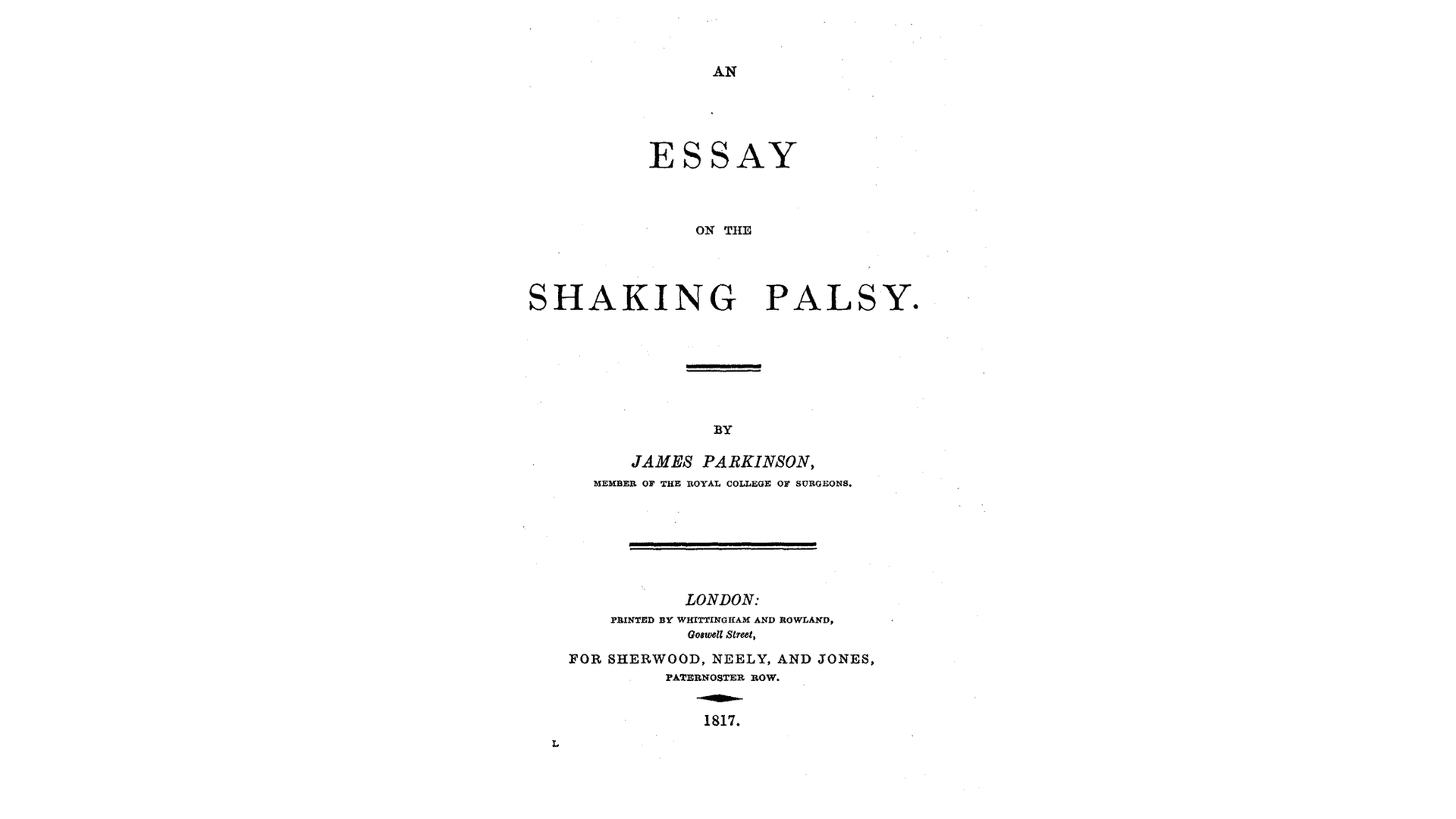
Hero image: Parkinson, An Essay on the Shaking Palsy (title page), by James Parkinson (1817), public domain. Via Wikimedia Commons.
Take our professional IQ test
Want to know your IQ? Try the first ever professional online IQ test.