Oct 3, 2026·Special Population & Related Conditions
Traumatic Brain Injury and IQ: How Much Scores Drop and How Much They Recover
Traumatic brain injury and IQ: mild injuries cause small effects that usually fade within months, while severe injuries can lower IQ by a large, lasting margin.
Dr. Russell T. WarneChief Scientist
Share
Whether a traumatic brain injury lowers IQ depends mostly on how severe the injury was and how long ago it happened. Mild injuries, including most concussions, produce small cognitive effects that typically fade within about three months, while severe injuries can lower full-scale IQ by roughly a standard deviation, with only partial recovery over the following years.
This page walks through the size of the effect at each level of severity, the shape of recovery, how clinicians estimate what someone's IQ was before the injury, and why people with similar injuries end up with different scores. An estimated 69 million people worldwide sustain a traumatic brain injury each year, according to a global modeling study by Dewan and colleagues, so these questions come up constantly in clinics and in legal disputes.
Severity is the strongest predictor of IQ loss
The effect of brain injury on intelligence follows a dose-response pattern: the more severe the injury, the larger the drop. Schretlen and Shapiro pooled 39 studies with 1,716 patients and 1,164 controls and found that, averaged across all follow-up periods, moderate to severe injury had an effect on overall cognitive functioning (Cohen's d = -0.74) "more than three times the effect" of mild head injury (d = -0.24). "Cohen's d" expresses a group difference in standard deviation units; on an IQ scale with a standard deviation of 15, a d of -1.0 is roughly a 15-point gap.
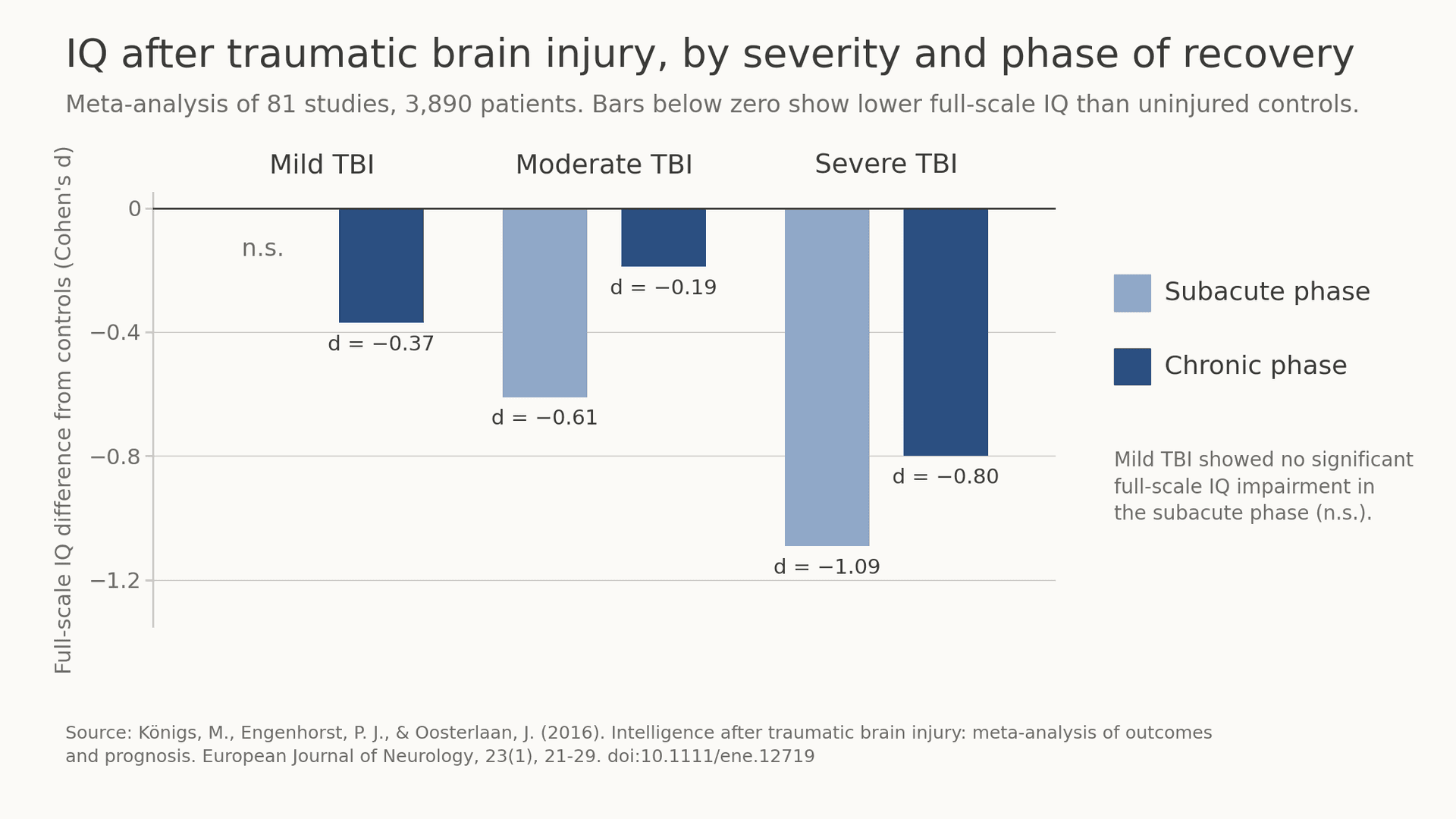
A later meta-analysis looked at IQ scores specifically. Königs, Engenhorst and Oosterlaan combined 81 studies covering 3,890 patients. In the subacute phase of recovery, full-scale IQ impairment was absent after mild injury, medium-sized after moderate injury (d = -0.61), and large after severe injury (d = -1.09). In the chronic phase the severe group still showed a large deficit (d = -0.80), while mild and moderate groups showed small ones (d = -0.37 and -0.19).
That mild-chronic figure is larger than the moderate one, which looks backward. Each cell of a meta-analysis draws on a different set of studies, and the two estimates were reported only as small effects, so the safest reading is that both groups end up with modest average deficits while the severe group stays clearly impaired.
Severity itself is measured in several ways. The Glasgow Coma Scale rates level of consciousness at the bedside, and its developers recommend using the total score to characterize groups and the three component scores to describe individual patients. The length of "post-traumatic amnesia," the period after injury when a person cannot form continuous new memories, is another. In an earlier meta-analysis, Königs and colleagues found that longer post-traumatic amnesia strongly predicted larger IQ deficits in both the subacute and chronic phases, and their 2016 analysis found that coma scale scores, loss of consciousness and amnesia duration each predicted IQ outcomes about equally well.
Recovery over time: fast after mild injury, partial after severe
Most of the recovery after a mild injury happens in weeks. Schretlen and Shapiro concluded that overall cognitive functioning "recovers most rapidly during the first few weeks" after mild head injury "and essentially returns to baseline within 1-3 months." A re-analysis of 25 studies by Rohling and colleagues put numbers on the curve: an effect size of -0.39 seven days after injury and -0.07 at three months, no longer statistically different from zero. The authors cautioned that their findings may not apply to people with multiple concussions or complicated mild injuries.
Recovery after moderate to severe injury is slower and less complete. Schretlen and Shapiro found that cognitive functioning improves during the first two years "but remains markedly impaired even among patients tested > 2 years post-injury." The comparison between the subacute and chronic estimates in the Königs data tells the same story: the severe-injury deficit shrinks by roughly 0.3 standard deviation and then stays large.
Age changes the picture. Königs and colleagues found that adults with mild injury had larger verbal and performance IQ deficits in the chronic phase than children did, whereas children with severe injury had larger full-scale and verbal IQ deficits than adults. Processing speed is the ability most tied to severity: in a cohort of 121 people tested with the WAIS-IV within a year of injury, Donders and Stout found that injury severity added to the prediction only for processing speed. Our explainer on the processing speed index covers what that score measures.
Estimating what the IQ was before the injury
Almost nobody has an IQ score on file from before an accident, so clinicians estimate "premorbid" ability, the level a person functioned at before the injury, and compare it with current results. The most common method relies on reading. Nelson and O'Connell's National Adult Reading Test, or NART, asks people to pronounce 50 irregular words that cannot be worked out phonetically, so a correct answer depends on prior familiarity with the word. In their original study of patients with cortical atrophy, NART reading was not significantly affected by the disease, which is what makes it usable as an estimate of earlier ability. The Test of Premorbid Functioning, or TOPF, applies the same idea and can be combined with demographic information such as education.
These estimates are useful and imperfect. Riley and Simmonds retested 26 people who had taken the NART within 12 months of a severe injury and found that scores improved significantly at least a year later, with 42% gaining more than five points on the verbal IQ estimate. Using the early scores alone would have missed real impairment in at least a quarter of a subsample. Joseph and colleagues found that the TOPF combined with demographics underestimated measured intelligence in 31% of 52 people with injuries, particularly those of high average to superior ability, and that the WAIS-IV Verbal Comprehension Index predicted full-scale IQ better.
The same comparison serves a second purpose. When a current score falls far below what premorbid estimates predict, by more than genuine injury usually produces, it can signal that the person was not fully engaged with testing. Martin and colleagues built performance validity indicators from exactly that discrepancy, and they classified invalid performance better than Reliable Digit Span, a standard embedded check. A clinician treats such a result as a reason to look more closely, and it proves nothing about motive on its own.
Cognitive reserve: why similar injuries lead to different outcomes
Two people with comparable injuries can end up with very different scores. The concept of "cognitive reserve" proposes that education and higher premorbid ability buffer the effects of brain damage. A meta-analysis of 90 studies by Mathias and Wheaton found that "higher levels of education and pre-morbid IQ are both associated with better outcomes" after traumatic brain injury, while the evidence for genetic sources of reserve, including the much-studied APOE e4 gene, was limited and inconsistent.
Some of the most direct evidence comes from people who happened to have brain scans before their injury. Kesler and colleagues studied 25 such patients and found that those with lower post-injury IQ scores had significantly smaller intracranial volumes on their pre-injury scans, irrespective of injury severity, and had experienced larger drops in IQ. Brain volume and education together predicted whether people scored above or below 90 after the injury, although pre-injury standardized test scores did not. Donders and Stout found reserve predicted every WAIS-IV index after injury, but concluded that the protection "is imperfect and does not completely negate the effect of injury severity." The same idea appears in research on aging, which our article on IQ and dementia covers in detail.
What an IQ score can and cannot show after a brain injury
A full-scale IQ is a summary, and brain injuries rarely affect every ability equally. Rohling's re-analysis found that the largest effects right after a mild injury fell on verbal and visual memory, and Donders and Stout found severity mattered most for processing speed, so a person can return a full-scale score close to their estimated premorbid level and still struggle with the pace of work or school. That is why a post-injury evaluation usually goes well beyond an intelligence test. Our article on neuropsychological testing explains what such an evaluation includes and who administers it. Sports concussion programs often use separate computerized baseline batteries such as ImPACT, which serve a different purpose from IQ testing.
If you or a family member has had a significant head injury and notice persistent changes in thinking, the right first step is a physician, who can refer to a neuropsychologist when formal testing is warranted.
Frequently asked questions
Can a concussion lower your IQ?
A single uncomplicated concussion usually produces a small, temporary dip in test performance that is no longer measurable by about three months in group studies. People with repeated or complicated injuries are less well described by that research.
How many IQ points can a severe brain injury cost?
Meta-analytic estimates for severe injury are around one standard deviation in the months after injury, which is roughly 15 IQ points, shrinking to about 12 points in the chronic phase. Individual outcomes range much more widely than those averages.
Does IQ recover after a traumatic brain injury?
Partly. After mild injury, recovery is usually complete within weeks to a few months, while after moderate to severe injury scores improve over roughly the first two years and often remain below the premorbid level after that.
How do doctors know what my IQ was before the injury?
They estimate it, usually from a word-reading test such as the TOPF or NART combined with education and other demographic information. These estimates can be too low soon after a severe injury and in people of above-average ability.
Does a higher IQ protect against brain injury?
Higher premorbid IQ and more education are associated with better outcomes, consistent with the idea of cognitive reserve. The protection is partial, and severe injuries still cause substantial deficits.
The takeaway
The link between traumatic brain injury and IQ follows severity and time. Mild injuries cause small effects that typically fade within about three months, while severe injuries lower full-scale IQ by about a standard deviation at first and leave a large deficit years later. Estimating the pre-injury baseline is the hardest part of the measurement problem, since reading-based estimates can be depressed early after severe injury and tend to underestimate people of high ability. Education and premorbid ability cushion the impact without cancelling it. For anyone who wants a well-normed baseline of their cognitive abilities on file, an online IQ test built by psychometricians gives a starting point, though it is no substitute for a clinical evaluation after an injury.
References
1. Dewan, M. C., Rattani, A., Gupta, S., Baticulon, R. E., Hung, Y.-C., Punchak, M., Agrawal, A., Adeleye, A. O., Shrime, M. G., Rubiano, A. M., Rosenfeld, J. V., & Park, K. B. (2019). Estimating the global incidence of traumatic brain injury. Journal of Neurosurgery, 130(4), 1080-1097. doi.org
2. Schretlen, D. J., & Shapiro, A. M. (2003). A quantitative review of the effects of traumatic brain injury on cognitive functioning. International Review of Psychiatry, 15(4), 341-349. doi.org
3. Königs, M., Engenhorst, P. J., & Oosterlaan, J. (2016). Intelligence after traumatic brain injury: Meta-analysis of outcomes and prognosis. European Journal of Neurology, 23(1), 21-29. doi.org
4. Königs, M., de Kieviet, J. F., & Oosterlaan, J. (2012). Post-traumatic amnesia predicts intelligence impairment following traumatic brain injury: A meta-analysis. Journal of Neurology, Neurosurgery & Psychiatry, 83(11), 1048-1055. doi.org
5. Teasdale, G., Maas, A., Lecky, F., Manley, G., Stocchetti, N., & Murray, G. (2014). The Glasgow Coma Scale at 40 years: Standing the test of time. The Lancet Neurology, 13(8), 844-854. doi.org
6. Rohling, M. L., Binder, L. M., Demakis, G. J., Larrabee, G. J., Ploetz, D. M., & Langhinrichsen-Rohling, J. (2011). A meta-analysis of neuropsychological outcome after mild traumatic brain injury: Re-analyses and reconsiderations of Binder et al. (1997), Frencham et al. (2005), and Pertab et al. (2009). The Clinical Neuropsychologist, 25(4), 608-623. doi.org
7. Donders, J., & Stout, J. (2019). The influence of cognitive reserve on recovery from traumatic brain injury. Archives of Clinical Neuropsychology, 34(2), 206-213. doi.org
8. Nelson, H. E., & O'Connell, A. (1978). Dementia: The estimation of premorbid intelligence levels using the New Adult Reading Test. Cortex, 14(2), 234-244. doi.org
9. Riley, G. A., & Simmonds, L. V. (2003). How robust is performance on the National Adult Reading Test following traumatic brain injury? British Journal of Clinical Psychology, 42(3), 319-328. doi.org
10. Joseph, A. C., Lippa, S. M., McNally, S. M., Garcia, K. M., Leary, J. B., Dsurney, J., & Chan, L. (2021). Estimating premorbid intelligence in persons with traumatic brain injury: An examination of the Test of Premorbid Functioning. Applied Neuropsychology: Adult, 28(5), 535-543. doi.org
11. Martin, P. K., Hunter, B. P., Rach, A. M., Heinrichs, R. J., & Schroeder, R. W. (2017). Excessive decline from premorbid functioning: Detecting performance invalidity with the WAIS-IV and demographic predictions. The Clinical Neuropsychologist, 31(5), 829-843. doi.org
12. Mathias, J. L., & Wheaton, P. (2015). Contribution of brain or biological reserve and cognitive or neural reserve to outcome after TBI: A meta-analysis (prior to 2015). Neuroscience & Biobehavioral Reviews, 55, 573-593. doi.org
13. Kesler, S. R., Adams, H. F., Blasey, C. M., & Bigler, E. D. (2003). Premorbid intellectual functioning, education, and brain size in traumatic brain injury: An investigation of the cognitive reserve hypothesis. Applied Neuropsychology, 10(3), 153-162. doi.org
Figure by RIOT IQ. Data from Königs, Engenhorst & Oosterlaan (2016), European Journal of Neurology 23(1), 21-29 (doi.org/10.1111/ene.12719).
Take our professional IQ test
Want to know your IQ? Try the first ever professional online IQ test.