What Is a Performance Validity Test? How Clinicians Check a Score Can Be Trusted
A performance validity test checks whether a person's scores reflect their true ability, using tasks easy enough that real impairment rarely causes failure.
Dr. Russell T. WarneChief Scientist
Share
A performance validity test, or PVT, is a measure that checks whether a person's scores on a cognitive evaluation reflect their actual abilities, usually by giving tasks that look demanding but are easy enough that people with genuine brain injury or memory disorders still pass them. A PVT therefore asks a question about one person's performance on one occasion, which is separate from whether the test itself is valid.
That second question, whether a test measures what it claims to, is covered in our article on whether IQ tests are valid. This page covers how PVTs work, the best-known instruments, how often invalid performance turns up, the formal criteria clinicians use, and why a failed PVT is never by itself proof that someone lied.
How a performance validity test works
Every cognitive score rests on an assumption that the examinee was trying. If a person disengages, rushes, or deliberately underperforms, the score will underestimate what they can do, and nothing in the raw number reveals it. A PVT is designed to detect that situation directly.
Most PVTs exploit a floor. The tasks are built so that nearly everyone with real impairment, including many people with moderate to severe brain injury, scores close to the maximum. A low score then signals that something other than ability is limiting performance.
Many PVTs also use a forced-choice format, in which the examinee picks between two options on every item. Someone with no memory at all would still land near 50% by guessing, so a score well below chance implies the person recognized the right answers and chose the wrong ones. Slick, Sherman, and Iverson defined "significantly below chance" as a score falling below a confidence interval of 90% or more around chance.
The field now separates two kinds of validity measure. Larrabee proposed "performance validity" for the validity of test performance and "symptom validity" for the validity of symptom reports, replacing older terms such as "effort" and "response bias." A symptom validity test is usually a set of scales on a self-report questionnaire, while a PVT is an ability task.
The best-known instruments
PVTs come in two forms. A "standalone" PVT is a separate test given for this purpose, while an "embedded" indicator is a score pulled from a regular ability test the person was taking anyway.
• Test of Memory Malingering (TOMM): A 50-item visual recognition test with two learning trials and an optional retention trial. In a replication of Tombaugh's validation work, a Trial 2 cutting score of more than 5 errors was sensitive to suboptimal performance while remaining remarkably insensitive to cognitive impairment in patients with documented traumatic brain injury.
• Word Memory Test (WMT): A verbal recognition and recall test developed by Paul Green. In 904 consecutive patients, the battery-wide mean score was 1.20 standard deviations lower in those who failed the WMT than in those who passed it.
• Reliable Digit Span (RDS): An embedded indicator proposed by Greiffenstein and colleagues in 1994. It sums the longest digit strings a person repeats without error on both trials, forward and backward, from an ordinary digit span test. A systematic review by Schroeder and colleagues found that cutoffs of 7 or below call for caution in every clinical group, and that even the stricter cutoff of 6 or below needs caution in people with stroke, severe memory disorders, intellectual disability, borderline intellectual functioning, or English as a second language.
That last point matters for anyone reading an IQ report. An embedded indicator taken from a working memory subtest will flag more false positives in people whose true ability is low, because the floor of the PVT and the floor of the person start to overlap.
Why the check matters, and how often performance is invalid
The size of the problem surprised many clinicians when the data arrived. Green, Rohling, Lees-Haley, and Allen gave 43 tests to 904 consecutive patients, mostly in compensation claims, and averaged them into an overall battery mean. A measure of effort correlated .73 with that mean, and suboptimal effort suppressed it 4.5 times more than moderate to severe brain injury did. Patients with severe brain injuries scored significantly lower than groups presumed to have no neurological impairment only once the analysis was restricted to people who had performed validly.
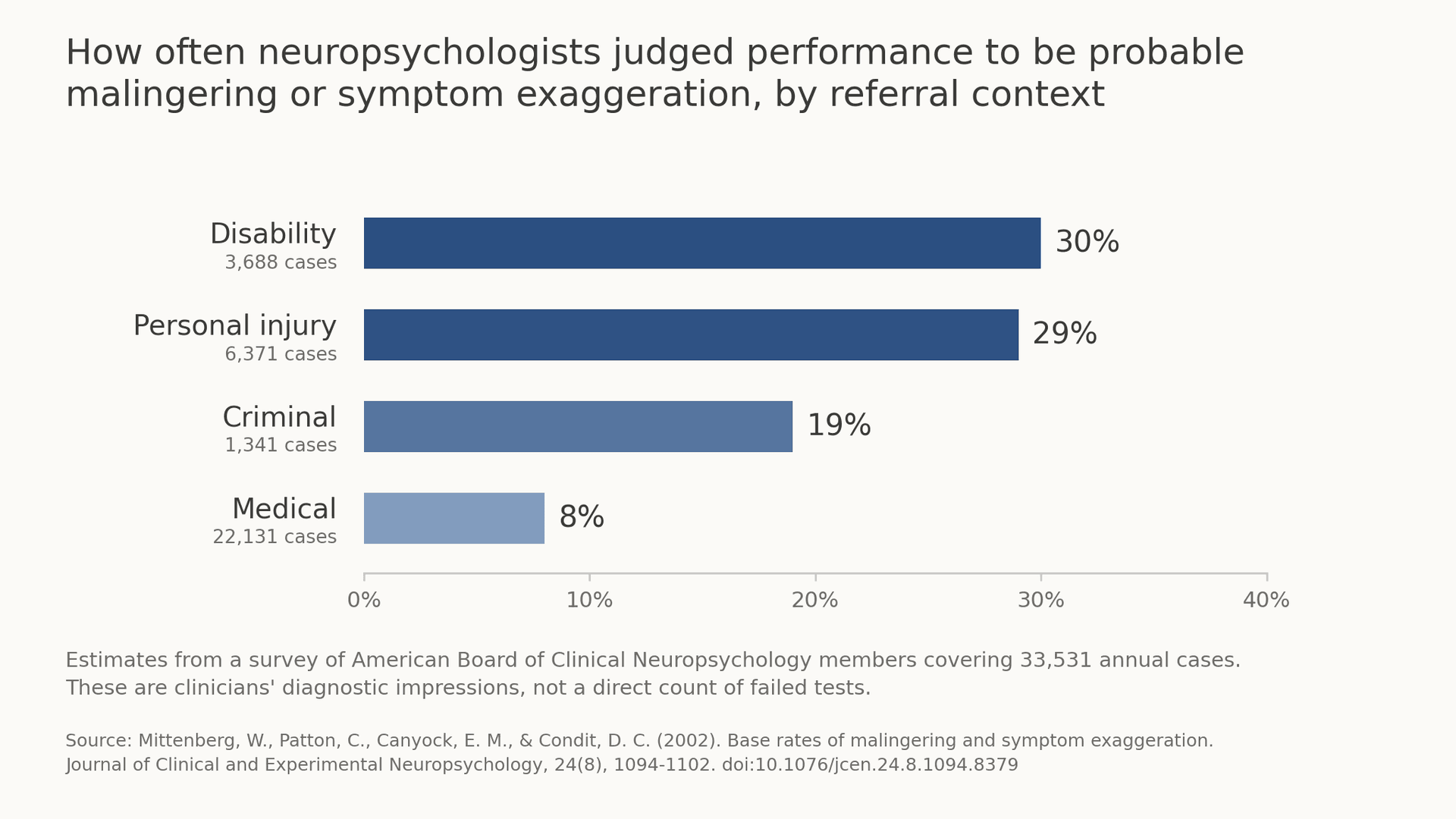
How often does this happen? The most widely cited estimates come from a survey of American Board of Clinical Neuropsychology members by Mittenberg and colleagues, covering 33,531 cases a year. Clinicians reported probable malingering or symptom exaggeration in 30% of disability cases, 29% of personal injury cases, 19% of criminal cases, and 8% of medical cases. Rates were 39% for mild head injury claims, 35% for fibromyalgia or chronic fatigue, and 31% for chronic pain.
These numbers need careful reading. They are clinicians' diagnostic impressions reported in a survey, not a direct count of failed PVTs, and they were related to the share of plaintiff versus defense referrals in each practice. The evidence behind the impressions was varied, with below-cutoff scores on forced-choice tests cited in 57% of cases and an impairment pattern inconsistent with the condition in 64%. What the figures do show is that context changes the prior probability a lot, which is why validity testing is routine in forensic work.
Failing a performance validity test is not the same as lying
A failed PVT says the scores from that session cannot be interpreted as a measure of ability. It does not say why. Fatigue, pain, a misunderstanding of instructions, severe depression, or a child who simply stopped caring can all produce invalid data without any intent to deceive.
The formal criteria are built around that distinction. Slick, Sherman, and Iverson's 1999 criteria for malingered neurocognitive dysfunction required three things: a substantial external incentive, evidence from testing or self-report, and a finding that the behavior was not fully explained by psychiatric, neurological, or developmental factors. They graded the conclusion as definite, probable, or possible, and reserved "definite" for below-chance performance on a forced-choice test.
Their 2020 update tightened the rules further. It states that failing a single PVT when several are given is insufficient unless the score is significantly below chance, notes that failing two or more out of four to nine PVTs occurs rarely in people who are not malingering, and requires PVTs used for the purpose to have a false-positive rate no higher than .10. It also lists conditions that preclude the diagnosis outright, including moderate to severe dementia and moderate to severe intellectual disability, giving an IQ below 60 as an example.
The American Academy of Clinical Neuropsychology's 2009 consensus statement, led by Heilbronner, and its 2021 update, led by Sweet, frame validity assessment as a standard part of every evaluation. The 2021 update concludes that all clinical and forensic evaluations "must proactively address the degree to which results of neuropsychological and psychological testing are valid." Larrabee's review adds the statistical reason for using several indicators together: requiring multiple independent failures drives false positives down.
Performance validity testing in children
Children were long assumed to be too unsophisticated to underperform on purpose. The evidence says otherwise. Kirkwood and colleagues described six clinical cases showing that children down to at least age 8 can produce noncredible performance, some with clear external incentives and others where psychological factors seemed to drive it, and in most of the cases clinical judgment alone would not have caught it.
In a consecutive sample of 193 patients aged 8 to 17 with mild traumatic brain injury, Kirkwood and Kirk found 33 who failed the Medical Symptom Validity Test, a pediatric-friendly PVT. After allowing for false positives and negatives, they estimated the base rate of suboptimal effort at 17%, and only one failure appeared to be linked to litigation.
The practical lesson is that school-age evaluations benefit from PVTs too, with cutoffs validated on children. Validity checks are now also built into computerized concussion baseline testing for young athletes, where the problem has its own research literature. A full neuropsychological evaluation normally includes more than one validity measure spread across the session.
Frequently asked questions
What is the difference between a performance validity test and a symptom validity test?
A performance validity test checks whether ability test scores are credible. A symptom validity test checks whether reported symptoms are credible, usually through scales on a self-report questionnaire.
Can you fail a performance validity test if you really have a brain injury?
It is uncommon but possible. Good PVTs are chosen for low false-positive rates, and some embedded indicators such as Reliable Digit Span need extra caution in people with stroke, severe memory disorders, or intellectual disability.
Does failing a PVT mean someone is malingering?
No. It means the scores from that session cannot be trusted as a measure of ability. Malingering is a separate conclusion that also needs an external incentive and the exclusion of other explanations.
Are performance validity tests used in IQ testing?
They are standard in neuropsychological and forensic evaluations and increasingly common in clinical ones. An IQ score obtained without any check on engagement assumes valid performance rather than demonstrating it.
Do children take performance validity tests?
Yes. Research shows children as young as 8 can perform noncredibly, and one study of youth with mild brain injury estimated a 17% base rate of suboptimal effort.
The takeaway
A performance validity test is the check that lets a clinician interpret everything else. It answers a narrow question, whether this person's scores on this day reflect what they can actually do, and it answers it with tasks easy enough that real impairment rarely causes failure. The research shows why the question cannot be skipped: invalid performance can depress a whole battery more than a severe brain injury does, and in compensation settings clinicians judge it present in close to a third of cases. The same research is equally firm that a failed PVT describes the data and not the person, and that any conclusion about deliberate deception needs converging failures plus a motive, with other explanations ruled out. A trustworthy score of any kind starts with a well-built test taken under good conditions, and you can see what that looks like when you take a full-length online IQ test.
References
1. Mittenberg, W., Patton, C., Canyock, E. M., & Condit, D. C. (2002). Base rates of malingering and symptom exaggeration. Journal of Clinical and Experimental Neuropsychology, 24(8), 1094-1102. [doi.org/10.1076/jcen.24.8.1094.8379](. doi.org
2. Heilbronner, R. L., Sweet, J. J., Morgan, J. E., Larrabee, G. J., Millis, S. R., & Conference Participants. (2009). American Academy of Clinical Neuropsychology consensus conference statement on the neuropsychological assessment of effort, response bias, and malingering. The Clinical Neuropsychologist, 23(7), 1093-1129. [doi.org/10.1080/13854040903155063](. doi.org
3. Sweet, J. J., Heilbronner, R. L., Morgan, J. E., Larrabee, G. J., Rohling, M. L., Boone, K. B., Kirkwood, M. W., Schroeder, R. W., Suhr, J. A., & Conference Participants. (2021). American Academy of Clinical Neuropsychology (AACN) 2021 consensus statement on validity assessment: Update of the 2009 AACN consensus conference statement on neuropsychological assessment of effort, response bias, and malingering. The Clinical Neuropsychologist, 35(6), 1053-1106. [doi.org/10.1080/13854046.2021.1896036](. doi.org
4. Slick, D. J., Sherman, E. M. S., & Iverson, G. L. (1999). Diagnostic criteria for malingered neurocognitive dysfunction: Proposed standards for clinical practice and research. The Clinical Neuropsychologist, 13(4), 545-561. [doi.org/10.1076/1385-4046(199911)13:04;1-Y;FT545](. doi.org
5. Sherman, E. M. S., Slick, D. J., & Iverson, G. L. (2020). Multidimensional malingering criteria for neuropsychological assessment: A 20-year update of the malingered neuropsychological dysfunction criteria. Archives of Clinical Neuropsychology, 35(6), 735-764. [doi.org/10.1093/arclin/acaa019](. doi.org
6. Larrabee, G. J. (2012). Performance validity and symptom validity in neuropsychological assessment. Journal of the International Neuropsychological Society, 18(4), 625-630. [doi.org/10.1017/S1355617712000240](. doi.org
7. Haber, A. H., & Fichtenberg, N. L. (2006). Replication of the Test of Memory Malingering (TOMM) in a traumatic brain injury and head trauma sample. The Clinical Neuropsychologist, 20(3), 524-532. [doi.org/10.1080/13854040590967595](. doi.org
8. Tombaugh, T. N. (1997). The Test of Memory Malingering (TOMM): Normative data from cognitively intact and cognitively impaired individuals. Psychological Assessment, 9(3), 260-268. [doi.org/10.1037/1040-3590.9.3.260](. doi.org
9. Green, P., Rohling, M. L., Lees-Haley, P. R., & Allen, L. M., III. (2001). Effort has a greater effect on test scores than severe brain injury in compensation claimants. Brain Injury, 15(12), 1045-1060. [doi.org/10.1080/02699050110088254](. doi.org
10. Greiffenstein, M. F., Baker, W. J., & Gola, T. (1994). Validation of malingered amnesia measures with a large clinical sample. Psychological Assessment, 6(3), 218-224. [doi.org/10.1037/1040-3590.6.3.218](. doi.org
11. Schroeder, R. W., Twumasi-Ankrah, P., Baade, L. E., & Marshall, P. S. (2012). Reliable Digit Span: A systematic review and cross-validation study. Assessment, 19(1), 21-30. [doi.org/10.1177/1073191111428764](. doi.org
12. Kirkwood, M. W., & Kirk, J. W. (2010). The base rate of suboptimal effort in a pediatric mild TBI sample: Performance on the Medical Symptom Validity Test. The Clinical Neuropsychologist, 24(5), 860-872. [doi.org/10.1080/13854040903527287](. doi.org
13. Kirkwood, M. W., Kirk, J. W., Blaha, R. Z., & Wilson, P. (2010). Noncredible effort during pediatric neuropsychological exam: A case series and literature review. Child Neuropsychology, 16(6), 604-618. [doi.org/10.1080/09297049.2010.495059](. doi.org
Figure by RIOT IQ. Data from Mittenberg, Patton, Canyock & Condit (2002), Journal of Clinical and Experimental Neuropsychology 24(8), 1094-1102 (doi.org/10.1076/jcen.24.8.1094.8379).
Take our professional IQ test
Want to know your IQ? Try the first ever professional online IQ test.