What is the IQ of artificial intelligence? AI has no real IQ—it mimics patterns, not true reasoning or understanding. Discover why AI can't be measured like human intelligence
Dr. Russell T. WarneChief Scientist
Share
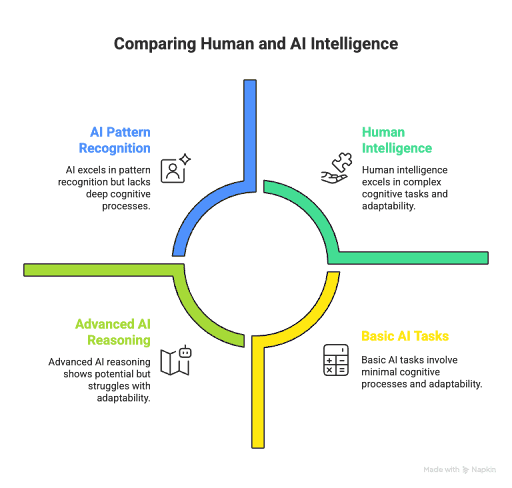
IQ tests were designed to measure human reasoning and problem-solving, not algorithmic output. They assess how individuals learn from experience, adapt to new information, and apply abstract thought, all traits rooted in human biology and consciousness.
Artificial intelligence operates differently. Systems such as ChatGPT analyze data statistically, generating responses by predicting patterns in language rather than by understanding concepts. Because IQ depends on human cognitive processes, assigning a score to a machine has no scientific basis.
How AI Performs on IQ-Type Problems
When researchers present AI models with IQ test questions, results vary widely. Performance depends on whether the model encountered similar material during training and how closely the task aligns with the pattern recognition algorithms the model is equipped with. On some problems, the output resembles that of a high-scoring human; on others, the model fails basic logic or comprehension. These inconsistencies reveal that apparent intelligence arises from content familiarity, not reasoning. AI retrieves and reconfigures information but does not infer or generalize beyond what it has learned.
Computation Versus Cognition
Artificial systems simulate reasoning through programmed probabilities rather than mental processes. They can reproduce the structure of logical argument or creative writing but lack awareness, goals, and understanding.
Human intelligence involves abstraction, insight, and the ability to apply learned principles to unfamiliar situations. Machines follow deterministic rules; their apparent thought is an artifact of computation, not cognition. IQ measures mental adaptability, something algorithms do not possess.
The Psychological Definition of Intelligence
Psychologists define intelligence as a general ability enabling purposeful action, problem solving, and learning through experience. This definition presupposes consciousness and motivational qualities absent in artificial systems.
Processing power or data capacity does not constitute intelligence any more than a calculator’s speed reflects reasoning. AI can replicate outcomes associated with intelligence, yet it lacks the self-reflective and flexible capacities that IQ tests are meant to evaluate.
Why “AI IQ Scores” Are Misleading
An IQ score represents a person’s standing within a human population. Because AI does not share the developmental, biological, or experiential context that defines human cognition, its performance cannot be placed on that scale.
The act of assigning a numerical IQ to a machine confuses computational efficiency with intellectual ability. Even high test performance by an algorithm reflects optimization, not understanding, and carries no psychological meaning.
Ultimately, artificial intelligence can imitate the form of intelligent behavior, but does not exhibit intelligence itself. It processes data rather than reasoning about it, and its success on IQ-like tasks results from pattern recognition, not thought.
Watch “Human Intelligence vs. AI: What Really Defines ‘Smart’?” with Gilles Gignac on the Riot IQ YouTube channel to explore how scientists evaluate intelligence in machines compared to humans.
Take our professional IQ test
Want to know your IQ? Try the first ever professional online IQ test.