How reliable are IQ tests? Professional IQ tests are extremely reliable (0.90–0.95 consistency), among psychology’s most stable measures. Online amateur tests? Almost always unreliable. Discover the difference and why it matters.
Dr. Russell T. WarneChief Scientist
Share
In psychometrics (the science of psychological testing), "reliability" refers to the consistency or stability of test scores. A reliable test produces similar results when administered repeatedly to the same person under similar conditions. Though some variation in scores always exists, highly reliable tests minimize the random score changes that happen.
Psychologists examine several types of reliability when evaluating IQ tests:
1. Test-retest reliability
Test-retest reliability measures score consistency over time. The methodology is simple: researchers administer the same test to the same group of people on two separate occasions, then calculate the correlation between sets of scores. Most professionally developed IQ tests achieve test-retest reliability between .80 and .95 with several weeks between testings. This is considered excellent in psychological measurement. The Wechsler Adult Intelligence Scale (WAIS-IV), for instance, has a test-retest reliability of approximately .94 for full-scale IQ. Even over long periods of time, IQ is stable. One Scottish study found a test-retest reliability value of .67 from age 11 to age 90 -- an interval of 79 years! Some personality and mental health tests don’t have that level of reliability over 1 year.
High test-retest reliability confirms IQ as a stable trait, at least over the time period between the test administrations. IQ scores tend to have high test-retest reliability because intelligence does not fluctuate dramatically over short periods of time. However, practice effects can artificially inflate scores on subsequent testing.
2. Internal consistency reliability
This assesses how consistently items within a test measure the same construct. Statistics like Cronbach's alpha, omega, or split-half reliability estimate how consistent examinees’ responses are from item to item. Professional IQ tests typically have internal consistency coefficients above .90, indicating excellent cohesiveness.
3. Alternate forms reliability
Some IQ tests offer multiple equivalent versions. This reliability is calculated by administering different forms of the same test to the same individuals and measuring score correlation. High correlations indicate that both versions of the same test produce similar scores for examinees.
Professional Vs. Amateur Test Reliability
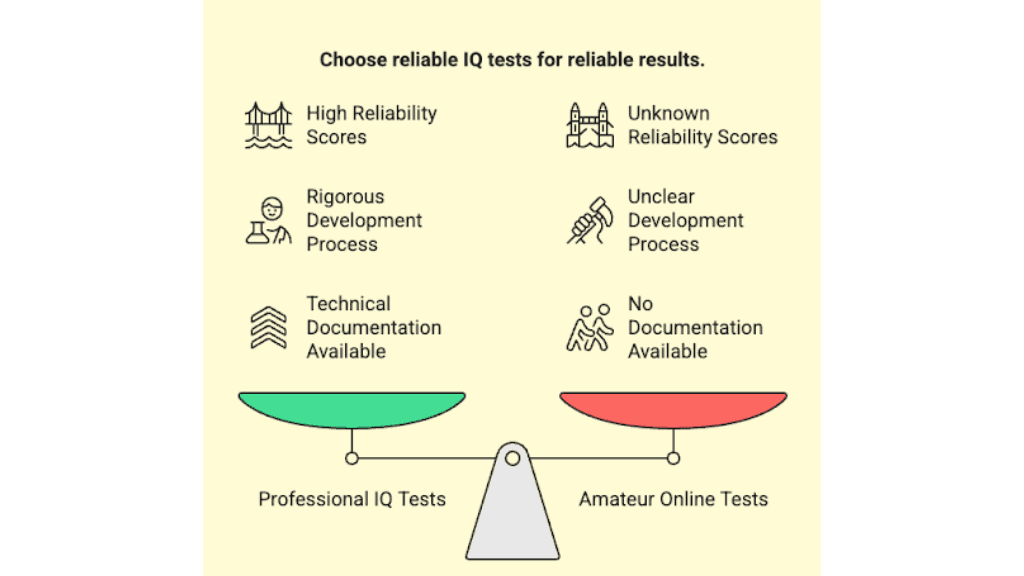
Reliability largely depends on who created the test and its development process. Tests created by trained psychometricians with careful attention to item selection, standardization procedures, and psychometric properties typically demonstrate excellent reliability.
By contrast, free online tests created by non-professionals have unknown levels of reliability. Without proper development and documentation, there's no way to know if they consistently measure anything meaningful, and scores may fluctuate significantly between attempts.
Factors Affecting Reliability
Several elements influence the reliability of scores from an IQ test:
• Test length: Longer tests generally provide more reliable results than shorter ones, which explains why comprehensive IQ batteries like the Wechsler scales or the Stanford-Binet Intelligence Scales require 60-90 minutes to complete. Brief screeners sacrifice some reliability for convenience.
• Standardization of administration: Professional tests have strict guidelines ensuring every test taker has an identical experience. Consistent procedures increase reliability, while varying conditions (different instructions, distracting environments) diminish it.
• Examinee factors: Individual state during testing affects reliability. Fatigue, illness, anxiety, or motivation can introduce measurement error. Professional administrators are trained to recognize and account for these variables.
• Quality of test items: Well-designed items that clearly measure specific cognitive abilities contribute to higher reliability. Ambiguous, culturally biased, or poorly constructed items reduce it.
Reliability Vs. Validity
While important, reliability differs from validity. Test scores can be reliable (consistent) without being valid (measuring what the scores are designed to measure). For instance, a test might consistently measure something other than intelligence. The best IQ tests demonstrate both high reliability and strong evidence of validity in their scores.
Ultimately, the reliability of IQ test scores varies significantly based on their development. Professional tests created using rigorous scientific methods demonstrate excellent reliability, with scores remaining consistent across time and different testing situations. In contrast, amateur online tests have unknown reliability and warrant skepticism.
For those seeking accurate intelligence measurement, investing in a professionally developed test with documented reliability ensures the most trustworthy results.
Curious about why we utilize IQ tests? Watch this:
Take our professional IQ test
Want to know your IQ? Try the first ever professional online IQ test.