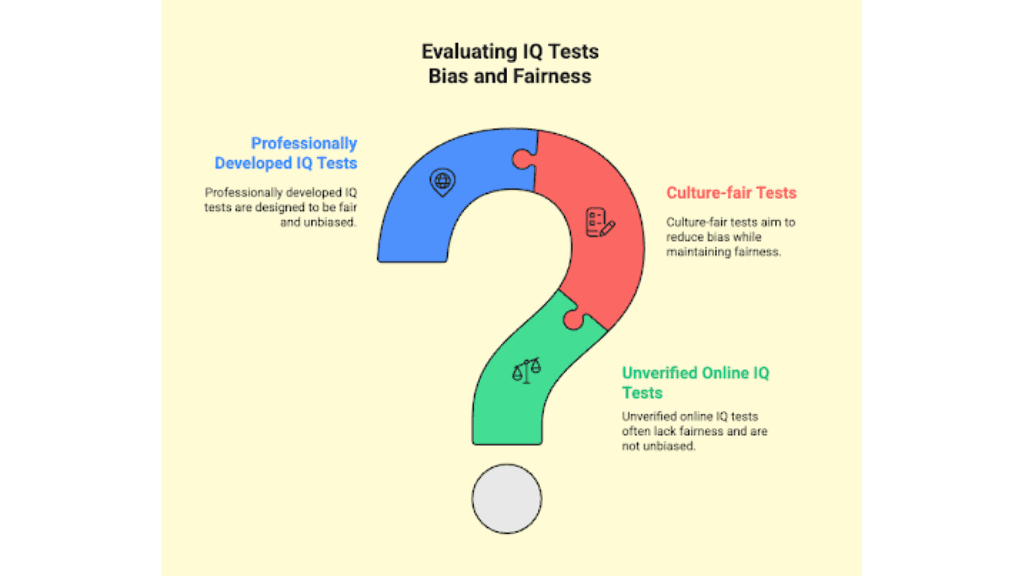
Are IQ tests biased? No—professionally developed IQ tests are not culturally or racially biased. Decades of research show they predict success equally across groups and meet strict fairness standards. Discover what “bias” really means in testing.
Dr. Russell T. WarneChief Scientist
Share
The question of whether IQ tests are biased has surrounded intelligence research for decades. In psychology, bias has a specific definition: a test is biased only if people of equal ability receive different scores for reasons unrelated to the ability being measured. Average score differences across groups do not, by themselves, indicate bias because differences may reflect actual average differences in ability. To determine if a test is biased, it is important to match examinees from different groups on their underlying ability and then determine whether they obtain the same score. A test is considered unbiased if it measures the same construct and produces the same scores for people with the same ability who belong to different groups that the test was intended for.
What Research Shows About Test Fairness
Systematic studies of test fairness began in the 1960s, when psychologists developed methods to detect items that gave unfair advantages to certain groups. The findings have been remarkably consistent.
Well-constructed IQ tests predict academic and occupational performance with similar accuracy across racial, ethnic, and gender groups. A review confirmed that professionally developed cognitive tests show minimal bias in predicting real-world success. These results indicate that differences in average IQ scores largely reflect differences in the abilities being measured rather than flaws in the tests themselves.
The Role of Culture-Fair Testing
Efforts to create “culture-fair” intelligence tests sought to minimize the influence of language and learned knowledge by using geometric or symbolic problems instead of verbal content. Although these tests reduce some cultural effects, they do not fully remove culture from the testing process. Familiarity with test materials, exposure to abstract reasoning tasks, and experience with timed examinations all affect performance.
Research shows that so-called culture-fair tests do not eliminate group score differences and sometimes enlarge them when used with examinees unaccustomed to formal testing. Because no test is completely culture-free, psychologists instead aim for measurement equivalence: ensuring that each item functions the same way for everyone. When this is achieved, the test can be considered unbiased even if average scores vary.
Professional Standards in Modern Testing
Professional test creators follow ethical and technical guidelines established by the American Psychological Association (APA), the American Educational Research Association (AERA), and the National Council on Measurement in Education (NCME). These standards require evidence of reliability, validity, and fairness for all intended populations.
Each item on a professional IQ test undergoes statistical analysis to verify that it measures reasoning ability consistently across demographic groups. Items that fail these criteria are revised or removed before publication. Legitimate developers also document their procedures in detailed technical manuals and norm their tests on representative samples. Tests created by anonymous or unqualified individuals do not meet these requirements, which is why unverified online IQ tests cannot provide trustworthy results.
Decades of empirical research show that professionally developed IQ tests are not biased when used appropriately. They measure cognitive ability in a consistent and equitable way across populations. Misunderstandings about bias often stem from confusing social inequalities with flaws in testing itself. Through continual refinement of scientific standards and the development of professional online assessments like the RIOT, intelligence testing remains one of psychology’s most rigorously evaluated and dependable fields.
Watch “What Actually Makes an IQ Test Biased? (Not What You Think)” with Craig Frisby on the Riot IQ YouTube channel for an eye-opening look at what bias in intelligence testing really means.
Take our professional IQ test
Want to know your IQ? Try the first ever professional online IQ test.