Jun 26, 2026·Accuracy, Reliability & CriticismHow to Tell If an Online IQ Test Is Legitimate
Worried about fake IQ scores? Discover the 6 checkpoints to identify a legitimate, professional cognitive assessment. Read the guide and try the RIOT test!
Dr. Russell T. WarneChief Scientist
The internet has made IQ testing accessible to anyone with a web browser — a development with real potential to democratize access to cognitive assessment. Unfortunately, that potential has been undermined by sites that present amateur or community-built tests with marketing language suggesting professional-grade quality. For people who are serious about understanding their cognitive abilities, distinguishing legitimate tests from illegitimate ones is essential.
This article provides a practical framework — six checkpoints — for evaluating any online IQ test, and applies those checkpoints to a specific site as a worked example.
The Six Checkpoints
Checkpoint 1: Can the Test Creator Be Identified?
The Standards for Educational and Psychological Testing expect that tests are developed by qualified professionals whose expertise can be independently verified [1]. Professional test creators are typically psychologists or psychometricians with graduate-level training and published research in peer-reviewed journals. Their names appear on their tests because they are willing to stake their professional reputation on their work's quality. If a test's creator cannot be identified — if the test is attributed to an online community rather than a named professional — anonymity prevents accountability.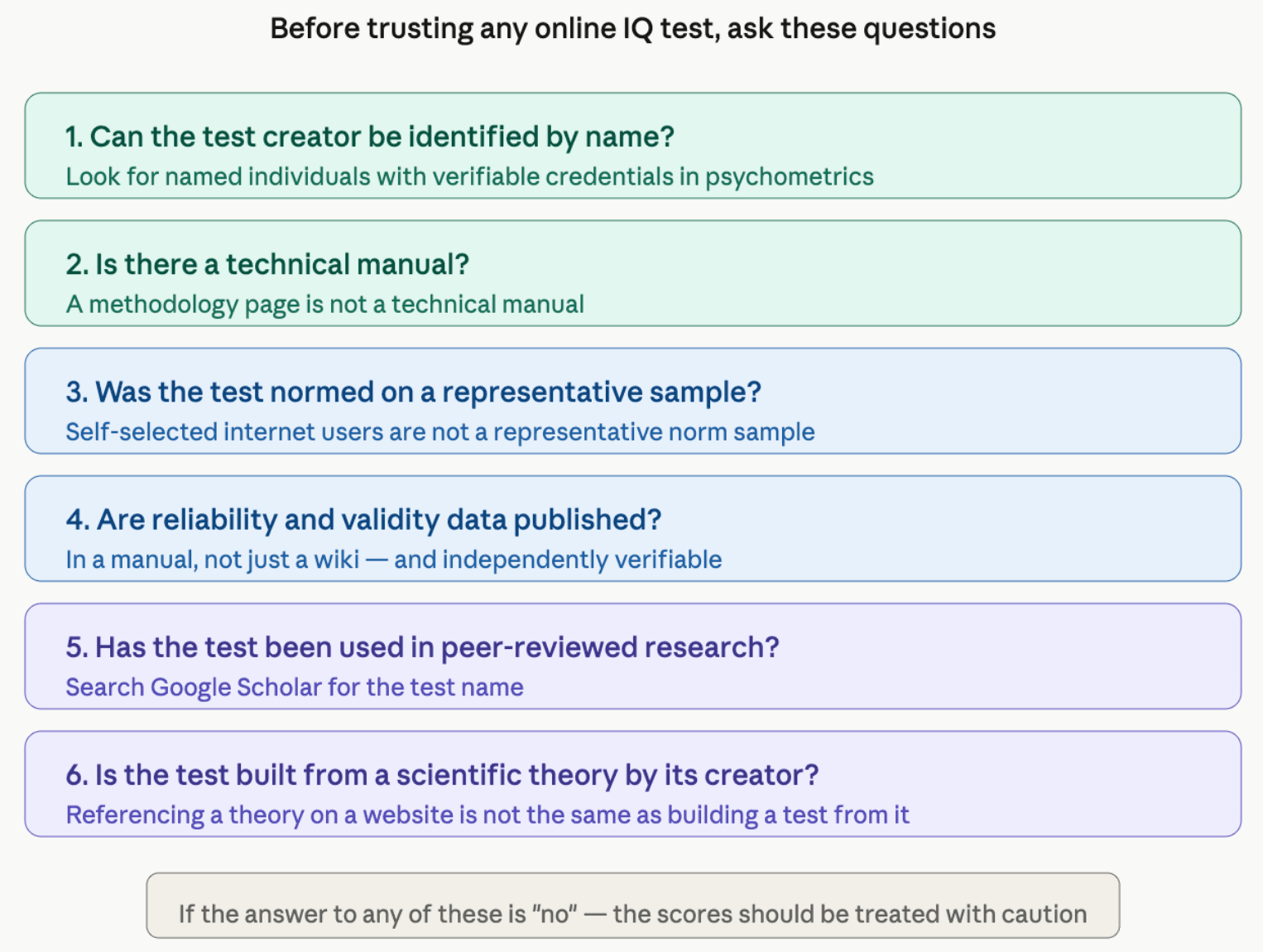
Checkpoint 2: Is There a Technical Manual?
Professional IQ tests come with book-length technical manuals documenting theoretical rationale, item development, pilot testing, norming procedures, reliability coefficients, validity evidence, fairness analyses, and scoring rules [2]. A few sentences about methodology on a website do not constitute technical documentation. The question to ask is whether the documentation is comprehensive enough that an independent psychometrician could evaluate the test's quality from it alone.
Checkpoint 3: Does the Test Have a Proper Norm Sample?
A legitimate IQ test must have a norm sample that is representative of its intended population, with demographic stratification matching the target population [3]. Self-selected internet users are not a representative norm sample. Neither is borrowing norm data from a historical test administered to a different population under different conditions — even if the historical test was professionally developed. Checkpoint 4: Are Reliability and Validity Data Published?
Professional IQ tests achieve test-retest reliability coefficients between .80 and .95 [4]. Validity evidence should demonstrate that the test measures what it claims to measure and that scores support their intended interpretations [5]. Claims of "high g-loading" or correlation with the WAIS need to be backed by independently verifiable data in a technical manual — not self-reported statistics on a wiki page. Checkpoint 5: Has the Test Been Used in Peer-Reviewed Research?
Searching for a test's name in Google Scholar is one of the quickest ways to evaluate its scientific standing. Professional IQ tests have thousands of citations in the scholarly literature [6]. If a test has never appeared in a peer-reviewed journal, there is no external evidence to support the test creator's claims. Checkpoint 6: Is the Test Built From a Scientific Theory by Its Creator?
Legitimate IQ tests are built on established scientific theories of cognitive abilities [7]. The most widely used framework is the Cattell-Horn-Carroll (CHC) theory. A theory provides a blueprint for what abilities to measure, how to sample them, and how to weight the scores. Referencing a theory on a website is not the same as using it as an engineering specification to develop original test content under professional guidance.
Applying the Checkpoints: cognitivemetrics.com
To see how these checkpoints work in practice, consider cognitivemetrics.com — a site that markets itself as offering "professional-grade IQ tests" that are "professionally developed and normed on millions of testees." Applying each checkpoint: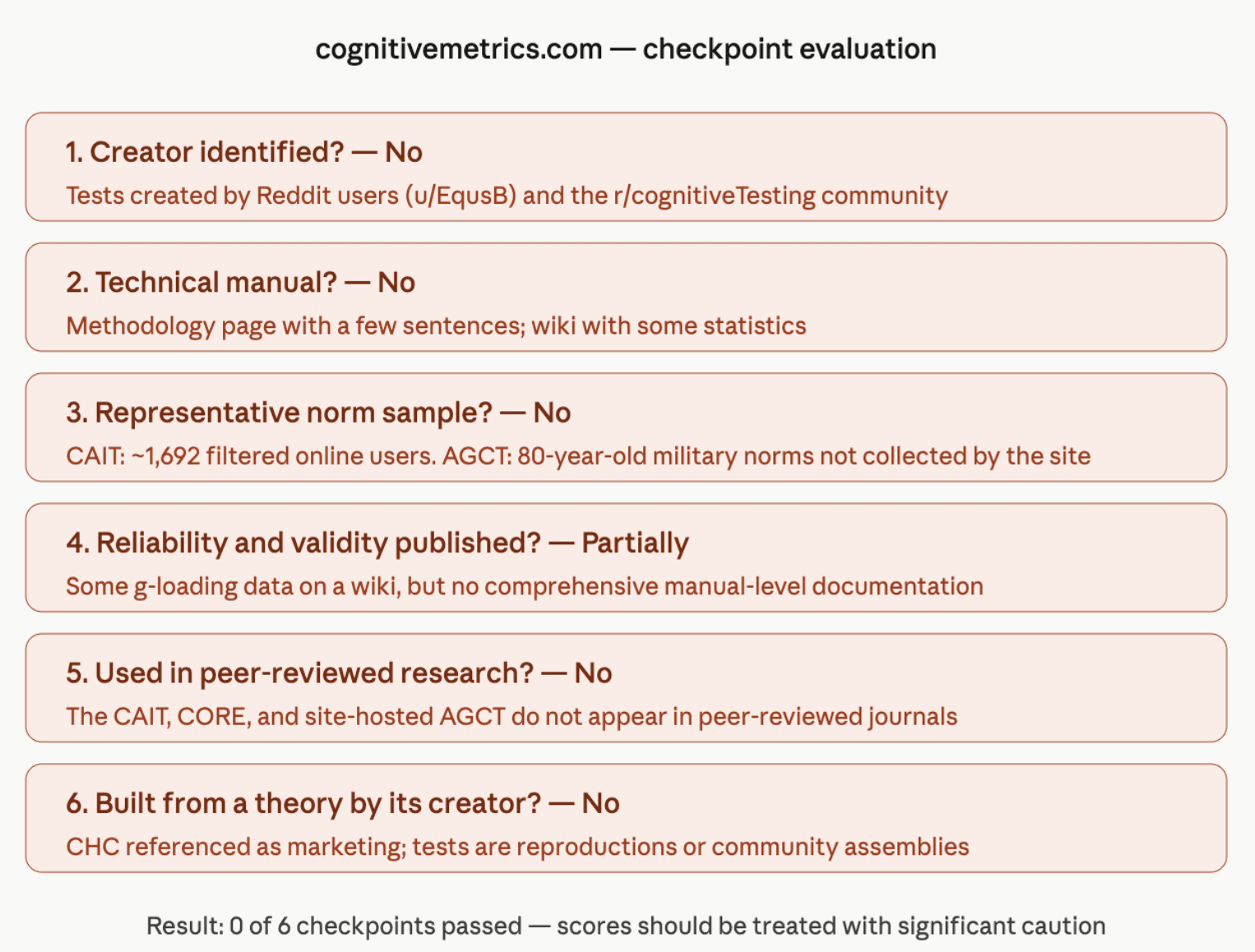 1. Creator: Tests attributed to Reddit user u/EqusB (CAIT), the r/cognitiveTesting community (CORE), and unnamed contributors who "restored" a WWII-era Army test (AGCT). No named psychometrician.
 2. Technical manual: None. A methodology page with a few sentences and a wiki with some statistics.
3. Norm sample: Convenience samples of self-selected internet users, or 80-year-old military norms the site did not collect.
4. Reliability/validity: Some self-reported g-loading data on a wiki. No comprehensive manual-level psychometric documentation.
5. Peer-reviewed research: The hosted tests do not appear in peer-reviewed journal articles. Validation consists of small community studies.
6. Theory-built: CHC theory referenced in marketing; tests are reproductions or community assemblies, not original instruments built from a theoretical blueprint.
Result: 0 of 6 checkpoints passed.
The Pattern to Watch For
What makes cognitivemetrics.com instructive is the specific pattern it illustrates — one that is common across the landscape of online testing. The pattern works like this: take a known test name (like the AGCT), reproduce the questions on a website, claim the historical norming as the site's own ("normed on millions"), calculate some statistics from a self-selected sample of enthusiasts, and market the result as "professional-grade." At each step, something essential is lost — the controlled conditions, the representative norm sample, the professional oversight, the comprehensive documentation — but the marketing language stays the same. Recognizing this pattern is the key to protecting against misleading test scores.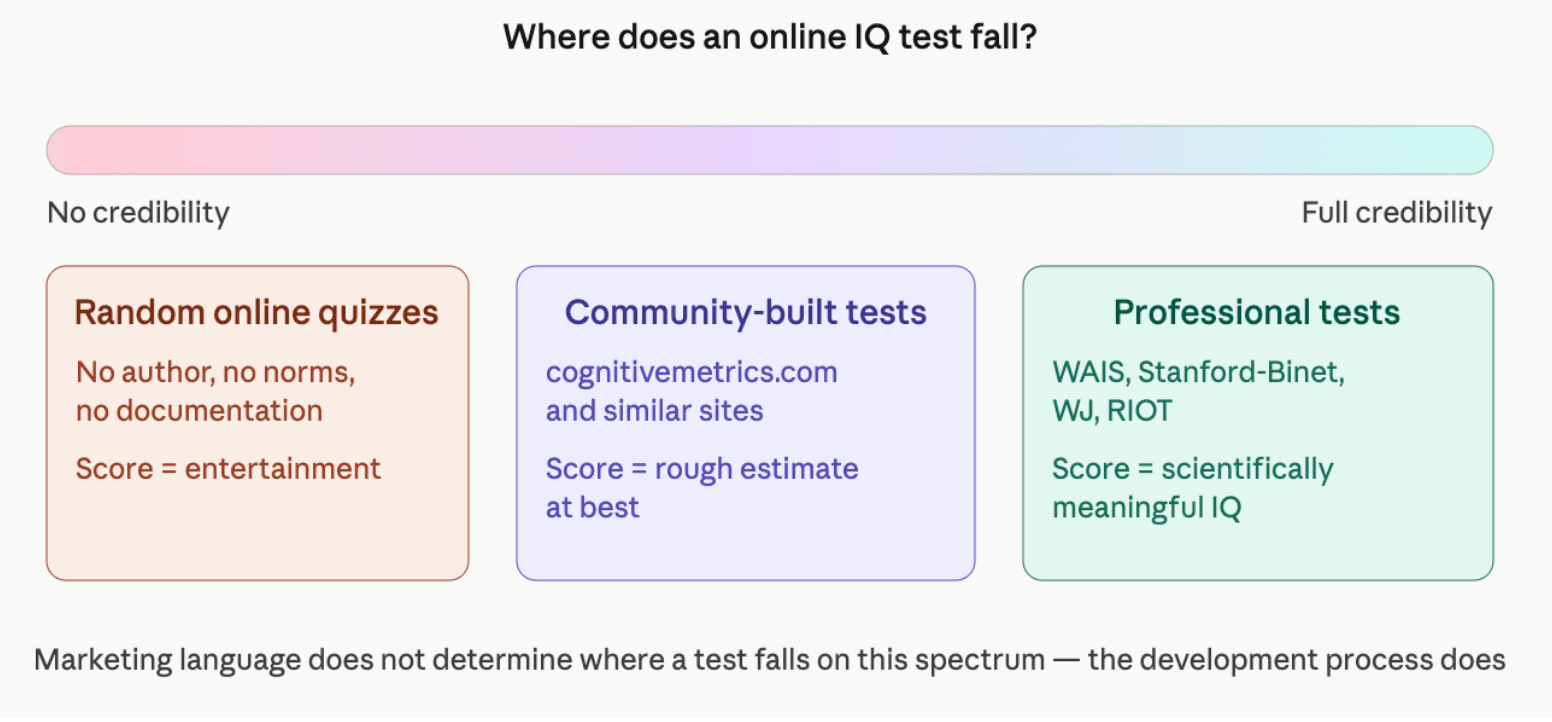
Putting It All Together
The six checkpoints provide a practical framework for separating tests that produce meaningful scores from those that do not. When applied to cognitivemetrics.com, the results are clear: the tests fail every checkpoint for professional quality. They may serve as rough cognitive exercises, but the scores they produce should not be treated as scientifically meaningful IQ — and the site's marketing language of "professional-grade" assessments "comparable to the WAIS" is not supported by the underlying evidence.
Before taking any online IQ test, asking these six questions can save time, money, and the frustration of trusting a number that has no scientific foundation behind it.
Take the First Ever Professional Online IQ Test
The Reasoning and Intelligence Online Test is the first online IQ test that actually meets professional standards for psychological assessment. It was created by Dr. Russell Warne, who has over 15 years of experience in intelligence research.
What makes the RIOT different from the countless online IQ tests found with a quick internet search? Most of those tests are created by amateurs without proper training in psychometrics. The RIOT clearly stands out as the first-ever professional online IQ test. The RIOT underwent the same rigorous development process as traditional in-person IQ tests used by psychologists, including expert review, the first-ever proper U.S.-based online norm sample, and compliance with educational and psychological testing standards from APA, AERA, and NCME. The RIOT reports not just an overall IQ score but six index scores — Verbal Reasoning, Fluid Reasoning, Spatial Ability, Working Memory, Processing Speed, and Reaction Time — providing a comprehensive picture of cognitive strengths and areas for growth.
References
[1] American Educational Research Association, American Psychological Association, & National Council on Measurement in Education. (2014). Standards for educational and psychological testing. AERA. https://www.testingstandards.net/ [2] Warne, R. T. (2020). In the know: Debunking 35 myths about human intelligence. Cambridge University Press. https://doi.org/10.1017/9781108593298 [3] Warne, R. T. (2025). Technical manual for the Reasoning and Intelligence Online Test, version 1.0. Riot IQ.
[4] Calamia, M., Markon, K., & Tranel, D. (2013). The robust reliability of neuropsychological measures. The Clinical Neuropsychologist, 27(7), 1077–1105. https://doi.org/10.1016/S0887-6177(02)00147-6 [5] Schmidt, F. L., & Hunter, J. E. (1998). The validity and utility of selection methods in personnel psychology. Psychological Bulletin, 124(2), 262–274. https://doi.org/10.1037/0033-2909.124.2.262 [6] Carroll, J. B. (1993). Human cognitive abilities: A survey of factor-analytic studies. Cambridge University Press.
[7] McGrew, K. S. (2009). CHC theory and the human cognitive abilities project. Intelligence, 37(1), 1–10. https://doi.org/10.1016/j.intell.2008.08.004 [8] Flynn, J. R. (1984). The mean IQ of Americans: Massive gains 1932 to 1978. Psychological Bulletin, 95(1), 29–51. https://doi.org/10.1037/0033-2909.95.1.29 [9] American Psychological Association. (2017). Ethical principles of psychologists and code of conduct. https://www.apa.org/ethics/code [10] Spearman, C. (1904). "General intelligence," objectively determined and measured. American Journal of Psychology, 15(2), 201–293. https://doi.org/10.2307/1412107 Take our professional IQ test
Want to know your IQ? Try the first ever professional online IQ test.
AuthorDr. Russell T. WarneChief Scientist
