The Mozart Effect: Does Listening to Music Raise IQ?
The Mozart effect claimed ten minutes of a sonata lifted IQ. Three decades of research shrank it to a brief mood boost. Here is what actually survived.
Dr. Russell T. WarneChief Scientist
Share
The "Mozart effect" is the claim that briefly listening to Mozart makes you smarter. The short answer from three decades of research: listening to music does not raise IQ. The 1993 study that launched the idea found a temporary bump on one spatial subtest, lasting ten to fifteen minutes, in 36 college students. Later meta-analyses shrank the effect to about a point, explained it as ordinary arousal and mood, and found that any enjoyable audio works as well. How that footnote became state policy is one of the best cautionary tales in psychology.
The 1993 study that started it
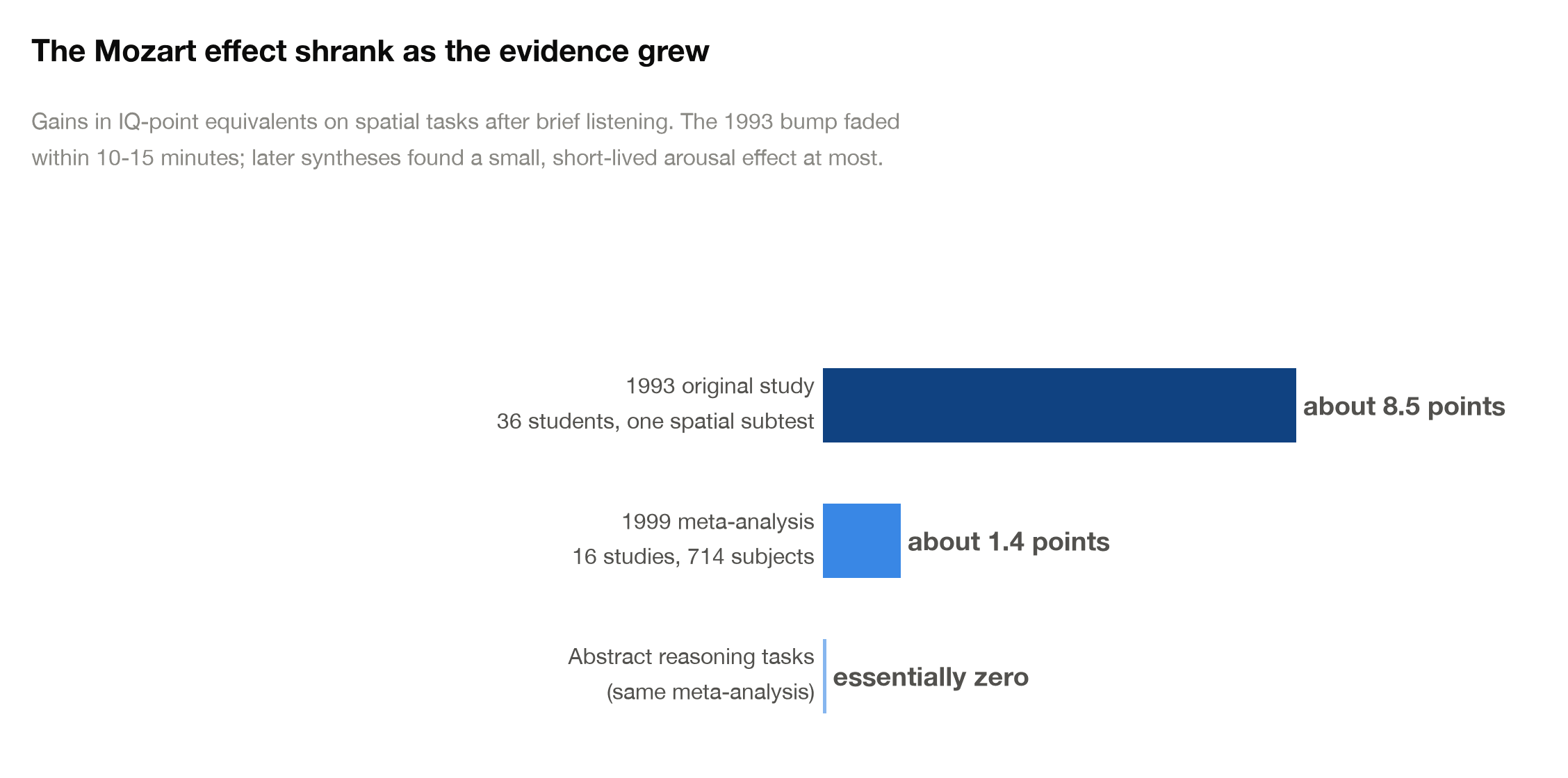
In 1993, Frances Rauscher, Gordon Shaw, and Katherine Ky reported in Nature that 36 undergraduates scored 8 to 9 points higher on the spatial reasoning subtest of the Stanford-Binet after ten minutes of Mozart's Sonata for Two Pianos in D major, K. 448, compared with relaxation instructions or silence. Two details were lost almost immediately in the retelling: the gain was on a single spatial subtest, expressed in IQ-equivalent points rather than full-scale IQ, and it lasted ten to fifteen minutes. The authors never claimed lasting intelligence gains.
How a footnote became public policy
The press release version, Mozart makes you smarter, traveled fast. By January 1998, Georgia governor Zell Miller asked his legislature for $105,000 to give every newborn in the state a classical music recording. The legislature balked, Sony donated the CDs instead, and Georgia hospitals handed out "Build Your Baby's Brain" discs to roughly 110,000 babies a year. The best detail in the story: Rauscher herself, whose study was cited as justification, publicly noted that none of her research showed casual listening does anything for children.
What replication found
When other laboratories repeated the experiment, the effect largely refused to appear. A direct replication following the original team's own published procedure failed outright in 1999. That same year, Christopher Chabris meta-analyzed 16 studies covering 714 subjects: the average enhancement was about 1.4 IQ points, confined to spatial-temporal tasks, with essentially zero effect on abstract reasoning. The definitive 2010 meta-analysis of roughly 40 studies and more than 3,000 subjects found the same pattern plus publication bias, and a telling comparison: any music produced about the same benefit as Mozart specifically. Its authors titled the paper "Mozart effect, Shmozart effect."
The arousal explanation
Why does any short-lived effect appear at all? Because pleasant, energetic stimulation temporarily lifts arousal and mood, and mildly aroused people perform slightly better on speeded spatial tasks. In a 2001 experiment, the Mozart advantage appeared after an upbeat Mozart sonata but not a slow, sad Albinoni piece, and when enjoyment, arousal, and mood were statistically controlled, the effect vanished entirely. A companion study found listeners did better after whichever stimulus they preferred, including a narrated story rather than music. Nothing about Mozart, or music, is special to the effect.
What actually helps
One nearby claim does have randomized evidence: music lessons. In a 2004 trial, 144 six-year-olds were randomly assigned to a year of keyboard or voice lessons, drama lessons, or no lessons; the music groups gained about 2.7 IQ points more than controls, a small but real effect, and the drama group gained instead on social behavior. Learning an instrument is cognitively demanding practice sustained for months, a different thing entirely from passive listening. For the broader question of what moves IQ scores over a lifetime, see does IQ change with age, and for the ability the original study actually measured, our article on fluid intelligence.
Frequently asked questions
Is the Mozart effect real?
As popularly understood, no. Listening to Mozart does not raise IQ. A small, short-lived boost on spatial tasks exists and is explained by arousal and mood; any enjoyable audio produces it.
Does classical music make babies smarter?
There is no evidence for it. The original study involved college students, not infants, and the researcher whose work inspired the baby-CD programs said herself that casual listening shows no effect for children.
Does listening to music while studying help?
It depends on the person and task. Enjoyable music can lift arousal and mood, which helps some people focus, but it adds no cognitive ability and can interfere with verbal memorization.
Do music lessons raise IQ?
Modestly, by the best randomized evidence: about 2.7 points over a year of lessons in six-year-olds. Sustained, demanding practice, not passive exposure, appears to drive the difference.
Why did the myth spread so fast?
It promised something for nothing, fit the era's anxieties about early childhood, and rode a wave of media simplification that turned a 15-minute spatial bump into "music makes babies smarter."
The takeaway
The Mozart effect is what it sounds like when a real but tiny finding meets a hungry press: three decades on, the surviving effect is about a point, brief, and not about Mozart at all. Listen to K. 448 because it is glorious. For your reasoning ability, measurement beats magic: the Reasoning and Intelligence Online Test from RIOT IQ will tell you where you stand, no sonata required.
References
1. Rauscher, F. H., Shaw, G. L., & Ky, K. N. (1993). Music and spatial task performance. Nature, 365(6447), 611. doi.org
2. Rauscher, F. H., et al. (1994). Music and spatial task performance: A causal relationship. APA Annual Convention paper. eric.ed.gov
3. Steele, K. M., Bass, K. E., & Crook, M. D. (1999). The mystery of the Mozart effect: Failure to replicate. Psychological Science, 10(4), 366-369. appstate.edu
4. Chabris, C. F. (1999). Prelude or requiem for the "Mozart effect"? Nature, 400(6747), 826-827. doi.org
5. Thompson, W. F., Schellenberg, E. G., & Husain, G. (2001). Arousal, mood, and the Mozart effect. Psychological Science, 12(3), 248-251. doi.org
6. Pietschnig, J., Voracek, M., & Formann, A. K. (2010). Mozart effect-Shmozart effect: A meta-analysis. Intelligence, 38(3), 314-323. doi.org
7. Schellenberg, E. G. (2004). Music lessons enhance IQ. Psychological Science, 15(8), 511-514. doi.org
8. Spigel, S. (1998). Georgia's provision of classical music for newborns (OLR Report 98-R-0888). Connecticut Office of Legislative Research. cga.ct.gov
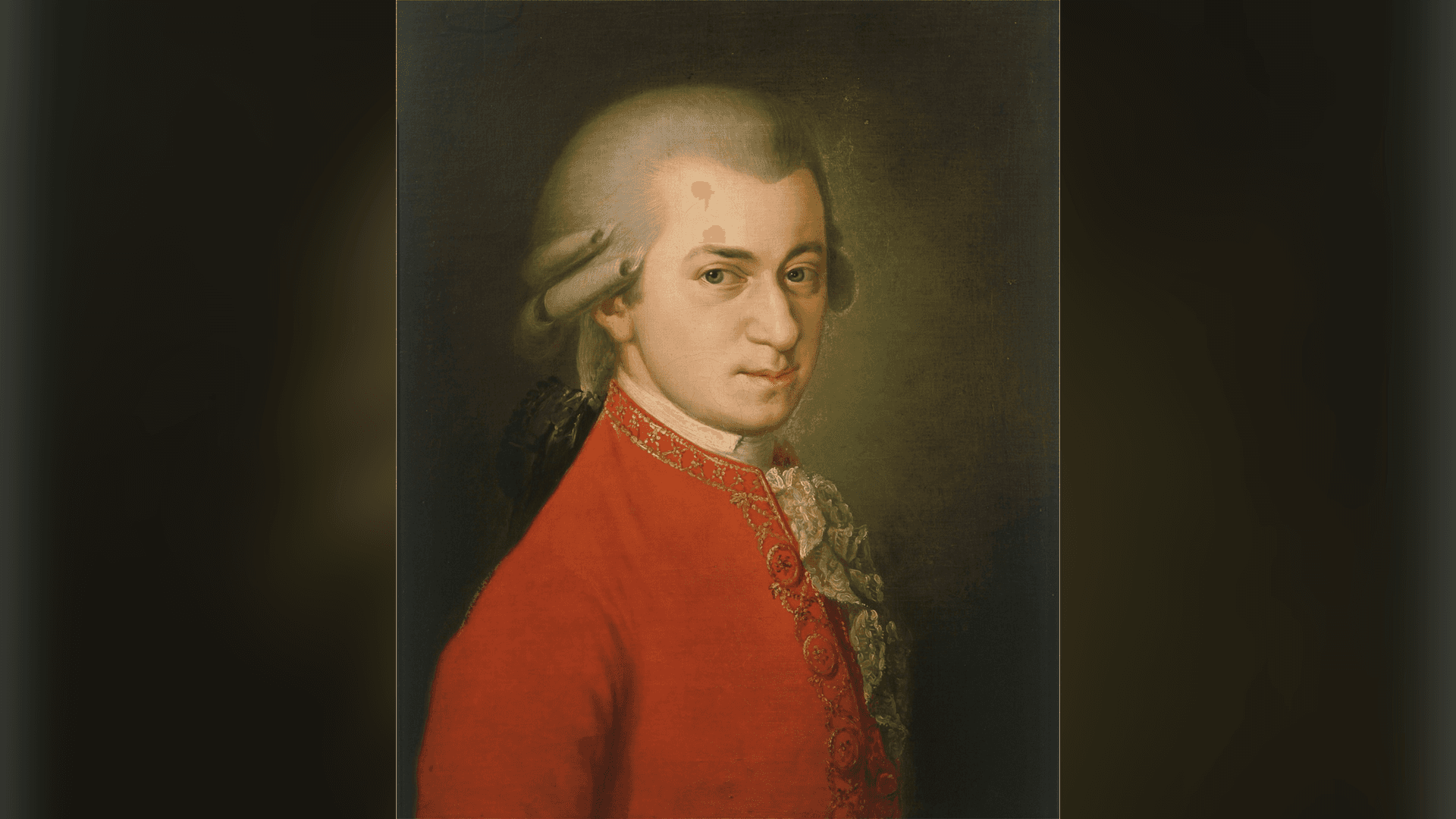
Hero image: Wolfgang Amadeus Mozart, posthumous portrait by Barbara Krafft, 1819. Public domain, via Wikimedia Commons.
Take our professional IQ test
Want to know your IQ? Try the first ever professional online IQ test.