Jul 29, 2026·Accuracy, Reliability & CriticismHow to Spot a Fake Online IQ Test
Are online IQ tests real or just scams? Learn how to spot fake tests, inflated scores, and paywall traps. Read the guide and take the legitimate RIOT test!
Dr. Russell T. WarneChief Scientist
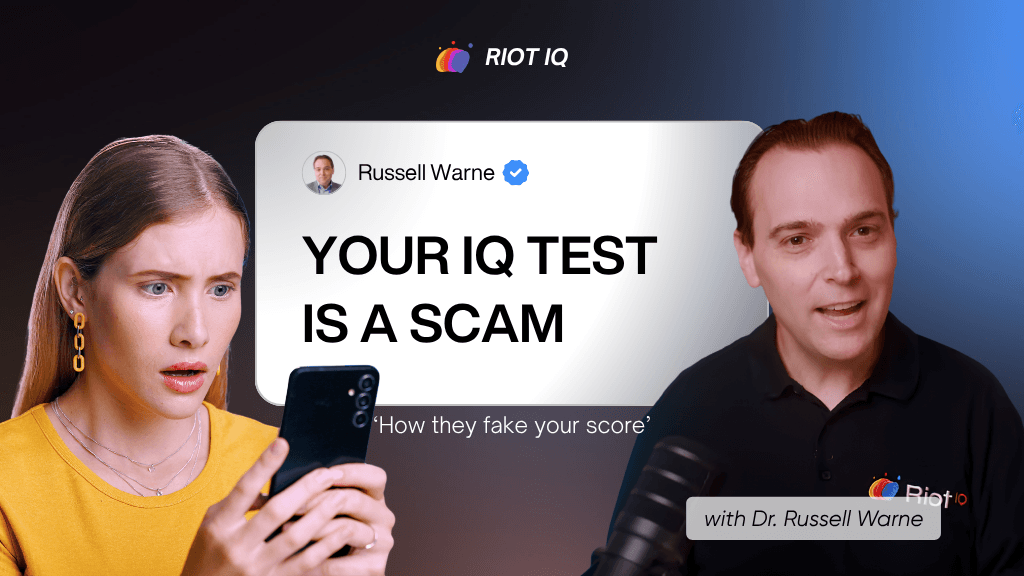
A simple search for "IQ test" returns millions of results, and the vast majority are scientifically worthless. Taking an IQ test should produce meaningful data about your cognitive profile. Most of what's available online produces something else entirely: a flattering number designed to be shared on social media, a data collection mechanism dressed up as a cognitive assessment, or a billing trap that charges you for a score you could have invented yourself. Knowing how to distinguish a legitimate online assessment from an entertainment product is genuinely useful because the consequences of misreading a fake score run in both directions. Overestimating your cognitive ability based on an inflated score leads to poor decisions. Underestimating it based on a poorly designed test leads to others. This article gives you the specific signals that separate real psychometric instruments from junk.
The Core Problem: What Makes a Test Legitimate
Before getting into the red flags, it's worth establishing what a legitimate IQ test actually requires because most people have never been told.
A genuine intelligence test requires four properties: reliability (consistent results across time and equivalent forms), validity (measuring what it claims to measure), standardization (uniform administration conditions), and a normative sample (a large, representative group whose performance anchors the scoring scale). Without all four, the score produced is not a measurement; it is a number.
Research from the American Psychological Association shows that while validated online tests can achieve 75–85% correlation with professional assessments like the WAIS, the majority of free tests online lack proper standardization and produce results that are essentially meaningless. The challenge is that legitimate and illegitimate tests often look similar on the surface. Both have questions. Both produce a number. Both may have professional-looking design. The difference is in what's behind them and most users have no way to check unless they know what to look for.
Red Flag 1: Your Score Is Suspiciously High
This is the single most reliable warning sign, and it exploits a statistical fact that most people don't know: by definition, only 2% of the population has an IQ above 130. If a test consistently returns scores in the 120–145 range, it is not measuring IQ. It is measuring something else or nothing at all. The psychology behind score inflation is straightforward and commercially motivated. A score of 135 gets posted on social media; a score of 98 does not. Sharing drives traffic, and traffic drives ad revenue. Without published validation data, no one can prove the scores are wrong. A legitimately normed IQ test, by definition, produces a bell curve centered at 100 with a standard deviation of 15. If a test's average reported score is significantly above 100, the test is not normed correctly or is not normed at all.
 When you see a result in the 130–145 range from a test that took under 15 minutes, the correct response is skepticism rather than celebration. Ask whether the platform publishes the distribution of scores across all users. If it doesn't — or if that distribution shows most users landing well above 100, the score is telling you something about the platform's incentives, not your cognitive ability.
Red Flag 2: Results Are Hidden Behind a Paywall
Paying for extras is one thing. Hiding the score until checkout is another. If a test requires payment before revealing your result, the commercial structure reveals the business model: the test exists to generate revenue, and your curiosity is the product being monetized. This doesn't mean paid tests are illegitimate, as some well-validated instruments do charge, but a test that withholds the basic result until you pay has designed the assessment around the transaction rather than the measurement. A legitimate test with a free tier should show you a result at the free level, even if that result has a wider margin of error than a premium tier would provide. The RIOT offers three formats: a free sample with a margin of error of ±14.9 points, a basic test, and a comprehensive full test, in each case giving you an actual score before asking you to upgrade. That structure is consistent with legitimate measurement: show the data, then offer more precision.
Red Flag 3: No Named Author, Psychologist, or Institution
A named author, team or institution provides accountability. Anonymous test pages deserve suspicion, especially when they ask for money. Legitimate psychometric instruments are built by identified experts who stake their professional reputation on the quality of their work. If a test has no named psychologist, no institutional affiliation, and no identifiable team behind it, there is no accountability for whether the questions were designed appropriately, whether the norming sample was representative, or whether the scoring algorithm is valid.
The RIOT was developed by me under my name and professional credentials. That's not a marketing claim; it's an accountability structure. If the test produces garbage results, my reputation is attached to it. Anonymous platforms have no equivalent skin in the game.
Red Flag 4: No Technical Documentation
The primary feature of questionable tests is often a complete lack of any technical documentation, such as a manual, that describes their creation and validation. This documentation is essential for the test to be externally evaluated, which is standard procedure for legitimate psychological tests.
What should you look for? A legitimate test should publish or reference its normative sample size and demographic composition, reliability coefficients (Cronbach's alpha should exceed 0.80 for a reliable test), validity evidence showing how scores correlate with established measures like the WAIS, and methodology documentation describing how items were developed, piloted, and calibrated. If a platform's "about" or "methodology" page provides only vague language about "scientific research" and "expert development" without any specifics, treat that as an absence of documentation rather than its presence. Marketing language is not psychometric evidence.
Red Flag 5: The Test Is Too Short
Tests with fewer than 20 questions cannot provide accurate IQ estimates. This is a psychometric floor, not a suggestion. Item count directly determines how much information a test can collect, and information directly determines the precision of the score it produces. A 10-question test cannot reliably differentiate between IQ 100 and IQ 115. The margin of error is simply too wide. A reliable online IQ test should take at least 20–30 minutes to complete. Anything under 15 minutes is almost certainly too short to produce a meaningful score, regardless of how sophisticated the interface looks. If a test promises to reveal your IQ in "just 5 minutes," the promise reveals the problem. Real cognitive measurement takes time because it requires sampling performance across multiple item types, difficulty levels, and cognitive domains, none of which can be achieved in a five-minute session.
Red Flag 6: It Only Measures One Type of Question
A legitimate IQ test samples multiple cognitive domains. Online IQ tests frequently miss working-memory span (digit-span backwards), processing-speed coding (symbol search), and the social context that a clinician uses to note whether you're anxious, ADHD, or sleep-deprived. But beyond those clinical elements, a valid online battery should at minimum cover verbal reasoning, numerical or logical reasoning, and visual-spatial reasoning because a score derived from a single question type is not a Full Scale IQ estimate, it's a domain-specific measure being mislabeled.
A multi-domain assessment covering at least three cognitive areas is one of the eight markers of a legitimate online assessment. If a test presents only one format; for example, only matrix reasoning, or only number series and reports the result as a Full Scale IQ, it is overextending what its data can actually support. One domain score is not equivalent to a composite across multiple domains.
Red Flag 7: No Confidence Interval or Margin of Error
Every real IQ score has a margin of error. A clinical battery like the WAIS-5 reports scores with a standard error of measurement and a confidence interval, typically a range of 5–10 points around the point estimate. Online tests have larger margins of error due to shorter length and absence of a clinician, and a test that reports your IQ as exactly 124 with no confidence interval, no standard error, and no acknowledgment of measurement uncertainty is giving you false precision.
Contextual score reporting with percentiles and confidence intervals is one of the eight markers of a legitimate online assessment. The confidence interval isn't a weakness to be hidden. It's the test being honest about what it knows and what it doesn't. A score reported as "124 ± 8 points" is telling you something real. A score reported as "124" with no qualification is telling you something about the platform's confidence in its own instrument or its willingness to be transparent about its limits.
Red Flag 8: No Acknowledgment of Limitations
A legitimate test acknowledges what it is and what it isn't. A good test tells you when to seek a psychologist. It distinguishes between what its results can inform and what requires a licensed clinician for educational placement, disability determination, clinical diagnosis, or forensic purposes. A platform that claims its online assessment can replace or substitute for a professional evaluation is either misinformed or deliberately misleading. The same principle applies to score interpretation. Legitimate tests explain what the score means, what it doesn't mean, and what factors might have suppressed or inflated it: sleep, anxiety, fatigue, unfamiliarity with the test format. Entertainment tests simply produce a number and present it as a verdict.
What Legitimate Tests Do Look Like
Having enumerated the red flags, the positive checklist is equally useful. Apply these eight legitimacy markers: transparent methodology mentioning psychometric principles; multi-domain assessment covering at least three cognitive areas; documented norming data with sample size and demographics; published reliability metrics (Cronbach's alpha above 0.80); realistic bell-curve score distribution; enforced timing controls; explicit limitations about non-clinical use; and contextual score reporting with percentiles and confidence intervals. Tests meeting all eight are likely valid for self-assessment. Tests meeting fewer than four should be treated with significant skepticism.
Price is not a reliable signal. Some free tests are well-designed and psychometrically sound, while some paid tests are junk with a price tag. What matters is whether the platform can answer the following questions with specific, verifiable information: Who built this test? What is the normative sample? What is the reliability coefficient? How does this score correlate with established clinical measures? What is the margin of error for this score?
If those questions produce specific answers with citations, the platform deserves your attention. If they produce marketing language, you have your answer.
The Takeaway
The online IQ testing landscape contains a small number of legitimate instruments embedded in a much larger ecosystem of entertainment products, data harvesting operations, and flattery engines. Distinguishing between them is not difficult once you know what to look for, and the signals are consistent: inflated scores, no named authors, no technical documentation, no confidence intervals, tests that are too short, and paywalls that withhold results until you've paid for something you haven't yet evaluated.
A legitimate online IQ test can provide genuine insight into your cognitive profile, but only if it was built with the same rigor applied to clinical batteries: proper item development, representative norming, published reliability evidence, and honest reporting of what the score does and doesn't tell you. The RIOT was built to meet that standard with named authorship, published methodology, documented norming, and score reporting that includes confidence intervals and explicit acknowledgment of what the instrument's results can and cannot support.
References
RIOT IQ. (2026). Are Online IQ Tests Scams? — red flags, technical documentation requirements, legitimacy criteria. https://www.riotiq.com/articles/online-iq-tests/are-online-iq-tests-scams What's Your IQ. (2026). Are Online IQ Tests Accurate? How to Spot Junk Tests — 12 red flags and 8 legitimacy markers. https://whats-your-iq.com/en/articles/online-iq-tests/are-online-iq-tests-accurate What's Your IQ. (2026). Are Online IQ Tests Accurate? A Critical Examination — score inflation mechanism and bell curve norming. https://whats-your-iq.com/en/articles/online-iq-tests/online-iq-test-accuracy Testrize. (2026). How Accurate Are Online IQ Tests? An Honest Guide — APA research, 75–85% correlation ceiling, 20-minute minimum. https://testrize.com/en/blog/iq-test-accuracy Free IQ Tests. (2026). Is It Safe to Trust Online IQ Tests? 12 Truths You Must Know — privacy risks and missing domains. https://www.freeiqtests.org/is-it-safe-to-trust-online-iq-tests/ MyIQTested. (2026). Are Online IQ Tests Accurate? An Honest 2026 Review — six legitimacy signals and paywall red flag. https://www.myiqtested.com/are-online-iq-tests-accurate Cogn-IQ.org. (2025). How to Spot a Fake IQ Test — psychometric requirements and validation evidence checklist. https://www.cogn-iq.org/blog/fake-iq-test/
Take our professional IQ test
Want to know your IQ? Try the first ever professional online IQ test.
AuthorDr. Russell T. WarneChief Scientist
