Apr 12, 2026·Accuracy, Reliability & Criticism7 Common Myths About IQ Tests Debunked
Are tests culturally biased? Does a high score guarantee success? Discover the scientific truth behind the 7 most common IQ test myths and real cognitive testing.
Dr. Russell T. WarneChief Scientist
Every week, I encounter misconceptions about IQ tests. On Reddit, users debate whether intelligence can be changed through brain training apps. On Quora, someone confidently explains that IQ tests are culturally biased tools. In popular media, the argument that IQ is "just a number" sits alongside the opposite extreme — that a high score alone guarantees success in life.
Neither extreme is right. What follows is a direct account of the seven most persistent myths about IQ tests and what the evidence actually shows.
Myth 1: IQ is fixed for life
One Reddit user captured this myth perfectly: "I always thought IQ was a fixed thing. Like ur either born smart or ur not."
IQ scores are relatively stable across adulthood — a healthy person who tests at 25 and retests at 45 will score similarly. That stability is a sign the test is measuring something real. Research tracking individuals from childhood into adulthood confirms that childhood IQ meaningfully predicts outcomes decades later. But stable is not the same as immutable. Schooling is the most robust environmental influence: one comprehensive review found that an additional year of education raises IQ by approximately one to two points. Adoption studies show consistent gains of roughly three points when children are placed in more stimulating environments. On the other side, lead poisoning, brain trauma, and prenatal toxin exposure can lower IQ. IQ reflects both genes and environment. Neither factor alone tells the whole story.
Myth 2: IQ tests are culturally biased
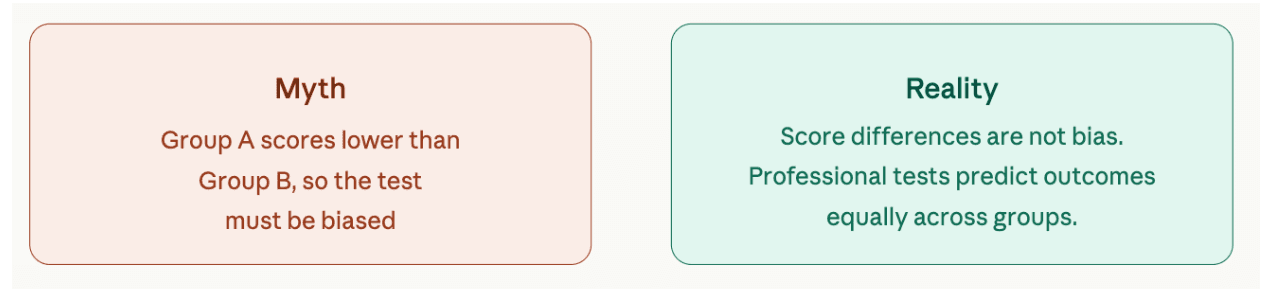
This claim comes in a predictable form: if minority groups score lower on average, the test must be measuring cultural exposure rather than intelligence. The reasoning sounds intuitive. It is also wrong.
Psychometricians define bias precisely. A test is biased when it measures different things for different groups, or when it predicts outcomes differently across groups — not when average scores differ. Average differences are not, by themselves, proof of bias. Differences can motivate an investigation into bias, but the investigation has to follow from data.
Since the 1960s, IQ test creators have systematically screened tests for bias before release. The results, summarized in expert reviews, are consistent: professional IQ tests show no measurement bias when used with the populations they were designed for. If tests were systematically suppressing scores for certain groups, we would expect those groups' life outcomes to be under-predicted by their scores. That is not what the data shows. One legitimate caveat exists. Administering a test normed on English-speaking Americans to recent immigrants, or using a Western IQ test in countries with very different educational systems, introduces real problems. That is a misapplication of the test, not a flaw in the test itself. Professional standards make this explicit and recommend against administering tests to people that do not belong to the population the test was designed for, unless there is evidence that the test functions properly for the new group.
Myth 3: A high IQ guarantees success
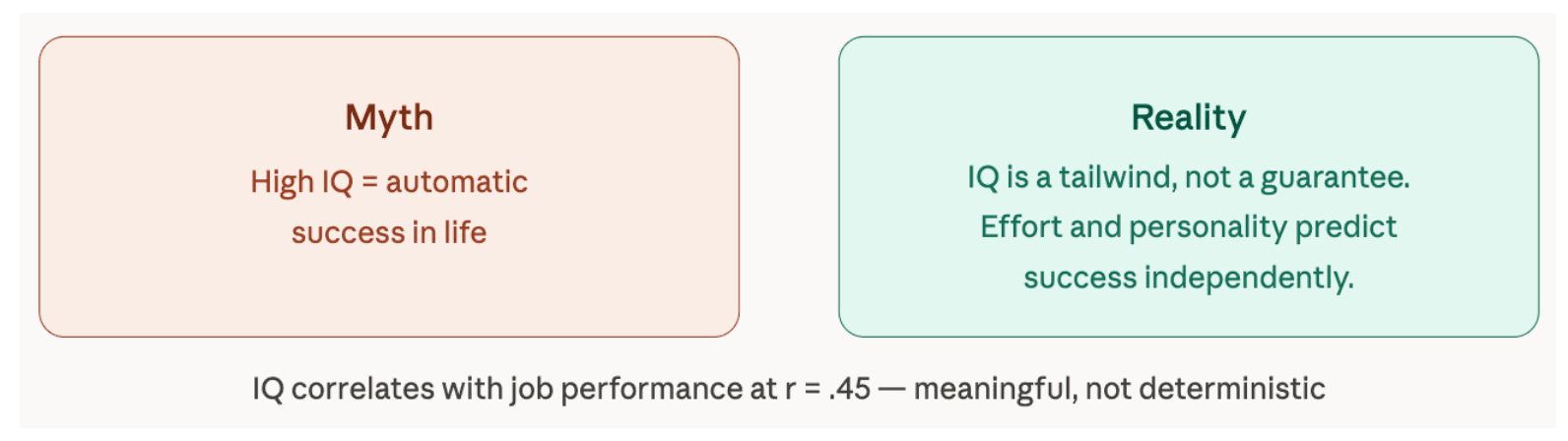
A Quora commenter once asked whether a person with a high IQ "must be successful, kind, and perfect." This mythology treats IQ as a golden ticket. The evidence says otherwise — in both directions.
A high IQ does not guarantee success, but it is one of the most consistently documented predictors of it. Research tracking thousands of individuals over decades shows IQ correlates with academic performance, employment prestige, income, physical health, and longevity. These are not small associations. IQ predicts job performance at around r = .45, which is among the strongest predictors in organizational psychology. The key word is predicts, not determines. A person with an IQ of 130 who applies no sustained effort will not outperform someone with an IQ of 115 who works methodically. Conscientiousness predicts job performance independently of intelligence, and together they predict better than either alone.
Low IQ is similarly not a sentence to a life of misery. Personality, a strong support network, and a structured environment can compensate for some cognitive disadvantage — though compensation has real limits.
Myth 4: IQ is purely genetic
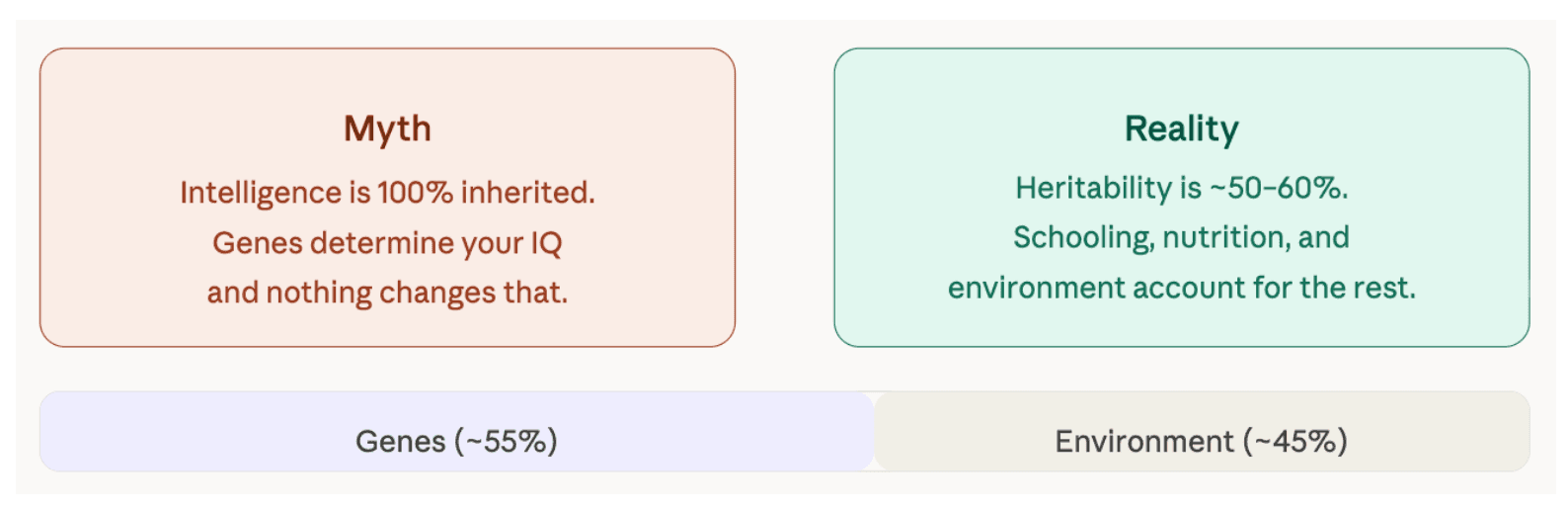
Both genes and environment contribute to IQ. In non-neglectful environments in wealthy countries, heritability estimates typically range from about 50% to 60%, with higher heritability in adulthood compared to childhood. Heritability is frequently misunderstood. A heritability of 0.60 does not mean 60% of a person's IQ came from their genes. It means that within the studied population, about 60% of the variation in IQ scores between people is attributable to genetic differences. The remaining variation comes from environment — and that share is real and meaningful.
The clearest evidence comes from what we know raises IQ: schooling (roughly one to two points per year), adoption into enriched homes (roughly three points), and the avoidance of known harms like lead exposure and malnutrition. Genes set a range of possible outcomes. Environment determines where within that range a person lands.
Myth 5: Brain training apps raise IQ
The brain-training industry is built on a sound intuition: that mental practice should produce mental gains. But reality is not that simple.
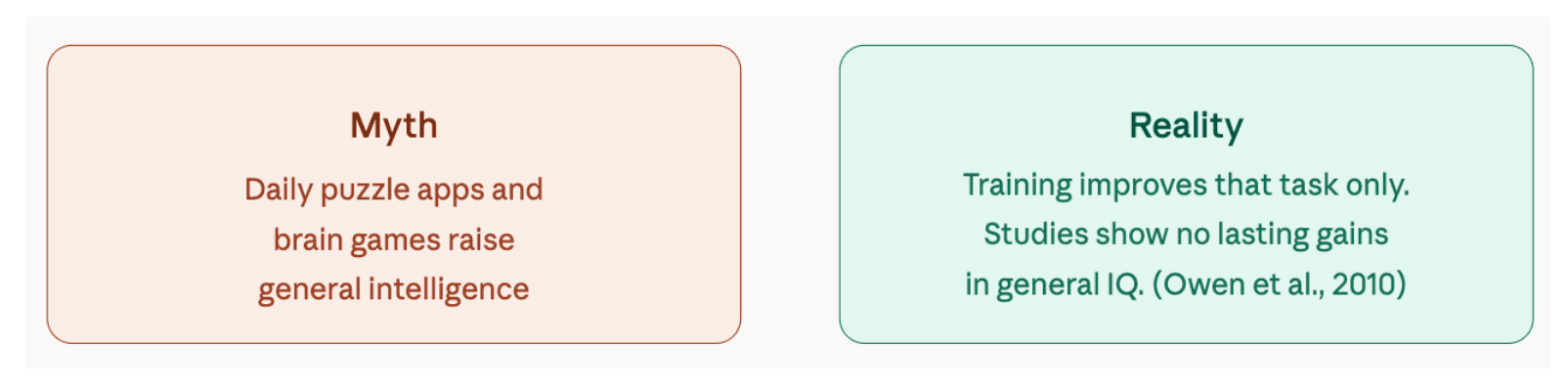
What brain training actually produces is improvement on the specific task being practiced. A person who trains on a working memory game gets better at that game. Performance on unrelated cognitive tasks — the kind of broad generalization that would constitute a real change in intelligence — does not improve. Researchers call this the failure of far transfer.
A landmark study testing over 100,000 participants found that people who reported regular brain training showed no advantage over non-trainers on broader measures of intelligence. The skill they practiced got better. General IQ did not move. This does not mean cognitive improvement is impossible. Sustained exposure to genuinely intellectually demanding environments — most reliably, formal schooling — is associated with real gains. A few minutes per day on a matching game is not the same thing.
Myth 6: Online IQ tests aren't legitimate
This myth has a kernel of truth. Most online IQ tests are not legitimate — created by individuals without technical training, lacking representative norm samples, often designed to produce flattering scores that drive engagement. Those are genuine problems.
But the method of delivery is not what determines quality. What matters is whether a test was developed by knowledgeable experts, grounded in a recognized theory of intelligence, normed on a representative sample, and built to meet the Standards for Educational and Psychological Testing published by the American Educational Research Association, the American Psychological Association, and the National Council on Measurement in Education. These standards do not dictate the administration mode of tests. Therefore, a poorly designed test administered by a psychologist in a clinical office is still a poor test, and a rigorously developed test can be administered online and produce scores that are just as interpretable.
The characteristics that separate a legitimate test from a fraudulent one are knowable and verifiable. The creator's identity and credentials should be transparent. The norm sample should be documented. Technical evidence for reliability and validity should exist in some publicly accessible form. When evaluating any test — online or otherwise — those are the questions worth asking.
Myth 7: IQ only measures school smarts
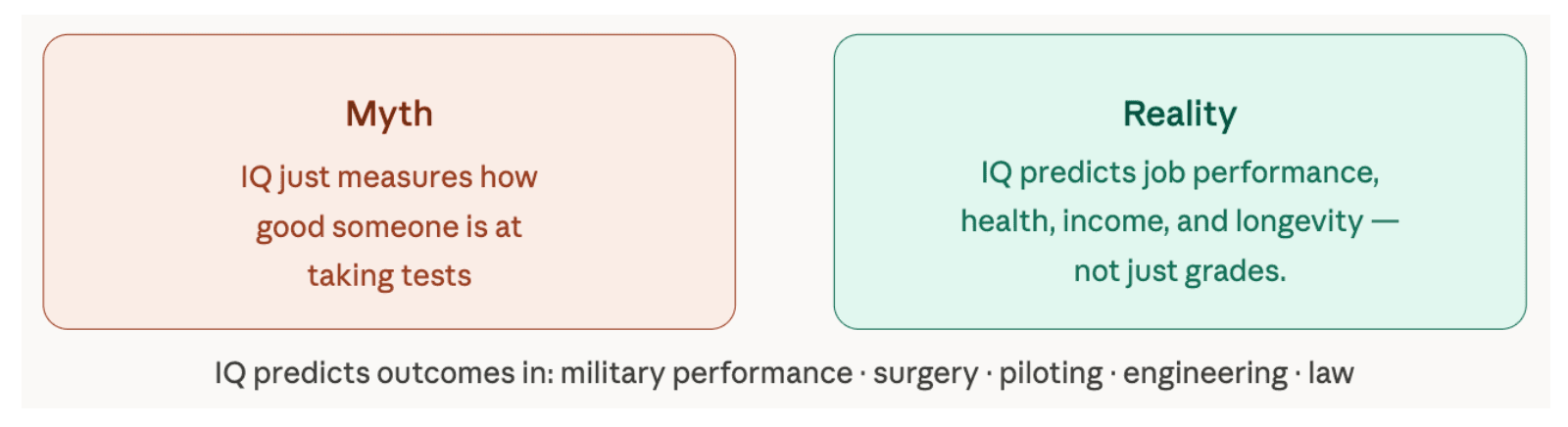
IQ tests were first developed in educational settings, which leads to the assumption that they only measure academic aptitude. Over a century ago, psychologists published research showing that IQ correlated with non-academic outcomes, such as job performance and military rank.
Modern research has confirmed these findings. There are strong associations with occupational attainment, income, health behaviors, and longevity. The military has relied on cognitive ability testing for over a century precisely because IQ predicts trainability and job performance in the field. The same predictive pattern appears across surgery, aviation, engineering, and law. IQ tests look like school tests — questions, time limits, a score at the end. What they measure is something that operates in virtually every domain where clear thinking is required.
What all seven myths have in common
Each of these misconceptions survives because intelligence research is genuinely complex, and because people have understandable emotional stakes in what a score means. A low score is threatening. A high score feels validating. Both reactions are human. Neither is a substitute for reading the evidence.
The accurate picture of IQ is neither the dismissive view — "it's just a number, it means nothing" — nor the deterministic one — "your score defines your ceiling." IQ is one of the most well-validated constructs in psychology, with real predictive power across multiple life domains. It is also a single number that captures a complex reality imperfectly. Both of those things are true simultaneously. Interested readers can learn more about the truth of IQ in my book In the Know: Debunking 35 Myths About Human Intelligence.
A note on choosing a professional IQ test
Understanding this properly requires a good test and an honest interpretation of the scores. Not every test available online provides either. Much of the confusion about IQ stems from low-quality assessments that circulate freely online. The instrument matters.
The Reasoning and Intelligence Online Test (RIOT) was developed to address this gap directly. It is the first online IQ test built to meet the full technical and ethical standards established by the American Educational Research Association, American Psychological Association, and the National Council on Measurement in Education — the same standards governing traditionally administered, in-person tests. The RIOT was built after more than 15 years of intelligence research, underwent expert review from researchers across cognitive, educational, and developmental psychology, and is normed on the first properly constructed, representative U.S.-based norm sample for an online IQ test. It is grounded in the Cattell-Horn-Carroll theory of intelligence and provides scores for Verbal Reasoning, Fluid Reasoning, Spatial Ability, Working Memory, Processing Speed, and Reaction Time alongside an overall IQ.
Sources
Deary, I. J., Whalley, L. J., & Starr, J. M. (2009). A lifetime of intelligence. American Psychological Association. https://doi.org/10.1037/11857-000 Ritchie, S. J., & Tucker-Drob, E. M. (2018). How much does education improve intelligence? Psychological Science, 29(8), 1358–1369. https://doi.org/10.1177/0956797618774253 Tucker-Drob, E. M., Briley, D. A., & Harden, K. P. (2013). Genetic and environmental influences on cognition across development and context. Current Directions in Psychological Science, 22(5), 349–355. https://doi.org/10.1037/a0035893 Schmidt, F. L., & Hunter, J. (1998). The validity and utility of selection methods in personnel psychology. Psychological Bulletin, 124(2), 262–274. https://doi.org/10.1037/0033-2909.124.2.262 Gottfredson, L. S. (1997). Why g matters: The complexity of everyday life. Intelligence, 24(1), 79–132. https://doi.org/10.1016/S0160-2896(97)90014-3 Spearman, C. (1904). "General intelligence," objectively determined and measured. American Journal of Psychology, 15(2), 201–292. https://doi.org/10.2307/1412107 Warne, R. T. (2021). In the know: Debunking 35 myths about human intelligence. Cambridge University Press. https://doi.org/10.1017/9781108593298 Deary, I. J., Strand, S., Smith, P., & Fernandes, C. (2007). Intelligence and educational achievement. Intelligence, 35(1), 13–21. https://doi.org/10.1016/j.intell.2006.02.001 Strenze, T. (2007). Intelligence and socioeconomic success. Intelligence, 35(5), 401–426. https://doi.org/10.1016/j.intell.2007.02.003 Jensen, A. R. (1980). Bias in mental testing. Free Press.
Reynolds, C. R., & Suzuki, L. A. (2013). Bias in psychological assessment. In I. B. Weiner (Ed.), Handbook of psychology (2nd ed., Vol. 10). Wiley.
Sala, G., & Gobet, F. (2017). Does far transfer exist? Current Directions in Psychological Science, 26(6), 515–520. https://doi.org/10.1177/0963721417712760 Owen, A. M., et al. (2010). Putting brain training to the test. Nature, 465, 775–778. https://doi.org/10.1038/nature09042 American Educational Research Association, APA, & NCME. (2014). Standards for educational and psychological testing. https://www.testingstandards.net/ Plomin, R., & Deary, I. J. (2015). Genetics and intelligence differences: Five special findings. Molecular Psychiatry, 20(1), 98–108. https://doi.org/10.1038/mp.2014.105 Lubinski, D. (2004). Introduction to the special section on cognitive abilities. Journal of Personality and Social Psychology, 86(1), 96–111. https://doi.org/10.1037/0022-3514.86.1.96 Warne, R. T. (2025). Technical manual for the Reasoning and Intelligence Online Test, version 1.0. RIOT IQ.
Take our professional IQ test
Want to know your IQ? Try the first ever professional online IQ test.
AuthorDr. Russell T. WarneChief Scientist